
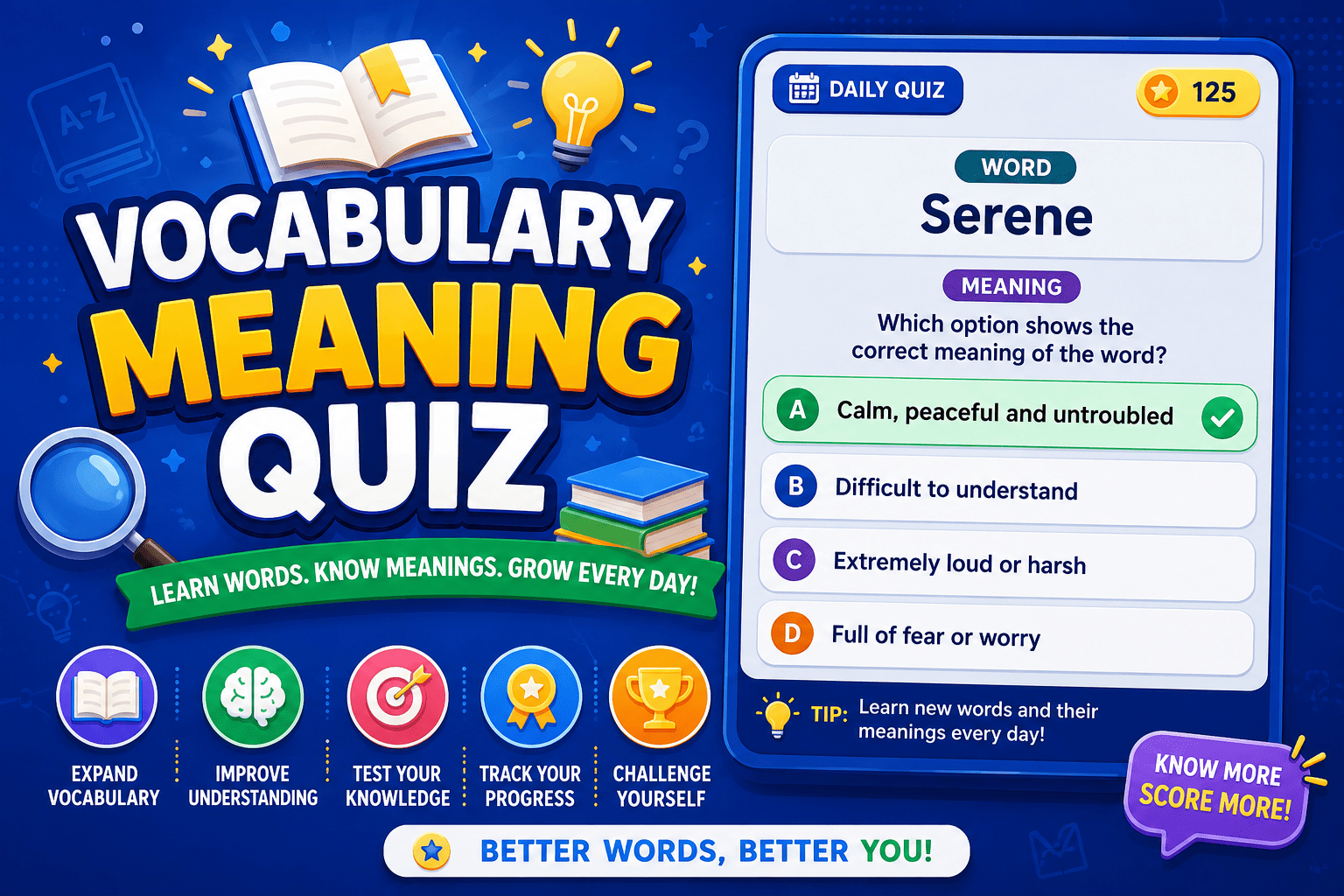
Vocabulary Meaning Quiz is a free online vocabulary game where you match English words with accurate definitions. Play Vocabulary Meaning Quiz to expand word knowledge and improve reading comprehension.
What Does the Vocabulary Meaning Quiz Test?
The Vocabulary Meaning Quiz checks how well you understand English words and their definitions. Each question presents a word and asks you to choose the meaning that matches it most accurately.
The quiz focuses on understanding vocabulary rather than spelling alone.
Your Goal
Choose the correct definition for every displayed word and complete the quiz with the highest possible score.
To answer correctly, you may need to recognize:
- Direct definitions.
- Synonyms.
- Opposite meanings.
- Contextual meanings.
- Word forms.
- Formal and informal vocabulary.
- Common academic words.
- Everyday English terms.
How to Answer Each Question
- Read the target word carefully.
- Pronounce it mentally if helpful.
- Review every definition option.
- Eliminate meanings that clearly do not fit.
- Select the most accurate definition.
- Read the feedback before continuing.
- Complete all questions to view your final result.
Example Question
Word: Reluctant
Which meaning is correct?
- Eager to begin.
- Unwilling or hesitant.
- Extremely noisy.
- Easy to understand.
Correct answer: Unwilling or hesitant
A reluctant person does not want to do something or feels uncertain about doing it.
Another Example
Word: Fragile
Correct meaning:
Easily broken or damaged
Example sentence:
The fragile glass must be handled carefully.
Types of Vocabulary Questions
Choose the Correct Definition
A word appears with several possible meanings.
Example:
Abundant
Correct meaning: Existing in large quantities
Match a Word With Its Synonym
Choose a word with a similar meaning.
Example:
Rapid
Correct synonym: Fast
Identify the Opposite Meaning
Select the antonym of the target word.
Example:
Ancient
Correct opposite: Modern
Complete a Meaning-Based Sentence
Choose the word that fits a sentence according to its meaning.
Example:
The room was so ___ that we could hear every sound.
Correct answer: Quiet
Identify Meaning From Context
A word appears inside a sentence, and you use surrounding information to understand it.
Example:
The exhausted runner sat down after the race.
“Exhausted” means extremely tired.
Match Academic Vocabulary
Some rounds may include words commonly used in school, reports, or formal writing.
Examples:
- Analyze
- Contrast
- Evidence
- Significant
- Interpret
- Conclusion
Understanding Definition Options
Incorrect answer choices are often designed to look believable. They may include:
- A related but inaccurate meaning.
- The meaning of a similar-looking word.
- An opposite definition.
- A definition that fits another word.
- A meaning that is too broad.
- A meaning that is too narrow.
Read every option before selecting an answer.
Quiz Rules
- Choose one meaning for each word.
- Select the most precise definition.
- Correct answers increase your score.
- Incorrect answers reveal the accepted meaning.
- A question cannot usually be changed after submission.
- Complete the full quiz to receive the final result.
- Restarting begins a new question set or resets the current round.
Vocabulary Meaning Quiz Features
- Multiple-choice definition questions.
- Common and advanced English words.
- Instant answer feedback.
- Correct-definition explanations.
- Score and question tracking.
- Randomized vocabulary sets.
- Replayable quiz rounds.
- Responsive controls for mobile and desktop.
- Beginner, intermediate, and advanced practice.
Vocabulary Areas the Quiz May Cover
Everyday Vocabulary
Words used in regular conversation and daily situations.
Examples:
- Repair
- Empty
- Borrow
- Arrive
- Hungry
Descriptive Vocabulary
Words used to describe people, places, objects, feelings, and situations.
Examples:
- Cheerful
- Narrow
- Ancient
- Smooth
- Nervous
Action Words
Verbs that describe activities or changes.
Examples:
- Examine
- Improve
- Reduce
- Prevent
- Gather
Academic Vocabulary
Words commonly used in education and formal writing.
Examples:
- Compare
- Define
- Demonstrate
- Interpret
- Relevant
Emotion Words
Vocabulary connected with feelings and reactions.
Examples:
- Anxious
- Delighted
- Frustrated
- Grateful
- Curious
Personality Words
Words that describe behavior or character.
Examples:
- Honest
- Generous
- Patient
- Stubborn
- Reliable
A Practical Method for Finding the Correct Meaning
Identify the Word Type
First decide whether the word is likely to be:
- A noun.
- A verb.
- An adjective.
- An adverb.
Example:
Carefully is an adverb, so its meaning should describe how an action is performed.
Look for Familiar Word Parts
Prefixes, suffixes, and roots may reveal meaning.
Example:
Unpredictable
- un- means not.
- predict means to say what may happen.
- -able means capable of.
The word means not able to be predicted.
Replace the Word With Each Meaning
Mentally insert each definition into a sentence containing the target word.
Choose the option that preserves the original meaning.
Eliminate Opposites
Some answer choices may describe the exact opposite of the target word.
Example:
For scarce, the option available in large amounts is incorrect because scarce means limited or difficult to find.
Choose the Most Exact Definition
Two answers may seem related, but one is usually more precise.
Example:
Observe
- Look.
- Watch carefully.
The stronger definition is watch carefully.
Using Context Clues
When a word appears in a sentence, nearby words may reveal its meaning.
Definition Clue
A habitat, the natural home of an animal, must be protected.
The sentence directly defines “habitat.”
Example Clue
Precious items, such as gold, diamonds, and rare paintings, were stored safely.
The examples suggest that “precious” means valuable.
Contrast Clue
Unlike his cheerful sister, Ahmed remained gloomy.
The contrast shows that “gloomy” means unhappy or sad.
Cause-and-Effect Clue
The road was slippery because heavy rain had fallen.
The cause explains that “slippery” means difficult to walk or drive on safely.
Tips for Improving Your Score
Read All Options
Do not select the first familiar definition. Another option may be more accurate.
Notice Small Differences
Words such as angry, annoyed, and furious are related, but they express different levels of emotion.
Learn Words in Context
Remember a word with an example sentence rather than memorizing only a short definition.
Study Word Families
Learning related forms builds stronger understanding.
Example:
- Decide
- Decision
- Decisive
- Indecisive
Review Mistakes Immediately
After an incorrect answer, read the correct definition and create a simple sentence using the word.
Group Vocabulary by Topic
Study words related to:
- Travel.
- Education.
- Nature.
- Emotions.
- Work.
- Health.
- Technology.
- Daily activities.
Common Mistakes to Avoid
- Choosing a definition based only on one familiar word.
- Ignoring the word’s grammatical role.
- Confusing a synonym with an exact definition.
- Selecting an opposite meaning.
- Skipping unfamiliar options without reading them.
- Guessing from spelling alone.
- Ignoring context clues.
- Moving to the next question without reviewing feedback.
How to Learn From Incorrect Answers
A wrong answer can still improve vocabulary when you:
- Read the accepted definition.
- Compare it with your selected option.
- Identify why your answer was inaccurate.
- Read or create an example sentence.
- Recall the word again later.
- Use it in speaking or writing.
Example:
Word: Brief
Correct meaning: Short in time or length
Example sentence:
The teacher gave a brief explanation.
Vocabulary Meaning Quiz for English Learners
English learners can use the quiz to connect unfamiliar words with clear definitions and practical sentence meanings.
The quiz supports:
- Reading comprehension.
- Vocabulary growth.
- Word recognition.
- Context understanding.
- Speaking confidence.
- Writing accuracy.
- Academic English.
- Everyday communication.
Multiple-choice answers also provide useful comparison between correct and incorrect meanings.
Vocabulary Meaning Quiz for Students
Students can use the quiz for:
- Vocabulary revision.
- Reading preparation.
- Classroom warm-ups.
- Homework practice.
- Test preparation.
- Academic word learning.
- Independent English study.
- Meaning and definition exercises.
Teachers may use question sets based on a lesson, textbook chapter, or reading passage.
Beginner, Intermediate, and Advanced Practice
Beginner Level
- Common everyday words.
- Short definitions.
- Clearly different answer choices.
- Simple sentence examples.
Intermediate Level
- Descriptive and academic words.
- Related definition choices.
- Context-based questions.
- Synonym and antonym practice.
Advanced Level
- Formal vocabulary.
- Subtle differences in meaning.
- Multiple-meaning words.
- Complex sentence context.
- Academic and professional terms.
Benefits of Regular Vocabulary Practice
Regularly completing vocabulary quizzes can help players:
- Understand reading passages faster.
- Express ideas more clearly.
- Choose more accurate words.
- Improve speaking and writing.
- Recognize synonyms and antonyms.
- Understand school and academic language.
- Remember definitions for longer.
- Build confidence with unfamiliar vocabulary.
Frequently Asked Questions
What is the Vocabulary Meaning Quiz?
It is a multiple-choice game that asks players to match English words with their correct meanings or definitions.
Does the quiz only test definitions?
Definitions are the main focus, but questions may also include synonyms, antonyms, sentence context, and word usage.
How do I answer an unfamiliar word?
Check its prefix, suffix, root, grammatical role, context, and available definition choices.
Will the quiz show the correct meaning?
Yes. Answer feedback identifies the accepted definition after you make a selection.
Can the quiz improve reading comprehension?
Yes. Understanding more vocabulary makes sentences, stories, instructions, and academic texts easier to understand.
Is the quiz useful for writing?
Yes. A larger vocabulary helps writers choose clearer, more precise, and more suitable words.
Are difficult words included?
The quiz may include beginner, intermediate, and advanced vocabulary depending on the selected round or difficulty level.
Can teachers use the Vocabulary Meaning Quiz?
Yes. Teachers can use it for lesson revision, classroom practice, homework, vocabulary tests, and reading preparation.
Can I restart the quiz?
Yes. Use the restart or new-quiz option to begin another vocabulary set.
Can I play on mobile?
Yes. The Vocabulary Meaning Quiz works on mobile phones, tablets, laptops, and desktop computers.
Explore More Word Games
Explore more vocabulary, spelling, grammar, matching, crossword, and word-meaning activities from the Word Games collection is attached below:
- Daily Word Guess
- Word Scramble
- Word Search Puzzle
- Hangman Game
- Anagram Builder
- Spelling Quiz
- Missing Letter Game
- Word Chain Game
- Daily Word Challenge
- Timed Word Finder
- Synonym and Antonym Quiz
- Mini Crossword
- Word Ladder
- Typing Word Game
- Homophone Quiz
- Prefix and Suffix Quiz
- Commonly Confused Words Game
- Word Category Sort
- Word Memory Match