
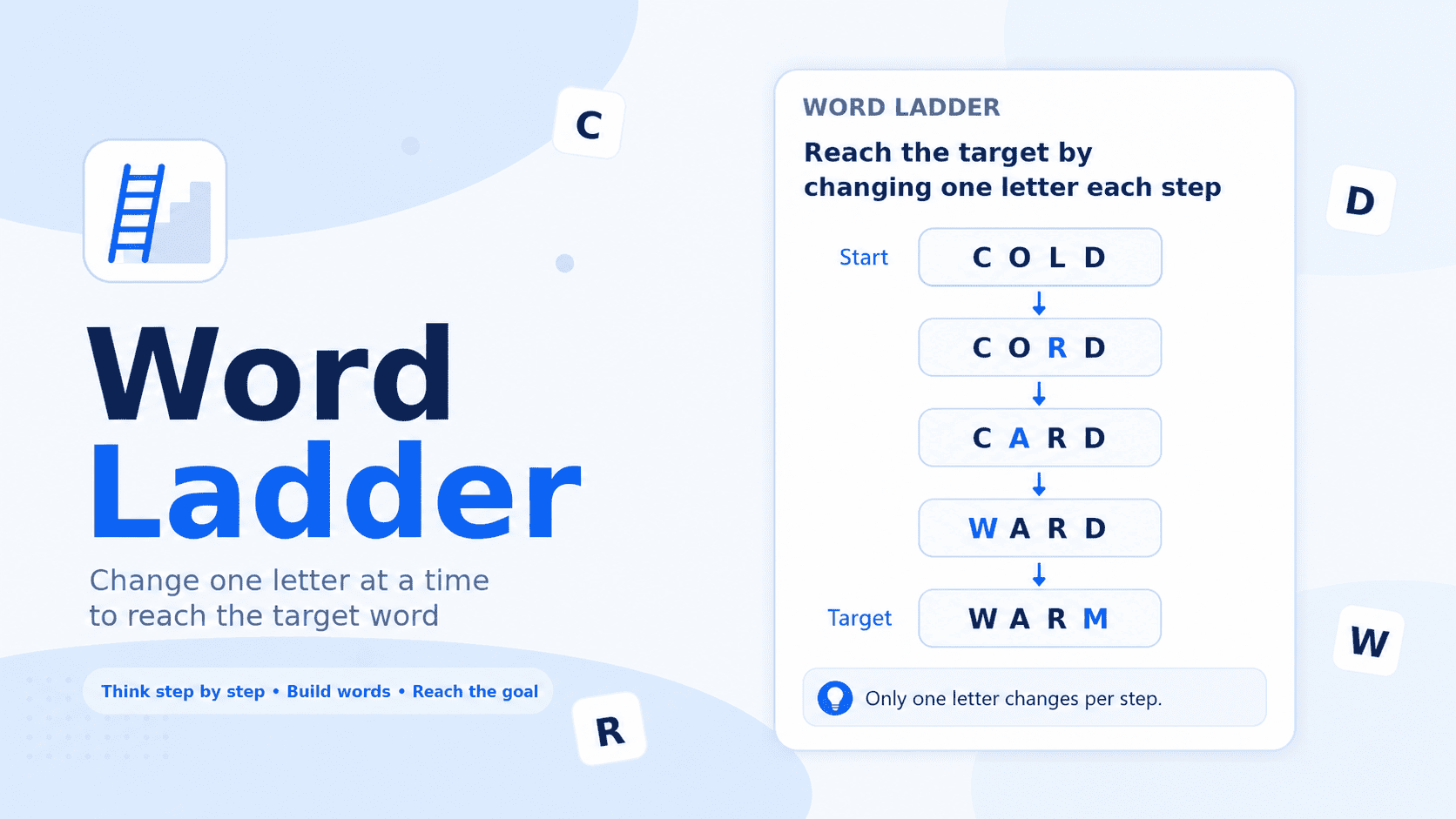
Word Ladder is a free online word transformation game where each step changes exactly one letter. Play Word Ladder to improve spelling, vocabulary connections, and step-by-step problem solving.
The Word Ladder Challenge
Word Ladder is a transformation puzzle where you change one word into another by replacing only one letter at each step. Every intermediate step must create a valid English word.
Example:
COLD → CORD → CARD → WARD → WARM
Only one letter changes between each pair of words.
Your Goal
Reach the target word from the starting word in the fewest valid steps possible.
A successful ladder must:
- Begin with the given starting word.
- End with the target word.
- Change exactly one letter per move.
- Keep all letters in their original positions.
- Use a valid word at every stage.
- Keep every word the same length.
How to Build a Word Ladder
- Read the starting and target words.
- Compare which letters are different.
- Change one letter in the starting word.
- Check that the new letter sequence forms a real word.
- Continue changing one letter at a time.
- Reach the target without using invalid words.
Example Puzzle
Transform:
CAT → DOG
One possible solution is:
CAT → COT → DOT → DOG
Step-by-step:
- CAT becomes COT by changing A to O.
- COT becomes DOT by changing C to D.
- DOT becomes DOG by changing T to G.
Core Word Ladder Rules
Change One Letter Only
You may replace only one letter during each move.
Valid:
HAT → HOT
Invalid:
HAT → DOG
More than one letter changed.
Keep the Same Word Length
A four-letter starting word must remain four letters throughout the ladder.
Valid:
COLD → CORD
Invalid:
COLD → COLDS
A letter was added.
Do Not Rearrange Letters
Letters must stay in their original positions.
Valid:
RATE → LATE
Invalid:
RATE → TEAR
The letters were rearranged.
Use Real English Words
Every intermediate entry must be accepted by the game’s word list.
Valid:
HEAD → HEAL
Invalid:
HEAD → HEAZ
“Heaz” is not a valid English word.
Understanding the Difference Count
Before starting, compare the starting and target words.
Example:
FALL → RISE
All four positions are different, so at least four changes are required. Additional steps may be necessary because every intermediate combination must also form a valid word.
Example:
FALL → WALL → WILL → WILE → RILE → RISE
The shortest possible path is not always obvious.
Word Ladder Features
- Starting and target words.
- Step-by-step word entry.
- Automatic word validation.
- One-letter-change checking.
- Move counter.
- Hint support.
- Incorrect-move feedback.
- Best-step tracking.
- New-ladder option.
- Mobile-friendly input controls.
A Better Solving Method
Compare Both Words First
Identify the positions that need to change.
Example:
GAME → MATH
- G must change to M.
- A already matches.
- M must change to T.
- E must change to H.
This gives you a transformation plan.
Work From Both Ends
When the path from the starting word is difficult, think backward from the target.
Example:
To reach WARM, possible earlier words include:
- WARD
- WORM
- WART
Then try connecting one of them to the starting word.
Protect Useful Letters
Once a letter matches the target, try to keep it unchanged unless changing it temporarily creates a necessary valid word.
Use Common Word Families
Words with similar endings often create useful paths.
Examples:
- CAT, BAT, HAT, MAT
- COLD, BOLD, GOLD, TOLD
- SAME, CAME, GAME, NAME
Test Common Vowels
Changing vowels can quickly create new words.
Example:
BIT → BAT → BET → BED
Think Beyond the Direct Route
A direct letter change may create an invalid word. An extra step may be needed to reach a valid path.
Efficient Ladder Strategies
Change Difficult Letters Early
Letters such as Q, X, J, and Z may limit the available word choices. Replace them early when possible.
Use Flexible Middle Words
Some words connect to many other words because several one-letter variations are valid.
Examples:
- Care
- Rate
- Mate
- Line
- Cold
- Sand
Avoid Dead Ends
Before submitting a word, check whether it has useful one-letter variations that can move you closer to the target.
Track Changed Positions
Notice which letter positions already match the target. This prevents unnecessary changes.
Keep the Target Visible
Compare every new word with the final target instead of focusing only on the previous step.
Common Invalid Moves
Changing Two Letters
CAT → DOG
Invalid because all three letters change.
Adding a Letter
PLAN → PLANE
Invalid because the word length changes.
Removing a Letter
STONE → TONE
Invalid because one letter is removed.
Rearranging Letters
STOP → POTS
Invalid because the letters change position.
Using a Non-Word
COLD → CILD
Invalid because “cild” is not a standard English word.
Repeating a Step
Returning to an earlier word may create an endless loop and increase the move count.
What Makes a Strong Solution?
A strong Word Ladder solution is:
- Valid at every step.
- Free from repeated words.
- Easy to follow.
- Close to the minimum number of moves.
- Built with correctly spelled English words.
- Progressively connected to the target.
Shortest Path vs. Valid Path
A valid ladder reaches the target while following all rules.
A shortest ladder reaches the target using the minimum possible number of steps.
Example:
HEAD → TAIL
Two different valid ladders may exist, but one may use fewer moves. The move counter helps players compare solutions.
Skills Developed by Word Ladder
Word Ladder helps improve:
- Vocabulary recall.
- Spelling accuracy.
- Logical sequencing.
- Pattern recognition.
- Problem-solving.
- Letter-position awareness.
- Strategic planning.
- Mental flexibility.
- Word-family knowledge.
- Concentration.
Word Ladder for English Learners
English learners can use Word Ladder to study how changing one letter creates a completely different word.
For example:
- Pin
- Pan
- Man
- Mat
- Cat
This helps learners notice spelling patterns, vowel changes, consonant changes, and relationships between similar-looking words.
Word Ladder for Students
Students can use the game for:
- Spelling revision.
- Vocabulary warm-ups.
- Classroom competitions.
- Phonics practice.
- Logical thinking exercises.
- Homework activities.
- Word-family lessons.
- Independent English practice.
Teachers can select ladders based on the students’ vocabulary level.
Possible Difficulty Levels
Easy Word Ladders
- Three-letter words.
- Common vocabulary.
- Short paths.
- Hint support.
Example:
CAT → DOG
Medium Word Ladders
- Four-letter words.
- Longer paths.
- Less obvious connections.
- Limited hints.
Example:
COLD → WARM
Hard Word Ladders
- Five-letter words.
- Rare intermediate words.
- Minimum-step targets.
- No hints or strict move limits.
Example:
STONE → MONEY
Benefits of Regular Practice
Playing Word Ladder regularly can help players:
- Recall words faster.
- Understand spelling patterns.
- Recognize word families.
- Plan several moves ahead.
- Improve vocabulary flexibility.
- Reduce spelling mistakes.
- Solve language puzzles more efficiently.
- Build confidence with English words.
Frequently Asked Questions
What is a Word Ladder?
A Word Ladder is a puzzle where one word is changed into another by replacing one letter at each step.
Can I change more than one letter?
No. Exactly one letter must change during each move.
Can I add or remove letters?
No. Every word must remain the same length.
Can I rearrange the letters?
No. Letters must stay in the same positions.
Must every step be a real word?
Yes. Each intermediate entry must be a valid English word accepted by the game.
Can I use the same word twice?
Repeated words should be avoided because they create loops and increase the number of moves.
What happens if my word is invalid?
The game rejects the entry and asks you to try another valid one-letter transformation.
Is there always only one solution?
No. Many Word Ladder puzzles have several valid paths.
How do I find the shortest ladder?
Compare both words, work from both ends, use common word families, and avoid unnecessary letter changes.
Does Word Ladder improve vocabulary?
Yes. It develops vocabulary recall, spelling, word-pattern recognition, and logical word connections.
Can I play Word Ladder on mobile?
Yes. The game works on mobile phones, tablets, laptops, and desktop computers.
Can I start a new puzzle?
Yes. Use the new-ladder or restart option to receive another starting and target word.
Explore More Word Games
Discover more vocabulary puzzles, spelling challenges, guessing games, crosswords, and letter activities from the Word Games collection.
- Daily Word Guess
- Word Scramble
- Word Search Puzzle
- Hangman Game
- Anagram Builder
- Spelling Quiz
- Missing Letter Game
- Word Chain Game
- Daily Word Challenge
- Timed Word Finder
- Vocabulary Meaning Quiz
- Synonym and Antonym Quiz
- Mini Crossword
- Typing Word Game
- Homophone Quiz
- Prefix and Suffix Quiz
- Commonly Confused Words Game
- Word Category Sort
- Word Memory Match