
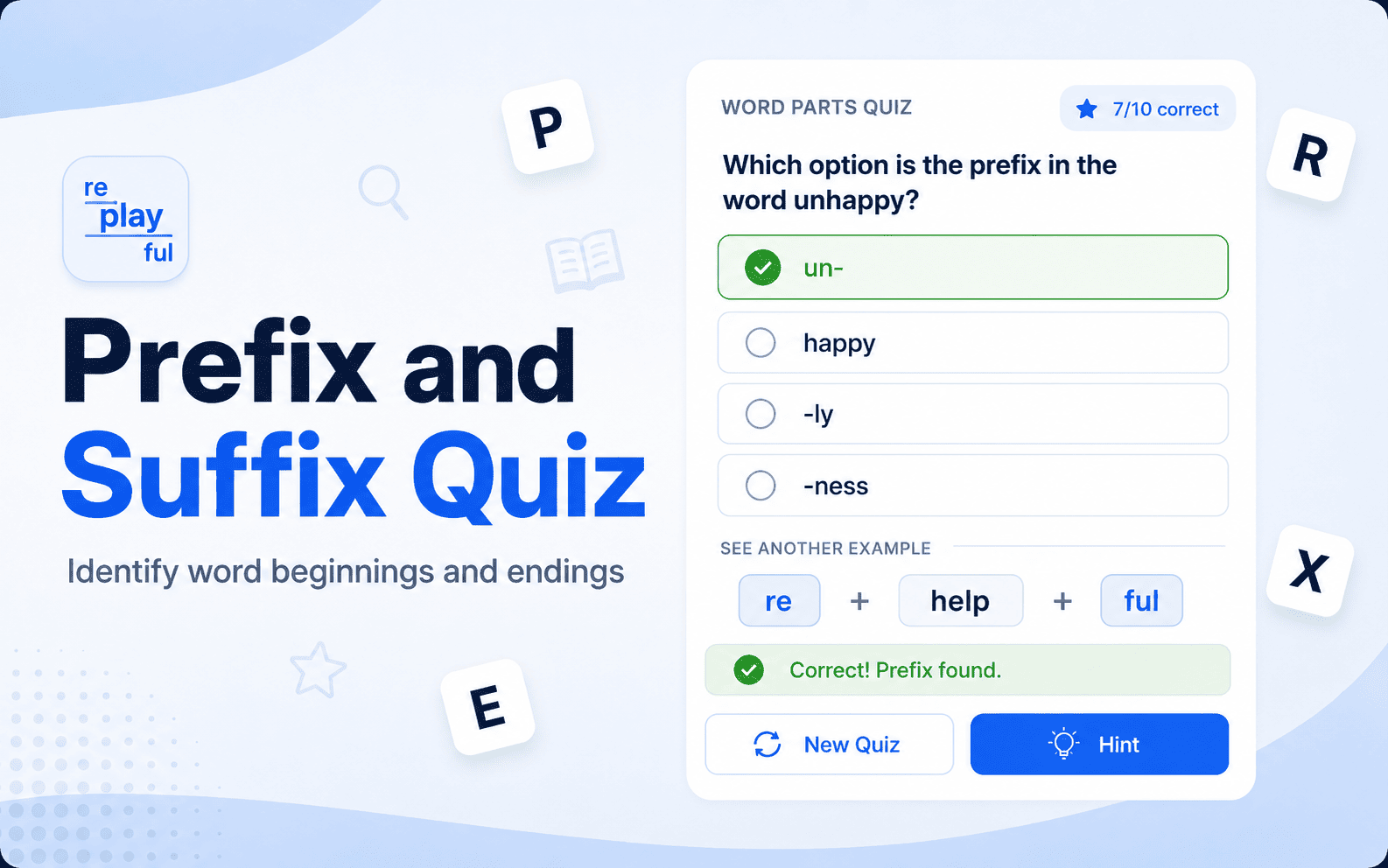
Prefix and Suffix Quiz is a free online affix game that tests how word beginnings and endings change meaning. Play Prefix and Suffix Quiz to understand word formation, grammar, and vocabulary patterns.
How the Prefix and Suffix Quiz Works
The quiz shows a word and asks you to identify its prefix, suffix, base word, or meaning. Choose the correct option to complete each question and learn how word parts change meaning and grammar.
Main Objective
The goal is to recognize common prefixes and suffixes, understand where they appear in a word, and identify how they affect the original word.
How to Play
- Read the word or question carefully.
- Decide whether the quiz is asking about a prefix, suffix, or base word.
- Compare all available options.
- Select the correct word part.
- Review the answer feedback.
- Continue until the quiz round is complete.
What Is a Prefix?
A prefix is a group of letters added to the beginning of a word. It usually changes the word’s meaning.
Examples:
- un + happy = unhappy
- re + write = rewrite
- dis + agree = disagree
- pre + view = preview
- mis + understand = misunderstand
In unhappy, the prefix is un-, which means “not.”
What Is a Suffix?
A suffix is a group of letters added to the end of a word. It may change the meaning, tense, number, or part of speech.
Examples:
- help + ful = helpful
- kind + ness = kindness
- quick + ly = quickly
- teach + er = teacher
- hope + less = hopeless
In helpful, the suffix is -ful, which means “full of” or “having.”
What Is a Base Word?
The base word is the main word before a prefix or suffix is added.
Examples:
- un + kind → kind
- care + less → care
- re + play → play
- hope + ful → hope
- slow + ly → slow
Recognizing the base word makes it easier to understand the complete word.
Types of Questions in the Quiz
Identify the Prefix
Example:
Which part is the prefix in “rewrite”?
Correct answer: re-
Identify the Suffix
Example:
Which part is the suffix in “careless”?
Correct answer: -less
Find the Base Word
Example:
What is the base word in “unhelpful”?
Correct answer: help
Match the Meaning
Example:
What does the prefix “mis-” mean?
Correct answer: wrongly or incorrectly
Build a New Word
Example:
Which suffix changes “teach” into a person who teaches?
Correct answer: -er
Common Prefixes Covered
The quiz may include prefixes such as:
- un- — not
- re- — again
- dis- — not or opposite
- mis- — wrongly
- pre- — before
- post- — after
- over- — too much
- under- — below or not enough
- sub- — under
- inter- — between
- non- — not
- anti- — against
Common Suffixes Covered
The quiz may test suffixes such as:
- -ful — full of
- -less — without
- -ness — state or quality
- -ly — in a particular way
- -er — a person or thing that performs an action
- -ment — result or process
- -tion — action or condition
- -able — capable of
- -ous — having a quality
- -ist — a person connected with something
- -ed — past tense
- -ing — ongoing action
Prefix and Suffix Quiz Rules
- Select one answer for each question.
- Read the complete word before choosing.
- Use the word’s position to identify the affix.
- A prefix appears before the base word.
- A suffix appears after the base word.
- Correct answers increase your score.
- Review incorrect answers before moving forward.
Quiz Features
- Multiple-choice word-part questions.
- Prefix, suffix, and base-word practice.
- Instant answer checking.
- Score and progress tracking.
- Correct-answer explanations.
- Different questions in each round.
- Hint and restart options.
- Responsive mobile and desktop controls.
Skills Improved by the Quiz
The Prefix and Suffix Quiz helps develop:
- Vocabulary knowledge.
- Word-formation skills.
- Reading comprehension.
- Spelling awareness.
- Grammar understanding.
- Context interpretation.
- Meaning prediction.
- Recognition of word families.
Tips for Answering Correctly
Check the Word Position
A prefix is always added before the base word, while a suffix appears after it.
Example:
un + comfort + able
- Prefix: un-
- Base word: comfort
- Suffix: -able
Remove the Word Part
Mentally remove the prefix or suffix and check whether the remaining letters form the base word.
Example:
carefully
Remove -fully to identify care as the base word.
Learn Common Meanings
Knowing that re- means “again” and -less means “without” can help you understand unfamiliar words quickly.
Watch for Spelling Changes
Adding a suffix may change the spelling of the base word.
Examples:
- happy + ness = happiness
- write + ing = writing
- beauty + ful = beautiful
Use Sentence Meaning
When a word appears in a sentence, use the surrounding context to decide what its prefix or suffix means.
Common Mistakes to Avoid
- Confusing the base word with the prefix.
- Choosing the first few letters without checking whether they are a real prefix.
- Treating every word ending as a suffix.
- Ignoring spelling changes in the base word.
- Assuming every affix has only one meaning.
- Selecting a suffix when the question asks for the prefix.
- Skipping the complete word and reading only the highlighted section.
Prefix and Suffix Quiz for English Learners
The quiz helps English learners break long words into smaller, understandable parts. Instead of memorizing every word separately, learners can use familiar prefixes, suffixes, and roots to predict meaning.
For example, knowing that un- means “not” helps explain words such as:
- Unclear
- Unfair
- Unusual
- Uncertain
- Unfriendly
This method supports faster vocabulary growth.
Prefix and Suffix Quiz for Students
Students can use the quiz for:
- Vocabulary revision.
- Grammar lessons.
- Word-building practice.
- Reading preparation.
- Classroom warm-ups.
- Homework activities.
- Spelling support.
- Exam preparation.
Teachers can also use specific prefix and suffix groups to support current lessons.
Benefits of Learning Prefixes and Suffixes
Understanding word parts can help players:
- Guess the meaning of unfamiliar words.
- Recognize related word families.
- Improve spelling and pronunciation.
- Understand how nouns, verbs, adjectives, and adverbs are formed.
- Read longer words with greater confidence.
- Expand vocabulary without memorizing isolated words.
- Write more accurately.
Frequently Asked Questions
What is the Prefix and Suffix Quiz?
It is a word-parts quiz that tests prefixes, suffixes, base words, meanings, and word formation.
What is the difference between a prefix and a suffix?
A prefix is added to the beginning of a word, while a suffix is added to the end.
Can a word contain both?
Yes. A word may contain both a prefix and a suffix.
Example:
unhelpful
- Prefix: un-
- Base word: help
- Suffix: -ful
Do prefixes change spelling?
Prefixes usually attach directly to the base word, although hyphens may be used in some words.
Can suffixes change the base word?
Yes. Adding a suffix may cause a spelling change, such as happy → happiness.
Does the quiz explain wrong answers?
Yes. Feedback shows the correct word part so players can learn from mistakes.
Is the quiz suitable for beginners?
Yes. The multiple-choice format is suitable for beginners, students, and English-language learners.
Can I replay the quiz?
Yes. Use the new-quiz or restart option to begin another round.
Can I play on mobile?
Yes. The Prefix and Suffix Quiz works on mobile phones, tablets, laptops, and desktop computers.
Explore More Word Games
Play more vocabulary, spelling, grammar, memory, and word-building challenges from the Word Games collection.
- Daily Word Guess
- Word Scramble
- Word Search Puzzle
- Hangman Game
- Anagram Builder
- Spelling Quiz
- Missing Letter Game
- Word Chain Game
- Daily Word Challenge
- Timed Word Finder
- Vocabulary Meaning Quiz
- Synonym and Antonym Quiz
- Mini Crossword
- Word Ladder
- Typing Word Game
- Homophone Quiz
- Commonly Confused Words Game
- Word Category Sort
- Word Memory Match