
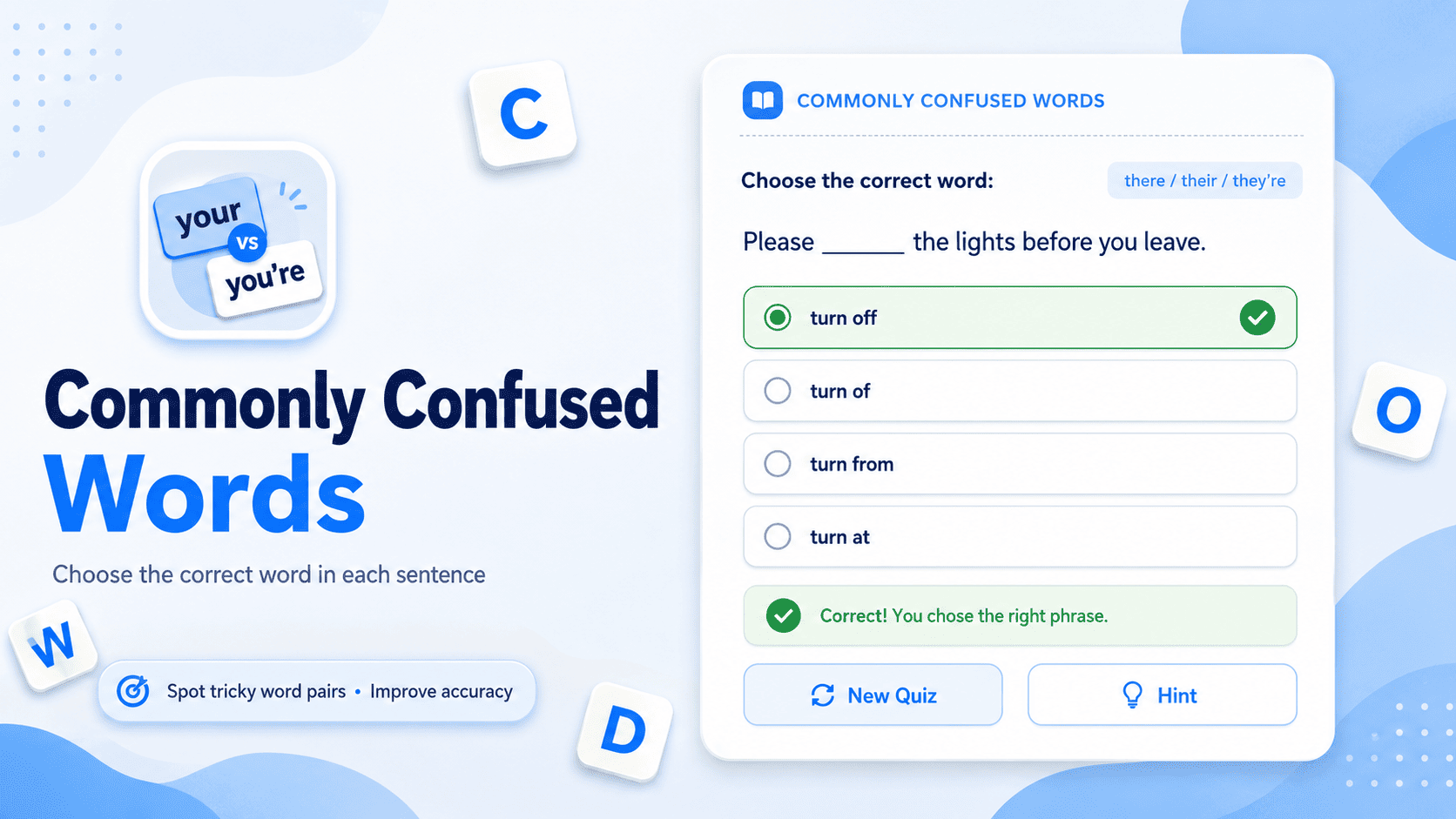
Commonly Confused Words is a free online grammar game that tests pairs such as affect and effect, their and there, or accept and except. Play Commonly Confused Words to improve accurate English usage in context.
How the Commonly Confused Words Game Works
The game presents a sentence with a missing word and two or more similar options. Choose the word that fits the sentence’s meaning, grammar, and context.
Main Objective
The goal is to distinguish between English words that look alike, sound alike, or have related meanings but are used differently.
How to Play
- Read the complete sentence carefully.
- Notice the meaning of the sentence.
- Compare the available word choices.
- Select the word that fits the context.
- Review the answer feedback.
- Continue until every question is complete.
Commonly Confused Words Game Rules
- Select only one answer for each sentence.
- Use sentence meaning rather than sound alone.
- Check whether the sentence needs a noun, verb, adjective, or adverb.
- Correct answers increase your score.
- Incorrect answers reveal the correct word.
- Complete the full question set to finish the round.
Types of Confused Words Covered
Words That Sound Similar
Some words have similar pronunciation but different spellings and meanings.
Examples:
- accept / except
- affect / effect
- advice / advise
- principal / principle
- stationary / stationery
Words That Look Similar
Some words have nearly identical spellings but different meanings.
Examples:
- quiet / quite
- lose / loose
- later / latter
- personal / personnel
- complement / compliment
Words With Related Meanings
Some words belong to a similar idea but cannot be used interchangeably.
Examples:
- borrow / lend
- bring / take
- say / tell
- learn / teach
- remember / remind
Words With Different Grammatical Roles
Some confused pairs differ because one is a noun and the other is a verb.
Examples:
- advice — noun
- advise — verb
- practice — noun in British English
- practise — verb in British English
- effect — usually a noun
- affect — usually a verb
Example Questions
Accept or Except
Everyone attended the meeting ___ Ali.
Correct answer: except
“Except” means excluding someone or something.
Their, There, or They’re
___ planning to visit the museum.
Correct answer: They’re
“They’re” is the contraction of “they are.”
Your or You’re
___ answer is correct.
Correct answer: Your
“Your” shows possession.
Affect or Effect
The weather may ___ our travel plans.
Correct answer: affect
“Affect” is used here as a verb meaning to influence.
Then or Than
This puzzle is easier ___ the previous one.
Correct answer: than
“Than” is used for comparisons.
Common Word Pairs Tested
The game may include:
- Accept and except.
- Affect and effect.
- Advice and advise.
- Allowed and aloud.
- Brake and break.
- Breath and breathe.
- Choose and chose.
- Desert and dessert.
- Farther and further.
- Hear and here.
- Its and it’s.
- Lose and loose.
- Passed and past.
- Peace and piece.
- Principal and principle.
- Than and then.
- Their, there, and they’re.
- To, too, and two.
- Weather and whether.
- Your and you’re.
Game Features
- Sentence-based multiple-choice questions.
- Common English word pairs.
- Instant answer checking.
- Correct-word explanations.
- Score and progress tracking.
- Randomized question order.
- Restartable quiz rounds.
- Mobile-friendly answer controls.
Skills Improved by the Game
Playing Commonly Confused Words can improve:
- Grammar accuracy.
- Vocabulary understanding.
- Sentence comprehension.
- Context recognition.
- Spelling awareness.
- Proofreading skills.
- Writing confidence.
- Correct word usage.
How to Choose the Correct Word
Read the Whole Sentence
Do not choose an answer after reading only the words near the blank. The complete sentence provides the meaning needed to identify the correct option.
Identify the Required Word Type
Determine whether the blank needs:
- A noun.
- A verb.
- An adjective.
- An adverb.
- A possessive word.
- A contraction.
For example:
She gave me useful ___.
The sentence requires a noun, so advice is correct instead of advise.
Replace Contractions
Expand contractions before answering.
- You’re = you are
- They’re = they are
- It’s = it is or it has
If the expanded form fits, the contraction is correct.
Check the Meaning
Think about what each option means.
- Borrow means to receive something temporarily.
- Lend means to give something temporarily.
Example:
Can I borrow your pen?
Look for Comparison Words
Use than when comparing two things.
Example:
This book is longer than that one.
Use then for time or sequence.
Example:
Finish your work, then take a break.
Useful Memory Tricks
Principal and Principle
- A principal can be a person, such as the head of a school.
- A principle is a rule, belief, or standard.
Stationary and Stationery
- Stationary means not moving.
- Stationery means writing materials.
The e in stationery can remind you of envelope.
Desert and Dessert
- A desert is a dry place.
- A dessert is a sweet dish.
Dessert has an extra s because people may want a second serving.
Lose and Loose
- Lose means to misplace or fail to keep something.
- Loose means not tight.
Affect and Effect
- Affect is commonly an action word.
- Effect is commonly the result of an action.
Common Mistakes to Avoid
- Choosing a word only because it sounds correct.
- Ignoring whether the blank needs a noun or verb.
- Confusing possessive words with contractions.
- Reading only part of the sentence.
- Selecting a familiar word without checking its meaning.
- Treating British and American spelling rules as identical.
- Skipping the explanation after an incorrect answer.
Commonly Confused Words for English Learners
This game helps English learners understand that similar-looking or similar-sounding words may perform different jobs in a sentence.
Sentence-based practice is especially useful because it teaches both meaning and correct usage. Instead of memorizing isolated definitions, learners see how each word functions naturally.
Commonly Confused Words for Students
Students can use the game for:
- Grammar revision.
- Vocabulary practice.
- Writing improvement.
- Exam preparation.
- Classroom warm-ups.
- Proofreading exercises.
- Homework support.
- Independent English practice.
Teachers can also use specific word pairs to support lessons about homophones, contractions, verbs, nouns, and sentence context.
Benefits of Practising Confused Words
Regular practice can help players:
- Reduce common writing mistakes.
- Select more accurate vocabulary.
- Understand sentence meaning faster.
- Improve grammar and spelling.
- Recognize contractions and possessives.
- Distinguish nouns from verbs.
- Proofread written work more effectively.
- Write with greater confidence.
Frequently Asked Questions
What are commonly confused words?
They are words that are often mixed up because they have similar spellings, pronunciations, meanings, or grammatical uses.
How do I choose the correct answer?
Read the full sentence, identify the required meaning and word type, and compare how each option is normally used.
Are confused words the same as homophones?
Not always. Some confused words are homophones, but others only look similar or have related meanings.
Does the game explain incorrect answers?
Yes. The feedback reveals the correct word and helps players understand why it fits the sentence.
Can this game improve grammar?
Yes. It teaches correct word choice, sentence context, contractions, possessives, nouns, verbs, and other grammar patterns.
Is the game useful for proofreading?
Yes. Recognizing confused words can help players detect common errors in emails, assignments, articles, and everyday writing.
Is the game suitable for beginners?
Yes. The multiple-choice format is accessible to beginners, students, and English-language learners.
Can I play another round?
Yes. Use the restart or new-quiz option to receive another set of sentences.
Can I play on mobile?
Yes. The game works on mobile phones, tablets, laptops, and desktop computers.
Explore More Word Games
Play more grammar, spelling, vocabulary, quiz, and sentence-based challenges from the Word Games collection and others attached belwo:
- Daily Word Guess
- Word Scramble
- Word Search Puzzle
- Hangman Game
- Anagram Builder
- Spelling Quiz
- Missing Letter Game
- Word Chain Game
- Daily Word Challenge
- Timed Word Finder
- Vocabulary Meaning Quiz
- Synonym and Antonym Quiz
- Mini Crossword
- Word Ladder
- Typing Word Game
- Homophone Quiz
- Prefix and Suffix Quiz
- Word Category Sort
- Word Memory Match