
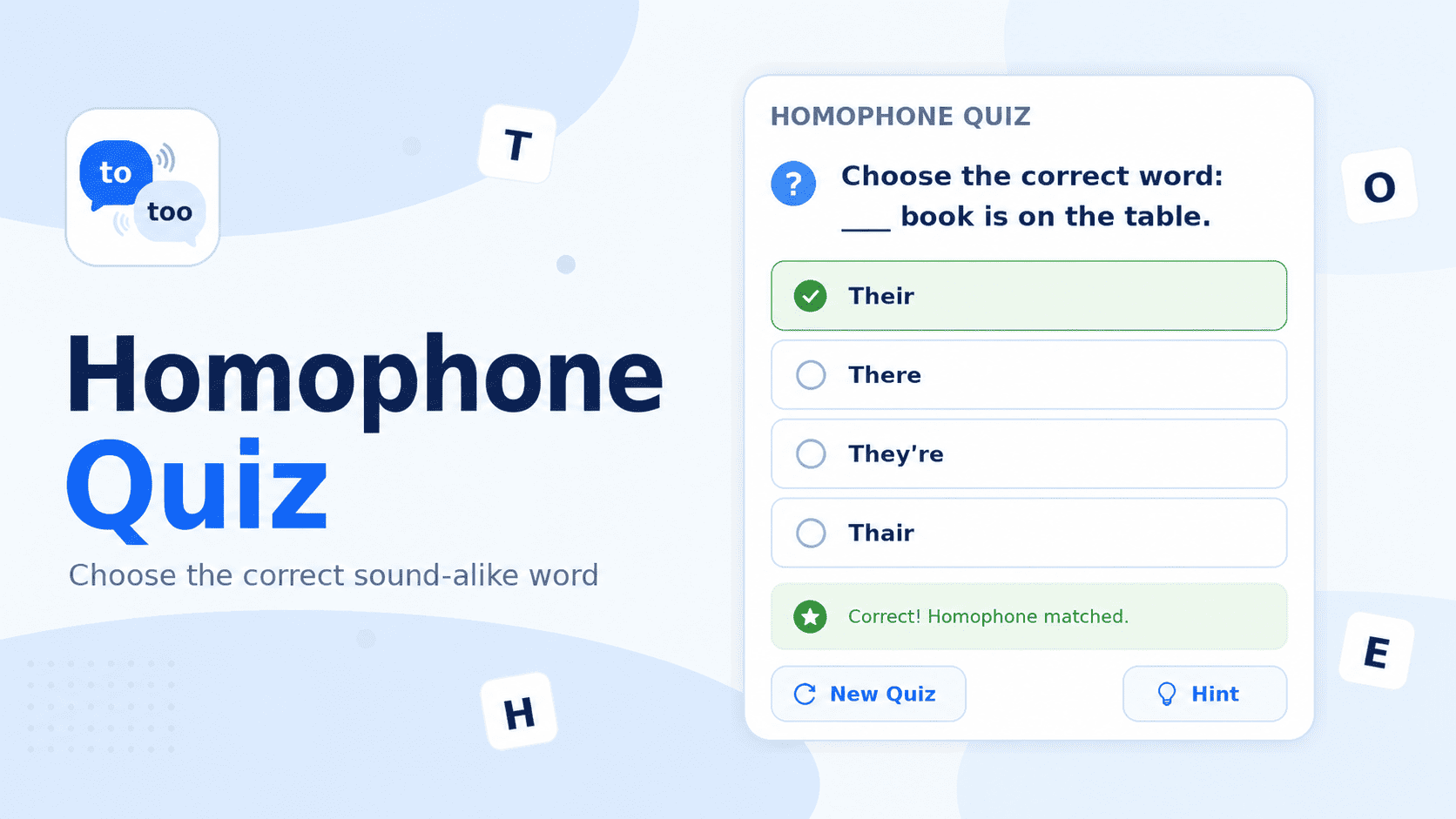
Homophone Quiz is a free online homophone game that tests words with the same pronunciation but different spellings and meanings. Play Homophone Quiz to improve listening-based spelling and contextual word choice.
What Does the Homophone Quiz Test?
The Homophone Quiz tests whether you can choose the correct word when two or more words sound the same but have different spellings and meanings.
Examples include:
- their / there / they’re
- to / too / two
- hear / here
- right / write
- peace / piece
- weather / whether
The correct answer depends on the meaning of the sentence, not only on pronunciation.
Your Task in Each Round
A sentence appears with one missing word. Read the sentence, compare the sound-alike options, and choose the word that completes the meaning correctly.
Example:
Please ___ your name clearly.
- right
- write
Correct answer: write
“Write” means to form words using a pen, pencil, or keyboard.
How to Complete the Quiz
- Read the sentence from beginning to end.
- Look at the available homophone choices.
- Think about the meaning of each word.
- Select the option that fits the sentence.
- Review the feedback.
- Move to the next question.
Why Sound Alone Is Not Enough
Homophones usually have the same or very similar pronunciation. Listening to the sentence may not reveal the correct answer because the difference appears in spelling and meaning.
For example:
- Sea means a large body of salt water.
- See means to look at something.
Sentence:
I can ___ the mountains from here.
Correct answer: see
Homophone Groups You May See
Their, There, and They’re
- Their shows possession.
- There refers to a place.
- They’re means “they are.”
Examples:
- Their books are on the desk.
- Put the bag over there.
- They’re waiting outside.
To, Too, and Two
- To is used with direction or an infinitive.
- Too means also or excessively.
- Two is the number 2.
Examples:
- We are going to school.
- I want to come too.
- She has two pencils.
Your and You’re
- Your shows possession.
- You’re means “you are.”
Examples:
- Your answer is correct.
- You’re doing very well.
Its and It’s
- Its shows possession.
- It’s means “it is” or “it has.”
Examples:
- The cat cleaned its paws.
- It’s raining today.
Hear and Here
- Hear relates to sound.
- Here refers to a place.
Examples:
- Can you hear the music?
- Please sit here.
Brake and Break
- Brake is used to slow or stop a vehicle.
- Break means to damage, divide, or pause.
Examples:
- Press the brake slowly.
- Do not break the glass.
Quiz Scoring
Your score increases when you select the correct homophone. Incorrect answers reveal the correct choice so you can compare the spelling and meaning before continuing.
A complete round may show:
- Total questions.
- Correct answers.
- Incorrect answers.
- Final percentage.
- Best score.
- Restart option.
Homophone Quiz Features
- Sentence-based questions.
- Multiple-choice answers.
- Common English homophone groups.
- Immediate correct-answer feedback.
- Score and progress tracking.
- Randomized question order.
- Replayable quiz rounds.
- Mobile and desktop compatibility.
A Simple Method for Choosing the Answer
Use this three-step method:
Step 1: Expand Short Forms
Replace contractions with their full forms.
- They’re = they are
- You’re = you are
- It’s = it is
Example:
They’re going home.
Replace it with:
They are going home.
The sentence still makes sense, so they’re is correct.
Step 2: Check the Meaning
Ask what the missing word should mean.
Example:
I ate a ___ of cake.
The missing word means a part or portion, so piece is correct, not peace.
Step 3: Check the Word’s Job
Decide whether the blank requires:
- A noun.
- A verb.
- A possessive word.
- A number.
- A place word.
- A contraction.
This helps eliminate options that sound right but do not fit grammatically.
Useful Homophone Examples
| Homophones | Meanings |
|---|---|
| allowed / aloud | permitted / spoken loudly |
| buy / by / bye | purchase / near or through / farewell |
| flower / flour | plant bloom / baking powder |
| knight / night | armored soldier / evening |
| mail / male | letters and parcels / masculine |
| meet / meat | come together / animal food |
| one / won | number 1 / past tense of win |
| pair / pear | group of two / fruit |
| plain / plane | simple or flat land / aircraft |
| road / rode | street / past tense of ride |
| sale / sail | selling event / boat cloth or travel |
| son / sun | male child / star in the sky |
| tail / tale | animal’s rear part / story |
| weak / week | not strong / seven days |
| which / witch | question word / magical character |
Tips for Better Results
Read Beyond the Blank
The words before and after the blank often reveal the intended meaning.
Focus on Meaning First
Do not choose an answer because it looks familiar. Match its definition with the sentence.
Look for Possession
Words such as their, your, and its usually appear before a noun.
Examples:
- Their house
- Your bag
- Its color
Test the Full Form
For contractions, read the sentence using the full phrase.
Example:
You’re correct becomes You are correct.
Learn Words in Pairs
Study homophones together rather than separately.
Example:
- hear = receive sound
- here = this place
Review Every Mistake
After an incorrect answer, read both meanings and create your own example sentences.
Mistakes Players Commonly Make
- Choosing by pronunciation only.
- Confusing possession with contractions.
- Ignoring the full sentence.
- Selecting a word with the wrong grammatical role.
- Mixing number words with prepositions.
- Forgetting the meaning of less familiar homophones.
- Moving forward without reviewing feedback.
How Homophone Practice Supports Writing
Homophone errors are common because spell-check tools may not flag a word that is spelled correctly but used incorrectly.
For example:
Their going home contains a real English word, but the sentence requires they’re.
Regular quiz practice can help players notice these errors while writing:
- Emails.
- School assignments.
- Articles.
- Messages.
- Reports.
- Social media posts.
Homophone Quiz for English Learners
The quiz helps English learners connect pronunciation with spelling and meaning. It shows that one sound may represent several different words depending on the sentence.
This supports:
- Listening accuracy.
- Reading comprehension.
- Correct spelling.
- Sentence construction.
- Vocabulary development.
- Confident English writing.
Homophone Quiz for Students and Teachers
Students can use the quiz for spelling revision, grammar practice, homework, test preparation, and classroom warm-ups.
Teachers can use individual question sets to teach:
- Possessive words.
- Contractions.
- Number words.
- Common spelling errors.
- Sentence context.
- Sound-alike vocabulary.
Frequently Asked Questions
What is a homophone?
A homophone is a word that sounds the same as another word but has a different spelling, meaning, or both.
Are “their,” “there,” and “they’re” homophones?
Yes. They sound similar but have different meanings and grammatical uses.
How can I choose the correct homophone?
Read the complete sentence, check the meaning of every option, and identify the type of word required.
Does the quiz include contractions?
Yes. Common contractions such as they’re, you’re, and it’s may appear with their sound-alike alternatives.
Why are homophones difficult?
They are difficult because pronunciation may not show which spelling or meaning is correct.
Does the game reveal the correct answer?
Yes. After a selection, the quiz shows whether the answer is correct and identifies the right word.
Can the Homophone Quiz improve spelling?
Yes. It helps players connect sounds with correct spellings and sentence meanings.
Is this quiz suitable for beginners?
Yes. The multiple-choice and sentence-based format is suitable for beginners, students, and English learners.
Can I replay the quiz?
Yes. Use the restart or new-quiz option to begin another question set.
Can I play on a phone?
Yes. The Homophone Quiz works on mobile phones, tablets, laptops, and desktop computers.
Explore More Word Games
Explore additional spelling, vocabulary, grammar, memory, and word-choice activities on the Word Games page and more are given below:
- Daily Word Guess
- Word Scramble
- Word Search Puzzle
- Hangman Game
- Anagram Builder
- Spelling Quiz
- Missing Letter Game
- Word Chain Game
- Daily Word Challenge
- Timed Word Finder
- Vocabulary Meaning Quiz
- Synonym and Antonym Quiz
- Mini Crossword
- Word Ladder
- Typing Word Game
- Homophone Quiz
- Prefix and Suffix Quiz
- Commonly Confused Words Game
- Word Category Sort
- Word Memory Match