
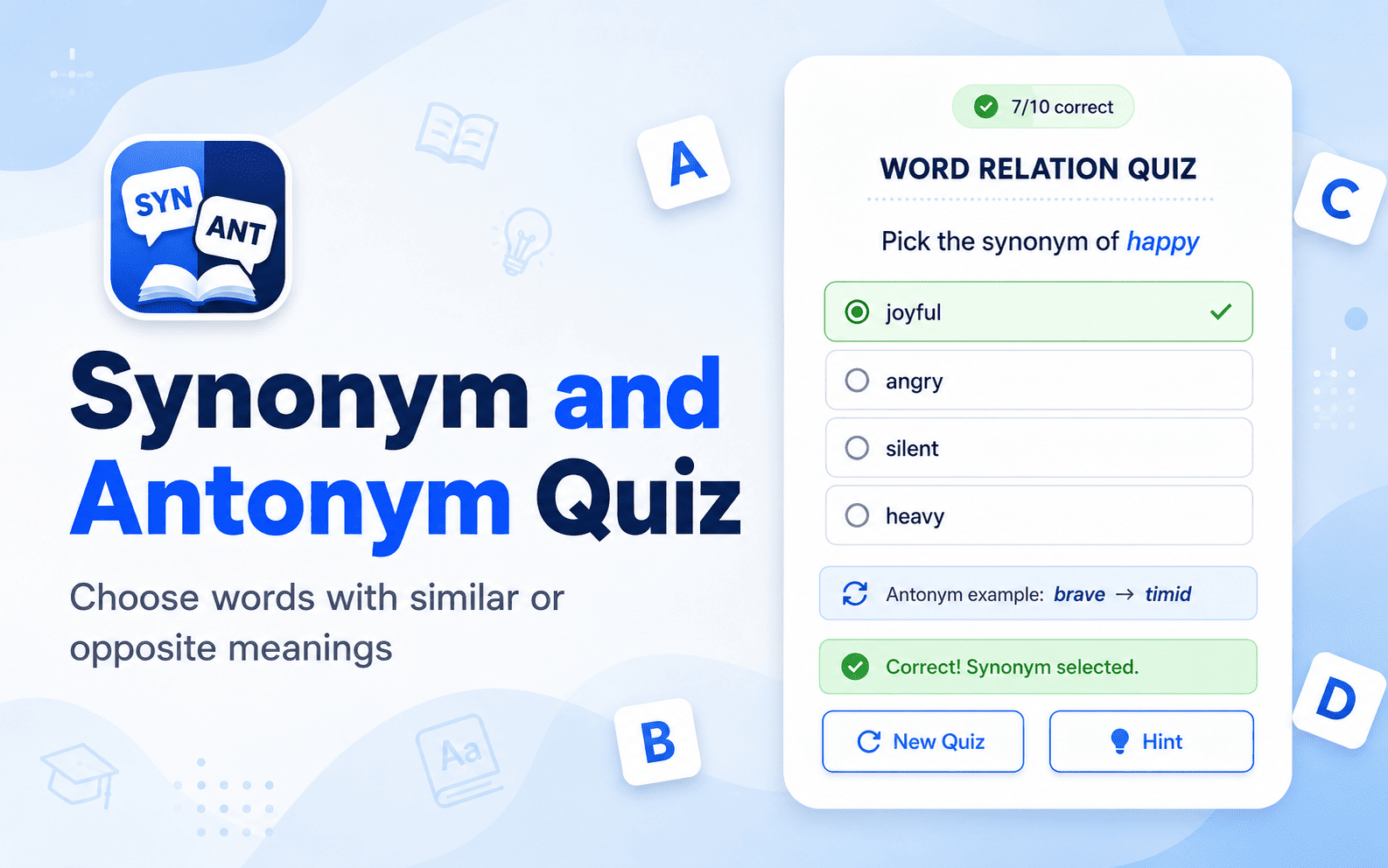
Synonym and Antonym Quiz is a free online word game that tests similar and opposite word meanings. Play Synonym and Antonym Quiz to improve vocabulary precision and understand word relationships.
Synonym and Antonym Quiz Overview
The Synonym and Antonym Quiz tests your ability to recognize words with similar or opposite meanings.
Each question presents a target word, sentence, or definition. You must decide which option is either:
- A synonym with a similar meaning.
- An antonym with an opposite meaning.
The quiz helps players understand relationships between words instead of memorizing vocabulary separately.
Synonym or Antonym?
Before choosing an answer, check what the question is asking.
Synonym
A synonym is a word with the same or a closely related meaning.
Examples:
- Happy — Joyful
- Large — Big
- Quick — Fast
- Silent — Quiet
- Begin — Start
Antonym
An antonym is a word with an opposite meaning.
Examples:
- Happy — Sad
- Large — Small
- Quick — Slow
- Silent — Noisy
- Begin — End
Main Quiz Objective
Your goal is to identify the correct word relationship and complete the question set with the highest possible score.
To succeed, you must:
- Read the target word carefully.
- Notice whether a synonym or antonym is required.
- Compare the meanings of all answer choices.
- Use sentence context when provided.
- Select the most accurate option.
How to Play
- Read the target word or sentence.
- Check whether the question requests a synonym or antonym.
- Review every available answer.
- Remove options with unrelated meanings.
- Select the strongest matching word.
- Read the feedback.
- Continue until the quiz is complete.
Example Synonym Question
Choose a synonym for “brave.”
- Afraid
- Courageous
- Weak
- Careless
Correct answer: Courageous
Both “brave” and “courageous” describe someone who faces danger or difficulty without fear.
Example Antonym Question
Choose an antonym for “ancient.”
- Historic
- Old
- Modern
- Traditional
Correct answer: Modern
“Ancient” describes something very old, while “modern” describes something connected with the present time.
Sentence-Based Example
The road was narrow. Choose an antonym for “narrow.”
- Short
- Wide
- Thin
- Rough
Correct answer: Wide
The sentence refers to the width of the road, so “wide” is the correct opposite.
Question Formats
Choose the Synonym
Select the word with the closest meaning.
Example:
Rapid
Correct synonym: Fast
Choose the Antonym
Select the word with the opposite meaning.
Example:
Generous
Correct antonym: Selfish
Complete the Sentence
Choose a synonym or antonym that fits the sentence correctly.
Example:
The room was enormous, not ___.
Correct answer: Tiny
Match Word Pairs
Identify whether two displayed words are synonyms, antonyms, or unrelated.
Example:
Purchase — Buy
Correct relationship: Synonyms
Replace the Highlighted Word
Choose a word that can replace the highlighted term without changing the sentence’s main meaning.
Example:
The child was delighted with the gift.
Replacement: Pleased
Find the Odd Word
Select the option that does not share the same meaning relationship as the others.
Example:
- Angry
- Furious
- Annoyed
- Cheerful
Correct answer: Cheerful
Common Synonym Groups
Happy
- Cheerful
- Joyful
- Pleased
- Delighted
- Content
Angry
- Furious
- Annoyed
- Irritated
- Enraged
- Upset
Intelligent
- Clever
- Smart
- Bright
- Wise
- Knowledgeable
Beautiful
- Attractive
- Lovely
- Pretty
- Gorgeous
- Elegant
Difficult
- Hard
- Challenging
- Complicated
- Demanding
- Tough
Common Antonym Pairs
| Word | Antonym |
|---|---|
| Accept | Refuse |
| Arrive | Depart |
| Ancient | Modern |
| Brave | Cowardly |
| Cheap | Expensive |
| Create | Destroy |
| Empty | Full |
| Expand | Contract |
| Generous | Selfish |
| Honest | Dishonest |
| Include | Exclude |
| Increase | Decrease |
| Permanent | Temporary |
| Success | Failure |
| Visible | Hidden |
Quiz Rules
- Select one answer for each question.
- Follow the requested relationship exactly.
- Do not choose an antonym when a synonym is required.
- Use the sentence meaning when context is provided.
- Correct answers increase your score.
- Incorrect answers reveal the accepted choice.
- Complete every question to receive the final result.
Quiz Features
- Synonym and antonym questions.
- Multiple-choice answers.
- Sentence-based vocabulary practice.
- Immediate answer checking.
- Correct-answer explanations.
- Progress and score tracking.
- Randomized question sets.
- Replayable quiz rounds.
- Mobile and desktop compatibility.
Synonyms Are Not Always Identical
Two synonyms may have similar meanings without being completely interchangeable.
Example:
- Look
- Stare
- Glance
All three relate to using the eyes, but they describe different actions.
- Look is general.
- Stare means looking for a long time.
- Glance means looking quickly.
The best answer depends on the target word and sentence context.
Antonyms Can Depend on Context
A word may have different opposites in different situations.
Example:
The word light can mean:
- Not heavy.
- Brightness.
- Pale in color.
Possible antonyms include:
- Heavy
- Dark
- Deep
The sentence determines which opposite is correct.
Example:
This bag is light.
Correct antonym: Heavy
The room is light.
Possible antonym: Dark
How to Find the Correct Synonym
Replace the Target Word
Put each answer option into the original sentence.
Example:
The teacher gave a brief explanation.
Possible synonym: Short
The teacher gave a short explanation.
The sentence keeps a similar meaning, so the answer fits.
Compare Strength
Some words express stronger emotions or actions.
Example:
- Annoyed
- Angry
- Furious
“Furious” is much stronger than “annoyed.”
Choose the word closest to the target’s exact intensity.
Check the Word Type
A noun should normally be matched with another noun, and a verb with another verb.
Example:
- Decide — verb
- Decision — noun
These words are related, but they are not direct synonyms.
How to Find the Correct Antonym
Identify the Main Meaning
Focus on what the word means in the current question.
Example:
Scarce means difficult to find or available in small amounts.
Correct antonym: Abundant
Look for Prefixes
Some antonyms are formed by adding prefixes.
Examples:
- Honest — Dishonest
- Possible — Impossible
- Regular — Irregular
- Patient — Impatient
- Agree — Disagree
However, not every opposite is formed with a prefix.
Example:
- Hot — Cold
- Early — Late
- Buy — Sell
Test the Contrast
Create a short contrast sentence.
Example:
The first room was spacious, but the second was cramped.
“Spacious” and “cramped” work as opposites in this context.
Useful Word-Part Clues
Prefixes can help identify opposite meanings:
- un-: unhappy, unfair
- dis-: disagree, dishonest
- in-: incorrect, incomplete
- im-: impossible, impatient
- ir-: irregular, irresponsible
- non-: nonviolent, nonfiction
Suffixes can help identify the word’s grammatical role:
- -ful often forms adjectives.
- -ness often forms nouns.
- -ly often forms adverbs.
- -tion often forms nouns.
- -ize often forms verbs.
Best Quiz Strategies
Confirm the Instruction
Look for words such as:
- Similar
- Closest
- Same meaning
- Opposite
- Contrast
- Antonym
- Synonym
Misreading the instruction can turn an easy question into a wrong answer.
Remove Unrelated Options
Eliminate answers that have no meaningful relationship with the target word.
Use Context Over Memorization
A word can have several meanings. The sentence shows which meaning is intended.
Compare Every Option
The first related word may not be the closest answer.
Notice Positive and Negative Meanings
Example:
Confident has a positive meaning, while arrogant often has a negative meaning. They are related but not exact synonyms.
Review Feedback
When an answer is incorrect, compare the target word, your choice, and the accepted answer.
Common Mistakes
- Confusing synonyms with antonyms.
- Choosing a related word instead of the closest meaning.
- Ignoring sentence context.
- Matching words with different grammatical roles.
- Selecting a word with the wrong emotional strength.
- Assuming all words with negative prefixes are exact opposites.
- Reading only the target word and skipping the instructions.
- Moving forward without reviewing mistakes.
Skills Improved by the Quiz
The Synonym and Antonym Quiz can improve:
- Vocabulary knowledge.
- Reading comprehension.
- Word-choice accuracy.
- Sentence interpretation.
- Writing variety.
- Speaking confidence.
- Context recognition.
- Verbal reasoning.
- Meaning comparison.
- Proofreading ability.
How Synonyms Improve Writing
Synonyms help writers avoid unnecessary repetition.
Repetitive sentence:
The film was good. The acting was good, and the ending was good.
Improved version:
The film was enjoyable. The acting was impressive, and the ending was satisfying.
Synonyms allow ideas to sound clearer and more natural, but each replacement must still fit the intended meaning.
How Antonyms Improve Understanding
Antonyms create clear contrasts.
Examples:
- Simple and complex.
- Success and failure.
- Permanent and temporary.
- Increase and decrease.
- Strength and weakness.
Recognizing these contrasts helps readers understand comparisons, arguments, instructions, and descriptions.
Synonym and Antonym Quiz for English Learners
English learners can use the quiz to expand vocabulary through connected word relationships.
Instead of learning one word alone, a learner can build a complete group.
Example:
Begin
- Synonyms: Start, commence
- Antonyms: End, finish
This approach supports:
- Faster vocabulary growth.
- Better word recall.
- More accurate speaking.
- Greater writing variety.
- Stronger reading comprehension.
Synonym and Antonym Quiz for Students
Students can use the game for:
- Vocabulary revision.
- Classroom warm-ups.
- Reading preparation.
- Writing improvement.
- Exam practice.
- Homework activities.
- Verbal reasoning.
- Independent English learning.
Teachers may create quiz sets based on vocabulary from current lessons, stories, textbooks, or reading passages.
Difficulty Levels
Beginner
- Common everyday words.
- Clearly different options.
- Simple synonym pairs.
- Direct antonyms.
Intermediate
- Sentence-based questions.
- Similar-looking answer choices.
- Words with multiple meanings.
- Differences in emotional strength.
Advanced
- Formal and academic vocabulary.
- Subtle meaning differences.
- Context-dependent antonyms.
- Complex word relationships.
Frequently Asked Questions
What is a synonym?
A synonym is a word with the same or a closely related meaning as another word.
What is an antonym?
An antonym is a word with an opposite meaning.
Are synonyms always interchangeable?
No. Synonyms may differ in context, strength, tone, or grammatical use.
Can one word have several antonyms?
Yes. Different meanings of the same word may produce different antonyms.
How do I know whether the quiz wants a synonym or antonym?
Read the question instruction carefully before reviewing the answer choices.
Why was a related word marked incorrect?
The selected word may be related but not close enough in meaning, or it may not fit the sentence context.
Does the quiz provide answer feedback?
Yes. It identifies the correct relationship or word after an answer is submitted.
Can the quiz improve writing?
Yes. Synonyms help reduce repetition, while antonyms help express comparisons and contrasts.
Is the quiz suitable for beginners?
Yes. Beginners can start with familiar words and direct meaning relationships.
Can I replay the quiz?
Yes. Use the restart or new-quiz option to receive another question set.
Can I play on mobile?
Yes. The Synonym and Antonym Quiz works on mobile phones, tablets, laptops, and desktop computers.
Explore More Word Games
Explore more vocabulary quizzes, meaning games, spelling challenges, crosswords, and word puzzles from the Word Games collection.
- Daily Word Guess
- Word Scramble
- Word Search Puzzle
- Hangman Game
- Anagram Builder
- Spelling Quiz
- Missing Letter Game
- Word Chain Game
- Daily Word Challenge
- Timed Word Finder
- Vocabulary Meaning Quiz
- Mini Crossword
- Word Ladder
- Typing Word Game
- Homophone Quiz
- Prefix and Suffix Quiz
- Commonly Confused Words Game
- Word Category Sort
- Word Memory Match