
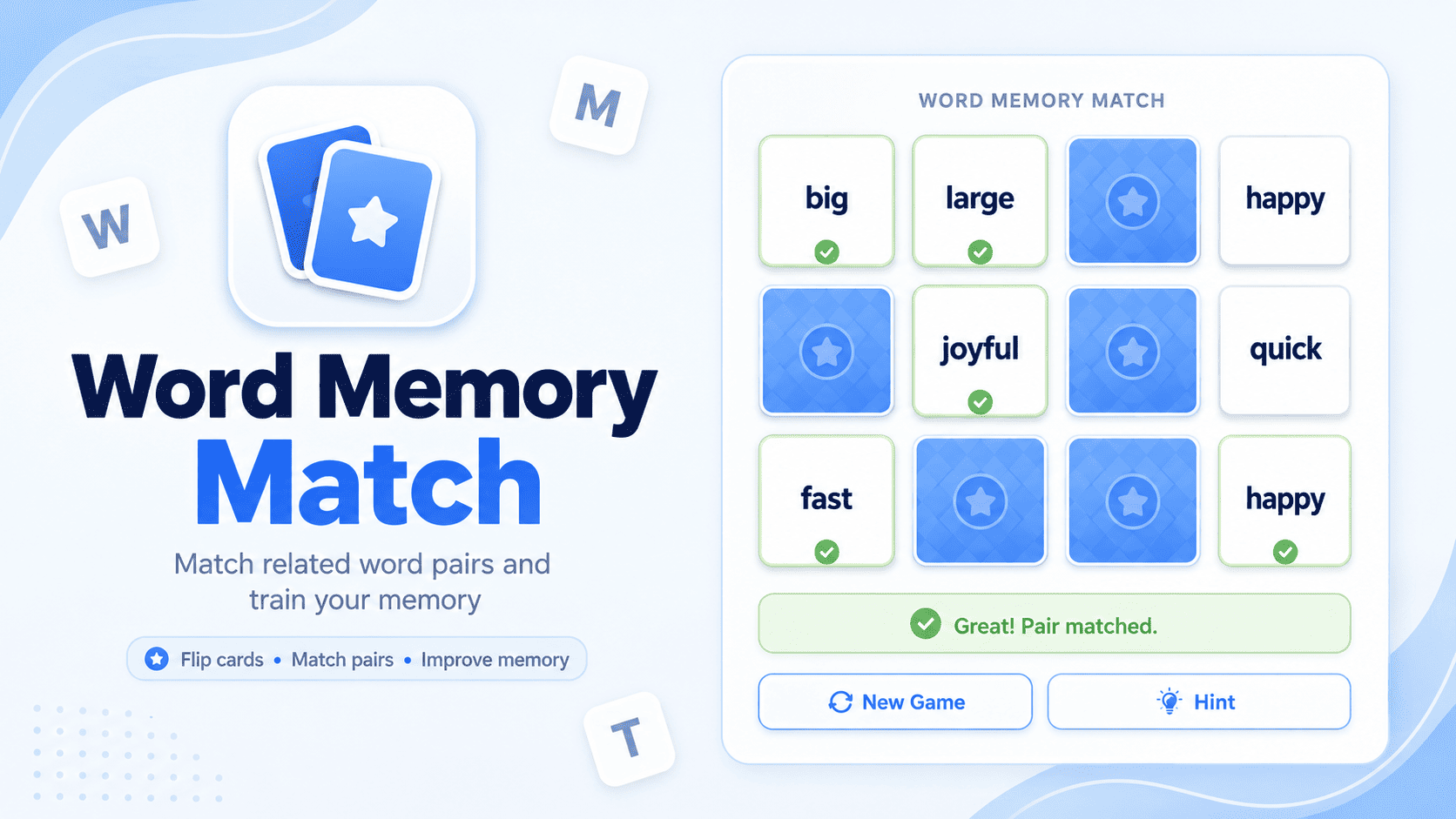
Word Memory Match is a free online vocabulary memory game where each English word must be paired with its definition. Play Word Memory Match to train recall, concentration, and word-meaning connections.
What Is the Goal of Word Memory Match?
The goal is to uncover hidden cards and find all matching word pairs. Players must remember each card’s position, identify related words, and complete the board using as few moves as possible.
Understanding the Card Board
The game board contains face-down cards arranged in rows and columns. Each card hides a word, meaning, synonym, antonym, picture label, or another related vocabulary item.
A matching pair may contain:
- The same word twice.
- A word and its meaning.
- A word and its synonym.
- A word and its antonym.
- A singular and plural form.
- A word and a related category.
- A word and its matching picture.
- A base word and its word form.
How to Play Word Memory Match
- Select one face-down card.
- Read or study the revealed word.
- Select a second card.
- Check whether both cards form a correct pair.
- Matching cards remain visible.
- Unmatched cards turn face down again.
- Continue until every pair has been found.
Example of a Matching Round
A board may contain these hidden cards:
- Happy
- Large
- Joyful
- Small
- Tiny
- Big
Possible matching pairs:
- Happy — Joyful
- Large — Big
- Small — Tiny
The player must remember where each word appeared and uncover its correct partner.
Types of Word Pairs
Identical Word Pairs
Both cards display the same word.
Example:
Apple — Apple
This format focuses mainly on visual memory and word recognition.
Word and Meaning Pairs
One card contains a word, while the other gives its definition.
Example:
Fragile — Easily broken
This type supports vocabulary comprehension.
Synonym Pairs
Both words have similar meanings.
Example:
Quick — Fast
Antonym Pairs
The words have opposite meanings.
Example:
Early — Late
Category Pairs
A word is matched with its correct group.
Example:
Tiger — Animal
Singular and Plural Pairs
The cards show different number forms of the same noun.
Example:
Child — Children
Word Family Pairs
The cards contain related forms of one base word.
Example:
Teach — Teacher
Game Rules
- Only two cards may be open at one time.
- A correct pair remains revealed.
- An incorrect pair turns face down.
- Previously matched cards cannot be selected again.
- Every card belongs to one matching pair.
- The round ends when the full board is cleared.
- Fewer moves usually produce a better result.
Scoring and Progress
The game may measure performance through:
- Number of matched pairs.
- Total moves used.
- Time taken.
- Incorrect attempts.
- Completion percentage.
- Best score.
- Fastest completion time.
A player performs better by remembering card positions and avoiding repeated incorrect selections.
Word Memory Match Features
- Face-down vocabulary cards.
- Different matching formats.
- Automatic pair checking.
- Move counter.
- Time tracking.
- Completion progress.
- New-board option.
- Restartable rounds.
- Mobile-friendly card controls.
- Different card arrangements in each game.
Memory Techniques That Help
Remember Card Locations
Connect each revealed word with its row and column.
Instead of remembering only “happy,” remember:
“Happy was near the top-left corner.”
Create Mental Connections
Link the two matching words through meaning.
Example:
Cold — Hot
Thinking of temperature makes the pair easier to remember.
Review Unmatched Cards
When two cards do not match, memorize both before they turn face down.
An incorrect attempt still provides useful information for later moves.
Clear One Area at a Time
Focus on a small section of the board before moving to another area. This reduces the number of card positions you must remember at once.
Use Confirmed Information
When you reveal a word you have seen before, select the location where its matching card appeared.
Avoid Random Clicking
Random selections increase moves without building a reliable memory of the board.
A Simple Matching Strategy
Use this process during each round:
First Pass: Discover Cards
Open new cards to learn what is hidden on the board.
Second Pass: Remember Connections
Notice possible matches and their positions.
Third Pass: Complete Known Pairs
Whenever you remember both locations, select them immediately.
Final Pass: Use Remaining Positions
As more cards disappear, the final pairs become easier to identify.
Common Mistakes to Avoid
- Selecting cards too quickly.
- Forgetting the position of recently revealed words.
- Opening the same incorrect pair repeatedly.
- Focusing only on spelling instead of meaning.
- Confusing synonyms with antonyms.
- Ignoring matched areas of the board.
- Clicking randomly when several card positions are already known.
- Restarting before using the information learned from previous turns.
Skills Developed Through Word Memory Match
The game can improve:
- Short-term memory.
- Visual memory.
- Vocabulary recognition.
- Reading accuracy.
- Meaning recall.
- Concentration.
- Attention to detail.
- Pattern recognition.
- Word association.
- Decision-making.
How the Game Supports Vocabulary Learning
Word Memory Match requires players to interact with each word several times.
A player may:
- Read the word when it first appears.
- Remember its position.
- Compare it with another word.
- Identify its meaning or relationship.
- Recall it again during a later turn.
This repetition can make vocabulary easier to remember than reading a word only once.
Word Memory Match for English Learners
English learners can use the game to connect new words with:
- Definitions.
- Synonyms.
- Antonyms.
- Pictures.
- Categories.
- Word forms.
- Singular and plural forms.
The matching format gives learners both visual and meaning-based clues, making unfamiliar vocabulary easier to practise.
Word Memory Match for Students
Students can use the game for:
- Vocabulary revision.
- Spelling recognition.
- Classroom warm-ups.
- Memory exercises.
- English homework.
- Test preparation.
- Word-family practice.
- Independent learning.
Teachers can create themed rounds based on animals, food, occupations, science, geography, verbs, adjectives, or lesson vocabulary.
Possible Game Difficulty Levels
Easy Level
- Fewer cards.
- Identical word pairs.
- Common vocabulary.
- No time limit.
Medium Level
- More cards.
- Synonym or category pairs.
- Limited viewing time.
- Move tracking.
Hard Level
- Large card board.
- Word-and-definition pairs.
- Similar-looking vocabulary.
- Time limit.
- Fewer allowed mistakes.
Benefits of Playing Regularly
Regular matching practice can help players:
- Remember new vocabulary more effectively.
- Recognize word relationships.
- Improve concentration.
- Reduce repeated mistakes.
- Strengthen visual recall.
- Read words more quickly.
- Build confidence with English meanings.
- Improve performance in memory-based tasks.
Frequently Asked Questions
What is Word Memory Match?
Word Memory Match is a card-based vocabulary game where players uncover hidden cards and find words or items that belong together.
How many cards can I reveal at once?
You can normally reveal two cards during each turn.
What happens when the cards match?
A correct pair stays visible or is removed from the active board.
What happens when the cards do not match?
The cards turn face down again, and you must remember their locations for later turns.
Are all pairs identical words?
No. Pairs may include words and definitions, synonyms, antonyms, categories, pictures, or related word forms.
How do I get a better score?
Complete the board using fewer moves, fewer mistakes, and less time.
Does Word Memory Match improve vocabulary?
Yes. It reinforces word recognition, meanings, relationships, spelling, and recall through repeated exposure.
Does the game improve memory?
Yes. Players must remember card positions and previously revealed information throughout the round.
Is Word Memory Match suitable for beginners?
Yes. Smaller boards and identical-word pairs are suitable for beginners, while advanced matching formats can challenge experienced learners.
Can I replay the game?
Yes. Use the restart or new-board option to play again with a different card arrangement.
Can I play on mobile?
Yes. Word Memory Match works on mobile phones, tablets, laptops, and desktop computers.
Explore More Word Games
Explore more vocabulary quizzes, matching activities, spelling games, word puzzles, and memory challenges from the Word Games collection:
- Daily Word Guess
- Word Scramble
- Word Search Puzzle
- Hangman Game
- Anagram Builder
- Spelling Quiz
- Missing Letter Game
- Word Chain Game
- Daily Word Challenge
- Timed Word Finder
- Vocabulary Meaning Quiz
- Synonym and Antonym Quiz
- Mini Crossword
- Word Ladder
- Typing Word Game
- Homophone Quiz
- Prefix and Suffix Quiz
- Commonly Confused Words Game
- Word Category Sort