
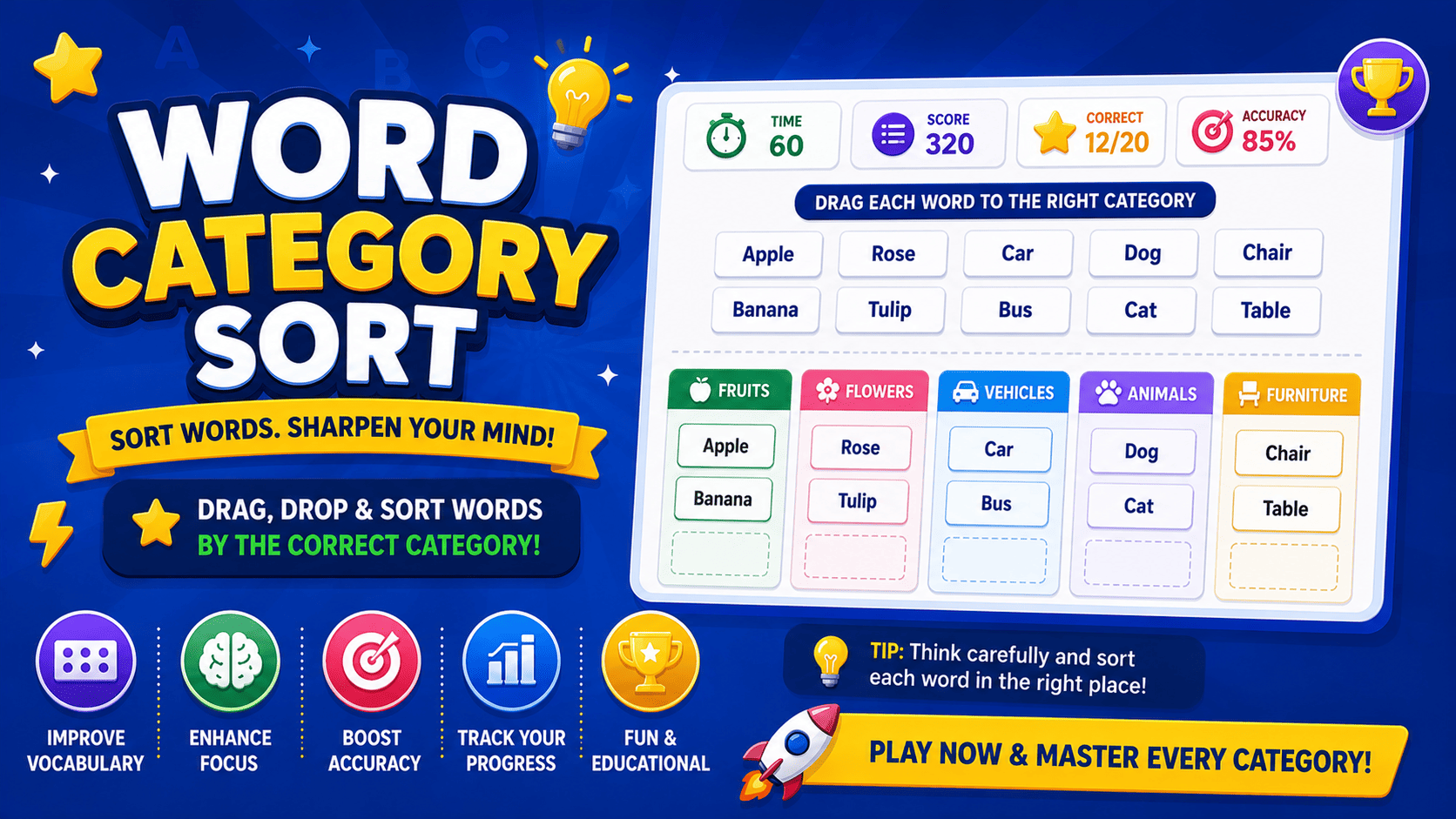
Word Category Sort is a free online classification game where you group English words by topic and meaning. Play Word Category Sort to strengthen semantic vocabulary, reading speed, and category recognition.
What Is Word Category Sort?
Word Category Sort is a classification game where players place each displayed word into the correct group based on its meaning, type, or relationship.
A round may ask you to sort words into categories such as:
- Animals
- Foods
- Places
- Actions
- Objects
- Emotions
- Professions
- Adjectives
Your Goal
Sort every word into its correct category without making unnecessary mistakes.
A successful round requires you to:
- Read each word carefully.
- Understand what it means.
- Compare the available categories.
- Select the most accurate group.
- Complete the full word set.
How to Play Word Category Sort
- Read the word shown on the screen.
- Review all available category labels.
- Decide which category best matches the word.
- Drag the word into that group or select the correct button.
- Check the answer feedback.
- Continue until every word has been sorted.
Example Sorting Round
Categories:
- Animals
- Fruits
- Vehicles
Words:
- Tiger
- Banana
- Bicycle
- Apple
- Horse
- Train
Correct sorting:
| Animals | Fruits | Vehicles |
|---|---|---|
| Tiger | Banana | Bicycle |
| Horse | Apple | Train |
Types of Categories Used
Meaning-Based Categories
Words are grouped according to what they represent.
Example:
Dog, Cat, Horse → Animals
Grammar Categories
Words are sorted by their grammatical function.
Example:
- Run → Verb
- Happy → Adjective
- Teacher → Noun
Topic Categories
Words are placed into subject-based groups.
Example:
- River → Nature
- Hospital → Places
- Pencil → School Items
Living and Non-Living Categories
Players decide whether a word represents something living or non-living.
Example:
- Tree → Living
- Chair → Non-living
Concrete and Abstract Categories
Words may be separated into things that can be physically experienced and ideas or feelings.
Example:
- Table → Concrete noun
- Honesty → Abstract noun
Synonym and Antonym Groups
Words may be sorted according to similar or opposite meanings.
Example:
- Happy, Joyful → Similar meanings
- Hot, Cold → Opposite meanings
Word Form Categories
Players may classify words as singular, plural, comparative, past tense, or another word form.
Example:
- Child → Singular
- Children → Plural
Word Category Sort Rules
- Each word belongs to one intended category.
- Read all category labels before answering.
- Select only the group that best matches the word.
- Correct placements increase progress or score.
- Incorrect placements may return the word for another attempt.
- Complete every word to finish the round.
- Repeated incorrect selections may reduce the final score.
How Correct Answers Are Checked
When a word is placed correctly:
- It stays inside the chosen category.
- Progress increases.
- The game may display positive feedback.
- The next word becomes available.
When a word is placed incorrectly:
- It may return to the unsorted area.
- The correct category may remain hidden.
- A hint or explanation may appear.
- The player can try again.
Word Category Sort Features
- Clear category labels.
- Drag-and-drop or tap-based controls.
- Automatic answer checking.
- Progress tracking.
- Score or mistake counter.
- Different category sets.
- Randomized words.
- Restartable rounds.
- Responsive mobile and desktop design.
A Reliable Sorting Method
Read the Category Labels First
Understand the available groups before studying the words.
For example, if the categories are Nouns, Verbs, and Adjectives, you must sort by grammar rather than general meaning.
Define the Word
Think of a short meaning for the word.
Example:
Swim means to move through water, so it belongs in Actions or Verbs.
Compare Every Category
Do not select the first category that seems possible. Check whether another option is more specific.
Example:
Rose could relate to nature, but if Flowers is available, that is the better category.
Use Elimination
Remove categories that clearly do not fit.
Example:
For Carrot:
- Not an animal.
- Not a vehicle.
- It belongs in vegetables.
Check the Word Form
A word’s ending may reveal its category.
Examples:
- Quickly → Adverb
- Helpful → Adjective
- Movement → Noun
- Running → Verb form or activity
Common Category Examples
Animals
- Lion
- Rabbit
- Dolphin
- Eagle
- Horse
Food
- Bread
- Rice
- Cheese
- Apple
- Soup
Occupations
- Doctor
- Teacher
- Farmer
- Pilot
- Engineer
Places
- School
- Hospital
- Market
- Airport
- Library
Actions
- Jump
- Read
- Write
- Build
- Speak
Emotions
- Happiness
- Anger
- Fear
- Excitement
- Sadness
Describing Words
- Bright
- Soft
- Tall
- Quiet
- Friendly
Household Objects
- Table
- Chair
- Lamp
- Spoon
- Pillow
Sorting Words With More Than One Possible Meaning
Some English words can belong to different categories depending on context.
Example:
Watch
- As a noun: an object worn on the wrist.
- As a verb: to look at something.
The game’s category labels and sentence context determine the intended answer.
Another example:
Light
- A source of brightness.
- Not heavy.
- To ignite something.
Always use the category set provided in the current round.
Strategies for Faster Sorting
Sort the Obvious Words First
Begin with words that clearly belong to one category. This reduces the remaining choices.
Leave Difficult Words Until Later
When a word seems ambiguous, sort the easier items first. The remaining categories may make the answer clearer.
Look for Shared Features
Ask what the words in each group have in common.
Example:
If Bus and Train are already in one group, Car probably belongs there too.
Check Grammar Endings
Common endings can reveal word type:
- -ly often indicates an adverb.
- -ness often forms a noun.
- -ful often forms an adjective.
- -ed may indicate past tense.
- -ing may indicate an action.
Use Category Specificity
Choose the most precise available category.
Example:
If both Food and Fruit are available, place Mango in Fruit.
Common Mistakes to Avoid
- Sorting by spelling instead of meaning.
- Ignoring the category instructions.
- Selecting a broad category when a specific one is available.
- Confusing nouns, verbs, and adjectives.
- Assuming every word has only one possible meaning.
- Dragging words too quickly without reading them.
- Repeating the same incorrect category.
- Ignoring feedback after a mistake.
What Skills Does Word Category Sort Develop?
The game helps improve:
- Vocabulary understanding.
- Word classification.
- Reading comprehension.
- Logical organization.
- Grammar recognition.
- Semantic awareness.
- Decision-making.
- Concentration.
- Pattern recognition.
- General knowledge.
Word Category Sort for English Learners
English learners can use the game to understand relationships between words instead of memorizing isolated vocabulary.
For example, learning these words together creates a stronger connection:
Bus, Train, Car, Bicycle → Transport
Category practice helps learners:
- Remember words by topic.
- Understand meanings faster.
- Distinguish similar vocabulary.
- Recognize parts of speech.
- Build organized word groups.
- Improve speaking and writing recall.
Word Category Sort for Students
Students can use the game for:
- Vocabulary revision.
- Grammar lessons.
- Classroom competitions.
- Topic-based learning.
- Homework practice.
- Reading preparation.
- Test revision.
- Independent English study.
Teachers can create category rounds based on current lessons, such as:
- Science words.
- Geography terms.
- Healthy foods.
- Farm animals.
- Action verbs.
- Descriptive adjectives.
- School objects.
- Community helpers.
Possible Difficulty Levels
Easy Level
- Two or three categories.
- Common everyday words.
- Clear differences between groups.
- No timer.
Medium Level
- Four or five categories.
- Similar word types.
- Larger word sets.
- Limited mistakes.
Hard Level
- Closely related categories.
- Ambiguous words.
- Grammar-based sorting.
- Timed rounds.
- Advanced vocabulary.
Why Category Learning Is Useful
Organizing vocabulary into groups can make words easier to understand and remember.
Instead of learning random words separately, players build connected vocabulary sets.
Example:
Weather
- Rain
- Snow
- Wind
- Storm
- Cloud
This type of grouping can improve recall during reading, speaking, and writing.
Frequently Asked Questions
What is Word Category Sort?
It is a vocabulary game where players place words into the correct groups based on meaning, grammar, topic, or word type.
How do I sort a word?
Read the word, compare the category labels, and drag or select it into the most accurate group.
Can one word fit more than one category?
Some words have multiple meanings, but each game question has one intended category based on the available options or context.
What happens after a wrong answer?
The word may return to the unsorted area, and the game may provide feedback or allow another attempt.
Does the game include grammar categories?
Yes. Some rounds may ask players to sort nouns, verbs, adjectives, adverbs, singular forms, or plural forms.
Can Word Category Sort improve vocabulary?
Yes. It helps players understand meanings, topics, word relationships, and grammatical roles.
Is the game suitable for beginners?
Yes. Beginners can start with simple everyday categories, while advanced players can use grammar and meaning-based rounds.
Can teachers use this game?
Yes. Teachers can use it for vocabulary revision, topic lessons, grammar practice, and classroom activities.
Can I replay a sorting round?
Yes. Use the restart or new-round option to practise another word set.
Can I play on mobile?
Yes. Word Category Sort works on mobile phones, tablets, laptops, and desktop computers.
Explore More Word Games
Explore more vocabulary quizzes, matching games, spelling activities, crosswords, and word puzzles from the Word Games collection attached below:
- Daily Word Guess
- Word Scramble
- Word Search Puzzle
- Hangman Game
- Anagram Builder
- Spelling Quiz
- Missing Letter Game
- Word Chain Game
- Daily Word Challenge
- Timed Word Finder
- Vocabulary Meaning Quiz
- Synonym and Antonym Quiz
- Mini Crossword
- Word Ladder
- Typing Word Game
- Homophone Quiz
- Prefix and Suffix Quiz
- Commonly Confused Words Game
- Word Memory Match