
If you have ever felt like you are flipping a coin when choosing between “may” and “might,” you are not alone. These two words are so close in meaning that even native speakers often use them interchangeably. However, there are specific, subtle differences that change the tone and accuracy of your sentences.
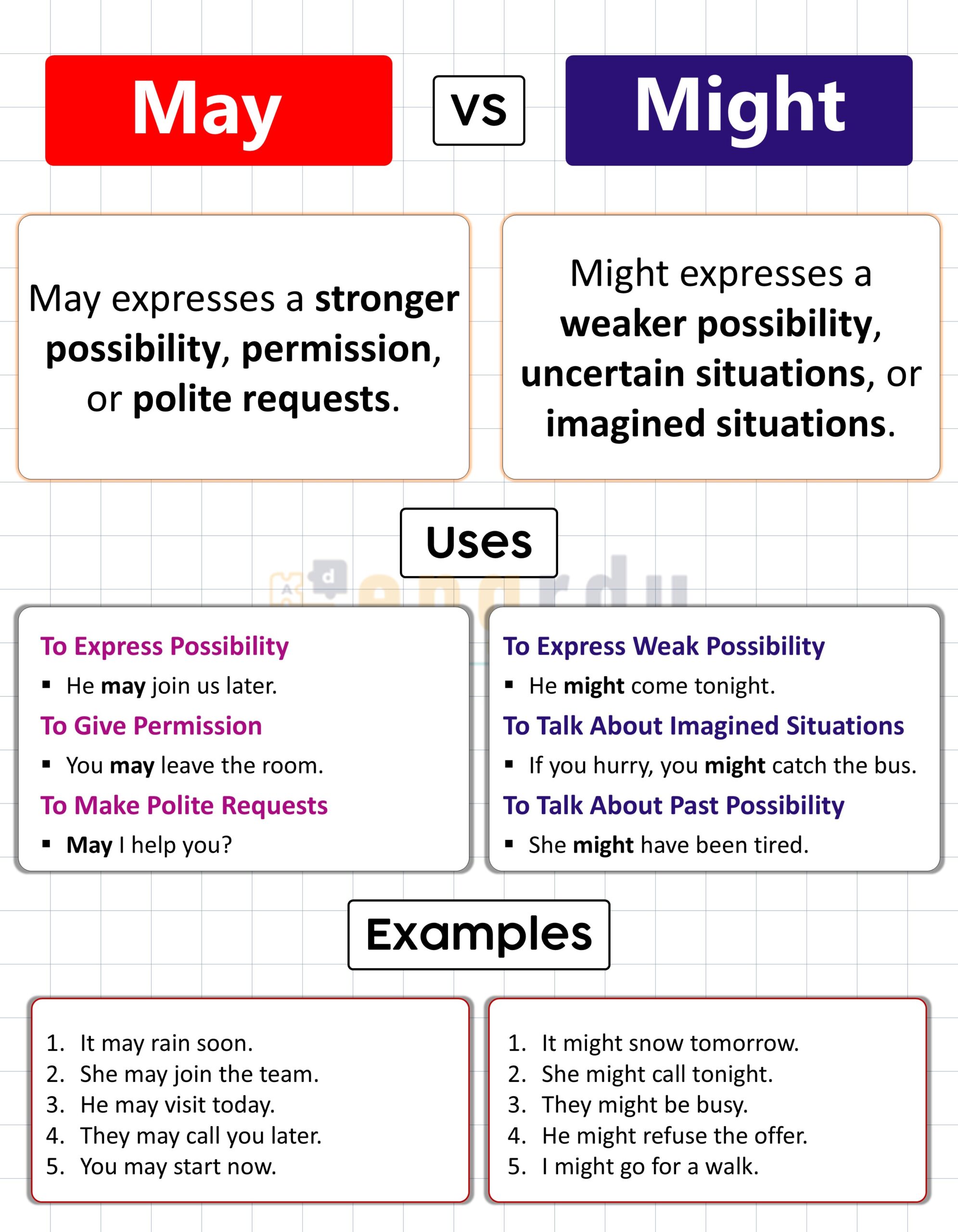
To simplify this: May indicates a higher probability or is used to ask for permission. Might suggests a lower probability or a more tentative possibility.
Let’s break down exactly when to use each so you can sound more confident and precise.
What You Need to Know
Think of it in terms of “certainty” and “authority.”
Use May: When you are reasonably sure something will happen (around a 50% chance or higher) or when you need to ask for permission in a formal way.
Use Might: When you are guessing, feeling uncertain, or speaking about a hypothetical situation that seems unlikely.
When to Use May
You will usually see may in two specific situations: permission and possibility.
Permission (Formal)
This is the most common use. When you are in a professional or formal setting, you use may to request or grant permission.
“May I use your phone for a moment?”
“You may take your seats now.”
High Probability
When you look at the evidence—like dark clouds in the sky—you use may because there is a logical reason to believe it will happen.
“The manager said she may arrive by noon, so let’s prepare the presentation.”
“We may have to reschedule if the traffic is this bad.”
When to Use Might
Might is the softer, more cautious sibling. It is for those moments when you are just not sure.
Low Probability
Use might when you are just taking a shot in the dark.
“I might go to the movies tonight, but I haven’t decided yet.”
“He might show up, but don’t count on it.”
Hypothetical Situations
When imagining a “what if” scenario that hasn’t happened yet, might is your go-to.
“If I saved more money, I might buy a house next year.”
“She might have finished the report if you had sent the data earlier.”
Indirect Speech (The Past Tense)
This is a specific usage rule. If you are reporting what someone said in the past, might acts as the past tense form of may.
Present: “She says, ‘I may go.'”
Past: “She said she might go.”
Why: When we move back in time to report what someone said, “may” shifts to “might.”
Quick Comparison Chart
| Feature | May | Might |
| Probability | Higher (I expect it to happen) | Lower (I am unsure/guessing) |
| Permission | Used formally (“May I…”) | Rarely used (“Might I…” is archaic) |
| Tone | Assertive, polite, professional | Tentative, casual, uncertain |
| Past Tense | May have | Might have |
May vs Might Examples in Sentences
See how the meaning shifts based on the word chosen:
The Weather:
“It may rain.” (I see gray clouds; I am fairly certain.)
“It might rain.” (The sky looks okay, but I’m just guessing it could happen.)
Making Plans:
“I may attend the meeting.” (I have the intent to go.)
“I might attend the meeting.” (I am considering it, but I’ll probably skip it.)
Asking for things:
“May I borrow your pen?” (Polite and correct.)
“Might I borrow your pen?” (Very formal, almost sounds like an old movie—usually better to use may.)
Tricks to Remember the Difference
The “50/50” Rule: If you are flipping a coin and you think it’s a coin-toss, use may. If you think there is less than a 50% chance, use might.
The “Formal” Rule: If you are talking to a boss, a teacher, or someone you don’t know well, choose may. It sounds respectful. If you are talking to friends, might is perfectly fine.
The “Memory” Trick:
M-A-Y has 3 letters. Think: “M-A-Y = Many chances.” (Higher probability).
M-I-G-H-T has 5 letters. Think: “Might = Minus chance.” (Lower probability).
Practice: May or Might?
Test your understanding with these sentences. Choose the best fit based on the context.
“I _______ finish this project by tonight, but I have a lot of work left to do.”
“_______ I come in? I have something to discuss.”
“The doctors said he _______ recover fully, though it is still early to tell.”
“We _______ go to Spain this summer, but we haven’t booked anything yet.”
“You _______ leave early if you have finished your tasks.”
Answer Key
Might (The speaker has a lot of work, suggesting it is unlikely/difficult).
May (Asking for permission).
May (Medical prognosis usually requires a slightly higher degree of confidence).
Might (Plans are not booked, so it is just a possibility).
May (Granting permission).
FAQs About May vs Might
What is the main difference between “may” and “might”?
Use “may” for higher probability or permission, and use “might” for lower probability or purely hypothetical situations where you are feeling unsure.
Can I use “may” and “might” interchangeably?
In casual conversation, yes, they are often interchangeable. However, you should strictly use “may” for permission and formal, high-probability statements instead.
When should I use “may” instead of “might”?
Use “may” when asking for formal permission or describing situations where there is a strong, logical reason to expect them to happen.
Is “might” more formal than “may”?
No, “may” is generally more formal and polite than “might,” especially when asking for permission or discussing professional, likely future events.
Can I say “Might I…?” to ask for permission?
While grammatically possible, it sounds extremely stiff and archaic. It is much more natural to use “May I…?” for all permission requests.
Which word implies a lower chance of happening?
“Might” implies a lower probability, suggesting the event is uncertain, speculative, or just a possibility rather than a likely or expected outcome.
How do I choose between “may” and “might” in writing?
Choose “may” for clear, probable outcomes or formal requests, and reserve “might” for distant possibilities, vague guesses, or purely hypothetical “what if” scenarios.
Explore More Confusing Words