


Many English learners confuse used to and be used to because they look almost the same. However, they have different meanings and follow different grammar rules.
The short answer is simple:
Used to talks about past habits or situations that are no longer true.
Be used to means being familiar or comfortable with something because it is not new anymore.
Understanding this difference will help you speak and write more naturally in English. This guide explains the meaning, grammar, common mistakes, examples, memory tips, and practice exercises to help you master both expressions.
Used to vs. Be Used To: Understanding the Basics
Although these expressions share the words used and to, they are not interchangeable.
| Expression | Meaning | Time |
|---|---|---|
| Used to | A past habit or past state that no longer exists | Past |
| Be used to | To be accustomed to or comfortable with something | Past, Present, or Future |
Compare these two sentences:
- I used to play football every weekend. (I don’t play regularly now.)
- I am used to playing football every weekend. (Playing every weekend feels normal to me.)
The first sentence focuses on the past.
The second sentence focuses on being accustomed to an activity.
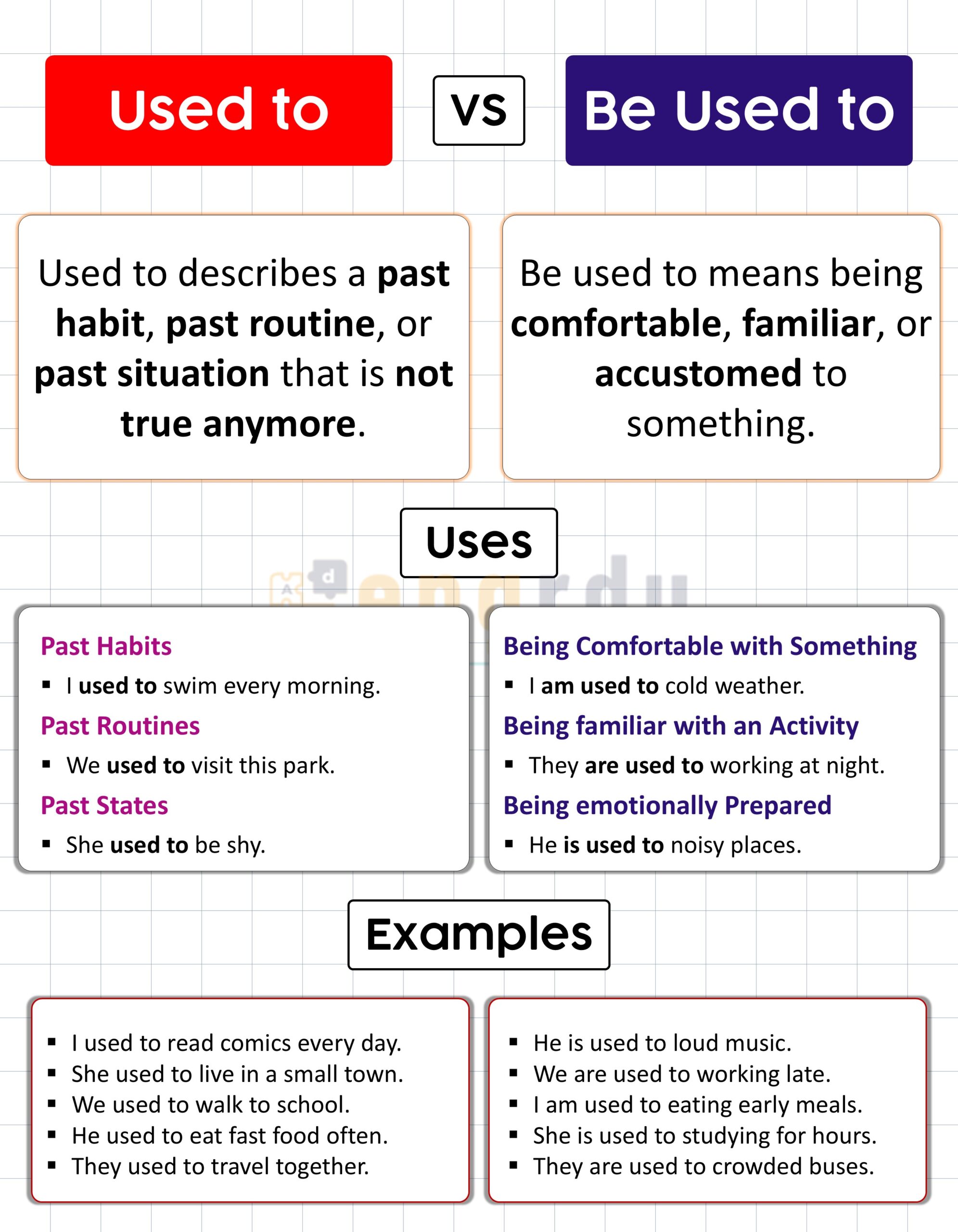
Used to vs Be Used to – Grammar Differences Explained
When to Use Used To
Use “used to” when talking about something that happened regularly in the past or a situation that existed before but has changed.
It describes:
- past habits
- repeated actions
- past states
- things that are no longer true
Structure
Subject + used to + base verb
Examples:
- She used to live in Canada.
- We used to travel every summer.
- My father used to smoke, but he quit years ago.
- I used to believe that English grammar was difficult.
- They used to play outside after school.
Notice that the verb after used to is always in its base form.
- ✔ used to eat
- ✔ used to walk
- ✔ used to study
- ✘ used to eating
- ✘ used to walked
Negative Form
There are two forms, but one is much more common.
Most common
did not (didn’t) use to + base verb
Examples:
- I didn’t use to drink coffee.
- She didn’t use to wear glasses.
- They didn’t use to drive.
Less common
used not to
Example:
- He used not to like spicy food.
This form sounds formal and is uncommon in everyday English.
Questions
Structure:
Did + subject + use to + base verb?
Examples:
- Did you use to play tennis?
- Did she use to work here?
- Did they use to live nearby?
Notice that after did, we write use, not used.
Correct:
✔ Did you use to swim?
Incorrect:
✘ Did you used to swim?
When to Use Be Used To
Use “be used to” when something feels familiar or normal because you have experienced it before.
It does not describe a past habit.
Instead, it describes your level of comfort or familiarity.
Structure
Subject + be + used to + noun / pronoun / gerund (-ing verb)
Examples:
- I am used to cold weather.
- She is used to working late.
- We are used to the noise.
- He was used to waking up early.
- They will be used to the new schedule soon.
Notice what comes after to.
Correct:
- used to the weather
- used to the traffic
- used to getting up early
- used to working from home
Incorrect:
✘ I am used to wake up early.
Correct:
✔ I am used to waking up early.
Definitions and Examples of Used to and Be Used to
Used to Definition and Examples
An expression that describes actions, habits, or situations that happened regularly in the past but no longer happen.
Examples:
- I used to ride my bike every day.
- She used to have long hair.
- We used to visit our grandparents often.
Be Used To Definition and Examples
An adjective phrase meaning accustomed to, familiar with, or comfortable with something.
Examples:
- I am used to early mornings.
- She is used to speaking English at work.
- They were used to living in a small apartment.
Main Differences Between Used to and Be Used to
| Feature | Used to | Be Used to |
|---|---|---|
| Main meaning | Past habit or past state | Being accustomed to something |
| Time | Only past | Past, present, and future |
| Verb after it | Base verb | Noun or verb + ing |
| Talks about | Change from the past | Familiarity or comfort |
| Auxiliary verb | No “be” | Requires a form of “be” |
| Example | I used to run every morning. | I am used to running every morning. |
Grammar Patterns You Should Know
One reason learners confuse these expressions is that both contain the word to, but the grammar after to is completely different.
Pattern 1
used to + base verb
Examples:
- used to eat
- used to drive
- used to study
Pattern 2
be used to + noun
Examples:
- used to the weather
- used to the job
- used to the city
Pattern 3
be used to + verb-ing
Examples:
- used to driving
- used to speaking
- used to getting up early
Remember:
In be used to, to is a preposition, so it is followed by a noun or -ing form.
In used to, to is part of the expression, so it is followed by the base verb.
Used to vs. Be Used to Examples in Sentences
Talking about past habits
- I used to watch cartoons every Saturday.
- She used to write letters by hand.
- They used to visit us every winter.
Talking about being accustomed
- I am used to working under pressure.
- She is used to long meetings.
- They are used to the local food.
Compare the meanings.
I used to work at night.
→ I worked at night before, but I don’t now.
I am used to working at night.
→ Working at night feels normal to me.
He used to wear glasses.
→ He wore glasses before.
He is used to wearing glasses.
→ Wearing glasses feels normal to him.
We used to live in a village.
→ We don’t live there anymore.
We are used to living in a village.
→ Village life is familiar and comfortable for us.
Common Mistakes Learners Make
- I am used to wake up early. ❌
- I am used to waking up early. ✔
- I used to working late. ❌
- I used to work late. ✔
- Did you used to play football? ❌
- Did you use to play football? ✔
- I am use to cold weather. ❌
- I am used to cold weather. ✔
- She is used to cook every day. ❌
- She is used to cooking every day. ✔
Used to, Get Used to, and Be Used to
Many learners also confuse get used to with the other two expressions.
Here’s an easy comparison.
| Expression | Meaning |
|---|---|
| Used to | Past habit |
| Be used to | Already accustomed |
| Get used to | Become accustomed over time |
Examples:
- I used to drink tea every morning.
- I am used to drinking tea every morning.
- I am getting used to drinking tea every morning.
The third sentence shows a process of becoming comfortable, not the final result.
Tips for Remembering the Differences
1. Past habit? → Use “used to”.
Example: I used to play outside.
2. Comfort or familiarity? → Use “be used to”.
Example: I am used to the noise.
3. Easy Grammar Trick:
- Used to + base verb → used to study ✅
- Be used to + noun / verb + ing → used to studying ✅
4. Look for the word “be”.
If you see am, is, are, was, or were, you probably need be used to.
5. After “did” or “didn’t”, use “use to”.
✔ Did you use to live here?
✘ Did you used to live here?
6. Quick Memory Trick:
Used to = Then (past)
Be used to = Now (familiar)
Quick Summary About Used to, Be Used to, and Get Used to
| If you want to talk about… | Use |
|---|---|
| Something you did in the past but not now | Used to |
| Being familiar with something | Be used to |
| Becoming familiar with something | Get used to |
Used to vs Be Used to Worksheet with Answers
Fill in the blanks.
- I ______ live near the beach.
- She is used to ______ in a busy office.
- They didn’t ______ eat spicy food.
- We are used to ______ weather.
- Did you ______ play chess?
- He was used to ______ early.
- My brother used to ______ basketball.
- I am used to ______ my own meals.
- They used to ______ here.
- She is used to the ______.
Answers
- used to
- working
- use to
- hot
- use to
- getting up
- play
- cooking
- live
- noise
Used to vs Be Used to: Practice Quiz
Choose the correct answer.
1. I _____ get up before sunrise.
A. am used to
B. used to
2. She is used to _____ English every day.
A. speak
B. speaking
3. Did they _____ live in London?
A. use to
B. used to
4. We are used to _____ long distances.
A. walk
B. walking
5. He _____ have a beard.
A. used to
B. is used to
6. I am used to _____ the cold weather.
A. handle
B. handling
7. They _____ staying up late now.
A. are used to
B. used to
8.
My parents _____ travel every summer.
A. used to
B. are used to
Quiz Answers
- B
- B
- A
- B
- A
- B
- A
- A
Frequently Asked Questions
1. Is used to the same as be used to?
No. Used to describes a past habit or situation that has changed. Be used to means being accustomed to something.
2. Why does be used to take an -ing verb?
Because to is a preposition in this expression. After a preposition, English normally uses a noun or a gerund (verb + -ing).
Correct:
- used to driving
- used to studying
3. Can be used to be used in the past?
Yes.
Examples:
- I was used to the cold.
- She was used to working at night.
4. Can used to describe the present?
No.
It only refers to the past.
Incorrect:
- I used to live here now.
Correct:
- I live here now.
- I used to live there.
5. Which is more common: “didn’t use to” or “used not to”?
Didn’t use to is much more common in modern English, especially in conversation. Used not to is correct but sounds formal and is less common.
6. Is get used to the same as be used to?
Not exactly.
- Get used to describes the process of becoming accustomed.
- Be used to describes the finished state of already being accustomed.
Example:
- I am getting used to the new software.
- I am used to the new software now.
Final Takeaway
The easiest way to remember Used to vs Be Used to is to focus on the meaning rather than the similar wording.
- Choose used to when talking about a habit, routine, or situation that existed in the past but no longer does.
- Choose be used to when you want to describe being comfortable, familiar, or accustomed to something. Remember that this expression is followed by a noun or an -ing verb, not a base verb.
Once you recognize whether you’re describing a past habit or a present (or past/future) state of familiarity, choosing the correct expression becomes much easier. Practice with your own sentences, pay attention to the grammar pattern that follows each expression, and you’ll avoid one of the most common mistakes made by ESL learners.
Explore More Confusing Words




Leave a Comment