


Talking about the future in English can feel like a trap. If you say, “I will visit my mother this weekend,” native speakers will understand you perfectly—but it might sound slightly unnatural if you have had this trip planned for a month.
Unlike many other languages, English doesn’t have a single future tense verb ending. Instead, we rely on helper words like will and going to.
While both point to the future, they carry different hidden meanings about when you made your decision and why you think something is going to happen. Let’s break down exactly how to choose the right one.
Quick Answer: When to Use Will vs. Going to
Use “will” for sudden decisions made at the exact moment of speaking, promises, and predictions based on your personal opinion.
Use “going to” for future plans decided before you started speaking, and for predictions based on visible evidence happening right now.
Basics of Future Tenses
To express the future in English, we combine a subject, a modal verb (or phrase), and the base form of a main verb. The two most common structures are:
Subject + will + base verb (I will go)
Subject + to be + going to + base verb (I am going to go)
Though they seem interchangeable, native speakers instinctively switch between them based on planning and evidence.
Will vs. Going to: Understanding the Basics
The easiest way to master these two forms is to look at four specific categories: decisions, predictions, intentions, and formality.
1. Decisions: Now vs. Then
Use “will” for instant decisions made at the moment of speaking.
If someone knocks on the door, you make a split-second choice.
“I’ll get the door!” (Not: “I am going to get the door.”)
Use “going to” for plans or decisions made before the moment of speaking.
If you bought plane tickets last week, the decision is already made.
“We are going to fly to Paris on Tuesday.”
2. Predictions: Guesses vs. Evidence
Use “will” for predictions based on personal opinions or beliefs.
When you are guessing about the future without hard physical proof, “will” is your best choice. It often pairs with phrases like I think, I hope, or I doubt.
“I think humans will live on Mars someday.”
Use “going to” for predictions based on present evidence.
When you can see, hear, or feel something right now that proves what is about to happen, use “going to.”
“Look at those dark clouds. It is going to rain.”
3. Intentions
Use “going to” when expressing intentions or plans that have already been decided.
If you have a clear intention to do something, even if the exact time isn’t set yet, this is the natural choice.
“I am going to start eating healthier next month.”
4. Formality
In formal writing, academic papers, or business contracts, it’s important to distinguish between the two. “Will” is generally seen as more formal and authoritative. “Going to” (often pronounced as “gonna” in casual speech) is highly conversational.
Formal Business: “The company will release its earnings report on Friday.”
Casual Office: “We are going to talk about the budget in the meeting.”
Will vs Going to
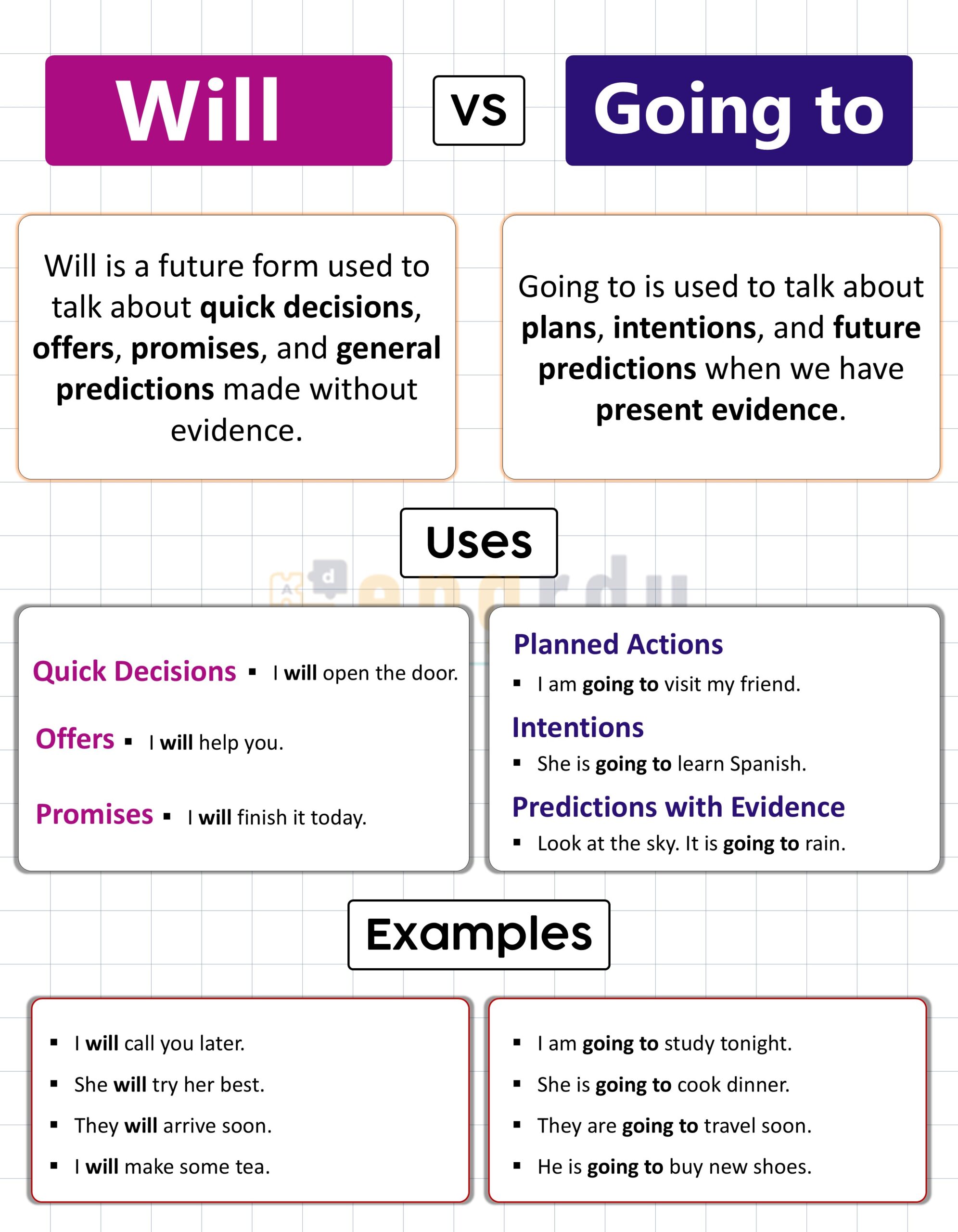
When to use Will
Use will when the future is unwritten, uncertain, or decided right now.
Spontaneous decisions: You notice you are out of milk. “I’ll go to the store.”
Promises: “I won’t tell anyone your secret.” (Won’t = will not)
Offers and Volunteers: “You look tired. I’ll wash the dishes tonight.”
Refusals: “The car won’t start.”
General facts about the future: “The sun will rise at 6:00 AM tomorrow.”
When to use Going to
Use going to when the future is already set in motion by a plan or physical evidence.
Prior plans: “I am going to see the dentist at 3 PM.” (You already made the appointment).
Imminent physical events: You see a glass teetering on the edge of a table. “Watch out! It is going to fall.”
Strong intentions: “I’ve decided I am going to ask for a promotion.”
Will and Going to: Similarities and Differences
Sometimes, the line between these two gets blurry. Here is how they compare directly.
Similarity in Usage
For long-term, general predictions where neither evidence nor plans are relevant, you can often use either one without changing the meaning.
Both are correct: “The year 2050 will be very different.” / “The year 2050 is going to be very different.”
Differences in Usage
| Feature | “Will” | “Going To” |
| Timing of Decision | Just now (Spontaneous) | In the past (Pre-planned) |
| Prediction Basis | Opinion, belief, guess | Physical clues, current evidence |
| Tone | Often formal or abstract | Conversational, concrete |
| Special Uses | Promises, offers, threats | Strong personal intentions |
Tips for Remembering the Differences
If you get stuck during a conversation, use these two mental shortcuts:
The “Calendar vs. Oops” Trick: If the event is written on your calendar, use going to. If you just realized you need to do it (“Oops, I forgot the milk!”), use will.
The “Detective” Trick: Are you looking at clues right now? (Black clouds, a speeding car, a falling glass). If you have physical clues, use going to.
Will vs. Going to: Examples in Sentences
Notice how the context changes the correct choice in these comparisons:
Phone rings: “I’ll answer it!” (Instant reaction).
Friend asks about your weekend: “I am going to paint my bedroom.” (Prior plan).
Tasting awful food: “I don’t think I will finish this.” (Personal opinion).
Seeing someone trip: “Oh no, he is going to drop those boxes!” (Present evidence).
Key Takeaways
Use will for quick decisions, promises, and opinion-based predictions.
Use going to for things you already planned and predictions based on things you can see right now.
When in doubt for academic writing, lean toward will.
In casual speech, native speakers frequently shorten “going to” to “gonna,” but never write “gonna” in formal situations.
Will vs Going to Worksheet / Practice Quiz
Choose the most natural option for each sentence. (Answers are at the bottom)
A: “We don’t have any bread.”
B: “Really? I (will / am going to) go buy some.”
“Look at the traffic! We (will / are going to) be late for the movie.”
A: “Why are you wearing your running shoes?”
B: “I (will / am going to) go for a jog.”
“I promise I (will / am going to) call you as soon as I arrive.”
“Next year, I think the economy (will / is going to) improve, but nobody knows for sure.”
“Have you decided what to study at university?”
“Yes, I (will / am going to) study engineering.”
“This bag is too heavy.”
“Don’t worry, I (will / am going to) help you carry it.”
Answers:
will (Instant decision upon hearing there is no bread).
are going to (Present evidence: looking at the traffic).
am going to (Prior plan: already wearing the shoes).
will (A promise).
will (An opinion/guess without hard evidence).
am going to (A previously made decision/intention).
will (An offer/instant decision to help).
FAQs About Will vs Going To
1. What is the main difference between will and going to?
Use “will” for instant decisions and promises made right now, but use “going to” for plans decided before the moment of speaking.
2. When should I use will instead of going to?
You should use “will” when making spontaneous choices, offering help, promising something, or guessing about the future without clear physical evidence.
3. Can you use will and going to interchangeably?
Yes, but only for general predictions about the future. For specific personal plans or instant decisions, their meanings are entirely different.
4. Which future tense is more formal in English writing?
“Will” is generally considered more formal and professional, making it the preferred choice for business writing, academic papers, and official contracts.
5. How do you make predictions with going to?
Use “going to” when you can see present physical evidence, like dark clouds showing that it is definitely about to rain.
6. Why do we use will for promises in English?
“Will” expresses a strong personal commitment made at the current moment, which is why native speakers always use it for sincere promises.
7. How do native speakers use “gonna” in conversation?
“Gonna” is just the casual, spoken contraction of “going to.” You should only use it in relaxed speech, never in formal writing.
Explore More Confusing Words




Leave a Comment