
Will and going to are used to talk about the future, but they have different meanings and uses. In this Grammar lesson, understanding the differences helps you speak, write, and understand English more accurately. Using them correctly makes your sentences clear and natural when discussing future plans or predictions. In this blog post, you will learn the differences between will and going to with examples to practice and use confidently in everyday English.
Meanings of Will and Going To
Will
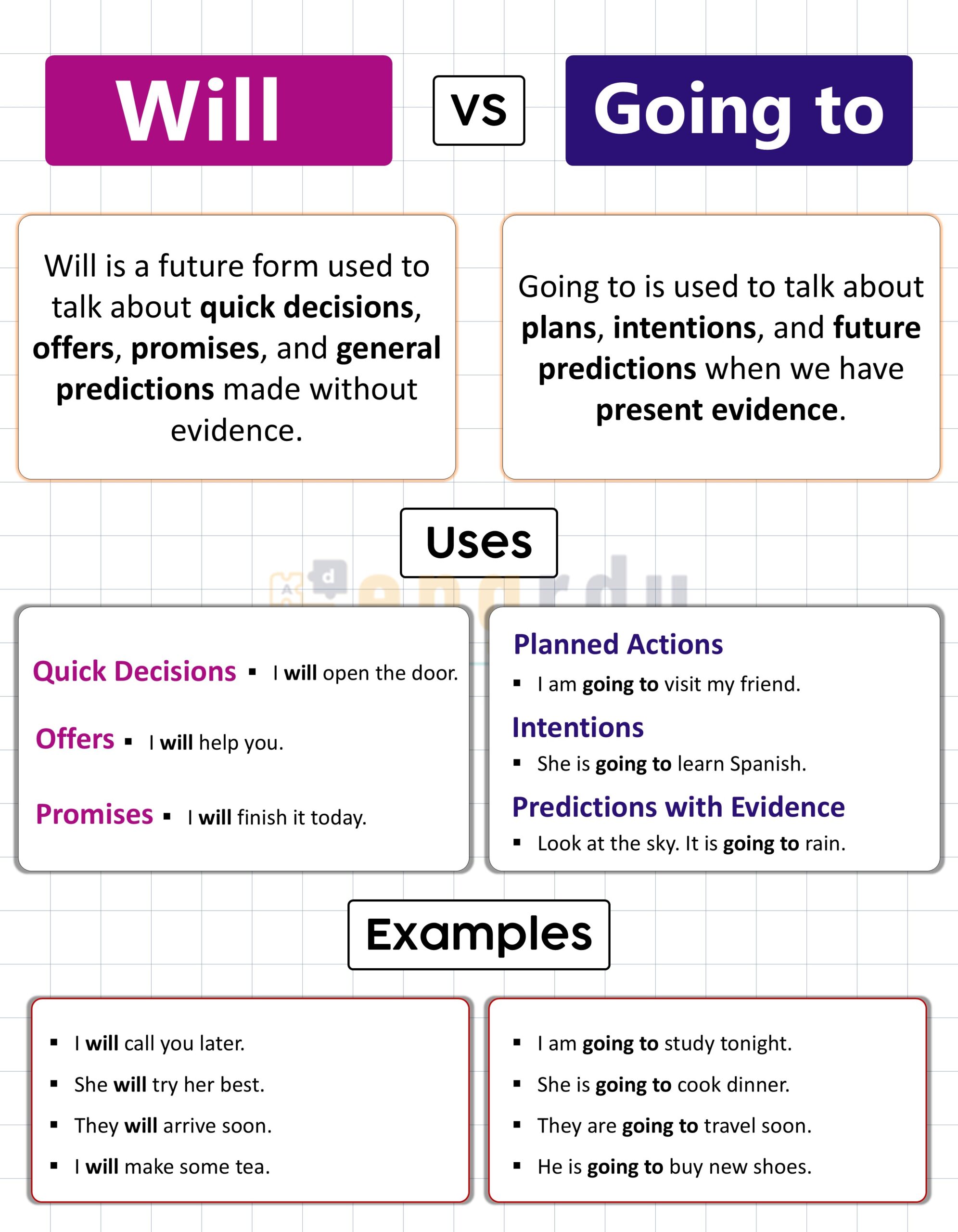
Will is a future form used to talk about quick decisions, offers, promises, and general predictions made without evidence.
Going To
Going to is used to talk about plans, intentions, and future predictions when we have present evidence.
Difference between Will and Going to
| Point of Difference | Will | Going To |
|---|---|---|
| Decision Time | Used for decisions made at the moment | Used for decisions planned earlier |
| Future Plan Strength | No clear plan | Clear plan or arrangement |
| Predictions | Prediction without evidence | Prediction with present evidence |
| Purpose / Meaning | Promises, offers, quick decisions | Intentions, planned actions |
| Structure | Subject + will + base verb | Subject + am/is/are + going to + base verb |
| Examples | I will help you. | I am going to visit my friend. |
| It will rain tomorrow. | Look at the sky. It is going to rain. |
Usage of Will
1. Quick Decisions
Used for quick decisions made at the moment of speaking.
I will open the door.
I will call him now.
2. Offers
Used for offers:
I will help you.
I will carry your bag.
3. Promises
Used for promises, offers, and strong commitments.
I will finish it today.
I will not forget.
4. General Predictions
Used for general predictions with no clear sign.
It will be sunny tomorrow.
People will enjoy the event.
Usage of Going To
1. Planned Actions
Used for decisions already planned before the moment of speaking.
I am going to visit my friend.
We are going to clean the room.
2. Intentions
Used for personal intentions (things you want to do).
She is going to learn Spanish.
They are going to start a project.
3. Predictions with Evidence
Used when there is present evidence.
Look at the sky. It is going to rain.
He is running fast. He is going to win.
4. Scheduled Personal Plans
I am going to start classes next week.
They are going to buy a new car.
Formal and Informal Usage
Formal Usage
Formal use appears in writing, professional speech, or polite statements.
Examples
- The company will announce the results tomorrow.
- We are going to review your request soon.
Informal Usage
Informal use appears in daily conversation.
Examples
- I will text you later.
- We are going to watch a film tonight.
Sentences with Will
- I will call you later.
- She will try her best.
- They will arrive soon.
- I will make some tea.
- He will finish his homework.
- We will join you.
- It will snow today.
- I will check the answer.
- She will read the book.
- I will turn off the lights.
- They will help us.
- He will move to a new flat.
- I will start tomorrow.
- She will buy a gift.
- It will be fine.
- We will wait here.
- I will send the email.
- They will see the doctor.
- He will clean the desk.
- I will explain it again.
Sentences with Going To
- I am going to study tonight.
- She is going to cook dinner.
- They are going to travel soon.
- He is going to buy new shoes.
- We are going to visit our aunt.
- I am going to clean my room.
- She is going to start a course.
- They are going to move house.
- He is going to fix the bike.
- I am going to watch a show.
- She is going to meet her teacher.
- We are going to plan a trip.
- They are going to open a shop.
- He is going to join the team.
- I am going to sleep early.
- She is going to write a story.
- They are going to paint the wall.
- He is going to practise piano.
- I am going to call my friend.
- We are going to start soon.
Will is used for quick decisions, offers, promises, and general predictions. Going to is used for plans, intentions, and predictions with evidence. Both forms talk about the future, but they show different levels of planning and certainty. Learning the difference helps you speak clearly and naturally in future situations.
FAQs about Will vs Going to
What is the meaning of will?
Will shows future actions such as decisions, promises, offers, and predictions.
What is the meaning of going to?
Going to shows future plans, intentions, and predictions based on evidence.
What is the difference between will and going to?
Will is for quick decisions, promises, and general predictions.
Going to is for planned actions, intentions, and predictions that have evidence.
When should I use will?
Use will when you decide at the moment, make a promise, offer help, or predict the future without evidence.
When should I use going to?
Use going to when you already have a plan, intention, or see something happening now.
What is an easy trick to remember the difference between will and going to?
Think of this:
Will = decision now.
Going to = plan before.
Can we use will and going to in formal writing?
Yes. Both forms can be used, but will is more common in formal communication.
Do both forms talk about the future?
Yes, both describe future actions but show different meanings.
Is going to stronger than will?
Yes, going to often shows stronger plans and clear intentions.
Read More