In this blog post, you will learn 100 scientific instruments names in English with their uses and pictures. Knowing these words helps you understand science lessons, follow experiments, and describe tools correctly. Learning scientific instruments improves your speaking, reading, writing, and listening skills. By practicing these terms, you can communicate confidently in school, labs, and everyday science discussions.
What Are Scientific Instruments?
Scientific instruments are special tools used in science. They help us:
- Measure temperature, weight, and length
- Observe tiny objects
- Test chemicals
- Study plants, animals, and space
For example, a thermometer measures temperature, and a microscope helps us see very small objects.
Why Learn Scientific Instruments Names?
Learning these vocabulary words helps you:
- Understand school science lessons
- Read textbooks with confidence
- Follow lab instructions correctly
- Improve academic English
- Prepare for exams
Now, let’s explore the main types of scientific instruments.
Laboratory Instruments Names
- Beaker – A glass container used to mix or heat liquids.
- Test Tube – A small glass tube for holding small amounts of liquid.
- Flask (Erlenmeyer Flask) – A container with a narrow neck for mixing chemicals.
- Tripod Stand – A three-legged stand used to hold equipment over a flame.
- Bunsen Burner – A gas burner used to heat substances.
- Measuring Cylinder – A tall container used to measure liquid volume.
- Dropper – A small tool used to add liquid drop by drop.
- Tongs – A tool used to hold hot objects.
- Spatula – Used to transfer solid chemicals.
- Funnel – Helps pour liquid into narrow containers.
Measuring Instruments Names
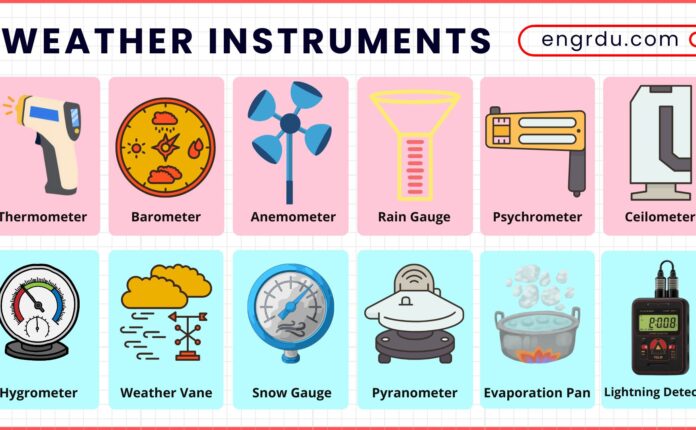
- Thermometer – Measures temperature.
- Balance (Weighing Scale) – Measures weight or mass.
- Ruler – Measures length.
- Stopwatch – Measures time.
- Spring Balance – Measures force or weight.
- Barometer – Measures air pressure.
- Hygrometer – Measures humidity (moisture in air).
- Vernier Caliper – Measures small lengths accurately.
- Micrometer – Measures very small thickness.
- Anemometer – Measures wind speed.
Physics Instruments Names
- Ammeter – Measures electric current.
- Voltmeter – Measures electric voltage.
- Galvanometer – Detects small electric currents.
- Electroscope – Detects electric charge.
- Dynamometer – Measures force or power.
- Spectrometer – Measures light properties.
- Seismograph – Records earthquakes.
- Oscilloscope – Shows electrical signals as waves.
Chemistry Instruments Names
- Distillation Apparatus – Separates liquids by heating.
- Burette – Measures liquid in titration experiments.
- Pipette – Transfers small amounts of liquid accurately.
- Condenser – Cools vapor into liquid.
- Crucible – Heats solid substances at high temperature.
- Evaporating Dish – Evaporates liquids.
- Litmus Paper – Tests acidity or alkalinity.
- pH Meter – Measures the pH level of a solution.
Biology Instruments Names
- Microscope – Observes tiny living things.
- Compound Microscope – Magnifies very small objects.
- Dissecting Kit – Tools used to cut and study organisms.
- Petri Dish – Grows bacteria or cells.
- Incubator – Keeps samples warm for growth.
- Centrifuge – Separates substances by spinning.
- Microtome – Cuts thin tissue slices.
- Hand Lens – A small magnifying glass.
Medical and Health Instruments Names
- Stethoscope – Listens to heart and lung sounds.
- Sphygmomanometer – Measures blood pressure.
- Medical Thermometer – Checks body temperature.
- Syringe – Injects medicine.
- X-ray Machine – Takes images of bones.
- Ultrasound Machine – Uses sound waves to see inside the body.
- ECG Machine – Records heart activity.
- Otoscope – Examines the ear.
Earth and Space Instruments Names
- Telescope – Observes stars and planets.
- Satellite – Collects data from space.
- Weather Station – Measures weather conditions.
- Rain Gauge – Measures rainfall.
- Compass – Shows direction.
- GPS Device – Finds exact location.
- Theodolite – Measures land angles.
- Globe – A model of Earth.
Optical Instruments Names
- Binoculars – Help see distant objects clearly.
- Periscope – Allows viewing from hidden positions.
- Camera – Captures images.
- Projector – Displays images on a screen.
- Magnifying Glass – Enlarges small objects.
Electrical and Electronic Instruments
- Multimeter – Measures voltage, current, and resistance.
- Transformer – Changes voltage levels.
- Signal Generator – Produces electronic signals.
- Power Supply – Provides electrical energy.
- Circuit Tester – Checks electrical circuits.
Environmental Instruments
- Sound Level Meter – Measures noise levels.
- Radiation Detector – Detects harmful radiation.
- Soil Moisture Meter – Measures water in soil.
- Lux Meter – Measures light intensity.
- Gas Analyzer – Detects gas concentration.
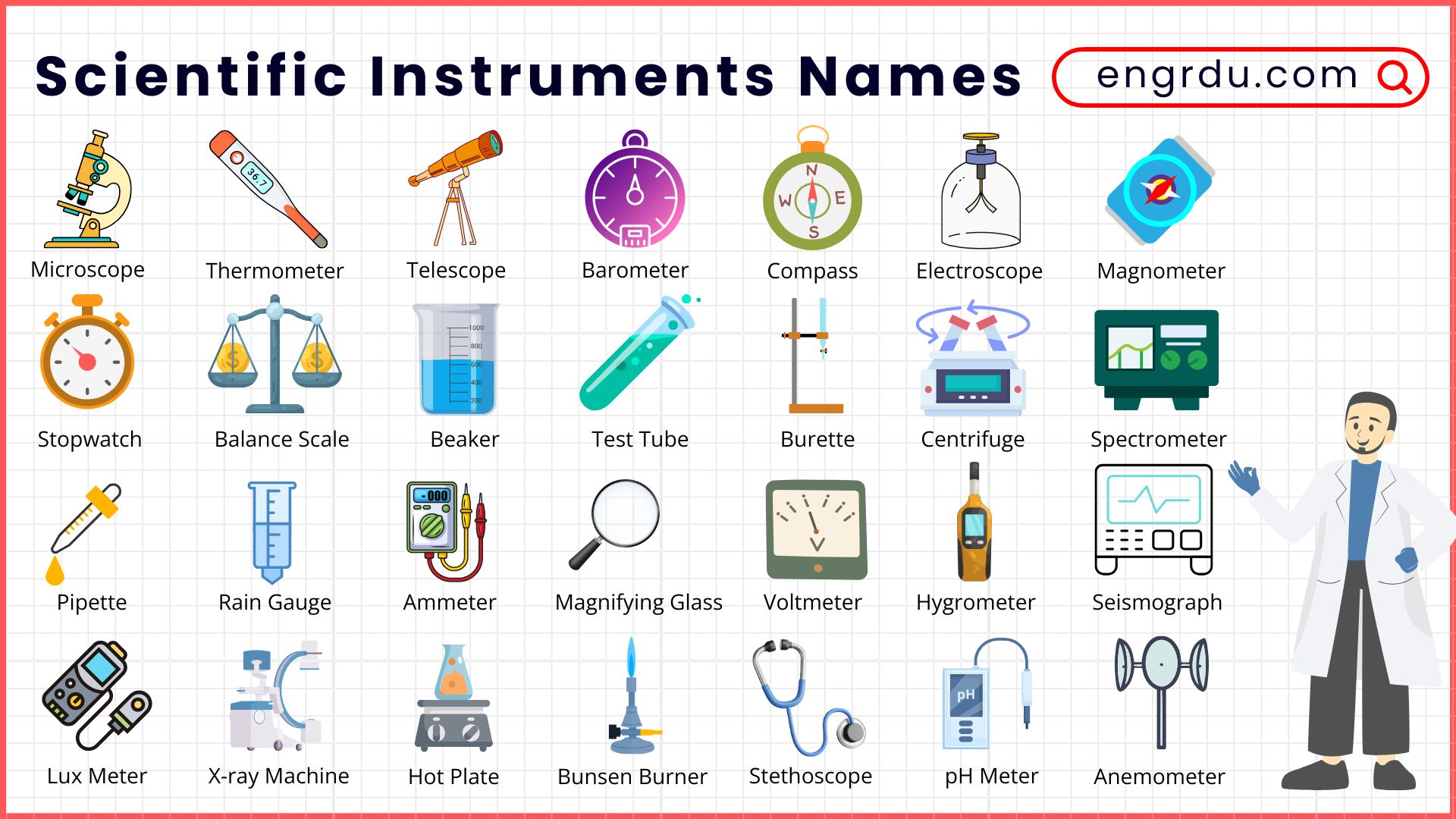
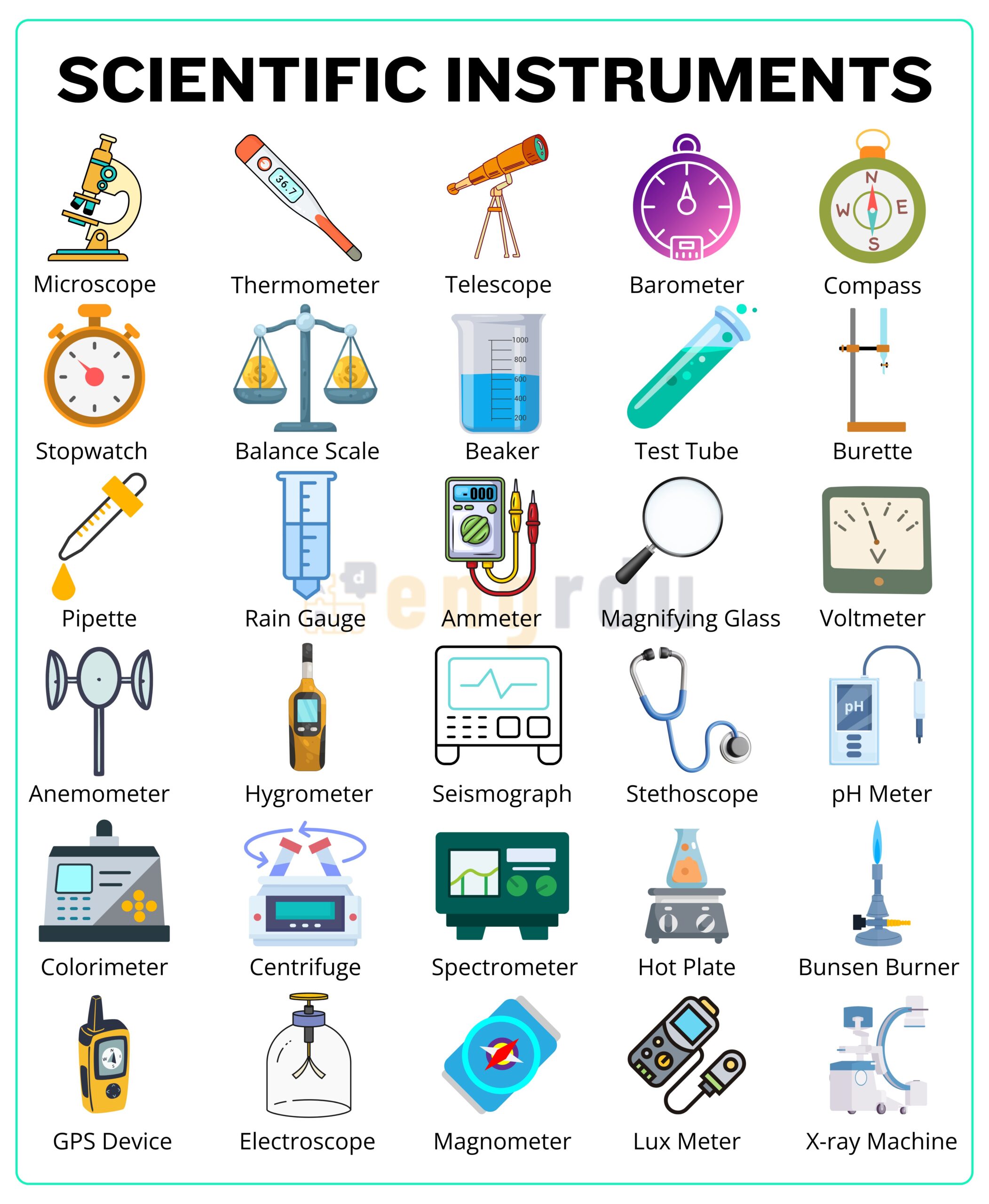
Scientific Instruments Names and Pictures
How to Remember Scientific Instruments
To learn faster:
- Group words by subject (biology, chemistry, physics).
- Use the word in a short sentence.
- Example: “The scientist used a microscope to study bacteria.”
- Revise 10–15 words daily.
- Connect each instrument with its function.
Practice makes vocabulary strong.
Conclusion
Learning 100 scientific instruments names in English with uses improves both your science knowledge and your English vocabulary. These words often appear in textbooks, exams, and real-life discussions.
Keep practicing. Review regularly. Use the words in context.
Frequently Asked Questions
What are scientific instruments?
Scientific instruments are tools used to observe, measure, and test things in science. They help scientists and students collect accurate data. Common examples include a microscope, thermometer, balance, and telescope.
What are some common scientific instruments used in schools?
Common school scientific instruments include a beaker, test tube, microscope, thermometer, ruler, and balance. Students use them to measure temperature, observe cells, mix chemicals, and record data.
What is the use of a microscope in scientific instruments?
A microscope is one of the most important scientific instruments. It magnifies very small objects such as cells, bacteria, and tiny organisms. Students use it in biology classes to study living things closely.
What is the difference between measuring instruments and laboratory instruments?
Measuring instruments, such as a thermometer, ammeter, and hygrometer, measure temperature, current, and humidity. Laboratory instruments, like a flask or crucible, help mix or heat substances.
Which scientific instruments measure weather and environment?
Weather and environmental scientific instruments include a rain gauge, barometer, anemometer, hygrometer, and thermometer. These tools measure rainfall, air pressure, wind speed, humidity, and temperature.
Related Articles