
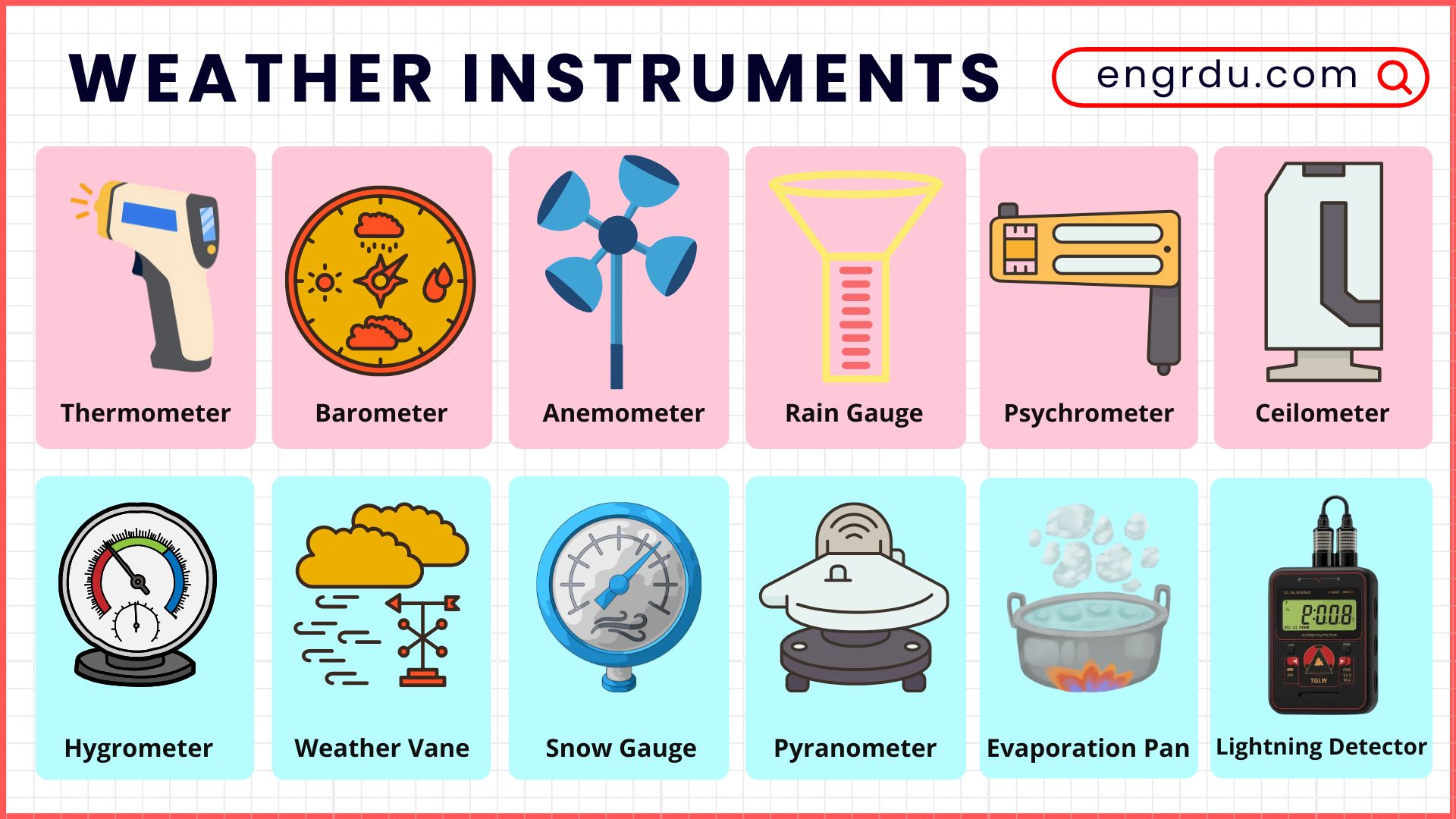

Weather instruments are tools and devices used to measure, observe, and record atmospheric conditions such as temperature, rainfall, air pressure, humidity, wind speed, and wind direction. Common examples include thermometers, barometers, hygrometers, anemometers, rain gauges, and wind vanes. Each instrument measures a specific weather element and helps meteorologists monitor atmospheric changes, prepare weather forecasts, and study climate patterns.
In this article, we explore weather instruments names in English with pictures and their uses. The list covers temperature-measuring devices, wind instruments, rainfall collectors, pressure gauges, humidity sensors, and other meteorological equipment. We explain what each instrument measures and how it is used, helping us recognize common weather tools and expand our English vocabulary related to weather and meteorology.
What Are Weather Instruments?
Weather instruments are devices used to measure and record weather conditions. Scientists, meteorologists, and weather observers use them to study the environment.
Different instruments measure different weather factors. Some measure temperature, others measure rainfall, wind speed, or atmospheric pressure. Using these tools, people can forecast weather, plan activities, and respond to natural events like storms or heatwaves.
Why Learning Weather Instruments Names Is Important
Learning the names of weather instruments has several benefits:
- Improves science and weather vocabulary
- Helps learners understand weather forecasts
- Supports reading science articles and reports
- Improves speaking and writing when discussing weather
- Strengthens listening skills for news or educational videos
Understanding these terms allows learners to communicate effectively about weather and climate topics.
Common Weather Instruments Names and Uses
Here are some important weather instruments and their functions:
- Thermometer – Measures air temperature.
- Barometer – Measures atmospheric pressure to predict storms or clear weather.
- Anemometer – Measures wind speed.
- Rain Gauge – Measures the amount of rainfall.
- Hygrometer – Measures humidity in the air.
- Weather Vane (Wind Vane) – Shows wind direction.
- Snow Gauge – Measures snowfall amount.
- Pyranometer – Measures solar radiation.
- Psychrometer – Measures relative humidity using dry and wet bulbs.
- Ceilometer – Measures cloud height in the sky.
- Evaporation Pan – Measures water evaporation from a surface.
- Lightning Detector – Detects and measures lightning strikes.
- Weather Balloon Instruments – Collect data on pressure, temperature, and humidity at high altitudes.
- Tide Gauge – Measures sea level changes, important in coastal weather studies.
- Anemograph – Records wind speed over time.
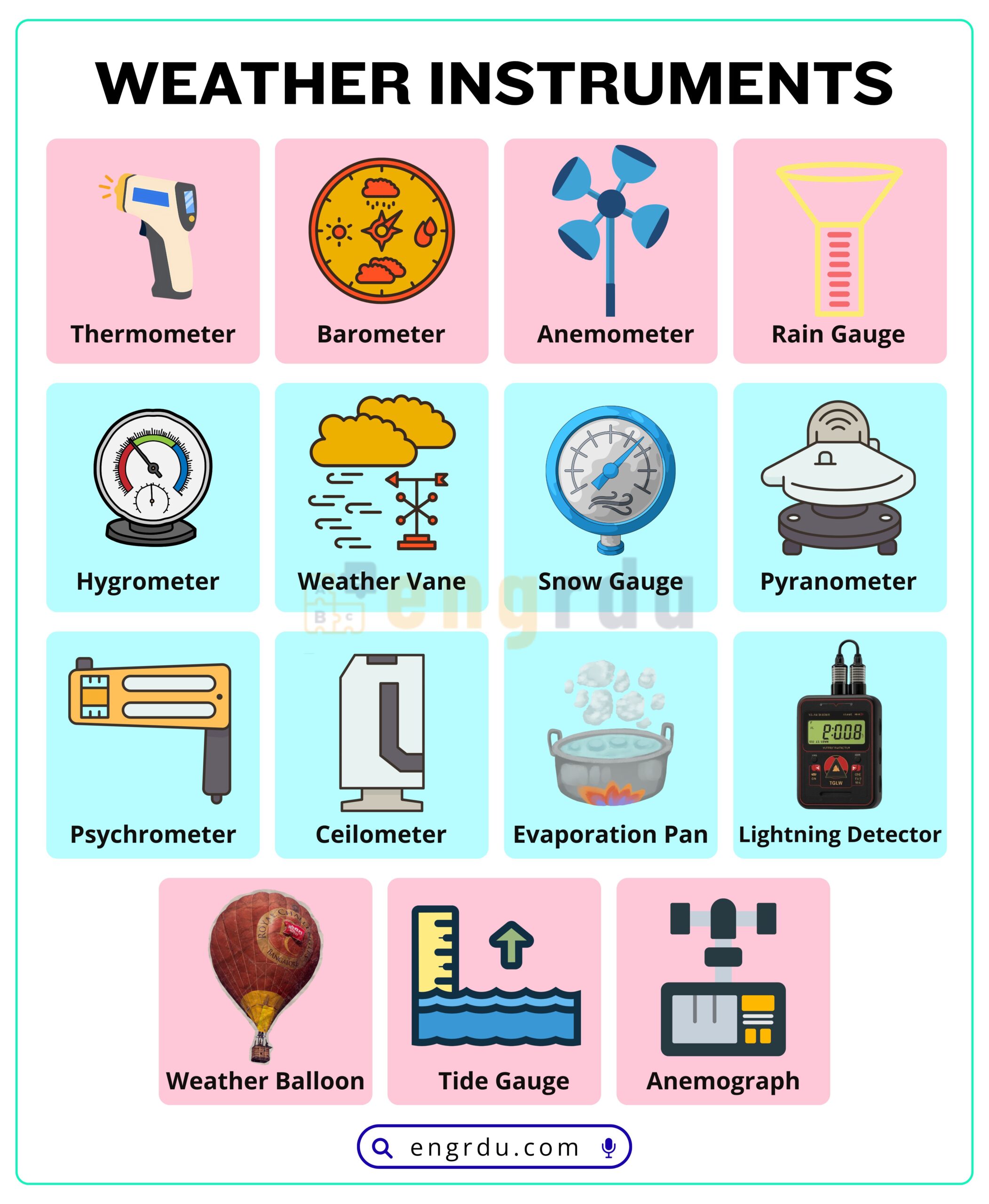
Weather Instruments Names with Pictures
Instruments Used to Measure Temperature
These instruments measure the temperature of the air, soil, and water. They help meteorologists monitor temperature changes and understand weather conditions.
- Thermometer – Measures air temperature.
- Soil Thermometer – Measures soil temperature.
- Oceanographic Thermometer – Measures ocean water temperature.
- Thermograph – Records temperature changes over time.
Instruments Used to Measure Atmospheric Pressure
These instruments measure the pressure exerted by the atmosphere. Changes in air pressure help meteorologists predict weather conditions, including approaching storms and rainfall.
- Barometer – Measures atmospheric pressure.
- Aneroid Barometer – Measures air pressure using a sealed metal chamber.
- Mercury Barometer – Measures atmospheric pressure using a column of mercury.
- Barograph – Records changes in atmospheric pressure over time.
Instruments Used to Measure Humidity
These instruments measure the amount of water vapor present in the air. They help meteorologists monitor moisture levels, estimate dew points, and understand the possibility of fog, clouds, and rainfall.
- Hygrometer – Measures humidity in the air.
- Psychrometer – Measures humidity using wet-bulb and dry-bulb temperatures.
- Hair Hygrometer – Measures air humidity using changes in human or synthetic hair.
- Dew Point Hygrometer – Measures the dew point of the air.
- Hygrograph – Records changes in air humidity over time.
Instruments Used to Measure Wind Speed
These instruments measure how fast the air moves. They help meteorologists monitor wind conditions, study storms, and assess potential risks from strong winds.
- Anemometer – Measures wind speed.
- Cup Anemometer – Measures wind speed using rotating cups.
- Propeller Anemometer – Measures wind speed using a rotating propeller.
- Hot-Wire Anemometer – Measures wind speed using the cooling effect of moving air.
- Sonic Anemometer – Measures wind speed and direction using ultrasonic sound waves.
- Anemograph – Records wind speed over time.
Instruments Used to Measure Wind Direction
These instruments show the direction from which the wind is blowing. They help meteorologists study wind patterns and understand how air moves across different regions.
- Wind Vane – Shows wind direction.
- Wind Sock – Indicates wind direction and provides an approximate idea of wind strength.
- Wind Direction Sensor – Measures and records wind direction.
- Wind Recorder – Records wind direction and changes over time.
Instruments Used to Measure Rainfall
These instruments measure the amount, intensity, and characteristics of rainfall. They help meteorologists monitor precipitation, study rainfall patterns, and assess flood risks.
- Rain Gauge – Measures the amount of rainfall.
- Tipping-Bucket Rain Gauge – Measures rainfall using a tipping-bucket mechanism.
- Weighing Rain Gauge – Measures rainfall by weighing collected precipitation.
- Optical Rain Gauge – Measures rainfall using changes in light caused by falling raindrops.
- Disdrometer – Measures the size, speed, and distribution of raindrops.
Instruments Used to Measure Snowfall
These instruments measure snowfall depth and the amount of water stored in accumulated snow. They help meteorologists monitor snow conditions and estimate the potential for snowmelt and flooding.
- Snow Gauge – Measures the amount of snowfall.
- Snowboard – Provides a flat surface for measuring fresh snow depth.
- Snow Depth Sensor – Measures the depth of accumulated snow.
- Snow Pillow – Measures the water equivalent of accumulated snow.
Instruments Used to Measure Solar Radiation and Sunshine
These instruments measure sunlight and solar energy reaching the Earth’s surface. They help meteorologists study sunshine duration, radiation levels, and their effects on temperature and climate.
- Pyranometer – Measures global solar radiation received on a surface.
- Pyrheliometer – Measures direct solar radiation.
- Sunshine Recorder – Records the duration of bright sunshine.
- Solarimeter – Measures solar radiation.
- Net Radiometer – Measures the difference between incoming and outgoing radiation.
Instruments Used to Measure Cloud Height and Conditions
These instruments detect clouds and measure the height of their bases. They help meteorologists monitor cloud cover, study cloud development, and support aviation weather forecasting.
- Ceilometer – Measures the height of cloud bases.
- Cloud Radar – Detects clouds and studies their movement and properties.
- Cloud Camera – Captures images of cloud cover and sky conditions.
- Laser Cloud-Height Sensor – Measures cloud height using laser light.
Instruments Used to Measure Visibility
These instruments measure how clearly objects can be seen through the atmosphere. They help monitor fog, haze, dust, and other conditions that reduce visibility, especially at airports and on roads.
- Visibility Meter – Measures the distance at which objects can be seen clearly.
- Transmissometer – Measures visibility by measuring the transmission of light through the atmosphere.
- Forward Scatter Visibility Meter – Estimates visibility by measuring light scattered by particles in the air.
Instruments Used to Detect Storms and Lightning
These instruments detect thunderstorms, lightning activity, and precipitation movement. They help meteorologists monitor severe weather and provide warnings about dangerous storms.
- Weather Radar – Detects precipitation and tracks storms.
- Doppler Radar – Measures the movement of precipitation to monitor storms and wind patterns.
- Lightning Detector – Detects lightning activity.
- Lightning Mapping Array – Detects and maps lightning discharges over a wide area.
Instruments Used to Observe Weather from Space
These instruments and satellites observe weather conditions from space. They help meteorologists monitor large cloud systems, tropical cyclones, storms, and changing weather patterns across the Earth.
- Weather Satellite – Observes clouds, storms, and weather patterns from space.
- Geostationary Satellite – Continuously monitors weather over the same region of Earth.
- Polar-Orbiting Satellite – Observes weather conditions across different parts of Earth.
- Satellite Radiometer – Measures electromagnetic radiation to monitor atmospheric and surface conditions.
Instruments Used to Measure Atmospheric Conditions at Different Heights
These instruments collect weather information from different layers of the atmosphere. They measure conditions such as temperature, humidity, air pressure, and wind to improve weather forecasting.
- Weather Balloon – Carries weather instruments into the atmosphere.
- Radiosonde – Measures atmospheric temperature, humidity, and pressure at different heights.
- Rawinsonde – Measures upper-air temperature, humidity, pressure, and wind conditions.
- Dropsonde – Measures atmospheric conditions while descending from an aircraft.
- Microwave Radiometer – Measures atmospheric temperature and moisture using microwave radiation.
Instruments Used to Measure Evaporation
These instruments measure how quickly water changes into water vapor and enters the atmosphere. They help meteorologists and agricultural researchers study water loss, atmospheric conditions, and irrigation requirements.
- Evaporimeter – Measures the rate of water evaporation.
- Atmometer – Measures the evaporative demand of the atmosphere.
- Class A Evaporation Pan – Measures water evaporation from an open pan.
- Piche Evaporimeter – Measures evaporation using a water-filled tube and an exposed paper surface.
Instruments Used to Measure Soil and Plant Conditions
These instruments measure soil moisture, soil temperature, and moisture on plant leaves. They help farmers monitor growing conditions, manage irrigation, and assess the effects of weather on crops.
- Soil Moisture Sensor – Measures the amount of water in soil.
- Soil Thermometer – Measures soil temperature.
- Leaf Wetness Sensor – Measures moisture on plant surfaces.
- Soil Water Tensiometer – Measures soil water tension to indicate how strongly water is held in soil.
Instruments Used to Measure Ocean and Water Conditions
These instruments measure water temperature, sea level, wave activity, and ocean salinity. They help scientists monitor ocean conditions, study marine weather, and understand interactions between oceans and the atmosphere.
- Weather Buoy – Measures weather and ocean conditions over water.
- Water Temperature Sensor – Measures the temperature of water.
- Wave Recorder – Measures the height and movement of ocean waves.
- Tide Gauge – Measures changes in sea level.
- Ocean Salinity Sensor – Measures the salt concentration of seawater.
Tips to Remember Weather-Instrument Names
Use pictures
Visuals help learners connect names with instrument shapes.
Group by purpose
Learn temperature, wind, and precipitation instruments separately.
Practice sentences
Example: The meteorologist checked the thermometer to know the temperature.
Review regularly
Repetition helps store vocabulary in long-term memory.
FAQs
What are weather instruments?
Weather instruments are tools used to observe and measure conditions like temperature, wind, rainfall, and humidity. They help scientists understand and forecast the weather.
What is a thermometer and how is it used?
A thermometer measures air temperature. Meteorologists, farmers, and students use it to know if it is hot, cold, or mild outside.
What does a barometer do in weather observation?
A barometer measures air pressure. It helps predict weather changes, like storms, rain, or clear skies.
How is an anemometer used to measure wind?
An anemometer measures wind speed. It shows how fast the wind is blowing, which is important for weather forecasts and safety warnings.
What is a rain gauge and how does it work?
A rain gauge measures rainfall. It collects water during rain to show how much has fallen over a period of time.
What weather instrument measures air pressure?
A barometer measures air pressure. Meteorologists use it to predict weather changes like storms, rain, or clear skies.
What instruments can you use to gather information about weather?
To gather weather information, you can use a thermometer for temperature, anemometer for wind speed, rain gauge for rainfall, hygrometer for humidity, and a barometer for air pressure.
Related Articles:
Conclusion
Weather instruments are essential for studying the environment. Each tool measures a specific aspect of weather, such as temperature, wind, rain, or humidity.
Learning weather instruments names and uses helps English learners improve science vocabulary and understand meteorology. By recognizing these instruments, learners can read weather reports, follow forecasts, and discuss weather topics confidently.

Leave a Comment