In this blog post, you will learn Instruments, their Names, and their Uses in English with pictures. Instruments are tools people use in music, science, medicine, engineering, and daily life. Knowing these words helps you understand school lessons, books, and real conversations. When you learn instrument vocabulary, you improve your speaking because you can describe tools correctly. You also strengthen reading and listening skills because you recognize these words in texts and discussions. In addition, your writing becomes more accurate when you use the right terms. Step by step, you will master important instrument names and understand how they are used in real situations. Keep reading to build strong and practical English vocabulary.
What Are Instruments?
Instruments are tools or devices people use to create music, measure things, perform surgery, or do scientific work. Learning instrument names in English helps you speak clearly, read confidently, and understand real-life conversations.
For example, you may hear:
- “She plays the violin.”
- “The doctor used a stethoscope.”
- “The lab needs a microscope.”
When you know these words, your English becomes stronger and more practical.
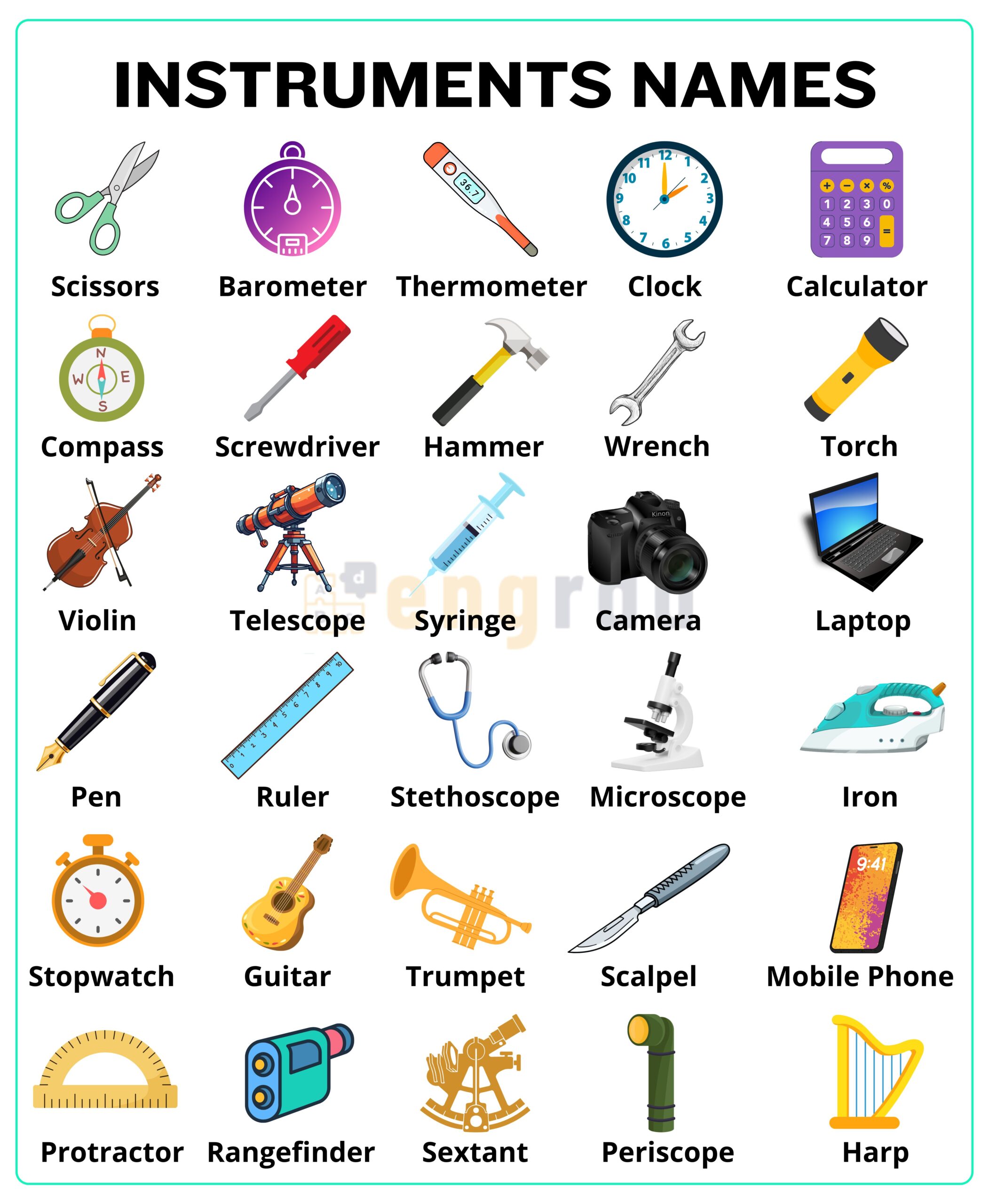
Why Learning Instrument Names Is Important
Learning instruments vocabulary helps you:
- Improve speaking and writing skills
- Understand school textbooks and news
- Talk about music, science, and health
- Expand topic-based vocabulary
- Build confidence in conversations
Instruments are common in daily life, school, hospitals, laboratories, and concerts. Therefore, this vocabulary is useful and practical.
Musical Instruments Names in English
Musical instruments produce sound and music. People play them in bands, orchestras, and concerts.
A. String Instruments
String instruments produce sound from vibrating strings.
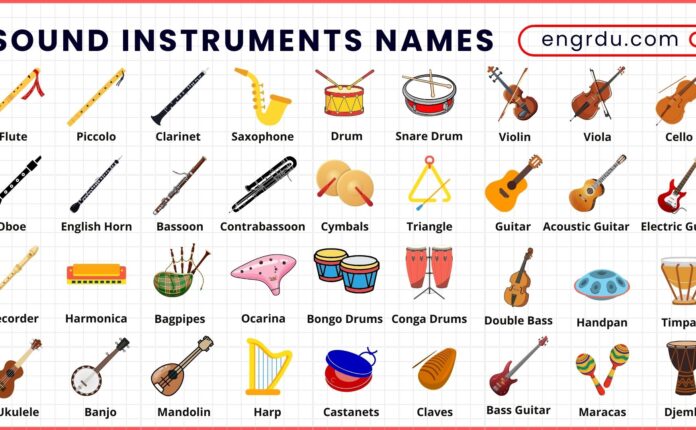
- Violin – A small wooden instrument played with a bow.
- Viola – Slightly larger than a violin, deeper sound.
- Cello – Large string instrument played while sitting.
- Double bass – The largest string instrument in an orchestra.
- Guitar – Popular instrument with six strings.
- Acoustic guitar – Guitar without electricity.
- Electric guitar – Guitar that needs an amplifier.
- Harp – Large triangular instrument with many strings.
- Ukulele – Small guitar-like instrument.
- Banjo – Round-bodied string instrument.
- Mandolin – Small instrument with paired strings.
- Sitar – Traditional Indian string instrument.
- Lute – Ancient string instrument.
- Zither – Flat instrument with many strings.
- Lyre – Old harp-like instrument.
B. Wind Instruments
Wind instruments produce sound when air moves through them.
- Flute – Long metal instrument played sideways.
- Piccolo – Small, high-pitched flute.
- Clarinet – Black woodwind instrument.
- Oboe – Double-reed wind instrument.
- Bassoon – Long wooden wind instrument.
- Saxophone – Brass instrument used in jazz.
- Trumpet – Small brass instrument with three valves.
- Trombone – Brass instrument with a slide.
- Tuba – Large, deep-sounding brass instrument.
- French horn – Curved brass instrument.
- Harmonica – Small mouth instrument.
- Accordion – Instrument with keys and bellows.
- Bagpipes – Air-filled traditional instrument.
- Recorder – Simple wooden flute.
- Pan flute – Instrument made of pipes.
- Cornet – Similar to trumpet.
- Didgeridoo – Long wooden wind instrument.
- Ocarina – Small clay wind instrument.
- Melodica – Keyboard wind instrument.
- Shawm – Early wind instrument.
C. Percussion Instruments
Percussion instruments produce sound when hit or shaken.
- Drum – Basic percussion instrument.
- Snare drum – Small drum with sharp sound.
- Bass drum – Large, deep drum.
- Cymbals – Two metal plates hit together.
- Triangle – Metal instrument shaped like a triangle.
- Tambourine – Hand drum with metal jingles.
- Xylophone – Wooden bars played with sticks.
- Marimba – Large wooden keyboard percussion.
- Bongo drums – Two small connected drums.
- Conga – Tall hand drum.
- Castanets – Small hand percussion pieces.
- Gong – Large hanging metal disc.
- Timpani – Kettle-shaped drum.
- Chimes – Hanging metal tubes.
- Claves – Two wooden sticks.
- Wood block – Hollow wooden instrument.
- Shaker – Instrument you shake.
- Tabla – Pair of Indian drums.
- Djembe – African hand drum.
- Steel drum – Metal drum from the Caribbean.
D. Keyboard Instruments
Keyboard instruments have keys.
- Piano – Popular keyboard instrument.
- Grand piano – Large concert piano.
- Upright piano – Smaller home piano.
- Keyboard – Electronic piano.
- Organ – Instrument used in churches.
- Pipe organ – Large air-powered organ.
- Harpsichord – Early keyboard instrument.
- Clavichord – Soft-sounding keyboard.
- Synthesizer – Electronic sound instrument.
- Digital piano – Electronic piano with realistic sound.
Scientific and Laboratory Instruments
These instruments are used in schools and research labs.
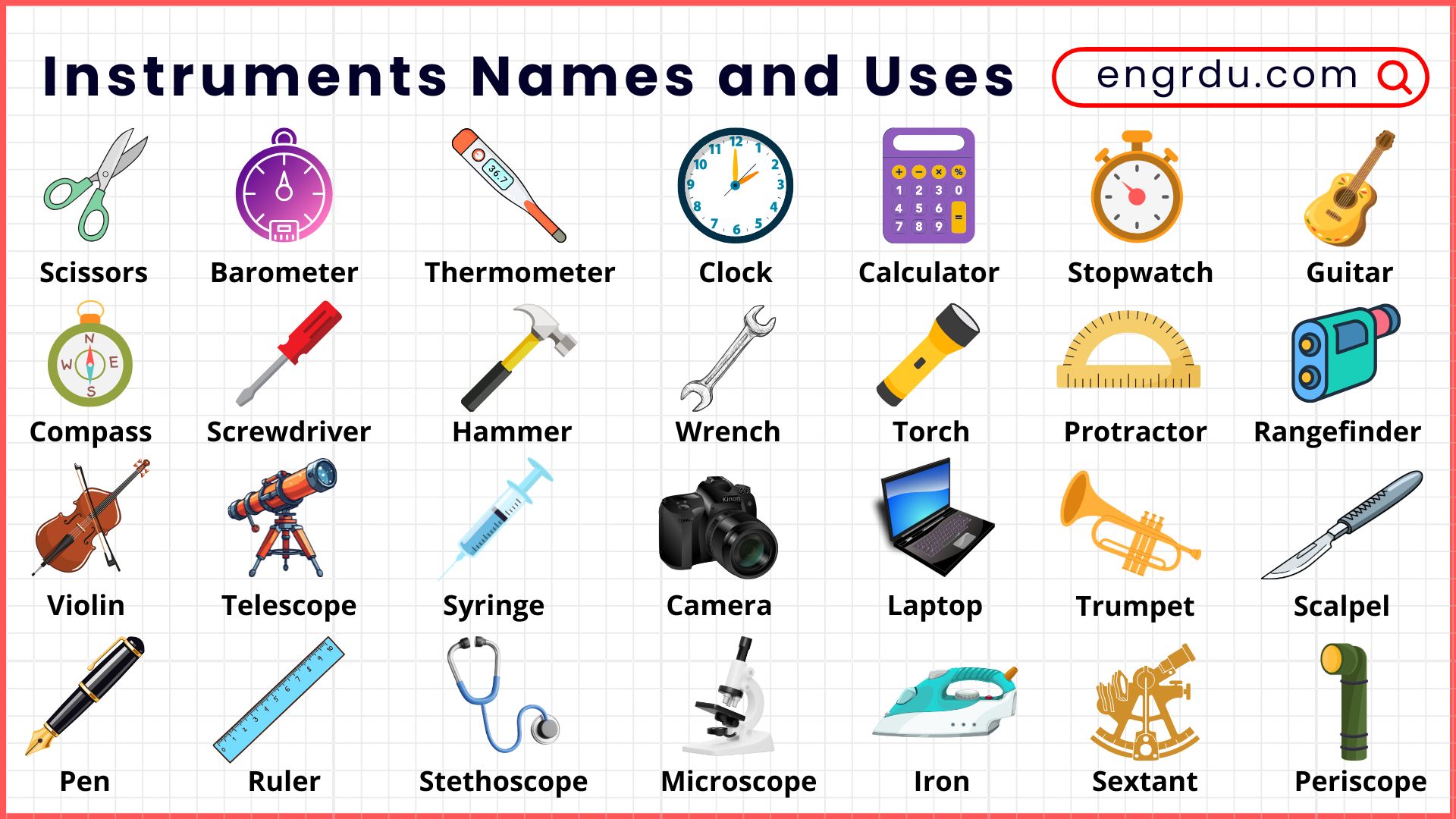
- Microscope – Makes tiny objects look larger.
- Telescope – Helps see distant objects.
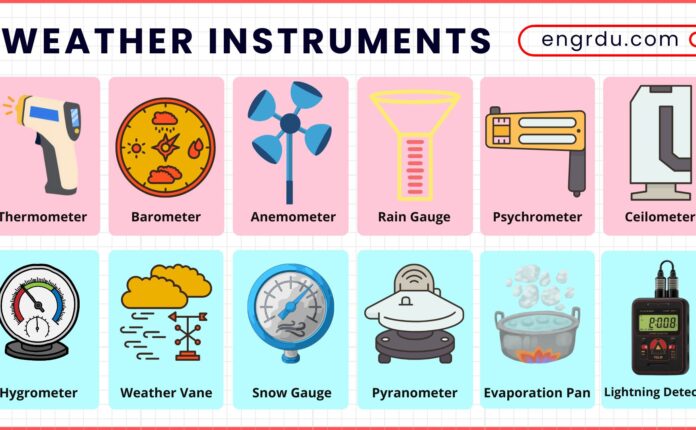
- Thermometer – Measures temperature.
- Barometer – Measures air pressure.
- Hygrometer – Measures humidity.
- Beaker – Glass container for mixing liquids.
- Test tube – Small glass tube for experiments.
- Bunsen burner – Gas burner for heating substances.
- Balance scale – Measures weight.
- Graduated cylinder – Measures liquid volume.
- Voltmeter – Measures electrical voltage.
- Ammeter – Measures electric current.
- Ohmmeter – Measures electrical resistance.
- pH meter – Measures acidity or alkalinity.
- Spectrometer – Studies light and materials.
- Centrifuge – Separates substances by spinning.
- Calorimeter – Measures heat energy.
- Stopwatch – Measures time accurately.
- Magnetometer – Measures magnetic force.
- Geiger counter – Detects radiation.
Medical Instruments
Doctors and nurses use these tools in hospitals and clinics.
- Stethoscope – Listens to heart and lungs.
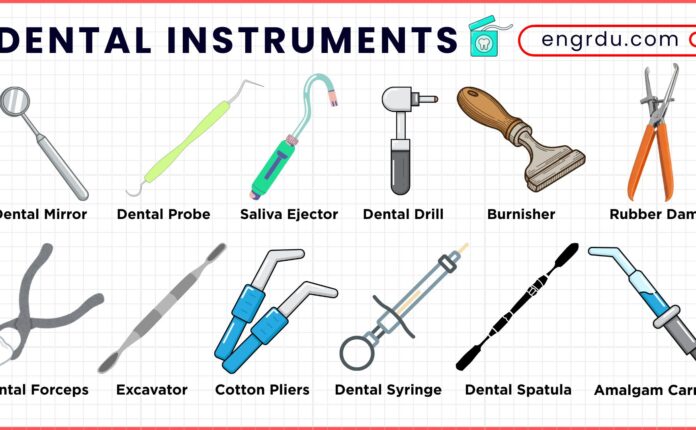
- Syringe – Gives medicine or injections.
- Scalpel – Small sharp knife for surgery.
- Forceps – Holds small objects during surgery.
- Otoscope – Examines the ears.
- Ophthalmoscope – Checks the eyes.
- Reflex hammer – Tests body reflexes.
- Thermometer (medical) – Checks body temperature.
- Blood pressure monitor – Measures blood pressure.
- Glucometer – Measures blood sugar.
- Defibrillator – Restarts the heart.
- Surgical scissors – Cuts tissue or bandages.
- Retractor – Holds open a surgical area.
- Needle holder – Holds surgical needles.
- Pulse oximeter – Measures oxygen level.
- Endoscope – Looks inside the body.
- Speculum – Opens body cavities for examination.
- Tongue depressor – Holds the tongue down.
- Suction pump – Removes fluids during surgery.
- Thermal scanner – Detects body heat.
Measuring Instruments
These tools measure length, size, speed, or quantity.
- Ruler – Measures straight lines.
- Tape measure – Flexible measuring tool.
- Caliper – Measures thickness or diameter.
- Micrometer – Measures very small distances.
- Weighing scale – Measures weight.
- Speedometer – Shows vehicle speed.
- Altimeter – Measures height above sea level.
- Anemometer – Measures wind speed.
- Protractor – Measures angles.
- Meter – Measures electricity or gas usage.
- Pressure gauge – Measures pressure.
- Flow meter – Measures liquid flow rate.
- Depth gauge – Measures depth.
- Lux meter – Measures light intensity.
- Sound level meter – Measures noise levels.
- Tachometer – Measures rotation speed.
- Odometer – Records distance traveled.
- Rain gauge – Measures rainfall.
- Hydrometer – Measures liquid density.
- Chronometer – Accurate timekeeping device.
Drawing and Technical Instruments
Students, architects, and engineers use these tools.
- Drawing compass – Draws circles.
- Divider – Measures and transfers distances.
- T-square – Draws straight horizontal lines.
- Set square – Draws angles.
- Drafting board – Surface for technical drawing.
- French curve – Draws smooth curves.
- Scale ruler – Measures drawings precisely.
- Stencil – Template for shapes or letters.
- Technical pen – Fine pen for precise lines.
- Eraser shield – Protects areas while erasing.
- Template ruler – Has ready-made shapes.
- Plotter – Prints technical drawings.
- Laser level – Creates straight light lines.
- Angle finder – Measures angles in construction.
- Digital caliper – Electronic measuring tool.
Engineering and Industrial Instruments
Factories and workshops use these instruments.
- Torque wrench – Tightens bolts correctly.
- Soldering iron – Melts metal for joining wires.
- Multimeter – Measures voltage, current, and resistance.
- Clamp meter – Measures electric current safely.
- Oscilloscope – Displays electrical signals.
- Drill press – Drills accurate holes.
- Lathe machine – Shapes metal or wood.
- Milling machine – Cuts and shapes materials.
- Pressure regulator – Controls gas pressure.
- Boiler gauge – Monitors boiler pressure.
- Thermal camera – Detects heat differences.
- Vernier caliper – Measures precise dimensions.
- Load cell – Measures force or weight.
- Gas detector – Detects harmful gases.
- Voltage tester – Checks electric power.
Navigation and Weather Instruments
These tools help with direction and climate study.
- Compass – Shows direction (north, south, east, west).
- GPS device – Shows location using satellites.
- Sextant – Measures angle between objects.
- Weather vane – Shows wind direction.
- Wind sock – Indicates wind speed and direction.
- Marine chronometer – Accurate sea clock.
- Radar – Detects objects using radio waves.
- Sonar – Detects objects underwater.
- Seismograph – Records earthquakes.
- Thermograph – Records temperature changes.
Optical Instruments
These instruments use lenses or light.
- Magnifying glass – Enlarges small objects.
- Binoculars – Helps see distant objects clearly.
- Camera – Captures images.
- Projector – Displays images on a screen.
- Periscope – Views objects from hidden positions.
- Night vision device – Helps see in the dark.
- Laser pointer – Produces a narrow light beam.
- Optical lens – Focuses light.
- Rangefinder – Measures distance with light.
- Fiber optic scope – Uses light for viewing inside spaces.
Safety and Monitoring Instruments
These instruments protect people and monitor systems.
- Smoke detector – Detects smoke.
- Fire alarm panel – Controls fire alarms.
- Carbon monoxide detector – Detects harmful gas.
- Radiation monitor – Checks radiation levels.
- Breathalyzer – Measures alcohol level in breath.
- Metal detector – Finds hidden metal objects.
- Security scanner – Scans bags or people.
- Surveillance camera – Records video for safety.
- Motion sensor – Detects movement.
- Temperature sensor – Monitors heat levels.
Smart Learning Tips
- Study 10–15 words daily.
- Write simple example sentences.
- Group words by category.
- Review weekly for better memory.
When you learn practical vocabulary like instrument names, your English becomes clearer, stronger, and more confident.
Quick Review: What You Learned
In this article, you learned:
- 165 instruments and their names in English
- Musical, medical, scientific, and technical tools
- Clear meanings for each word
- Practical vocabulary for real-life use
Now you can say:
- “He plays the trumpet.”
- “The scientist used a microscope.”
- “The doctor checked my blood pressure.”
FAQs
What are instruments?
Instruments are tools or devices used to perform a specific task. They can measure, cut, observe, test, or produce sound. In English vocabulary, instrument names help learners describe equipment used in science labs, hospitals, workshops, and daily life situations accurately and confidently.
How many musical instruments are there?
There is no exact number of musical instruments in the world. Different cultures have created thousands of instruments over time. In English learning materials, students usually study 50 to 200 common musical instruments. The number depends on how detailed the classification system is.
What are some common medical instruments and their uses?
Common medical instruments include a stethoscope (to listen to the heart), a syringe (to give injections), a thermometer (to measure body temperature), and a blood pressure monitor (to check blood pressure). Knowing these names helps learners understand health-related conversations.
What are common laboratory instruments students should know?
Important laboratory instruments include a microscope, test tube, beaker, graduated cylinder, and Bunsen burner. Students often see these in science classes. Understanding these terms supports reading comprehension and helps learners follow classroom instructions correctly.
What are the different types of musical instruments?
Musical instruments are usually grouped into four main types: string instruments, wind instruments, percussion instruments, and keyboard instruments. Some systems also include electronic instruments as a separate group. These categories help learners understand how instruments produce sound.
What are musical instruments?
Musical instruments are devices used to produce sound and create music. People play them by blowing air, striking, shaking, or vibrating strings. Examples include the piano, guitar, drum, and flute. Each instrument produces a unique sound and plays a different role in music.
Why is learning the names of different musical instruments important?
Learning musical instrument names improves vocabulary and communication skills. It helps students talk about music classes, concerts, and hobbies confidently. Knowing correct instrument terms also supports reading comprehension and listening skills when discussing bands, orchestras, or cultural traditions.
Related Articles