Learning antonyms in English helps you understand the opposite meanings of words, which improves your vocabulary, writing, and speaking skills. In this Vocabulary lesson, you will explore 100 important antonyms along with examples to see how they are used in sentences. Using antonyms correctly makes your communication clearer and more precise. In this blog post, you will discover 100 important English antonyms with examples to practice and use confidently in daily conversations.
What Are Antonyms in English?
Antonyms are words that have opposite meanings.
For example:
- Hot ↔ Cold
- Big ↔ Small
When you learn antonyms, you understand meaning better and express ideas more clearly.
Why Antonyms Are Important for English Learners
Learning important antonyms in English helps you:
- Build strong vocabulary
- Understand texts faster
- Speak more naturally
- Write with more clarity
100 Important Antonyms in English
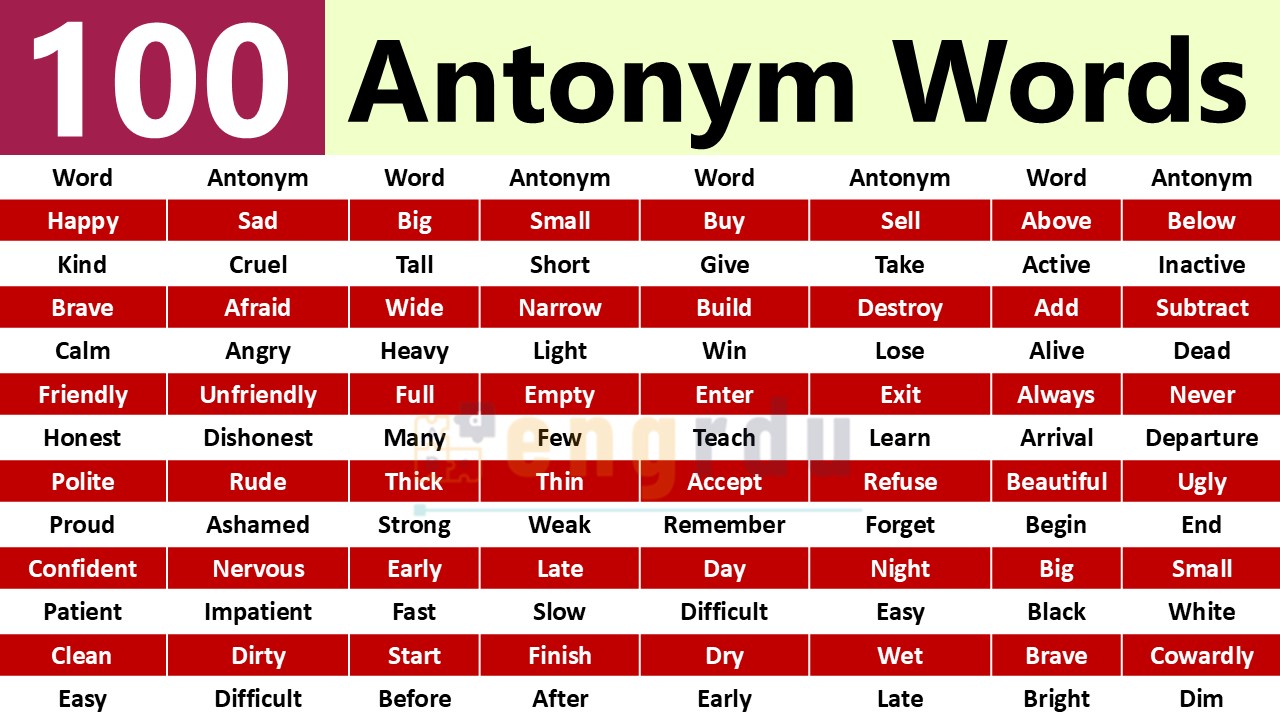
Here’s the list of 100 very important and daily used English words with their antonyms and use in sentences. Here, you will see a new and fresh method to learn and easily memorise these daily used antonym words along with their examples in sentences.
Size & Quantity Related Words with Antonyms
| Word | Antonym | Example |
|---|---|---|
| Big | Small | The house is big, but the garden is small. |
| Long | Short | The film was long, but the trailer was short. |
| Tall | Short | He is tall, but his brother is short. |
| Wide | Narrow | The road is wide, but the path is narrow. |
| Heavy | Light | The bag is heavy, but the box is light. |
| Full | Empty | The glass is full, now it is empty. |
| Many | Few | She has many books, but few toys. |
| Thick | Thin | The book is thick, the paper is thin. |
| Deep | Shallow | The pool is deep, the water near the edge is shallow. |
| Strong | Weak | He feels strong today, not weak. |
Time & Speed Related Words with Antonyms
| Word | Antonym | Example |
|---|---|---|
| Early | Late | I arrived early, she came late. |
| Fast | Slow | The train is fast, the bus is slow. |
| Start | Finish | We start now and finish later. |
| Before | After | Wash your hands before dinner, not after. |
| Always | Never | He always helps, she never lies. |
| Day | Night | I work in the day, I rest at night. |
| First | Last | She was first in line, he was last. |
| Old | New | The phone is old, the laptop is new. |
| Quick | Delayed | The reply was quick, the payment was delayed. |
| Soon | Late | I will come soon, not late. |

Feelings & Personality Related Words with Antonyms
| Word | Antonym | Example |
|---|---|---|
| Happy | Sad | She feels happy today, not sad. |
| Kind | Cruel | The teacher is kind, not cruel. |
| Brave | Afraid | He is brave, not afraid. |
| Calm | Angry | Stay calm, do not get angry. |
| Friendly | Unfriendly | She is friendly, not unfriendly. |
| Honest | Dishonest | He is honest, not dishonest. |
| Polite | Rude | The boy is polite, not rude. |
| Proud | Ashamed | He felt proud, not ashamed. |
| Confident | Nervous | She is confident, not nervous. |
| Patient | Impatient | Be patient, not impatient. |
Quality & Condition Related Words with Antonyms
| Word | Antonym | Example |
|---|---|---|
| Clean | Dirty | The room is clean, not dirty. |
| Easy | Difficult | The test was easy, not difficult. |
| Safe | Dangerous | This place is safe, not dangerous. |
| Cheap | Expensive | The bag is cheap, not expensive. |
| Bright | Dark | The room is bright, not dark. |
| Smooth | Rough | The road is smooth, not rough. |
| Soft | Hard | The pillow is soft, the floor is hard. |
| Wet | Dry | The clothes are wet, not dry. |
| Correct | Wrong | Your answer is correct, not wrong. |
| Clear | Confusing | The rules are clear, not confusing. |

Actions & States Related Antonyms Words
| Word | Antonym | Example |
|---|---|---|
| Open | Close | Please open the door, do not close it. |
| Push | Pull | Push the cart, do not pull it. |
| Buy | Sell | I buy fruit, he sells it. |
| Give | Take | Please give help, do not take too much. |
| Build | Destroy | They build houses, not destroy them. |
| Win | Lose | We win today, not lose. |
| Enter | Exit | Please enter here, exit there. |
| Teach | Learn | I teach English, you learn it. |
| Accept | Refuse | I accept the offer, not refuse it. |
| Remember | Forget | Remember your keys, do not forget them. |
How to Use Antonyms in Sentences
To use antonyms correctly:
- Compare two ideas
- Show contrast
- Make your meaning clear
Example:
The exam was easy for her but difficult for him.
Check Your Understanding by Solving Antonyms Worksheets
100 Antonym Words PDF


Get the free PDF of these 100 Antonym Words:
100 Antonyms Words with Examples PDF
Summary on Antonyms Words
- Antonyms are words with opposite meanings.
- Learning 100 important antonyms in English helps you speak, read, and write better.
- Use antonyms to compare ideas and show contrast.
- Practice them in short sentences every day.
FAQs about 100 Antonyms in English
What are the Antonyms Words?
Antonym words are words that have opposite meanings. For example, big is the antonym of small, and hot is the antonym of cold. In “100 Important Antonyms in English with Examples,” you learn how opposite words help express contrast and clear meaning in English.
What are the 10 Examples of Synonyms and Antonyms?
Here are 10 pairs showing both synonyms and antonyms:
- Big – Large (synonyms), Big – Small (antonyms)
- Fast – Quick, Fast – Slow
- Happy – Glad, Happy – Sad
- Easy – Simple, Easy – Difficult
- Begin – Start, Begin – Finish
- Bright – Shiny, Bright – Dark
- Clean – Tidy, Clean – Dirty
- Strong – Powerful, Strong – Weak
- Buy – Purchase, Buy – Sell
- Safe – Secure, Safe – Dangerous
What are the 10 Antonyms Words with Examples?
Here are 10 important antonyms in English with examples:
- Hot – Cold: The soup is hot, but the drink is cold.
- Big – Small: The dog is big, the cat is small.
- Fast – Slow: The car is fast, the bike is slow.
- Happy – Sad: She feels happy today, not sad.
- Easy – Difficult: The task is easy, not difficult.
- Open – Close: Please open the window, then close it.
- Clean – Dirty: The room is clean, not dirty.
- Early – Late: I arrived early, he came late.
- Strong – Weak: He is strong, not weak.
- Buy – Sell: I buy fruit, they sell fruit.
What is the difference between Synonyms and Antonyms?
Synonyms are words that have the same or similar meanings, such as big and large. Antonyms are words with opposite meanings, such as big and small. In “100 Important Antonyms in English with Examples,” the focus is on learning opposite word pairs to improve understanding and expression.
Why learning Antonyms is Important in English?
Learning antonyms is important because it helps you understand meaning clearly, compare ideas, and speak with accuracy. When you know both a word and its opposite, you can explain thoughts better in writing and conversation. That is why studying “100 Important Antonyms in English with Examples” helps learners build strong, balanced vocabulary.
How can I practise the 100 Important Antonyms in English with Examples?
You can practise by making short sentences, comparing two ideas, and using each pair in daily speech. For example: The test was easy for me but difficult for him. Regular practice with the 100 important antonyms in English helps you master contrast and meaning quickly.
Read More