
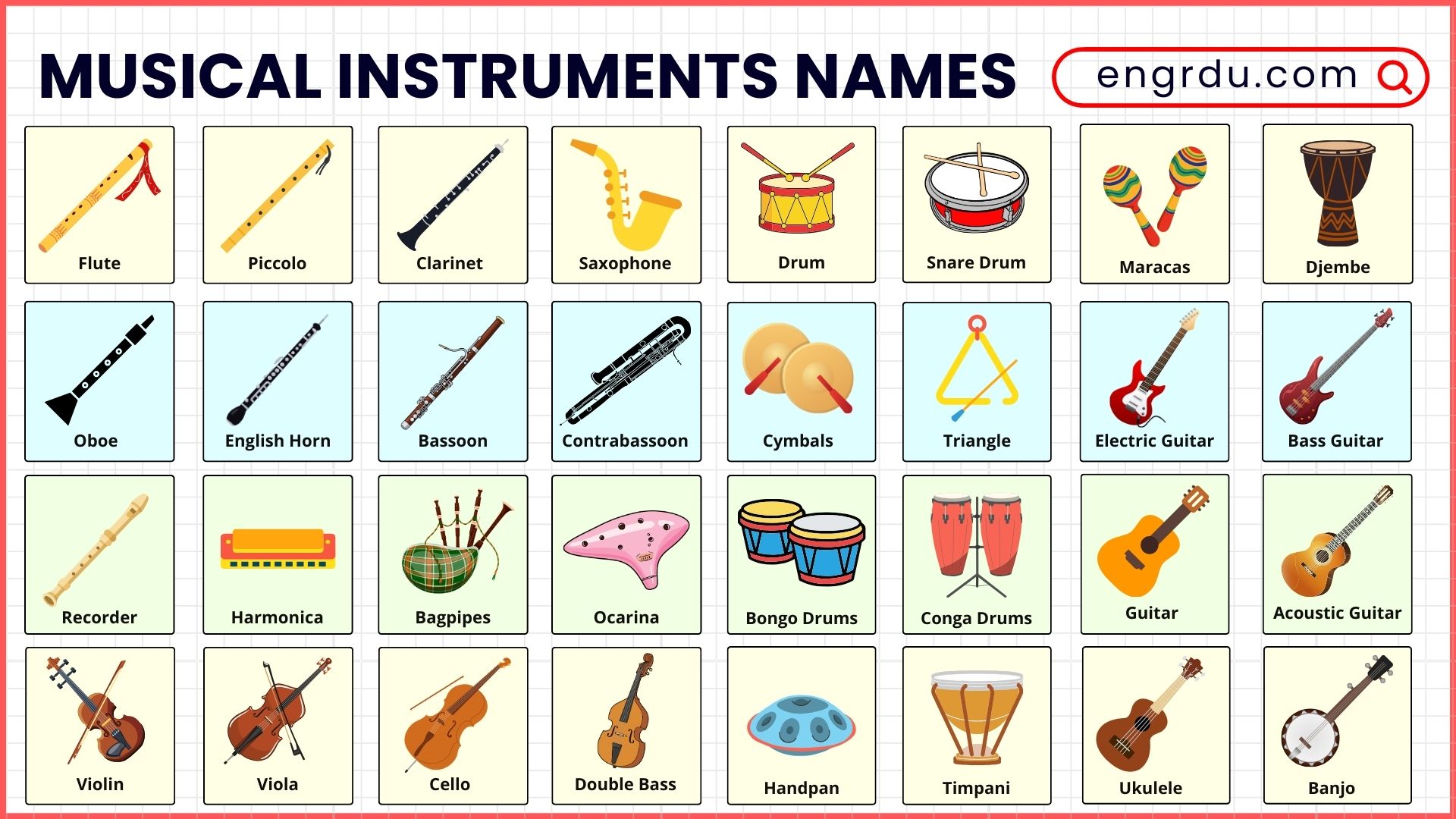

In this blog post, you will learn the names of 100+ musical instruments, including their types, uses, and pictures. Musical instruments are objects people use to make sounds, like a guitar, piano, or drum. Knowing these words is very helpful for English learners because it lets you understand conversations about music, school lessons, and songs. You will also learn how to describe instruments, how they are played, and what sounds they make. Studying musical instruments vocabulary improves your speaking, reading, writing, and listening skills. With these words, you can confidently talk about music, follow instructions, and enjoy learning English at the same time.
What Are Musical Instruments?
A musical instrument is an object people use to produce musical sounds. Musicians play instruments by striking, blowing, shaking, or pressing them. Each instrument creates a unique sound, and different cultures use different instruments in their music.
For example:
- A guitar creates sound when a player plucks its strings.
- A drum makes sound when someone hits it.
- A flute produces sound when a musician blows air through it.
Because these words appear often in music lessons, films, and conversations, they are useful vocabulary for English learners.
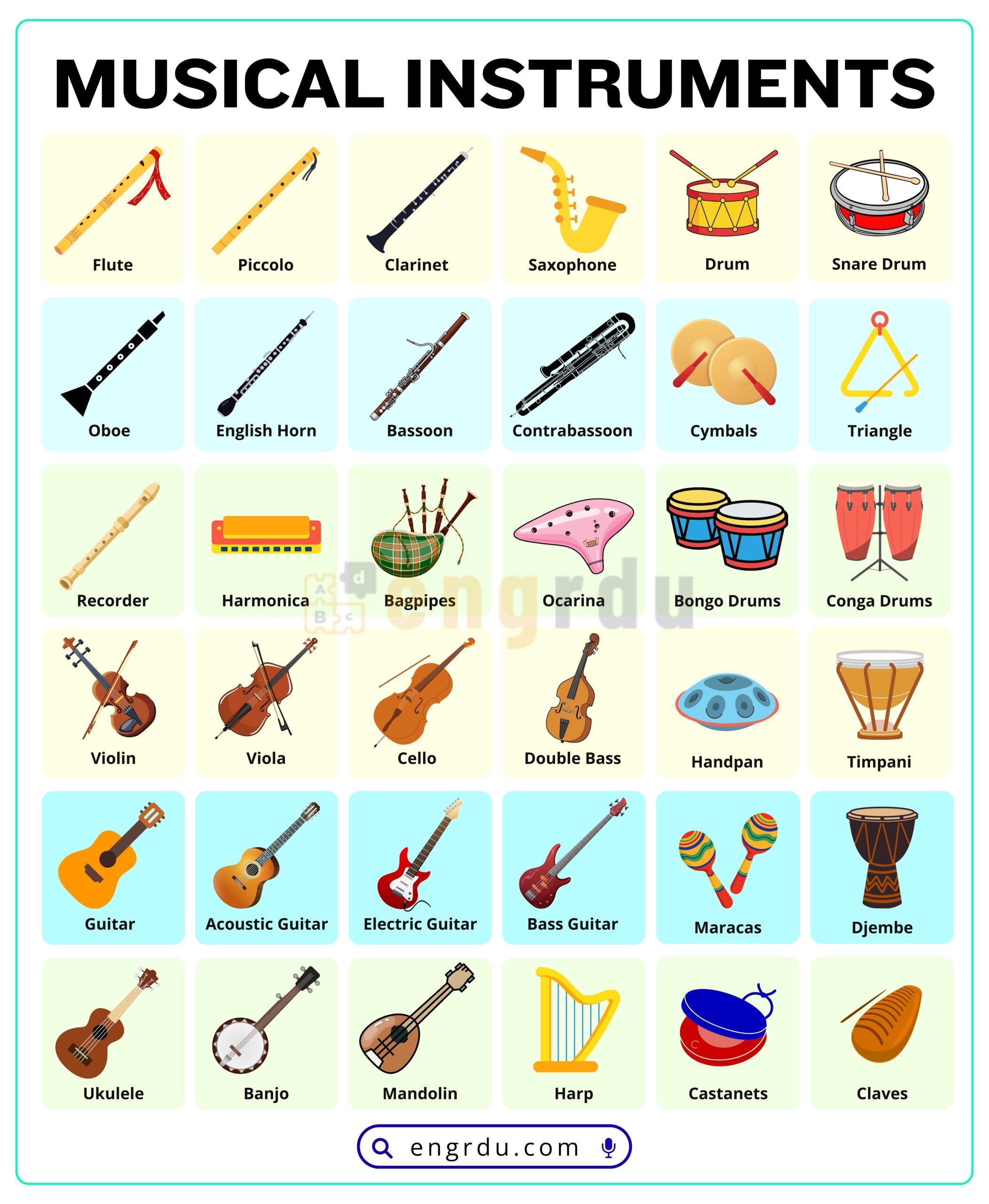
Musical Instruments Name and Uses
Why Learning Musical Instrument Names Is Important
Learning musical instrument vocabulary helps learners in many ways.
- It improves listening comprehension when hearing music discussions.
- It strengthens speaking skills when describing songs or performances.
- It helps learners understand school lessons about music and culture.
- It builds general English vocabulary used in daily life.
In addition, these words often appear in stories, movies, and online content.
Types of Musical Instruments Names in English
In this section, you will discover a complete list of over 100 musical instruments. Each instrument is categorized by type—string, wind, brass, percussion, or keyboard—and includes its use in music along with pictures to help you learn and recognize them easily.
1. String Musical Instruments
String instruments produce sound from vibrating strings. Musicians pluck, strum, or bow the strings to create music.
| Name | Use |
|---|---|
| Guitar | Plucked or strummed; used in pop, rock, folk, and classical music |
| Acoustic Guitar | Strummed for soft, natural sound in songs and lessons |
| Electric Guitar | Amplified for rock, pop, and jazz music |
| Bass Guitar | Provides low rhythm in bands and orchestras |
| Violin | Played with bow in orchestras and classical music |
| Viola | Slightly larger than violin with a deeper sound |
| Cello | Large string instrument with deep tones in classical music |
| Double Bass | Largest string instrument; used in jazz and orchestras |
| Harp | Plucked for soft, melodic sound; classical and folk music |
| Banjo | Bright, plucked sound; folk and country music |
| Mandolin | Small string instrument; used in folk and bluegrass music |
| Ukulele | Small four-string instrument; cheerful sound in Hawaiian music |
| Lute | Ancient instrument used in early classical music |
| Sitar | Indian classical music instrument; plucked strings |
| Sarod | Indian instrument; deep, melodic sound |
| Tanpura | Background drone in Indian classical music |
| Balalaika | Russian triangular string instrument |
| Zither | Strings stretched across a flat body; folk music |
| Koto | Japanese long string instrument; plucked with fingers |
| Oud | Middle Eastern plucked string instrument |
| Lyre | Ancient Greek string instrument; plucked |
| Charango | Small South American string instrument |
| Bouzouki | Greek string instrument used in traditional music |
| Rebab | Middle Eastern bowed string instrument |
2. Wind Musical Instruments
Wind instruments produce sound when air flows through them. The player blows air into the instrument.
| Name | Use |
|---|---|
| Flute | Produces soft, clear notes; used in orchestras and bands |
| Piccolo | Small flute; very high pitch in orchestras |
| Clarinet | Woodwind with warm, rich tone; classical and jazz music |
| Bass Clarinet | Lower pitch clarinet; orchestras and bands |
| Oboe | Narrow woodwind; expressive sound in orchestras |
| English Horn | Large oboe variant; deep, rich tone |
| Bassoon | Long woodwind; produces low, reedy tones |
| Recorder | Simple flute; used in school music lessons |
| Pan Flute | Pipes of different lengths; played by blowing across them |
| Harmonica | Small portable instrument; used in blues and folk |
| Bagpipes | Traditional Scottish wind instrument; continuous drone |
| Duduk | Armenian woodwind; soft, haunting sound |
| Shakuhachi | Japanese bamboo flute |
| Tin Whistle | Small, simple flute; used in Irish folk music |
| Ocarina | Ceramic or plastic; melodic tone |
| Ney | Middle Eastern flute; soft, airy tones |
| Quena | Andean flute; traditional folk music |
| Xiao | Chinese vertical flute; soft, melodic sound |
3. Brass Musical Instruments
Brass instruments create sound when players buzz their lips into a metal mouthpiece.
| Name | Use |
|---|---|
| Trumpet | Bright, powerful sound; jazz, classical, and marching bands |
| Trombone | Uses slide; classical, jazz, and pop music |
| Bass Trombone | Larger, deeper version of trombone |
| French Horn | Smooth, rich tones; orchestras and classical music |
| Tuba | Largest brass instrument; low pitch and rhythm support |
| Cornet | Smaller trumpet; warm tone for bands |
| Flugelhorn | Soft brass tone; jazz music |
| Euphonium | Warm, mellow sound; brass bands |
| Sousaphone | Large tuba for marching bands |
| Mellophone | Marching bands; replaces French horn outdoors |
4. Percussion Musical Instruments
Percussion instruments produce sound when struck, shaken, or scraped. They usually provide rhythm in music.
| Name | Use |
|---|---|
| Drum | Basic rhythm; used worldwide in all music styles |
| Drum Set | Group of drums; played by one musician |
| Snare Drum | Sharp, crisp sound; marching and orchestras |
| Bass Drum | Deep beat; marching bands and orchestras |
| Tom-Tom | Cylindrical drum; rock and jazz music |
| Cymbals | Loud crashing sound; orchestras and bands |
| Hi-hat | Two cymbals in drum set; rhythm in pop and jazz |
| Tambourine | Hand percussion with jingles; folk and pop music |
| Triangle | Metal, high-pitched ringing; orchestras |
| Xylophone | Wooden bars; melodic percussion |
| Marimba | Deep-toned wooden bars; orchestras and solos |
| Glockenspiel | Metal bars; bright, bell-like sound |
| Vibraphone | Soft metal bars with resonators; jazz |
| Conga | Tall hand drum; Latin music |
| Bongo | Small drum set; Latin and Afro-Cuban music |
| Tabla | Indian hand drum; classical and folk music |
| Djembe | African drum; hand-played rhythms |
| Cajón | Box drum; flamenco and modern music |
| Castanets | Spanish hand percussion; dance accompaniment |
| Cowbell | Struck metal; Latin and rock music |
| Steel Drum | Caribbean melodic percussion |
5. Keyboard Musical Instruments
Keyboard instruments produce sound when keys are pressed. Many are common in music education and performances.
| Name | Use |
|---|---|
| Piano | Pressed keys strike strings; versatile in all music |
| Grand Piano | Large concert piano; classical and pop music |
| Upright Piano | Vertical piano for homes and schools |
| Digital Piano | Electronic; replicates piano and other instruments |
| Keyboard | Electronic; many sounds and effects |
| Organ | Produces sound through pipes or electronics; churches |
| Pipe Organ | Large, powerful; classical and sacred music |
| Electric Organ | Modern organ for bands and jazz |
| Harpsichord | Early keyboard; classical music |
| Clavichord | Soft, expressive early keyboard |
| Synthesizer | Electronic instrument; digital and experimental sounds |
| Mellotron | Early tape-based keyboard for unique sounds |
Musical Instruments Names A to Z
This alphabetical list helps learners quickly find instrument names.
A – Accordion, Angklung
B – Banjo, Bass Guitar, Bassoon, Bongo, Balalaika
C – Cello, Clarinet, Conga, Cornet, Cajón
D – Didgeridoo, Djembe, Drum
E – Electric Guitar, Erhu, Euphonium
F – Flute, Flugelhorn, French Horn
G – Guitar, Glockenspiel, Guzheng
H – Harmonica, Harp, Harpsichord
I – Indian Tabla
J – Jaw Harp
K – Kalimba, Koto
L – Lute, Lyre
M – Mandolin, Marimba, Mellotron
N – Ney
O – Oboe, Organ, Ocarina, Oud
P – Piano, Piccolo, Pan Flute, Pipa
Q – Quena
R – Recorder, Rubab
S – Saxophone, Sitar, Sarod, Synthesizer
T – Tambourine, Trombone, Trumpet, Tuba, Tabla
U – Ukulele
V – Vibraphone, Violin, Viola, Veena
W – Washboard
X – Xylophone
Y – Yangqin
Z – Zither
Summary of Major Musical Instrument Types
| Instrument Type | Examples |
|---|---|
| String Instruments | Guitar, Violin, Harp, Banjo |
| Woodwind Instruments | Flute, Clarinet, Oboe |
| Brass Instruments | Trumpet, Trombone, Tuba |
| Percussion Instruments | Drums, Cymbals, Xylophone |
| Keyboard Instruments | Piano, Organ, Synthesizer |
Tips to Remember Musical Instrument Vocabulary
Use these simple learning strategies to remember instrument names faster:
- Listen to music and identify instruments you hear.
- Watch performances and name each instrument in English.
- Practice using the words in sentences.
- Group instruments by type such as string, wind, or percussion.
- Review pictures while saying the instrument names aloud.
Regular practice helps learners remember vocabulary more easily.
Conclusion
Musical instruments are an important part of culture, entertainment, and education. Learning the names of musical instruments helps English learners understand music discussions, school lessons, and everyday conversations.
By studying these words and their uses, learners improve their vocabulary and gain confidence in describing music in English. With practice, these instrument names become natural and easy to remember.
FAQs
What are musical instruments?
Musical instruments are tools people use to create sounds and music. They include string, wind, brass, percussion, and keyboard instruments, each producing unique tones and rhythms.
What are the main types of musical instruments?
The main types are string, wind, brass, percussion, and keyboard instruments. Each type produces sound differently, helping learners identify instruments and understand music clearly.
Which are the most common string musical instruments?
Common string instruments include guitar, violin, cello, harp, and ukulele. They are played by plucking or bowing strings and appear in classical, folk, and modern music.
Which are popular wind and brass instruments?
Popular wind instruments are flute, clarinet, and saxophone. Brass instruments include trumpet, trombone, and tuba. They produce music by blowing air through them.
What are common percussion instruments used in music?
Percussion instruments include drums, cymbals, xylophone, tambourine, and marimba. They are struck or shaken to create rhythm and beats in many music styles.
How do keyboard instruments work?
Keyboard instruments like piano, organ, and synthesizer produce sound when keys are pressed. They are widely used in music learning, performances, and composing songs.
Related Articles:

Leave a Comment