A sentence is a group of words that expresses a complete thought. In this Grammar lesson, learning the types of sentences helps you write, speak, and understand English more effectively. Different sentence types—like statements, questions, commands, and exclamations—make your language more clear and interesting. In this blog post, you will explore the types of sentences with examples to practice and use them correctly in daily English.
What is a Sentence in English?
A sentence is a group of words that expresses a complete thought. It starts with a capital letter and ends with a full stop (.), question mark (?), or exclamation mark (!).
Each sentence must have a subject (who or what the sentence is about) and a predicate (what the subject does or is).
Example:
- She reads books.
- The sun is shining.
| Parts of a Sentence | Description | Example |
|---|---|---|
| Subject | The person or thing doing the action | John plays football. |
| Predicate | The action or what is said about the subject | John plays football. |
Types of Sentences in English
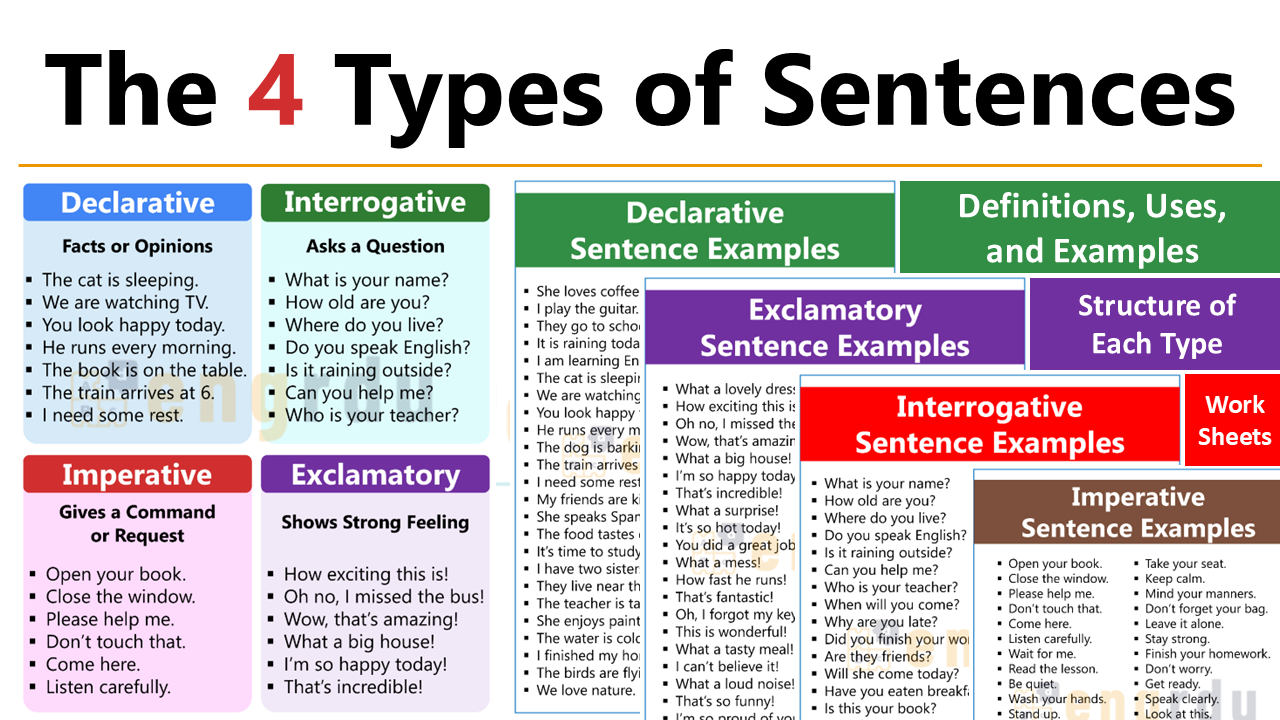
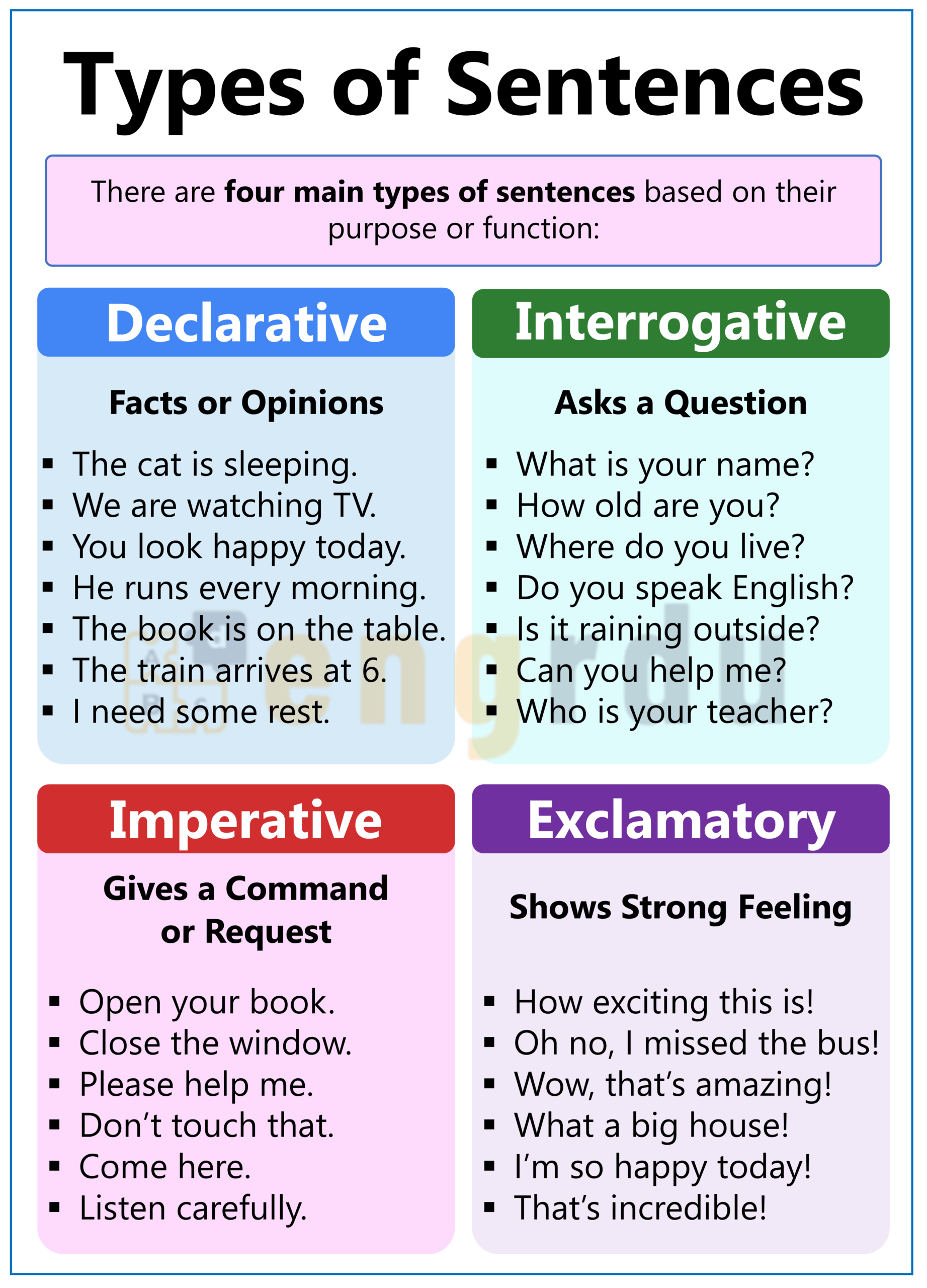
There are four main types of sentences based on their purpose or function:
| Type | Function | Punctuation |
|---|---|---|
| Declarative | States a fact or opinion | Full Stop (.) |
| Interrogative | Asks a question | Question Mark (?) |
| Imperative | Gives a command or request | Full Stop (.) or Exclamation (!) |
| Exclamatory | Shows strong feeling | Exclamation Mark (!) |
1. Declarative Sentence
A declarative sentence tells something or gives information. It is the most common type of sentence.
Example:
- The sky is blue.
- I like learning English.
Declarative Sentence Structure
Subject + Verb + Object (if needed)
Example: She (subject) reads (verb) books (object).
Declarative Sentence Usage
- Used to state facts or opinions.
- Ends with a full stop (.).
- Common in daily communication, writing, and storytelling.
Example:
- The sun rises in the east.
- I love learning English.
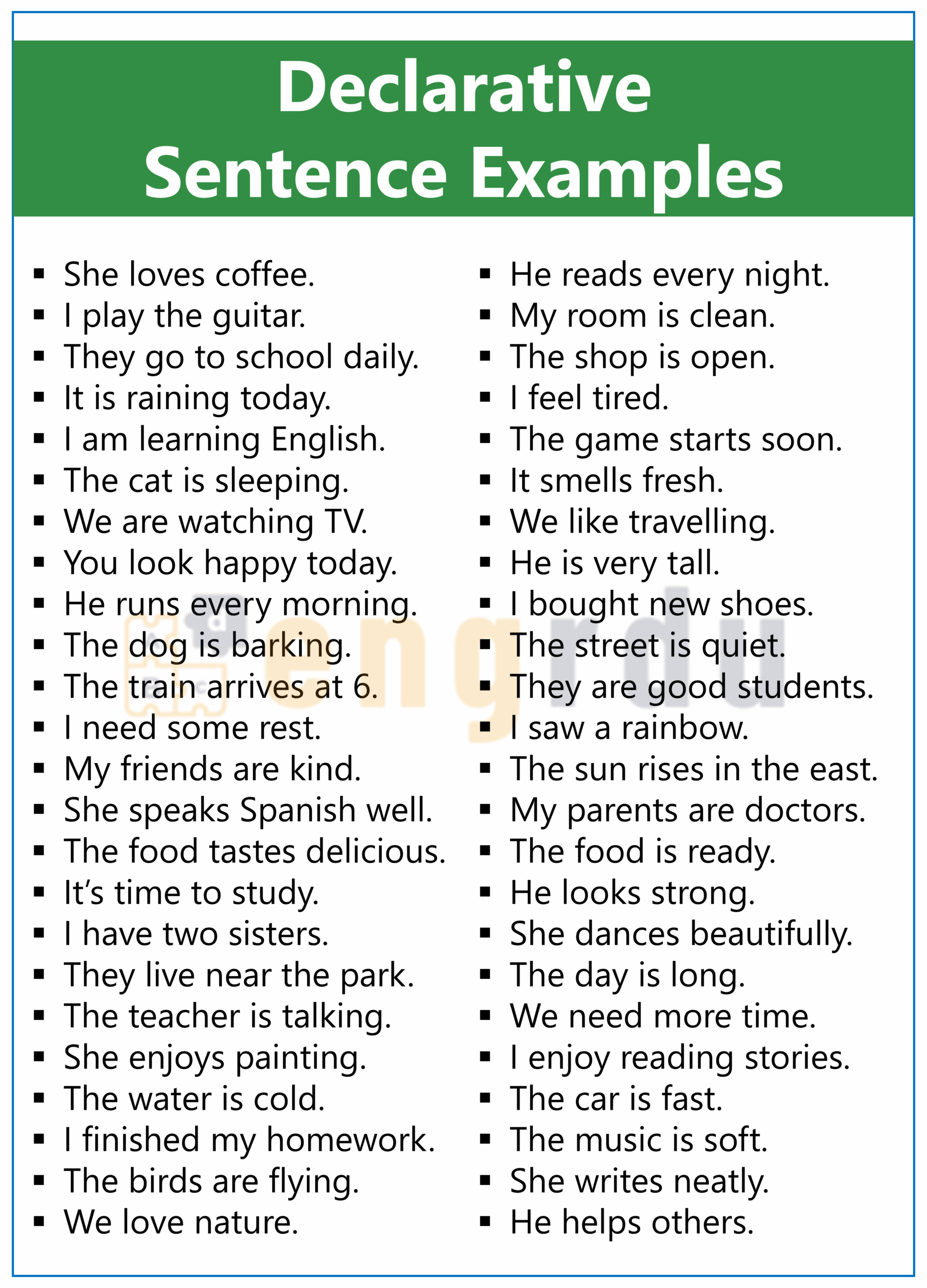
Declarative Sentence Examples
- She loves coffee.
- I play the guitar.
- They go to school daily.
- It is raining today.
- My brother works in a bank.
- The cat is sleeping.
- We are watching TV.
- You look happy today.
- He runs every morning.
- The book is on the table.
- The train arrives at 6.
- I need some rest.
- My friends are kind.
- She speaks Spanish well.
- The food tastes delicious.
- It’s time to study.
- I have two sisters.
- They live near the park.
- The teacher is talking.
- She enjoys painting.
- The water is cold.
- I finished my homework.
- The birds are flying.
- We love nature.
- He reads every night.
- My room is clean.
- The shop is open.
- I feel tired.
- The game starts soon.
- It smells fresh.
- We like travelling.
- He is very tall.
- I bought new shoes.
- The street is quiet.
- They are good students.
- I saw a rainbow.
- The sun rises in the east.
- My parents are doctors.
- The food is ready.
- He looks strong.
- She dances beautifully.
- The day is long.
- We need more time.
- I enjoy reading stories.
- The car is fast.
- The music is soft.
- She writes neatly.
- He helps others.
- The dog is barking.
- I am learning English.
2. Interrogative Sentence
An interrogative sentence is used to ask questions. It always ends with a question mark (?).
Example:
- Where are you going?
- Do you like pizza?
Interrogative Sentence Structure
(Helping Verb / Wh-word) + Subject + Main Verb + Object + ?
Example:
- Do you speak English?
- Where are you going?
Interrogative Sentence Usage
- Used to ask questions or get information.
- Always ends with a question mark (?).
- Common in conversations, interviews, and surveys.
Example:
- Can I help you?
- What time is it?
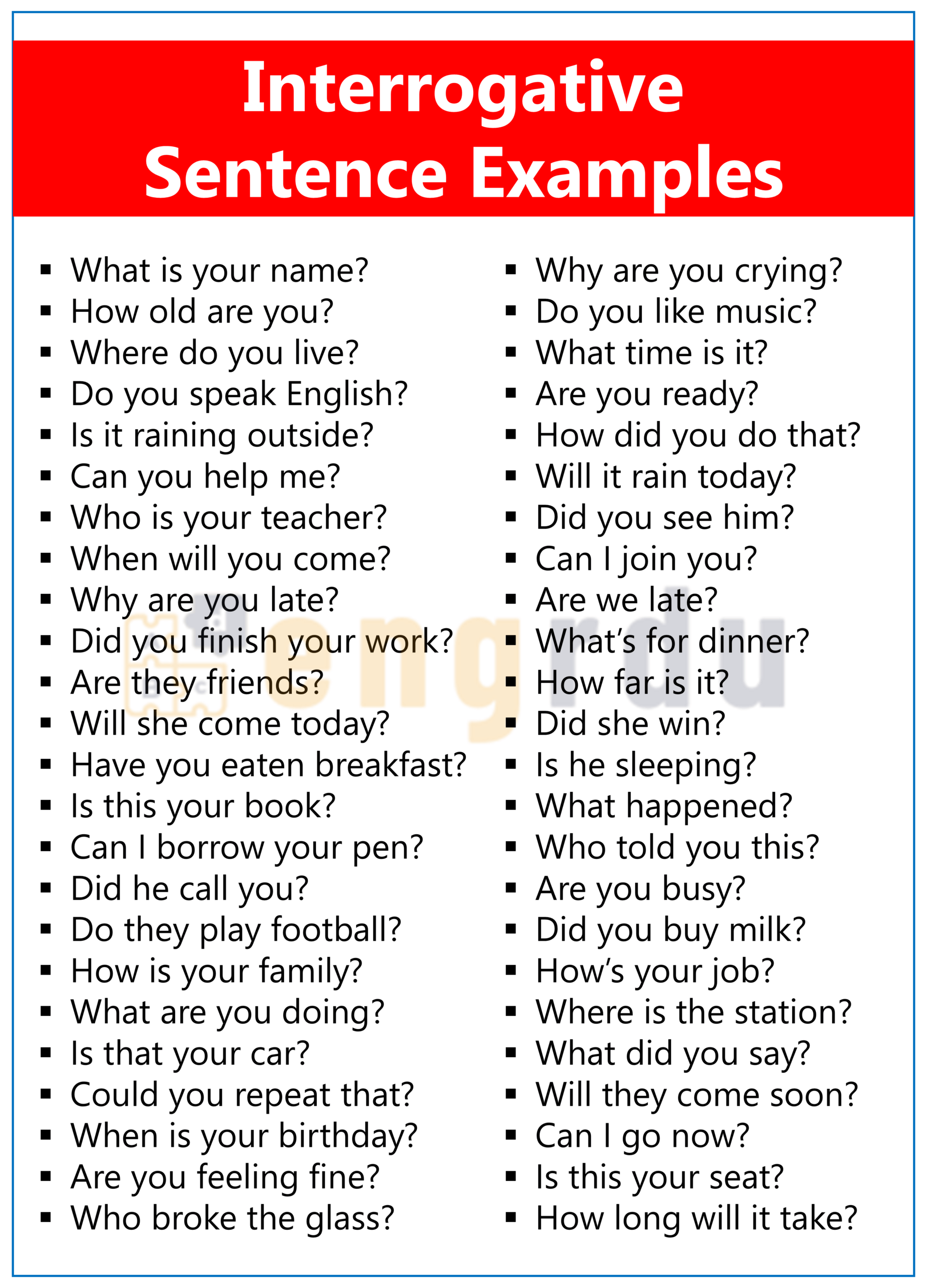
Interrogative Sentence Examples
- What is your name?
- How old are you?
- Where do you live?
- Do you speak English?
- Is it raining outside?
- Can you help me?
- Who is your teacher?
- When will you come?
- Why are you late?
- Did you finish your work?
- Are they friends?
- Will she come today?
- Have you eaten breakfast?
- Is this your book?
- Can I borrow your pen?
- Did he call you?
- Do they play football?
- How is your family?
- What are you doing?
- Is that your car?
- Could you repeat that?
- When is your birthday?
- Are you feeling fine?
- Who broke the glass?
- Why are you crying?
- Do you like music?
- Is this your first time here?
- What time is it?
- Are you ready?
- How did you do that?
- Will it rain today?
- Did you see him?
- Can I join you?
- Are we late?
- What’s for dinner?
- How far is it?
- Did she win?
- Is he sleeping?
- What happened?
- Who told you this?
- Are you busy?
- Did you buy milk?
- How’s your job?
- Where is the station?
- What did you say?
- Will they come soon?
- Can I go now?
- Is this your seat?
- How long will it take?
- Do you understand this?
3. Imperative Sentences
An imperative sentence gives a command, request, or instruction. It may end with a full stop (.) or an exclamation mark (!) depending on the tone.
Example:
- Please close the door.
- Sit down!
Imperative Sentence Structure
(Verb in base form) + Object (if any)
Example:
- Close the door.
- Please sit down.
Imperative Sentence Usage
- Used to give orders, requests, or instructions.
- Usually begins with a verb.
- Can end with a full stop (.) or exclamation mark (!) depending on tone.
Example:
- Be careful!
- Turn off the light.
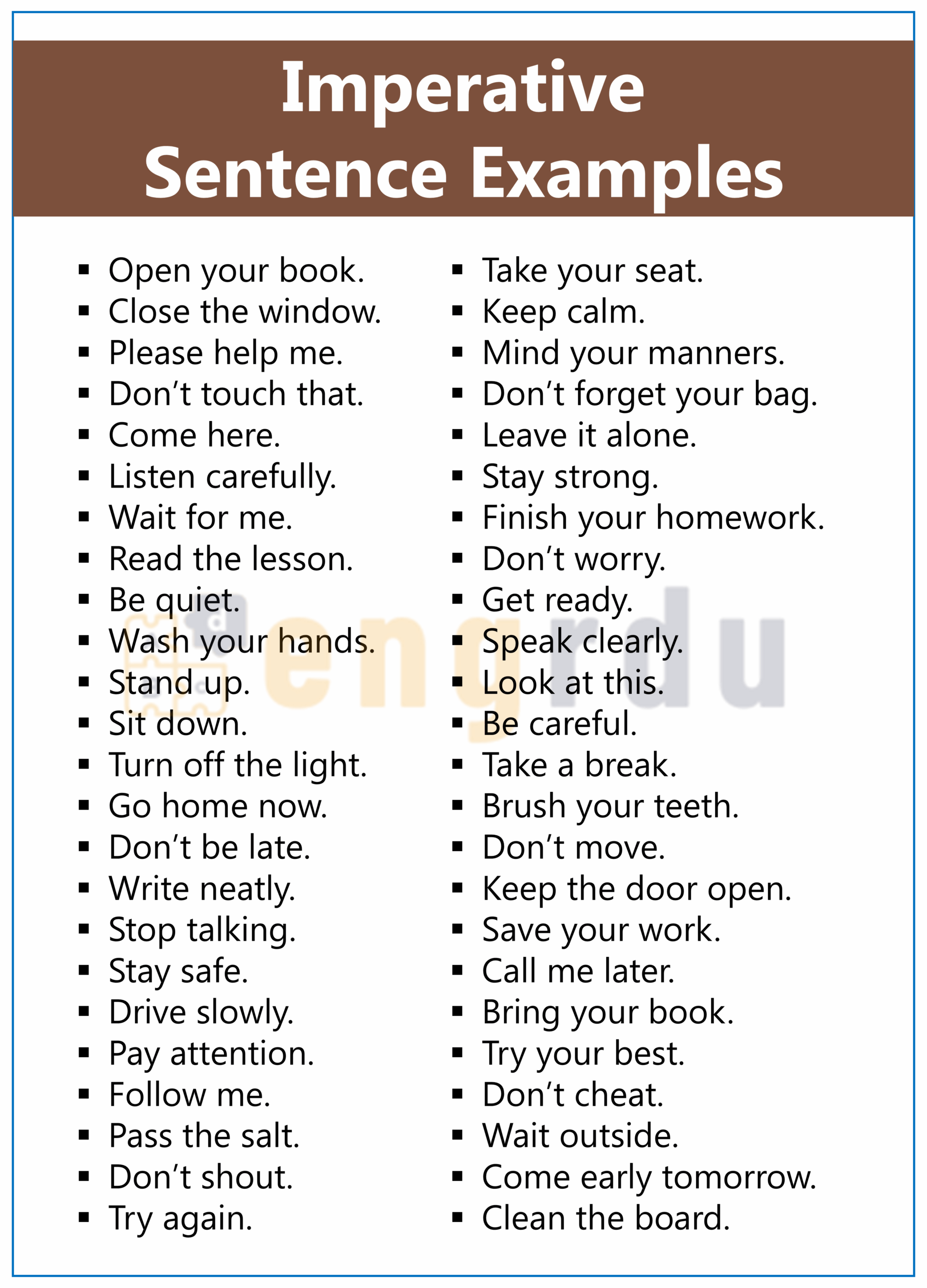
Imperative Sentence Examples
- Open your book.
- Close the window.
- Please help me.
- Don’t touch that.
- Come here.
- Listen carefully.
- Wait for me.
- Read the lesson.
- Be quiet.
- Wash your hands.
- Stand up.
- Sit down.
- Turn off the light.
- Go home now.
- Don’t be late.
- Write neatly.
- Stop talking.
- Stay safe.
- Drive slowly.
- Pay attention.
- Follow me.
- Pass the salt.
- Don’t shout.
- Try again.
- Take your seat.
- Keep calm.
- Mind your manners.
- Don’t forget your bag.
- Leave it alone.
- Stay strong.
- Finish your homework.
- Don’t worry.
- Get ready.
- Speak clearly.
- Look at this.
- Be careful.
- Take a break.
- Brush your teeth.
- Don’t move.
- Keep the door open.
- Save your work.
- Call me later.
- Bring your book.
- Try your best.
- Don’t cheat.
- Wait outside.
- Come early tomorrow.
- Clean the board.
- Stand in line.
- Turn the page.
4. Exclamatory Sentences
An exclamatory sentence shows strong feelings or emotions, like surprise, happiness, or anger. It always ends with an exclamation mark (!).
Example:
- What a beautiful day!
- I can’t believe this!
Exclamatory Sentence Structure
What / How + adjective/adverb + subject + verb + !
Example:
- What a lovely day it is!
- How beautiful this place is!
Exclamatory Sentence Usage
- Used to express strong emotions such as surprise, joy, anger, or sadness.
- Always ends with an exclamation mark (!).
- Common in emotional writing or spoken English.
Example:
- Wow! That’s amazing!
- Oh no! I forgot my keys!
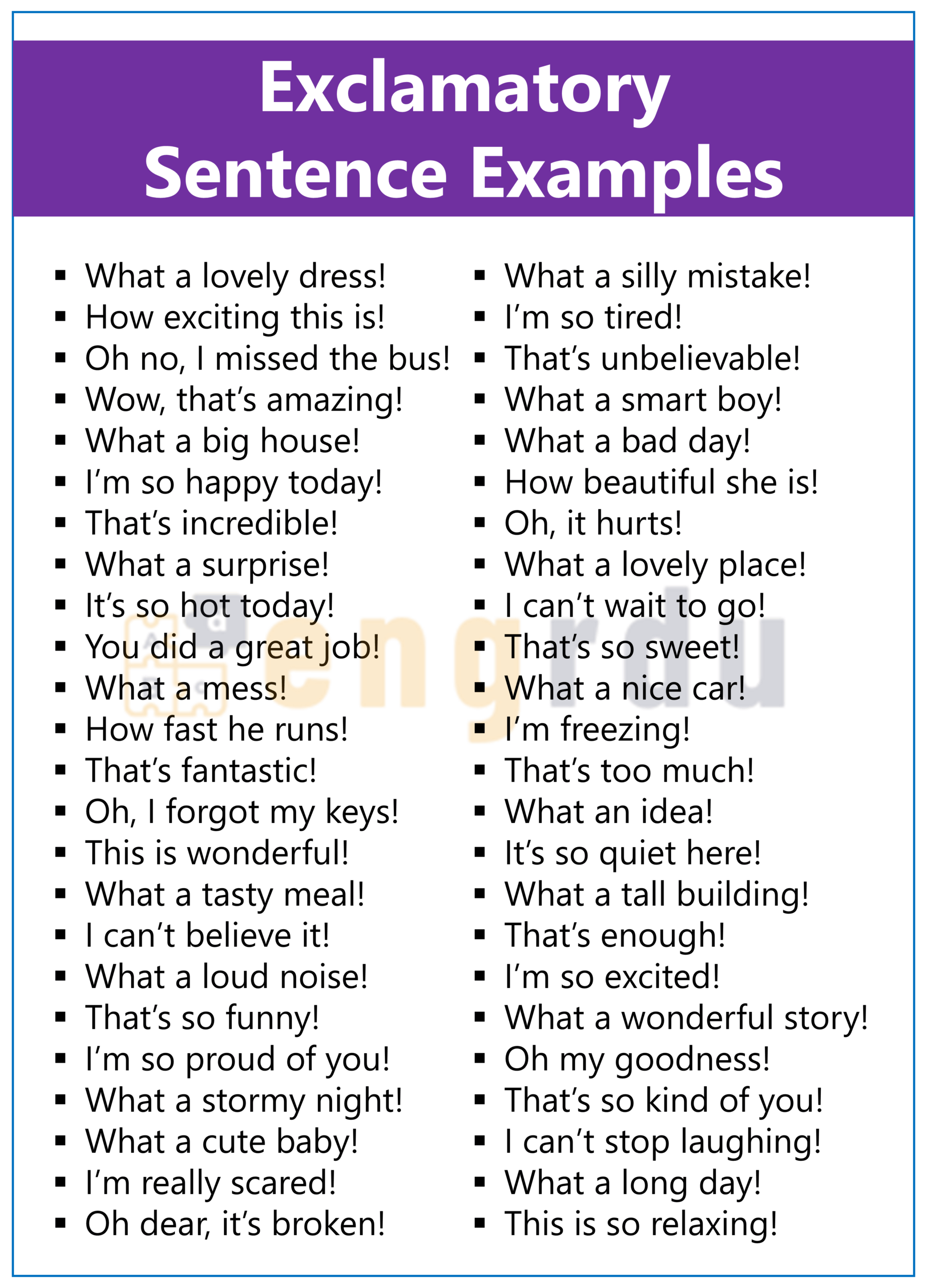
Exclamatory Sentence Examples
- What a lovely dress!
- How exciting this is!
- Oh no, I missed the bus!
- Wow, that’s amazing!
- What a big house!
- I’m so happy today!
- That’s incredible!
- What a surprise!
- It’s so hot today!
- You did a great job!
- What a mess!
- How fast he runs!
- That’s fantastic!
- Oh, I forgot my keys!
- This is wonderful!
- What a tasty meal!
- I can’t believe it!
- What a loud noise!
- That’s so funny!
- I’m so proud of you!
- What a stormy night!
- What a cute baby!
- I’m really scared!
- Oh dear, it’s broken!
- What a silly mistake!
- I’m so tired!
- That’s unbelievable!
- What a smart boy!
- What a bad day!
- How beautiful she is!
- Oh, it hurts!
- What a lovely place!
- I can’t wait to go!
- That’s so sweet!
- What a nice car!
- I’m freezing!
- That’s too much!
- What an idea!
- It’s so quiet here!
- What a tall building!
- That’s enough!
- I’m so excited!
- What a wonderful story!
- Oh my goodness!
- That’s so kind of you!
- What an interesting book!
- I can’t stop laughing!
- What a long day!
- This is so relaxing!
- What a lucky man!
Comparison between Types of Sentences
| Type | Purpose | Example |
|---|---|---|
| Declarative | Gives information | She likes tea. |
| Interrogative | Asks a question | Do you like tea? |
| Imperative | Gives command | Drink your tea. |
| Exclamatory | Shows emotion | What a tasty tea! |
Compound and Complex Sentences
A compound sentence has two independent clauses joined by a conjunction (like and, but, or).
Example: I like coffee, and she likes tea.
A complex sentence has one main clause and one or more dependent clauses.
Example: I stayed home because it was raining.
| Sentence Type | Structure | Example |
|---|---|---|
| Compound | Two independent clauses | She is tired, but she is working. |
| Complex | One main + one dependent clause | I left early because I was sleepy. |
Types of Sentences Worksheets
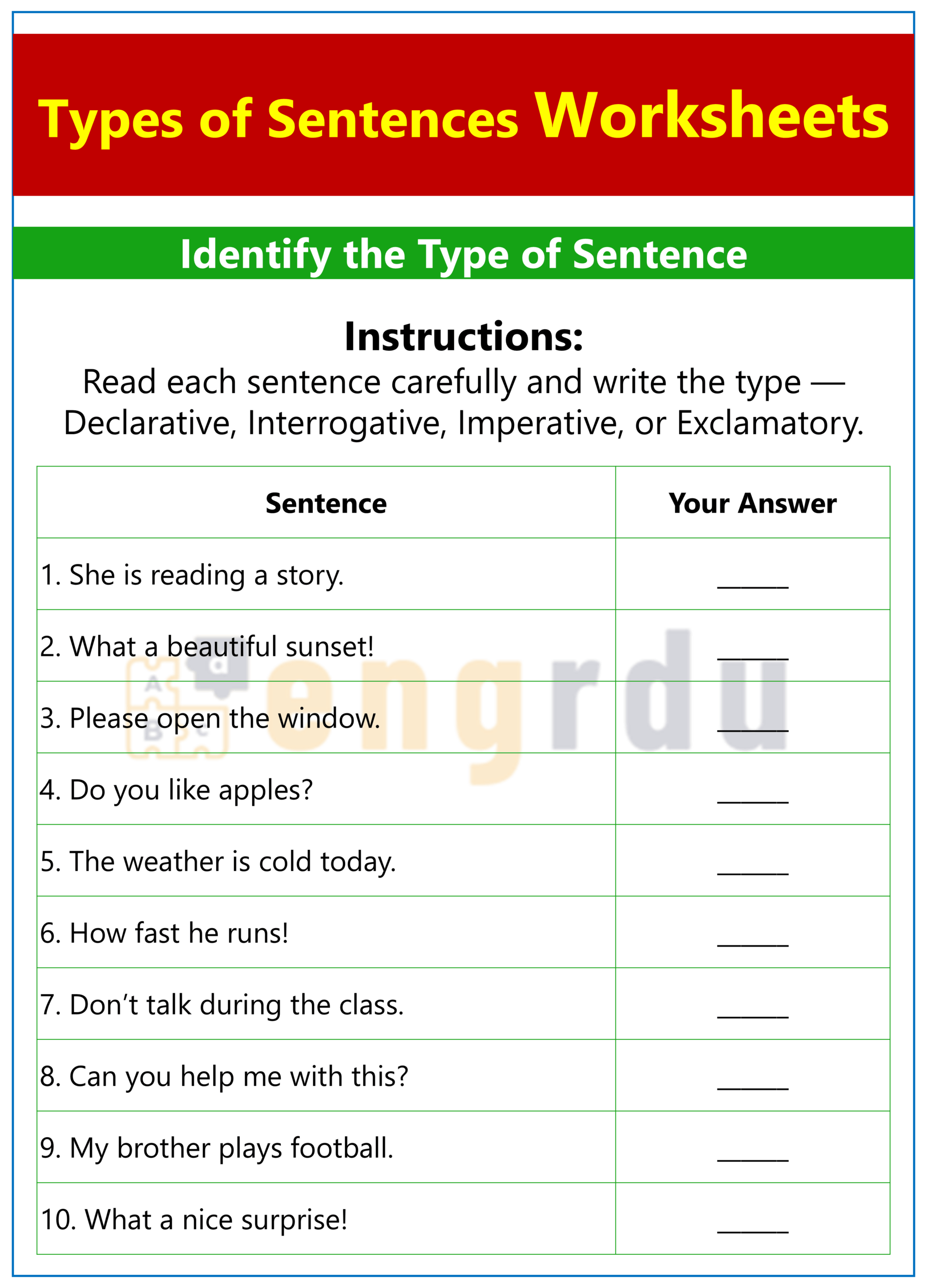
Identify the Type of Sentence
Instructions:
Read each sentence carefully and write the type — Declarative, Interrogative, Imperative, or Exclamatory.
| Sentence | Your Answer | Correct Answer |
|---|---|---|
| 1. She is reading a story. | ______ | Declarative |
| 2. What a beautiful sunset! | ______ | Exclamatory |
| 3. Please open the window. | ______ | Imperative |
| 4. Do you like apples? | ______ | Interrogative |
| 5. The weather is cold today. | ______ | Declarative |
| 6. How fast he runs! | ______ | Exclamatory |
| 7. Don’t talk during the class. | ______ | Imperative |
| 8. Can you help me with this? | ______ | Interrogative |
| 9. My brother plays football. | ______ | Declarative |
| 10. What a nice surprise! | ______ | Exclamatory |
Answers:
- Declarative
- Exclamatory
- Imperative
- Interrogative
- Declarative
- Exclamatory
- Imperative
- Interrogative
- Declarative
- Exclamatory
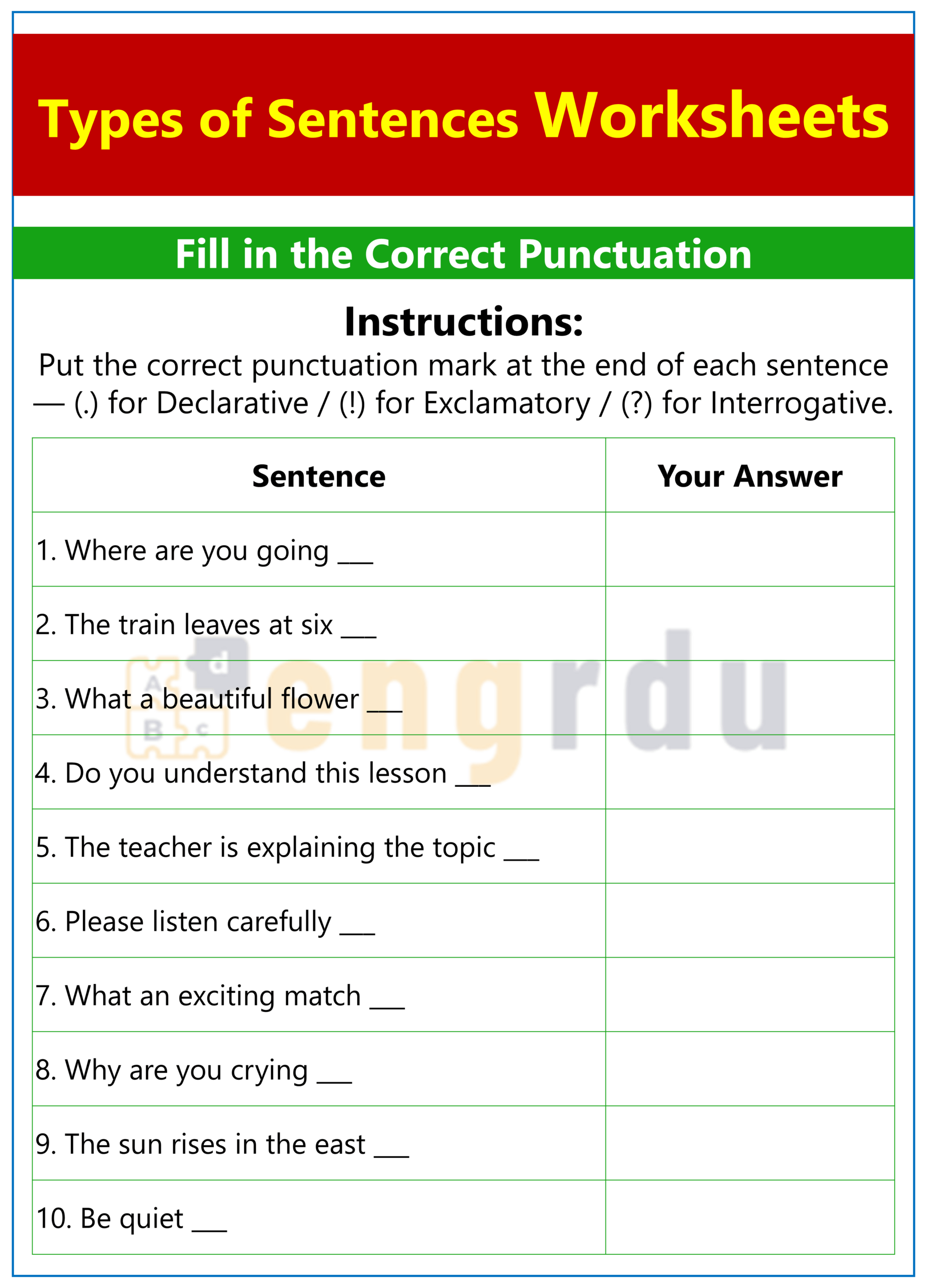
Fill in the Correct Punctuation
Instructions:
Put the correct punctuation mark at the end of each sentence — (.) for Declarative / (!) for Exclamatory / (?) for Interrogative.
| Sentence | Your Answer | Correct Answer |
|---|---|---|
| 1. Where are you going ___ | ? | |
| 2. The train leaves at six ___ | . | |
| 3. What a beautiful flower ___ | ! | |
| 4. Do you understand this lesson ___ | ? | |
| 5. The teacher is explaining the topic ___ | . | |
| 6. Please listen carefully ___ | . | |
| 7. What an exciting match ___ | ! | |
| 8. Why are you crying ___ | ? | |
| 9. The sun rises in the east ___ | . | |
| 10. Be quiet ___ | . or ! |
Answers:
? 2. . 3. ! 4. ? 5. . 6. . 7. ! 8. ? 9. . 10. . or !
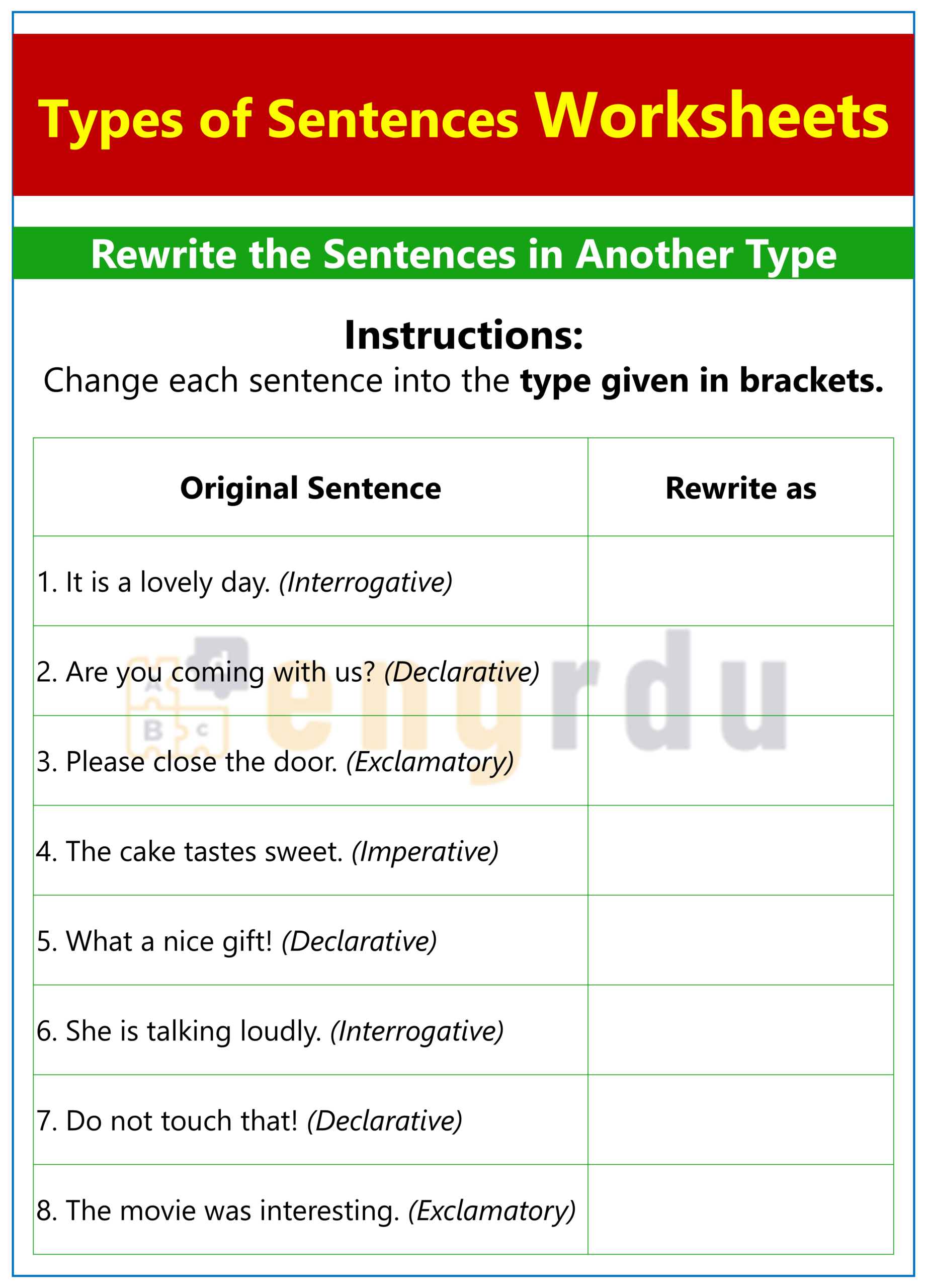
Rewrite the Sentences in Another Type
Instructions:
Change each sentence into the type given in brackets.
| Original Sentence | Rewrite as | Answer |
|---|---|---|
| 1. It is a lovely day. (Interrogative) | Is it a lovely day? | |
| 2. Are you coming with us? (Declarative) | You are coming with us. | |
| 3. Please close the door. (Exclamatory) | What a noisy door! | |
| 4. The cake tastes sweet. (Imperative) | Taste the cake. | |
| 5. What a nice gift! (Declarative) | It is a nice gift. | |
| 6. She is talking loudly. (Interrogative) | Is she talking loudly? | |
| 7. Do not touch that! (Declarative) | You should not touch that. | |
| 8. The movie was interesting. (Exclamatory) | What an interesting movie! |
Answers are flexible, but learners must keep the meaning clear and use correct punctuation.
Types of Sentences PDF
Get a free PDF book of four types of sentences with worksheets:
FAQs about Types of Sentences
What are the four types of sentences in English?
The four types of sentences in English are Declarative, Interrogative, Imperative, and Exclamatory.
Declarative sentences state facts, interrogative sentences ask questions, imperative sentences give commands, and exclamatory sentences show strong feelings.
What is a declarative sentence with example?
A declarative sentence is used to give information or express an idea. It ends with a full stop (.).
Example: She likes reading books.
What is the difference between interrogative and imperative sentences?
An interrogative sentence asks a question and ends with a question mark (?), while an imperative sentence gives a command or request and usually ends with a full stop (.) or exclamation mark (!).
Example (Interrogative): Are you ready?
Example (Imperative): Please sit down.
What is an exclamatory sentence used for?
An exclamatory sentence is used to express strong emotions like happiness, surprise, or anger. It always ends with an exclamation mark (!).
Example: What a beautiful day!
How do you identify the type of a sentence?
You can identify the type of a sentence by looking at its purpose and punctuation mark:
- Declarative: gives information → (.)
- Interrogative: asks a question → (?)
- Imperative: gives command or request → (.) or (!)
- Exclamatory: shows strong feeling → (!)
Read More