In this blog post, you will learn about the Singular Noun and how it works in everyday English. A singular noun names one person, place, thing, or idea. It is one of the most important parts of English grammar. When you understand singular nouns, you can build correct sentences and avoid common mistakes. You will also improve your grammar skills in speaking, reading, writing, and listening. By the end, you will feel more confident using English in school and daily life.
Singular Noun Definition and Examples
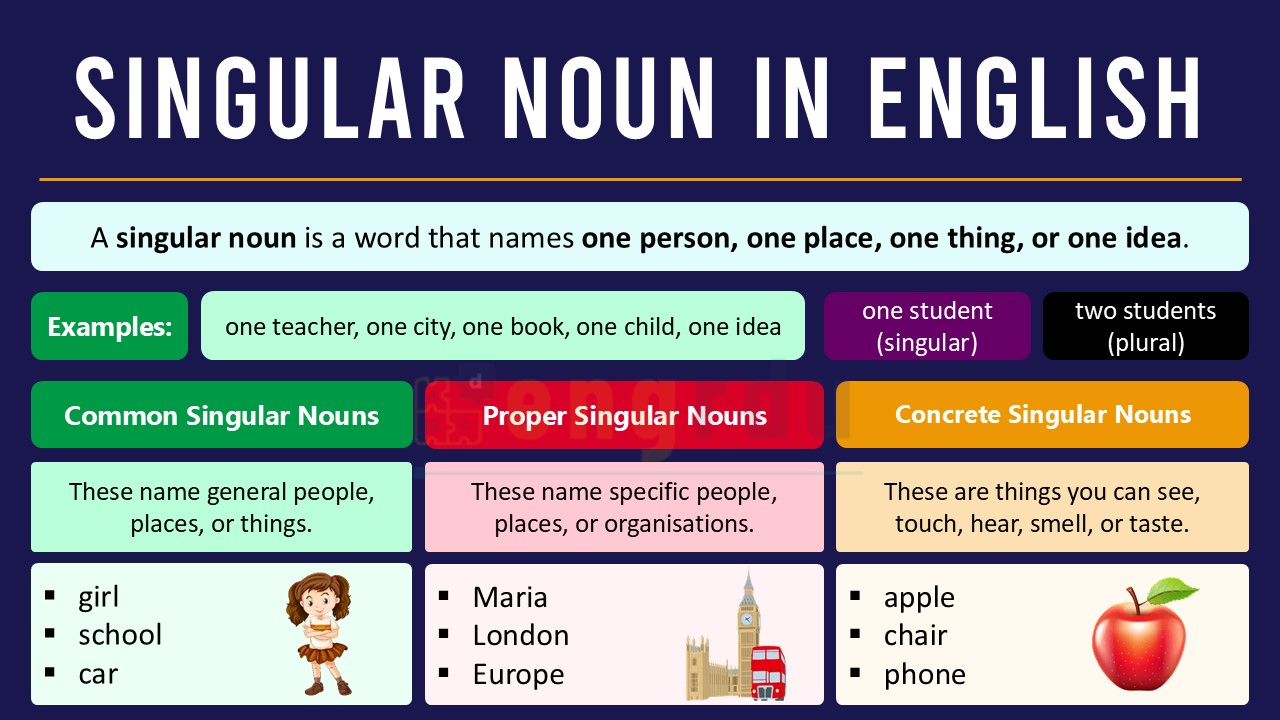
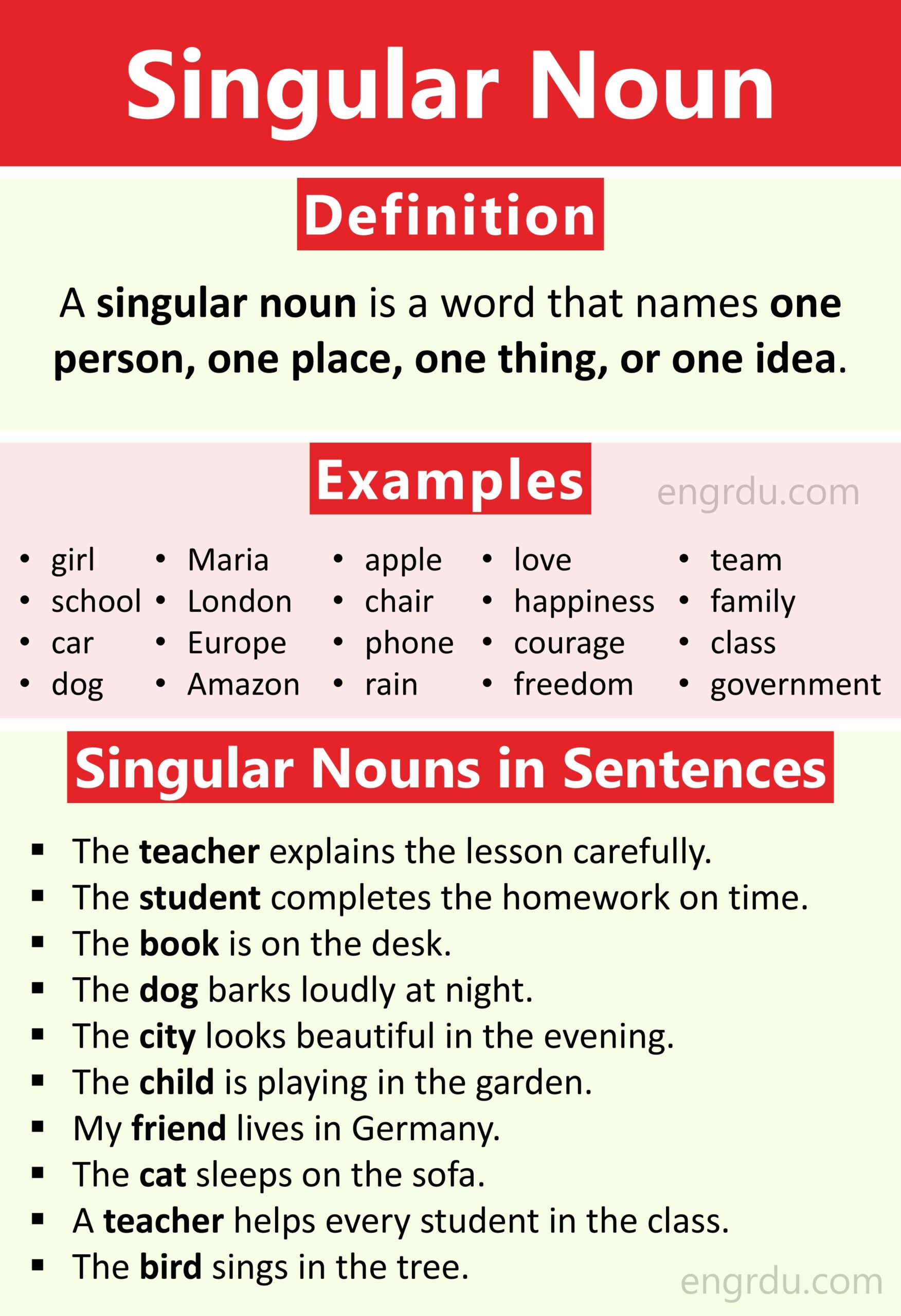
A singular noun is a word that names one person, one place, one thing, or one idea.
A singular noun means only one.
Examples:
- one teacher
- one city
- one book
- one child
- one idea
If you can count it as one, it is singular.
Compare:
- one student (singular)
- two students (plural)
Types of Singular Nouns
Singular nouns can appear in different forms. Let us look at the main types.
1. Common Singular Nouns
These name general people, places, or things.
Examples:
- girl
- school
- car
- dog
- river
Sentence:
- The girl is reading a book.
2. Proper Singular Nouns
These name specific people, places, or organisations. They always begin with a capital letter.
Examples:
- Maria
- London
- Europe
- Amazon
- Oxford University
Sentence:
- London is a beautiful city.
3. Concrete Singular Nouns
These are things you can see, touch, hear, smell, or taste.
Examples:
- apple
- chair
- phone
- rain
- flower
Sentence:
- The apple is fresh.
4. Abstract Singular Nouns
These name ideas, feelings, or qualities. You cannot touch them.
Examples:
- love
- happiness
- courage
- freedom
- education
Sentence:
- Happiness is important in life.
5. Collective Nouns (Singular Form)
Some nouns look singular but refer to a group. In British English, they can sometimes take a plural verb, but they are grammatically singular in form.
Examples:
- team
- family
- class
- government
Sentence (singular verb):
- The team is winning.
Sentence (British usage – plural verb possible):
- The team are wearing new uniforms.
How to Form Singular Nouns in English
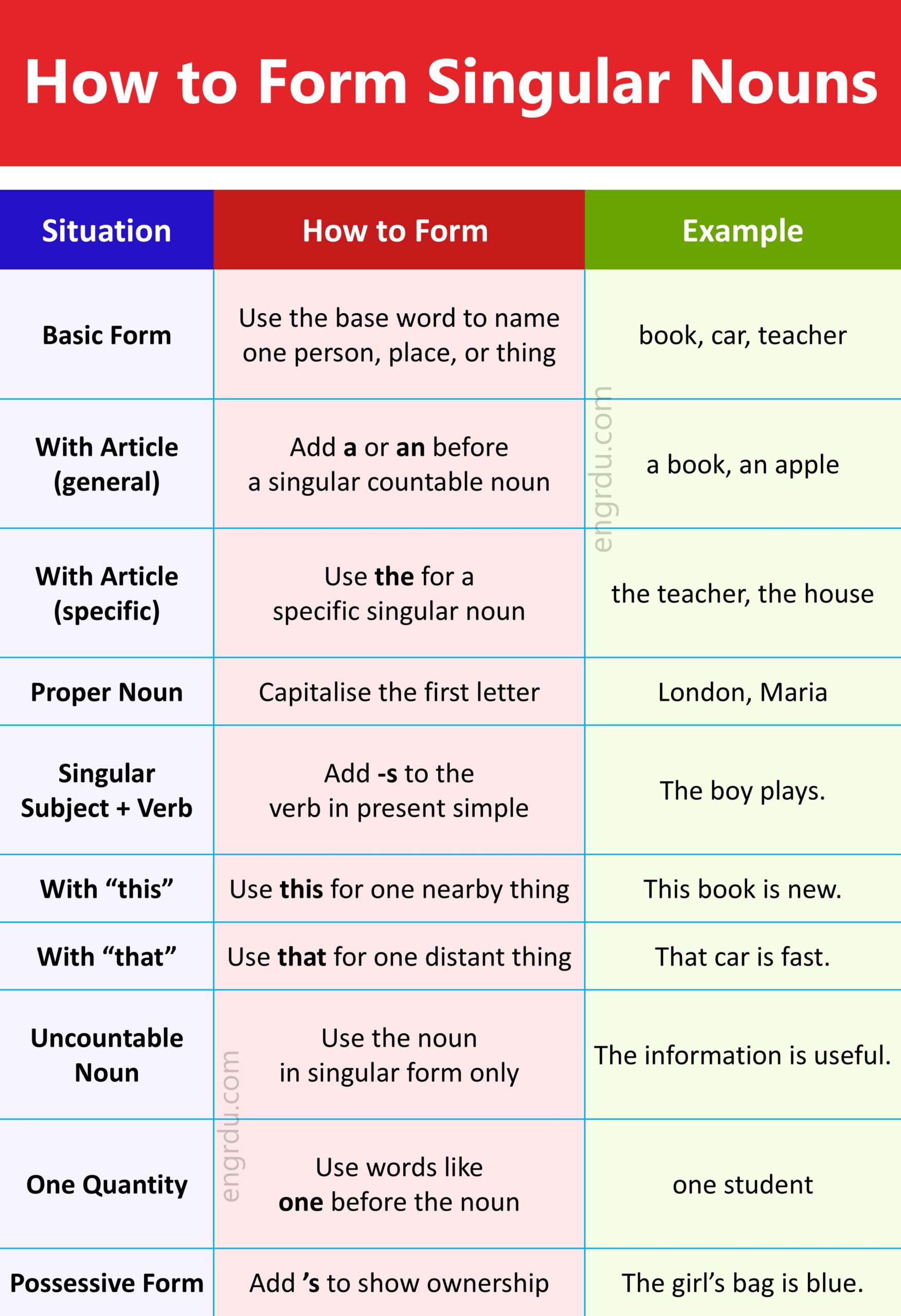
| Situation | How to Form | Example |
|---|---|---|
| Basic form | Use the base word to name one person, place, or thing | book, car, teacher |
| With article (general) | Add a or an before a singular countable noun | a book, an apple |
| With article (specific) | Use the for a specific singular noun | the teacher, the house |
| Proper noun | Capitalise the first letter | London, Maria |
| Singular subject + verb | Add -s to the verb in present simple | The boy plays. |
| With “this” | Use this for one nearby thing | This book is new. |
| With “that” | Use that for one distant thing | That car is fast. |
| Uncountable noun | Use the noun in singular form only | The information is useful. |
| One quantity | Use words like one before the noun | one student |
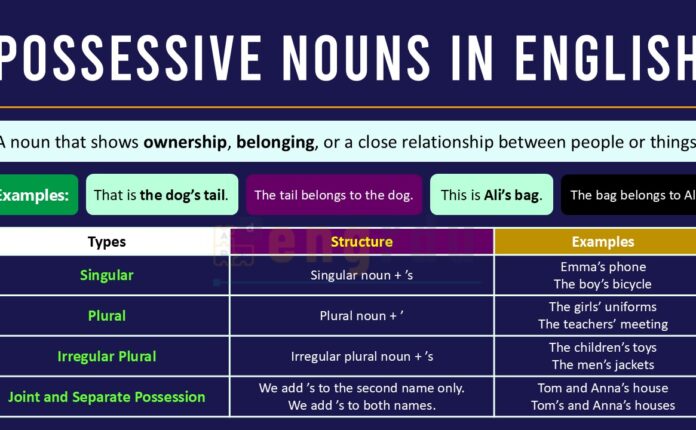
| Possessive form | Add ’s to show ownership | The girl’s bag is blue. |
Rules for Using Singular Nouns
Let us look at the most important grammar rules.
1: Singular Nouns Usually Need an Article
In English, most singular countable nouns need:
- a
- an
- the
Correct:
- I saw a dog.
- She has a pen.
- The teacher is kind.
Incorrect:
- I saw dog.
- She has pen.
Tip: If it is one countable thing, it usually needs a, an, or the.
2: Use “a” or “an” Correctly
Use a before consonant sounds.
- a book
- a car
- a university
Use an before vowel sounds.
- an apple
- an hour
- an umbrella
Remember: It depends on the sound, not just the letter.
3: Singular Subject Takes Singular Verb
A singular noun needs a singular verb in the present simple tense.
Correct:
- The boy plays football.
- The cat sleeps on the sofa.
- The teacher explains the lesson.
Incorrect:
- The boy play football.
- The cat sleep on the sofa.
Look for “-s” on the verb when the subject is singular (he, she, it).
4: Use “This” and “That” with Singular Nouns
- This book is interesting.
- That house is old.
For plural nouns, we use “these” and “those”.
5: Some Nouns Are Always Singular
Some nouns are uncountable. They stay singular and do not have a plural form.
Examples:
- information
- advice
- furniture
- news
- water
Correct:
- The information is helpful.
Incorrect:
- The informations are helpful.
Examples of Singular Nouns in Sentences
| Singular Word | Example Sentence |
|---|---|
| teacher | The teacher explains the lesson carefully. |
| student | The student completes the homework on time. |
| book | The book is on the desk. |
| dog | The dog barks loudly at night. |
| city | The city looks beautiful in the evening. |
| child | The child is playing in the garden. |
| car | The car needs fuel. |
| doctor | The doctor checks the patient. |
| house | The house has a red door. |
| river | The river flows through the village. |
| phone | The phone rings every morning. |
| friend | My friend lives in Germany. |
| school | The school opens at eight o’clock. |
| cat | The cat sleeps on the sofa. |
| apple | The apple tastes sweet. |
| shop | The shop closes at six o’clock. |
| computer | The computer works very fast. |
| bird | The bird sings in the tree. |
| train | The train arrives at the station. |
| teacher | A teacher helps every student in the class. |
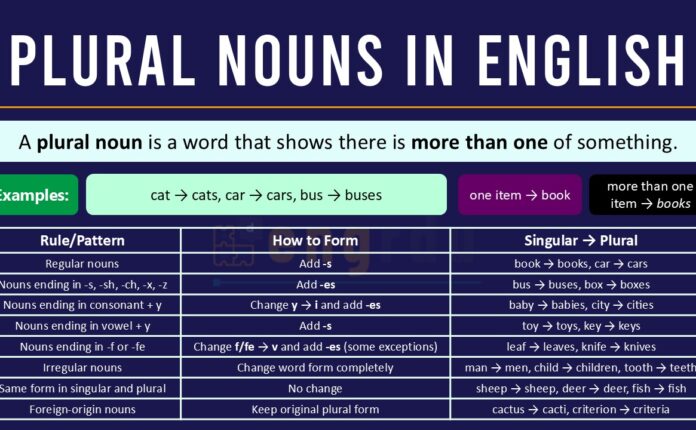
Singular vs Plural Nouns
Understanding the difference is very important.
| Feature | Singular Noun | Plural Noun |
|---|---|---|
| Meaning | One person/thing | More than one |
| Example | one book | two books |
| Verb form | The book is new. | The books are new. |
| Present simple | She works. | They work. |
| Articles | a/an/the | the (no a/an) |
Singular Nouns in British and American English
In British English, collective nouns can take singular or plural verbs.
British English:
- The team are playing well.
American English:
- The team is playing well.
Both are correct in their context. For global learners, it is important to understand both styles.
Practical Tips for Learners
Here are simple strategies to master singular nouns.
- Always check: Is it one or more than one?
- Add “a” or “an” when needed.
- Check the verb: Does it need “-s”?
- Learn common uncountable nouns.
- Read short English stories and underline singular nouns.
- Practise writing five sentences every day.
- Speak aloud to hear subject–verb agreement.
Small daily practice makes a big difference.
Conclusion
A singular noun names one person, place, thing, or idea. It is a basic but powerful part of English grammar. To use it correctly, remember three key points: use the correct article, choose the right verb form, and check whether the noun is countable or uncountable. With regular practice, you will speak and write more clearly and confidently. Keep noticing singular nouns in daily English, and try to use them correctly in your own sentences.
Read More