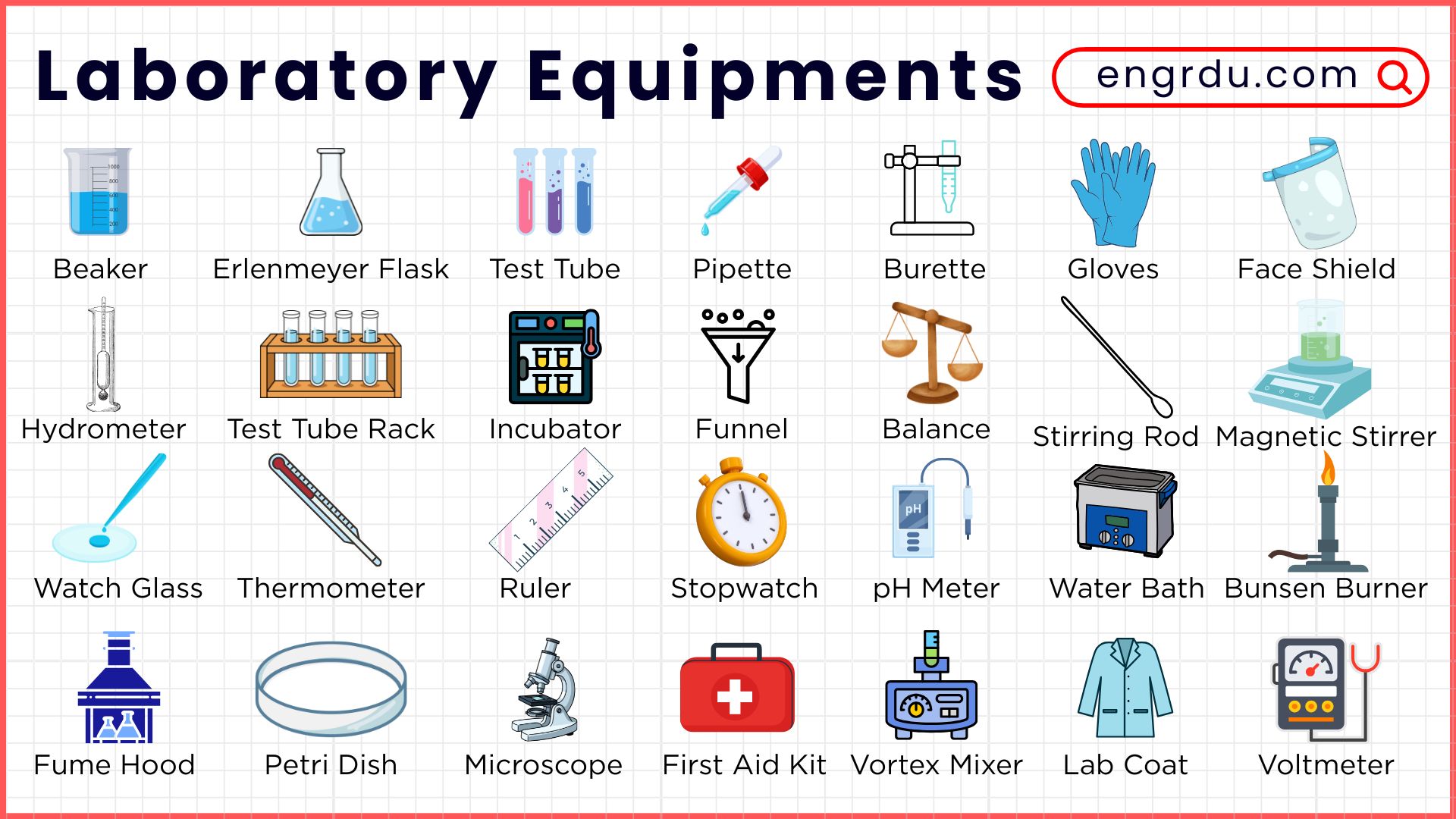
In this blog post, you will learn the names of common laboratory equipment with pictures. Laboratory vocabulary includes the tools and instruments used in science experiments, such as beakers, microscopes, and test tubes. Knowing these words helps you understand scientific texts, follow instructions, and communicate effectively in English. By studying these terms, you can master your speaking, reading, writing, and listening skills while exploring real-life science situations.
What Is Laboratory Equipment?
Laboratory equipment refers to tools used in a science lab to mix, heat, measure, observe, or store materials. Students use these tools in chemistry, biology, and physics classes.
For example, you use a beaker to hold liquids. You use a microscope to see tiny objects.
Each tool has a specific purpose. Therefore, knowing the correct name is important.
Why Learning Lab Vocabulary Is Important
Science classes use many technical words. When you know laboratory equipment names in English, you can:
- Follow teacher instructions easily
- Understand lab manuals
- Write better lab reports
- Speak confidently during experiments
Moreover, this vocabulary appears in exams and textbooks. So, learning it improves both language and academic skills.
Laboratory Equipment Names and Uses
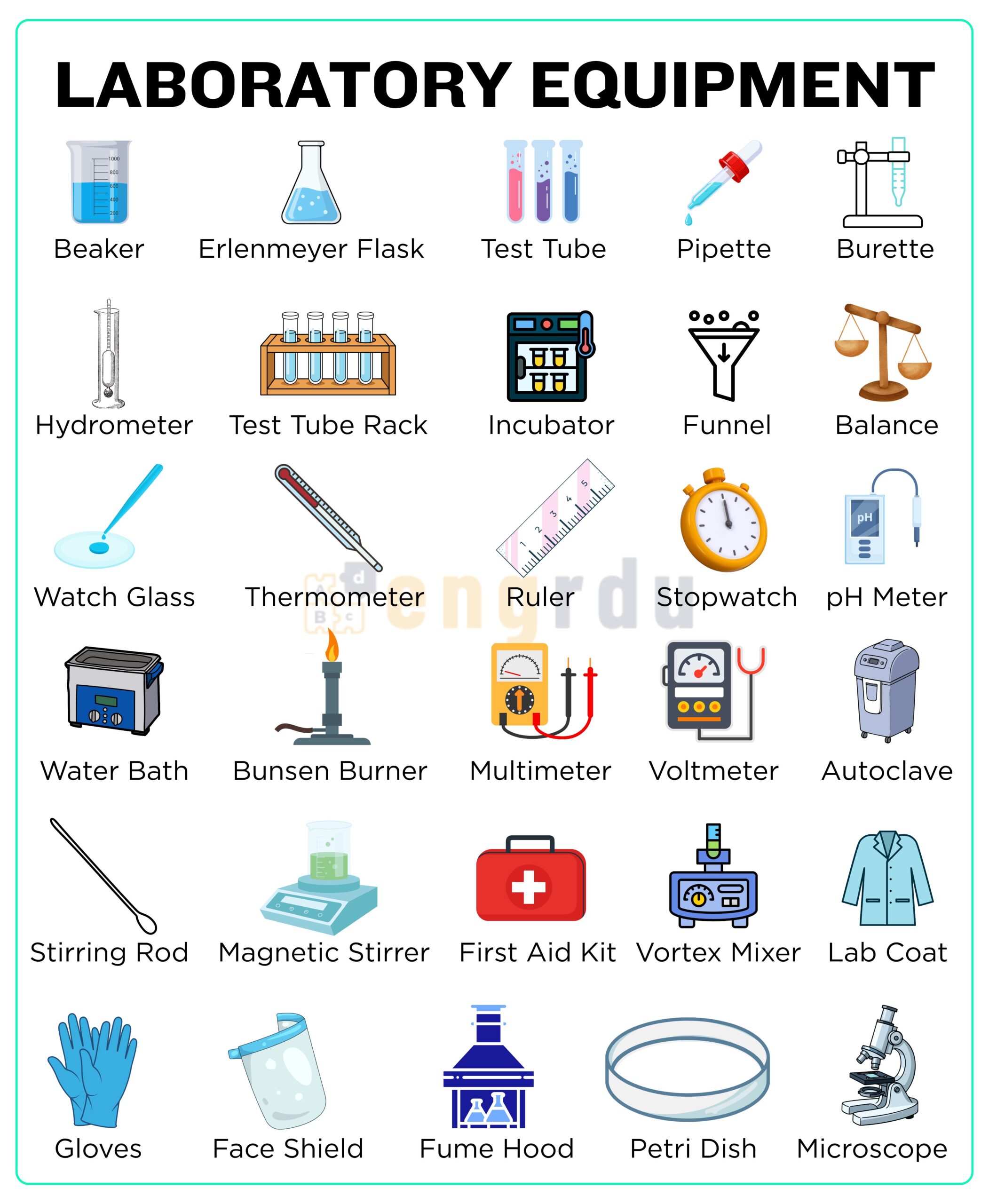
Below are 20 important laboratory equipment names with their uses and pictures.
1. Measuring Equipment
- Graduated Cylinder: A tall container used to measure liquid volume accurately.
- Measuring Cylinder: Another name for graduated cylinder.
- Balance (Scale): A tool that measures weight or mass.
- Thermometer: Measures temperature of liquids or air.
- Ruler: Measures length in centimeters or inches.
Students often use these tools at the beginning of an experiment.
2. Heating and Holding Equipment
- Beaker: A glass container used to hold and mix liquids.
- Test Tube: A small glass tube for holding small amounts of liquid.
- Flask (Erlenmeyer Flask): A container with a narrow neck used for mixing chemicals.
- Bunsen Burner: A gas burner used to heat substances.
- Tripod Stand: A three-legged stand that supports containers during heating.
In chemistry labs, students frequently heat liquids using a Bunsen burner and tripod.
3. Observation and Safety Equipment
- Microscope: An instrument used to see very small objects like cells.
- Magnifying Glass: Makes objects appear larger.
- Safety Goggles: Protect the eyes from chemicals.
- Lab Coat: Protects clothes and skin.
- Gloves: Protect hands from harmful substances.
Safety equipment is always necessary in a laboratory.
4. Storage and Transfer Tools
- Dropper (Pipette): Transfers small amounts of liquid.
- Funnel: Helps pour liquid into narrow containers.
- Stirring Rod: Mixes liquids safely.
- Wash Bottle: Contains distilled water for cleaning.
- Petri Dish: A shallow dish used to grow bacteria.
These tools help scientists handle materials carefully and correctly.
Laboratory Equipment Words in Sentences
Here are simple examples:
- The teacher poured water into a beaker.
- We measured 50 ml using a graduated cylinder.
- She looked at the cells through a microscope.
- He heated the solution with a Bunsen burner.
- Always wear safety goggles in the lab.
Using these words in sentences improves your speaking and writing skills.
List of Laboratory Equipment
- Beaker
- Test Tube
- Flask
- Graduated Cylinder
- Balance
- Thermometer
- Bunsen Burner
- Tripod Stand
- Microscope
- Magnifying Glass
- Safety Goggles
- Lab Coat
- Gloves
- Dropper
- Funnel
- Stirring Rod
- Wash Bottle
- Petri Dish
- Ruler
- Measuring Cylinder
FAQs
What is laboratory equipment?
Laboratory equipment refers to the tools and instruments used in a science lab to perform experiments, measure substances, and observe results. Common examples include a beaker, test tube, microscope, and balance. These tools help students and scientists complete scientific investigations safely and accurately.
What are the most common laboratory equipment names in English?
Some of the most common laboratory equipment names are beaker, graduated cylinder, test tube, flask, microscope, Bunsen burner, thermometer, balance, and safety goggles. These tools are frequently used in school science labs for measuring, heating, mixing, and observing substances.
What is the difference between a beaker and a graduated cylinder?
A beaker holds and mixes liquids, but it does not measure volume very accurately. A graduated cylinder measures liquid volume precisely because it has clear measurement markings. Students use a beaker for mixing and a graduated cylinder for accurate measurement in experiments.
What is the purpose of safety equipment in a laboratory?
Safety equipment protects students from harm during experiments. Items such as safety goggles, gloves, and lab coats prevent injuries from chemicals, heat, or broken glass. Using proper safety tools is an important part of responsible laboratory practice.
Where is laboratory equipment used besides school science labs?
Laboratory equipment is also used in hospitals, research centers, universities, and industrial laboratories. Scientists, doctors, and technicians use tools such as microscopes, balances, and test tubes to conduct research, perform medical tests, and develop new products.
Related Articles