Hand tools are simple instruments that people use to fix, build, or repair things. These tools are called hand tools because they are operated manually, without electricity.
Learning hand tools names helps English learners build practical vocabulary used in workshops, home repairs, and technical discussions. When you learn the names of tools like hammer, screwdriver, pliers, and wrench, you can understand instructions, read manuals, and communicate clearly about work tasks.
What Are Hand Tools?
Hand tools are manual instruments used to perform tasks such as cutting, holding, turning, striking, or measuring. They do not require power sources like electricity or batteries.
Different hand tools have different designs for specific purposes. Some are used for hammering nails, others for gripping objects, loosening bolts, or measuring lengths. They are common in homes, schools, workshops, and construction sites.
Why Learning Hand Tools Names Is Important
Learning hand tool names provides several benefits:
- Improves practical vocabulary in English
- Helps learners follow repair or assembly instructions
- Supports reading manuals and technical guides
- Improves speaking when describing tools or tasks
- Strengthens listening skills for instructional videos
Knowing these words allows learners to communicate effectively about DIY projects, repairs, or technical work.
Common Hand Tools Names and Uses
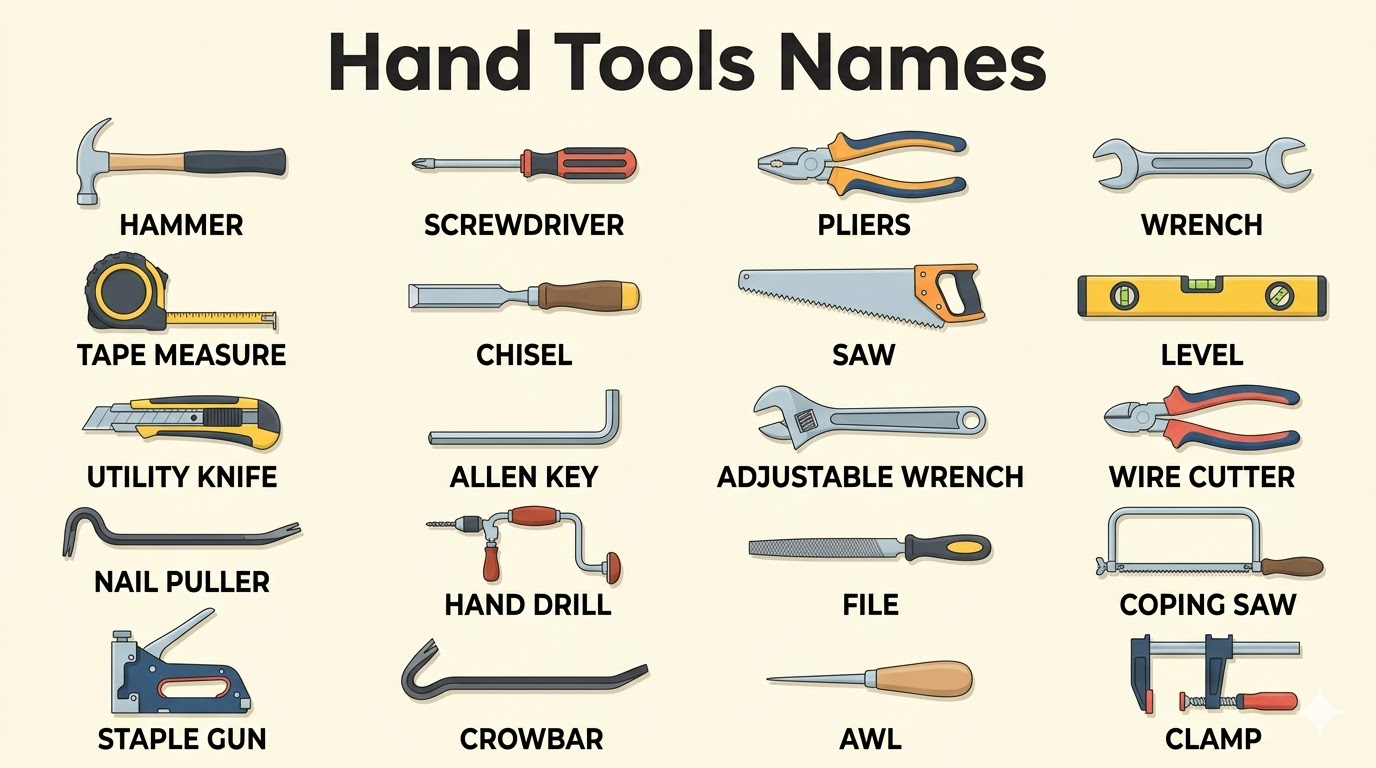
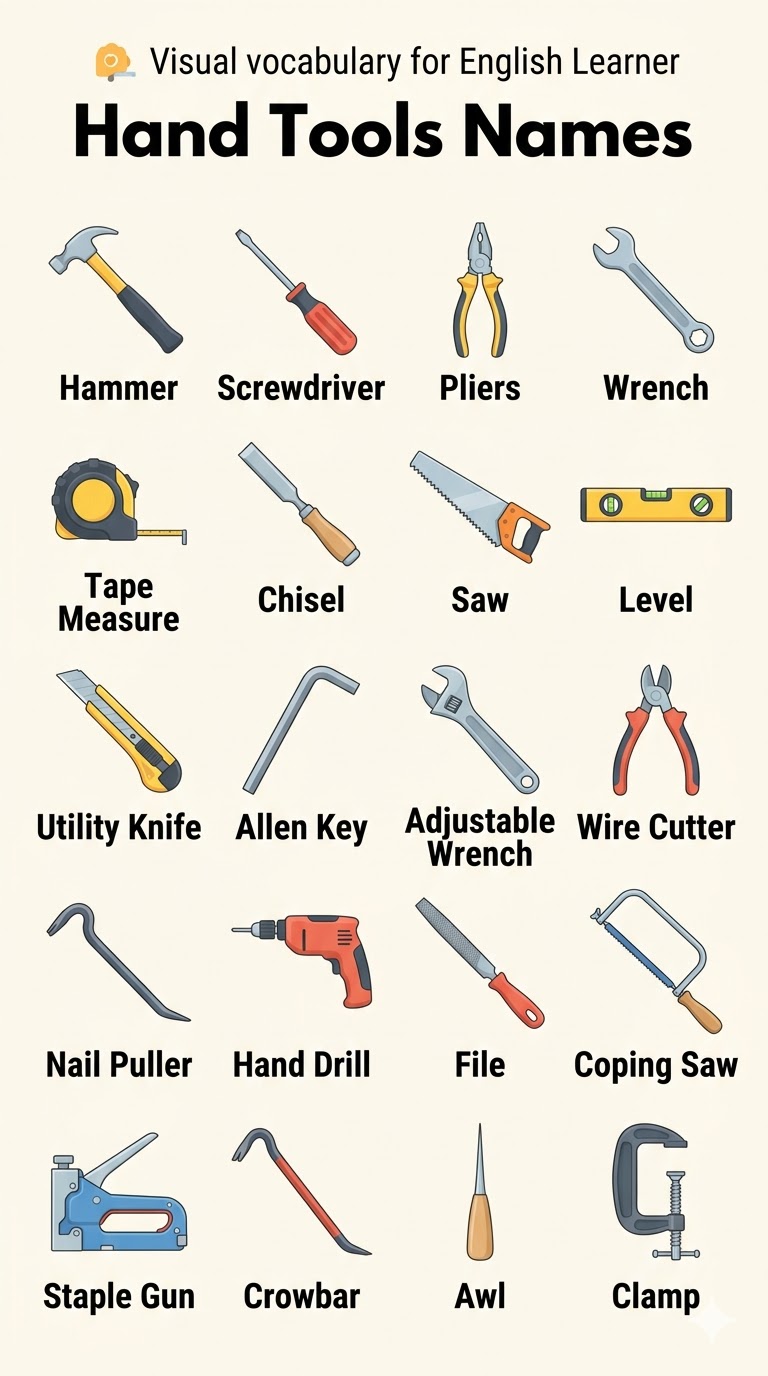
Here are important hand tools and their functions:
- Hammer – Used to drive nails into wood or surfaces.
- Screwdriver – Turns screws to fasten or loosen objects.
- Pliers – Grips, bends, or cuts wires and materials.
- Wrench (Spanner) – Tightens or loosens nuts and bolts.
- Tape Measure – Measures length, width, and height.
- Chisel – Cuts or shapes wood, metal, or stone.
- Saw – Cuts wood, metal, or plastic.
- Level – Checks if surfaces are horizontal or vertical.
- Utility Knife – Cuts materials like cardboard, paper, or plastic.
- Allen Key (Hex Key) – Tightens hexagonal bolts and screws.
- Adjustable Wrench – Fits various sizes of nuts and bolts.
- Wire Cutter – Cuts electrical or thin metal wires.
- Nail Puller (Claw Tool) – Removes nails from surfaces.
- Hand Drill – Drills small holes manually.
- File – Smooths rough edges of wood or metal.
- Coping Saw – Cuts intricate curves in wood or plastic.
- Staple Gun – Fastens materials like fabric or paper with staples.
- Crowbar (Pry Bar) – Pulls nails or pries objects apart.
- Awl – Pokes holes in wood, leather, or fabric.
- Clamp – Holds materials tightly while working.
Types of Hand Tools with Names
Hand tools are grouped based on their purpose:
Cutting Tools
Tools used to cut materials like wood, metal, or plastic:
- Handsaw
- Hacksaw
- Coping Saw
- Utility Knife (Box Cutter)
- Wire Cutter/Wire Stripper
- Tin Snips
- Chisel (Wood Chisel, Cold Chisel)
- Bolt Cutter
- Scissors (Heavy-duty / Shears)
- Cable Cutter
Striking Tools
Tools used to hit, drive, or shape materials:
- Hammer (Claw Hammer, Ball Peen Hammer, Sledgehammer)
- Mallet (Rubber Mallet, Wooden Mallet)
- Axe/Hatchet
- Mace Hammer
- Punch Tool
Fastening Tools
Tools used to tighten, loosen, or secure objects:
- Screwdriver (Flathead, Phillips, Torx, Robertson)
- Wrench (Open-end, Box-end, Combination)
- Adjustable Wrench
- Allen Key/Hex Key
- Ratchet Wrench and Socket Set
- Nut Driver
- Torque Wrench
- Pliers (Slip-joint, Needle-nose, Locking / Vise-grip)
- Pipe Wrench
- Crimping Tool
Measuring and Layout Tools
Tools used to measure, mark, or check alignment:
- Tape Measure
- Steel Ruler
- Square (Try Square, Combination Square)
- Level (Spirit Level / Bubble Level)
- Caliper (Vernier Caliper / Digital Caliper)
- Protractor
- Marking Gauge
- Chalk Line/String Line
- Angle Finder
Gripping, Holding, and Clamping Tools
Tools used to hold, grip, or stabilize objects:
- Pliers (Needle-nose, Slip-joint, Locking)
- Clamps (C-clamp, F-clamp, Spring Clamp)
- Vise/Bench Vise
- Pipe Clamp
- Tweezers
- Tongs
Boring and Drilling Tools
Tools used to drill or make holes:
- Hand Drill/Brace and Bit
- Auger Bit
- Gimlet
- Countersink Tool
- Twist Drill
Surface Preparation Tools
Tools used for smoothing, cleaning, or shaping surfaces:
- File/Rasp
- Sanding Block
- Scraper (Paint Scraper, Putty Scraper)
- Wire Brush
- Spokeshave
- Plane (Woodworking Plane)
Specialty and Miscellaneous Hand Tools
Other hand tools used for specific purposes:
- Crowbar/Pry Bar
- Nail Puller/Claw Tool
- Awl/Scratch Awl
- Punch/Center Punch
- Hacksaw Frame
- Hand Crank Grinder
- Staple Gun/Tack Gun
- Multi-tool (Pocket Knife/Leatherman style)
- Clamp Meter/Hand Testing Tools
Tips to Remember Hand Tools Names
Use pictures
Visuals help learners connect tool names with their shapes and functions.
Group by function
Study cutting, striking, gripping, fastening, and measuring tools separately.
Practice using sentences
Example: I used a hammer to fix the wooden frame.
Review regularly
Frequent practice helps learners remember vocabulary longer.
Conclusion
Hand tools are essential for repair, construction, and DIY tasks. Each tool has a specific purpose that helps people work safely and accurately.
Learning hand tools names and uses improves practical vocabulary and helps English learners understand instructions, manuals, and technical discussions. When learners recognize these words, they can describe tools, follow work processes, and complete tasks confidently.
FAQs
What are hand tools?
Hand tools are manual instruments used to build, repair, or fix objects. They do not require electricity and help complete tasks safely and accurately.
What is a hammer used for?
A hammer is used to drive nails into wood or other surfaces. It can also help remove nails using the claw end.
What does a screwdriver do?
A screwdriver tightens or loosens screws. Different types of screwdrivers, like flathead or Phillips, fit different screw heads.
What are pliers used for?
Pliers grip, bend, or cut wires and materials. They help hold objects firmly during construction or repair work.
What is a wrench and how is it used?
A wrench (or spanner) tightens or loosens nuts and bolts. An adjustable wrench can fit various sizes of fasteners.
What is a tape measure used for?
A tape measure measures length, width, and height. It is important for construction, DIY, and woodworking projects.
How is a saw used?
A saw cuts wood, metal, or plastic. Different saw types, like hand saw or coping saw, are used for straight or curved cuts.
What does a level do in construction?
A level checks if surfaces are horizontal or vertical. It ensures that objects like shelves, walls, and frames are straight.
Related Articles: