
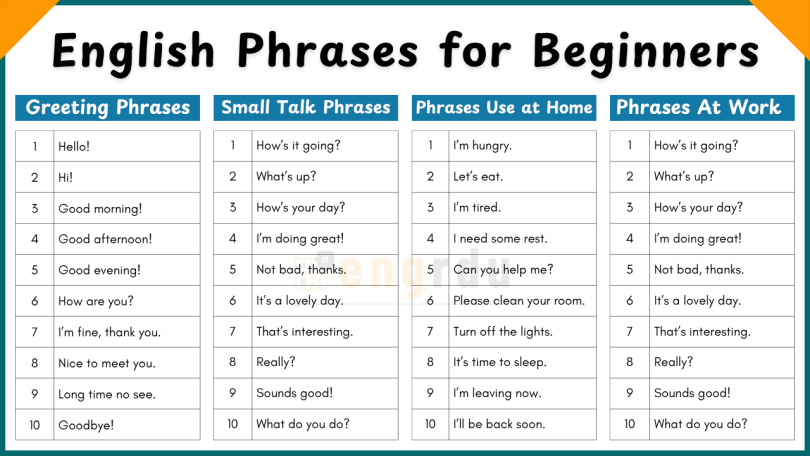

In this blog post, you will learn daily-used English phrases for beginners, with a PDF for easy practice. Knowing these phrases helps you understand everyday conversations at home, school, or in public places. It also improves your speaking and listening skills because you can communicate confidently in daily situations. By practicing these phrases regularly, you can also enhance your reading and writing skills. Learning daily-use English phrases will make your English more practical, natural, and easy to use every day.
Basic Greeting Phrases for Beginners
When meeting someone, your first impression often comes from a simple greeting. These basic English phrases are the perfect way to start:
- Hello!
- Hi!
- Good morning!
- Good afternoon!
- Good evening!
- How are you?
- I’m fine, thank you.
- Nice to meet you.
- Long time no see.
- Goodbye!

Basic Greeting Phrases in English
100 Common English Phrases for Small Talk
Once the greeting is done, it’s time for a little small talk. These daily phrases are your go-to lines to keep conversations going casually:
- How’s it going?
- What’s up?
- How’s your day?
- I’m doing great!
- Not bad, thanks.
- It’s a lovely day.
- That’s interesting.
- Really?
- Sounds good!
- What do you do?

Small Talk Phrases
Daily Used English Phrases at Home
Home is where we use English in its simplest and most casual form. These are great for everyday situations with family or roommates:
- I’m hungry.
- Let’s eat.
- I’m tired.
- I need some rest.
- Can you help me?
- Please clean your room.
- Turn off the lights.
- It’s time to sleep.
- I’m leaving now.
- I’ll be back soon.

Daily Used English Phrases at Home
Short Phrases At Work or School
Whether you’re at the office or in class, certain English expressions come in handy every day:
- I have a question.
- Can you explain this?
- Let’s start.
- Please be quiet.
- What time is the meeting/class?
- I don’t understand.
- Can you repeat that?
- That makes sense.
- Good job!
- Let’s take a break.
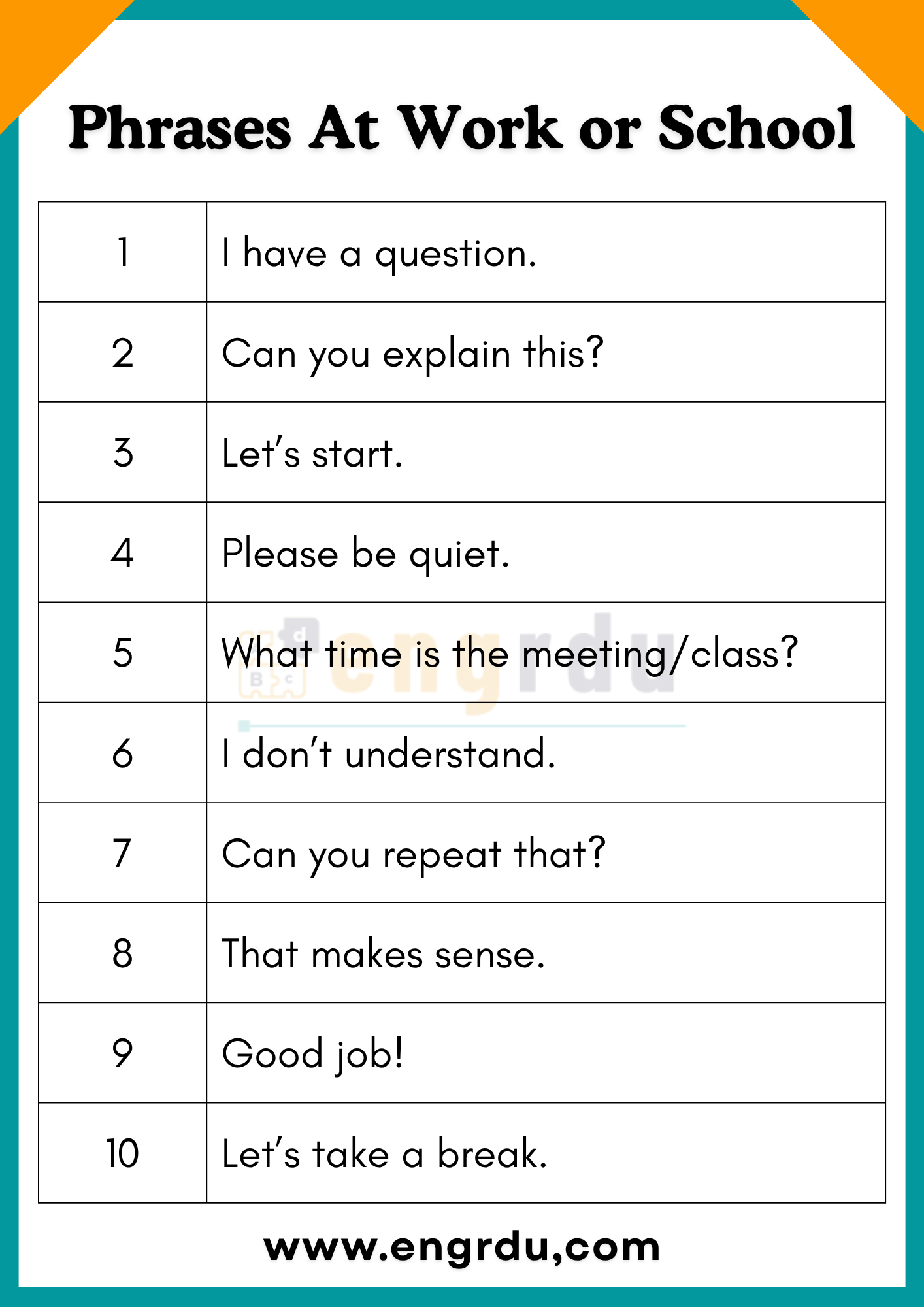
Phrases At Work or School
Everyday Phrases for Beginners in English
These phrases are very useful and they are commonly used in many different situations:
- Thank you!
- You’re welcome.
- Excuse me.
- I’m sorry.
- No problem.
- Be careful!
- What happened?
- That’s amazing!
- I agree.
- Let’s go!
Everyday Phrases with Meanings
In this section, you will learn everyday phrases with their meanings.
- Break the ice
To start a conversation in a social setting to relieve tension or awkwardness. - Hit the nail on the head
To describe exactly what is causing a situation or problem. - Let the cat out of the bag
To accidentally reveal a secret. - Bite the bullet
To do something unpleasant or difficult that you’ve been putting off. - Under the weather
Feeling sick or unwell. - Spill the beans
To reveal a secret or disclose information. - Piece of cake
Something that is very easy to do. - Once in a blue moon
Something that happens very rarely.
FAQs About Phrases for Beginners
What are Daily Used English Phrases for Beginners?
Daily Used English Phrases for Beginners are simple and common expressions that help learners communicate in everyday situations. They include greetings, questions, polite requests, and basic conversation patterns, making it easier for beginners to speak and understand English naturally.
What types of phrases are included in beginner lessons?
These lessons include greetings, polite requests, questions, responses, travel phrases, and common expressions used at home or school. Each phrase is shown with a simple example to make learning easy and practical.
Are these phrases useful for kids?
Yes, daily English phrases are very useful for kids. They help children learn simple greetings, questions, and everyday expressions, making it easier to speak, understand, and communicate in English confidently at school, home, or with friends.
How can learners practice these daily English phrases?
Students can practice by reading aloud, repeating phrases, writing sentences, and using them in conversations. Teachers can use role-plays, dialogues, and exercises to help learners use phrases naturally and confidently.
Read More






Leave a Comment