
How do you begin writing when you know what you want to say but cannot find the right first sentence? An introduction gives your writing a starting point, introduces the topic, provides context, and shows readers the main idea.
Whether you are writing an essay, school assignment, report, article, email, presentation, or personal piece, the opening should tell readers what they are about to read and why the topic matters.
This article explains what an introduction is, what it should contain, how to structure one, and how to write introductions for different types of writing with practical examples.
What Is an Introduction?
An introduction is the opening section of a piece of writing that prepares readers for the topic, provides context, and presents the main idea or thesis.
It usually appears at the beginning of an essay, article, report, paper, school assignment, or other written work.
A good introduction tells the reader:
- What is the topic?
- What is the main idea?
- What background information is needed?
- What will the writing discuss?
- What should the reader expect next?
An introduction can be one paragraph or several paragraphs, depending on the type and length of the writing.
Example
Topic: The Importance of Reading
Reading is an important part of education because it develops vocabulary, improves concentration, and exposes students to new ideas. However, many students spend less time reading because of digital entertainment. Schools and families can encourage regular reading by providing interesting books and creating dedicated reading time.
The first sentence introduces the topic. The next sentence provides context, and the final sentence presents the main direction of the discussion.
Complete Guide on How to Write an Introduction
Introduction Meaning and Pronunciation
The word introduction means the beginning section that presents a person, subject, idea, or piece of writing.
Pronunciation: /ˌɪn.trəˈdʌk.ʃən/
Introduction can be used in several common ways.
| Use | Example |
|---|---|
| Beginning of writing | The introduction explains the main topic. |
| Meeting someone | She gave a short introduction before the presentation. |
| Presenting a subject | The teacher gave an introduction to grammar. |
| Beginning of a speech | His introduction caught everyone’s attention. |
| Presenting yourself | I wrote a short introduction about myself. |
Introduction vs. Intro
Introduction is the full and formal word.
Intro is an informal shortened form.
- Formal: The introduction explains the purpose of the report.
- Informal: Let’s start with a short intro.
What an Introduction Does
An introduction does more than begin your writing. It gives the reader a clear starting point and establishes the direction of the whole piece.
1. It introduces the topic
The reader should know what the writing is about.
Example: Online learning has become an important part of modern education.
2. It provides necessary context
Give the reader enough background to understand the subject.
Example: Many schools now use online platforms to provide lessons, assignments, and educational resources.
3. It establishes the purpose
Tell the reader what the writing will explain, discuss, compare, or argue.
Example: This article explains how online learning can support students and what challenges they may face.
4. It presents the main idea
In academic writing, this is often called the thesis statement.
Example: Online learning can improve access to education, but students need reliable technology and regular support to succeed.
5. It prepares readers for what follows
A good opening creates a logical connection between the introduction and the body of the writing.
The Main Parts of an Introduction
Most effective introductions contain three main parts:
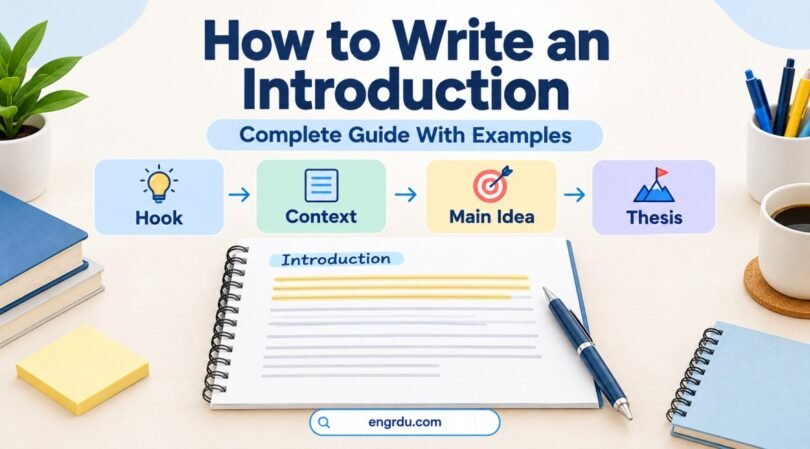
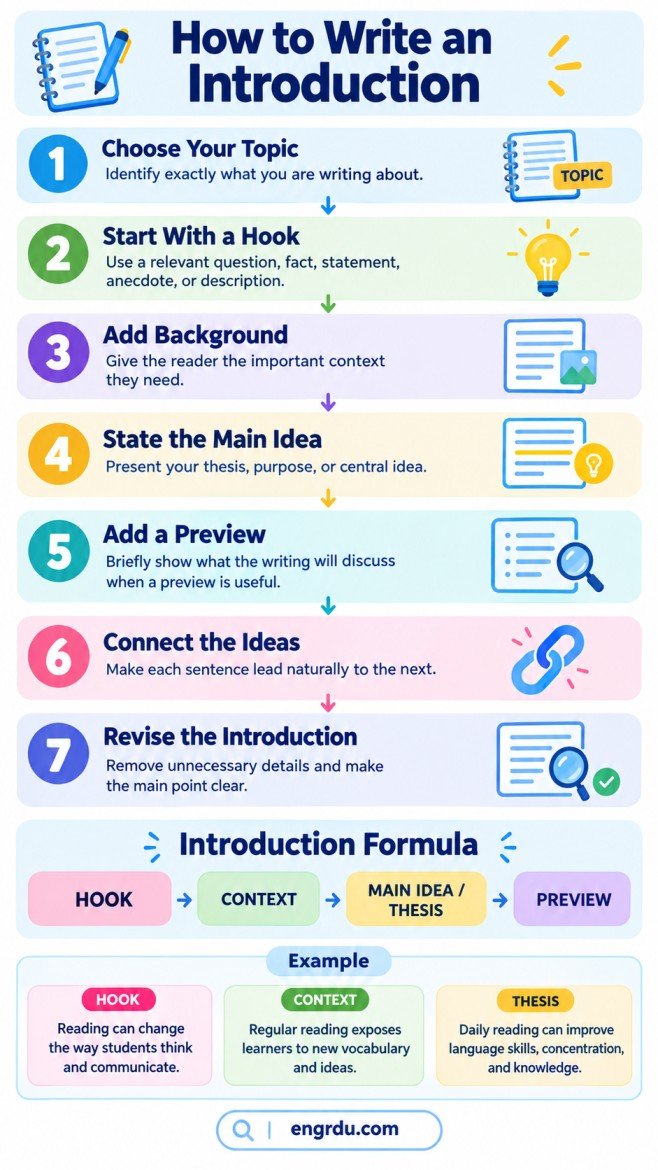
Hook → Context → Main Idea or Thesis
Longer academic or professional writing may also include a short preview.
| Part | Purpose | Example |
|---|---|---|
| Hook | Gets attention | Every day, millions of people use social media to communicate. |
| Context | Explains the situation | Social media has changed how people share information and maintain relationships. |
| Thesis | States the central idea | However, excessive use can affect concentration, sleep, and face-to-face communication. |
| Preview | Shows the coming points | This essay examines these effects and possible solutions. |
You do not always need all four parts. The structure should match the purpose of your writing.
Start With a Relevant Hook
A hook is the opening idea that gives readers a reason to continue.
The best hook is not necessarily dramatic. It should be relevant to the topic and appropriate for the audience.
Use a Question
What would happen if students stopped reading books regularly?
This works when the question leads directly into the topic.
Use a Fact
Many students spend several hours each day using digital devices.
A factual opening can quickly establish the subject.
Use a Strong Statement
Good communication can prevent many workplace problems.
A direct statement works well for professional and informative writing.
Use a Short Anecdote
When I entered my first classroom, I was too nervous to say a single word.
A personal experience works particularly well in personal essays and reflective writing.
Use a Description
The classroom was quiet except for the sound of pages turning.
A descriptive opening can introduce a personal, narrative, or creative topic.
Avoid an Unrelated Hook
Weak:
Everyone likes having a good day.
Better:
Regular exercise can improve both physical fitness and daily energy.
The second sentence immediately connects with the topic.
Add Only the Background the Reader Needs
After the opening, provide enough information to place the topic in context.
Do not turn the introduction into the entire background section.
Weak
Climate change has existed for a long time. There are many countries around the world. People live in cities and villages. Some people drive cars, while others use buses. Factories produce many products.
These sentences move in different directions.
Better
Rising temperatures are affecting weather patterns, ecosystems, and communities around the world. Human activities such as burning fossil fuels contribute significantly to greenhouse gas emissions.
The background directly supports the topic.
A useful rule
Ask:
What does my reader need to know before reading my main point?
Include that information and leave detailed evidence, examples, and explanations for later sections.
End With a Clear Main Idea or Thesis
A thesis statement tells readers the central point of an essay, paper, or argument.
Weak thesis
This essay is about exercise.
It tells the topic but not the main point.
Strong thesis
Regular exercise supports physical and mental health by improving fitness, reducing stress, and supporting better sleep.
The second version gives the reader a clear idea of what the writing will discuss.
A useful thesis pattern
You can use:
Topic + main point + supporting ideas
For example:
School uniforms can benefit students by reducing clothing-related pressure, creating a consistent school identity, and making daily preparation easier.
Not every introduction needs a formal thesis. Blog posts, emails, personal writing, and short answers may use a direct purpose statement instead.
Add a Preview When the Writing Is Long
A preview sentence briefly tells readers what the main sections will cover.
It is particularly useful in longer essays, research papers, and reports.
Example
This essay examines the main causes of water pollution, its effects on communities, and practical ways to reduce it.
The reader immediately knows the direction of the discussion.
For short writing, a preview sentence may be unnecessary.
How to Write an Introduction Step by Step
Writing becomes easier when you decide what the introduction needs to accomplish before choosing individual sentences.
Step 1: Identify Your Topic
First, decide exactly what you are writing about.
Topic: Healthy eating
This is still broad.
Narrowing it gives you a stronger direction.
Focused topic: How healthy eating affects school students
Now the reader knows the specific subject.
Step 2: Decide Your Purpose
Ask what you want your writing to do.
Your purpose might be to:
- explain
- describe
- inform
- compare
- persuade
- argue
- tell a personal experience
- present a recommendation
- introduce a subject
Example
Topic: School uniforms
Purpose: Persuade readers that schools should provide affordable uniforms.
Your introduction should support that purpose.
Step 3: Identify Your Main Point
Write your main idea in one sentence before building the introduction.
Schools should provide affordable uniforms because they reduce financial pressure on families and create a consistent dress standard.
This sentence gives you a clear direction.
Step 4: Choose an Appropriate Opening
Select a hook that fits the topic.
For example:
Every morning, students make dozens of small decisions before leaving for school, including what to wear.
This can naturally lead into a discussion about school uniforms.
Do not choose a hook merely because it sounds interesting. It should connect directly to the subject.
Step 5: Add Brief Context
Move from the opening idea toward your main point.
Clothing choices can sometimes create financial pressure and differences between students.
Now the reader understands why the topic matters.
Step 6: State the Main Idea
Bring the introduction to its central point.
Schools should provide affordable uniforms because they can reduce financial pressure and create a consistent dress standard.
Step 7: Connect the Sentences
The introduction should feel like one connected thought.
Complete example
Every morning, students make dozens of small decisions before leaving for school, including what to wear. Clothing choices can sometimes create financial pressure and visible differences between students. Schools should provide affordable uniforms because they can reduce financial pressure and create a consistent dress standard.
Step 8: Revise After Writing the Main Body
You do not have to write the final introduction first.
Sometimes the main body changes your ideas. After completing the writing, check whether the introduction accurately matches what follows.
Look for:
- unnecessary information
- unclear sentences
- a weak main point
- repeated ideas
- information that belongs in the body
- a thesis that no longer matches the writing
Introduction Structure for Different Types of Writing
The same structure does not work equally well for every type of writing.
| Writing type | Main focus of the introduction |
|---|---|
| Essay | Topic, context, thesis |
| Research paper | Research topic, background, research focus |
| Report | Purpose, situation, findings or direction |
| Article | Topic, reader interest, main information |
| Personal essay | Experience, situation, personal focus |
| Greeting, purpose, relevant context | |
| Speech | Audience connection, topic, purpose |
| Presentation | Topic, purpose, key points |
| Story | Setting, situation, character, conflict |
The writing situation determines the best opening.
How to Write an Essay Introduction
An essay introduction usually moves from the general topic toward the specific argument.
Basic structure
Hook → Background → Thesis
Example
Topic: The Benefits of Reading
Books provide more than information; they can also influence how people think and communicate. Regular reading exposes students to new vocabulary, ideas, and writing styles. For this reason, schools should encourage daily reading because it can improve language skills, concentration, and general knowledge.
Structure breakdown
- Hook: Books provide more than information.
- Background: Reading exposes students to vocabulary, ideas, and writing styles.
- Thesis: Schools should encourage daily reading because of its benefits.
How to Write a Research Paper Introduction
A research introduction usually provides more context than a short essay introduction.
Common structure
Topic → Background → Research problem → Main claim or purpose → Optional preview
Example
Plastic waste has become a major environmental concern because large quantities of plastic enter landfills, rivers, and oceans every year. Although plastic products are useful in many areas of daily life, their long-lasting environmental effects have increased concern about waste management. This paper examines how improved recycling systems, reduced single-use plastics, and consumer education can help reduce plastic waste.
The introduction gives the reader enough context to understand the research focus without presenting all the evidence.
How to Write a Report Introduction
A report introduction should usually be direct and purpose-focused.
Example
This report examines the main causes of delays in the company’s delivery process. Customer feedback, staff reports, and delivery records indicate that scheduling problems and poor communication are the main factors. The report recommends three changes to improve delivery times and communication between departments.
Notice that the introduction quickly explains:
- the purpose
- the source of information
- the main issue
- the direction of the report
How to Write an Article Introduction
An article introduction should quickly answer the reader’s reason for visiting the page.
Example
Writing a strong introduction can be difficult when you do not know how to begin. A good opening introduces the topic, gives readers the context they need, and presents the main point without unnecessary detail. The right structure depends on whether you are writing an essay, article, report, email, or personal piece.
This type of introduction works because it addresses the reader’s problem immediately.
How to Write a Personal Introduction
Personal writing often allows a more conversational opening.
Example
I had always been nervous about speaking in front of a class. One morning, my teacher asked me to give a five-minute presentation without any preparation. That experience changed the way I thought about public speaking and taught me how preparation can build confidence.
The introduction gives the reader:
- a personal situation
- a specific moment
- the main lesson
How to Write an Introduction About Yourself
When introducing yourself, the structure is different because the subject is you.
Basic structure
Name → Background → Role or interests → Purpose
Short example
My name is Ali, and I am a secondary school student from Lahore. I enjoy learning English and reading science books. I am particularly interested in improving my speaking and writing skills.
Professional example
My name is Ahmed Khan, and I work as a graphic designer with experience in digital design and WordPress websites. I specialise in creating educational and visual content. I am pleased to be part of this project and look forward to working with the team.
Keep a self-introduction relevant to the situation.
You do not need to provide your complete life history.
How to Write an Introduction for an Email
An email introduction should quickly explain who you are and why you are writing.
Example
Dear Mr Ahmed,
My name is Sara Khan, and I am a student in Class 10 at City School. I am writing to ask about the upcoming science competition and the registration process.
The recipient immediately knows:
- who the sender is
- why the sender is contacting them
- what the email concerns
For a professional email, avoid long personal details before stating the purpose.
Introduction Examples for Different Situations
Argumentative Essay Introduction
Social media has changed the way people communicate, but constant online interaction can create problems. Young people may spend less time communicating face to face while becoming increasingly dependent on digital platforms. Schools should teach responsible social media use because it can help students manage screen time, protect their privacy, and communicate more effectively.
Compare-and-Contrast Essay Introduction
Online classes and traditional classrooms both provide opportunities for education, but they offer different learning experiences. Online education gives students greater flexibility, while classroom learning provides direct interaction with teachers and classmates. Comparing these two approaches shows how technology, communication, and learning environments affect students differently.
Descriptive Essay Introduction
The old library stood quietly at the end of the school corridor. Tall wooden shelves covered its walls, and sunlight entered through three dusty windows. Every afternoon, I went there to read because the quiet atmosphere made the room feel like a private world.
Narrative Essay Introduction
I knew something had gone wrong when the lights suddenly went out during the school performance. The audience became silent, and everyone on the stage looked toward the teacher. What happened during the next ten minutes became one of the most memorable moments of my school life.
Informative Essay Introduction
Sleep plays an important role in physical health, concentration, and daily performance. Students who do not get enough sleep may find it harder to focus in class and complete their work. Understanding the causes and effects of poor sleep can help students develop healthier routines.
Presentation Introduction
Good morning, everyone. Today I am going to talk about the importance of reading. We will look at how reading develops vocabulary, improves concentration, and helps students gain knowledge.
Speech Introduction
Imagine going through an entire day without speaking to another person. Communication is such a regular part of our lives that we often forget how much it affects our relationships, education, and work. Today, I want to discuss why effective communication matters.
Strong and Weak Introduction Examples
Comparing two versions can help you see what makes an opening effective.
Weak Introduction
Exercise is important. Many people exercise. Exercise is good for health. There are many types of exercise. This essay will discuss exercise.
Problems
- Repeats the same word and idea.
- Gives little useful information.
- Has no clear direction.
- Uses a weak thesis.
Stronger Introduction
Regular exercise can improve physical fitness, mood, and daily energy. However, busy schedules often make it difficult for people to remain active. Building short periods of physical activity into the day can help people maintain healthier routines without requiring long gym sessions.
The second version develops one connected idea and gives the reader a clear direction.
Introduction Templates You Can Adapt
Templates can help when you are not sure how to begin. Change the wording to match your topic instead of copying the sentences exactly.
General Essay
[Opening idea]. [Brief background or context]. [Main point or thesis].
Argumentative Writing
[Relevant issue or fact]. Although [opposing or different view], [your position] because [reason 1] and [reason 2].
Informative Writing
[Topic] affects [people/place/situation] in several ways. Understanding [specific aspect] helps explain [main point].
Personal Essay
I remember [specific moment]. At the time, [brief context]. That experience taught me [main lesson].
Report
This report examines [subject]. The available information shows [main finding or problem]. It recommends [main action or solution].
My name is [name], and I am [role/background]. I am writing regarding [specific purpose].
How Long Should an Introduction Be?
There is no single correct length for every introduction.
The length should match the writing.
| Type | Typical approach |
|---|---|
| Short answer | 1–3 sentences |
| 1 short paragraph | |
| School essay | Usually 1 paragraph |
| Article | 1–3 short paragraphs |
| Research paper | 1 or more paragraphs |
| Report | Usually a concise paragraph |
| Speech | A short opening section |
| Personal essay | Usually 1 paragraph |
Do not add sentences merely to make the introduction longer.
A useful introduction contains enough information to establish the topic and direction without giving away the entire discussion.
When Should You Write the Introduction?
You can write an initial introduction before the main body or return to it later.
Write it first when:
- You already know your main argument.
- You understand the structure.
- You need an opening to guide your writing.
Write or revise it later when:
- Your ideas are still changing.
- You are unsure of your thesis.
- Your body paragraphs developed in an unexpected direction.
- You want the opening to accurately reflect the completed work.
A practical approach is to write a rough opening first and revise it after completing the main content.
How to Make an Introduction Stronger
Use these checks when revising.
Make the topic specific
Weak:
Technology is important.
Better:
Digital technology has changed how students communicate, study, and access educational resources.
Remove unnecessary background
Weak:
Humans have used many different methods of communication throughout history, and communication has always been an important part of society.
Better:
Digital communication now allows students to exchange information within seconds.
Replace vague claims
Weak:
This topic is very important in today’s world.
Better:
Rising food prices are affecting how families plan their weekly budgets.
Make the main point visible
Weak:
There are many things to consider about school uniforms.
Better:
Affordable school uniforms can reduce clothing-related financial pressure on families.
Common Introduction Mistakes
Keep these problems out of your opening:
- Too much background: Save detailed history, evidence, and examples for the body.
- Weak main point: Do not leave readers guessing about your purpose.
- Unrelated hook: An interesting sentence is useless if it does not connect to the topic.
- Repeating the title: Simply restating the topic does not create a useful introduction.
- Too many ideas: Focus on the subject and direction of the writing.
Key Points to Remember
- An introduction is the opening section of a piece of writing.
- It introduces the topic and gives readers the context they need.
- Most essay introductions move from an opening idea to background and then to a thesis.
- A hook should be relevant rather than dramatic just for attention.
- A thesis states the central idea, argument, or purpose.
- A preview sentence can help readers follow longer academic or professional writing.
- Different writing situations require different introduction structures.
- Emails usually need a direct purpose rather than a formal essay-style thesis.
- Personal writing can use an experience, memory, or observation as the opening.
- Revising the introduction after completing the main content can make it more accurate and focused.
- Remove information that does not help the reader understand the topic or purpose.
FAQs
What is the main purpose of an introduction?
The main purpose of an introduction is to introduce the topic, provide relevant context, and show readers the central idea or purpose.
What are the three main parts of an introduction?
The three common parts are a hook, brief background or context, and a thesis or main idea.
How long should an introduction be?
An introduction should be long enough to establish the topic and direction, but its length depends on the type and size of the writing.
Should every introduction have a hook?
No. A hook can be useful, but short emails, reports, and professional documents often work better with a direct opening.
What is a thesis statement in an introduction?
A thesis statement expresses the central argument, position, purpose, or main idea that the rest of the writing develops.
Can I write my introduction last?
Yes. Many writers create a rough introduction first and revise it after completing the main content.
What should I avoid in an introduction?
Avoid unrelated information, excessive background, repeated ideas, vague claims, weak thesis statements, and details that belong in the body.
How do I start an introduction about myself?
Start with your name, then briefly mention your background, role, interests, or reason for introducing yourself, depending on the situation.
Conclusion
A good introduction tells readers where the writing is going before they enter the main discussion. Start with a relevant opening, provide only the background readers need, and finish with a focused main idea or thesis when appropriate.
The exact structure depends on what you are writing. An essay may need a thesis, a report may need a direct purpose, an email may begin with the reason for writing, and a personal essay may begin with an experience. Choose the structure that fits the purpose, then revise the opening so every sentence leads naturally to the main point.