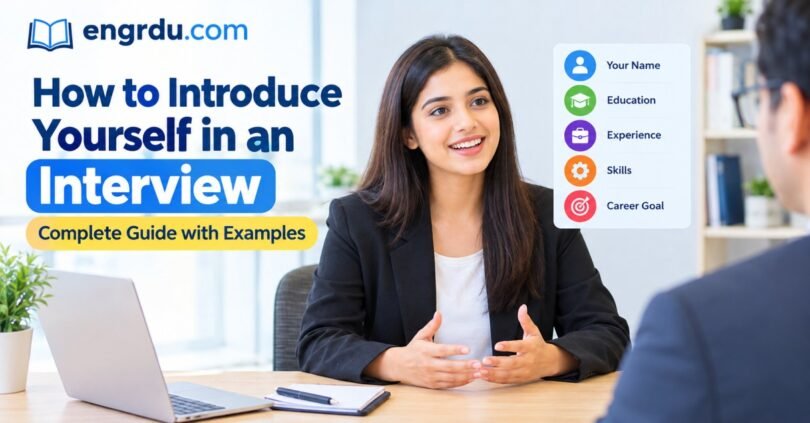

How to Introduce Yourself in an Interview can feel difficult when you are unsure what to say first. A good interview introduction should briefly present your name, background, skills, experience, and career goal without giving unnecessary details.
The best introduction is organised, relevant to the position, and easy for the interviewer to follow. In this article, you will find useful structures and examples for students, freshers, experienced candidates, and English learners.
What to Say When the Interviewer Says “Tell Me About Yourself”
When an interviewer says “Tell me about yourself,” they usually want a short professional introduction related to your education, experience, skills, and the position.
You do not need to tell your complete life story.
A useful answer can include:
- Your name
- Your education or current position
- Your relevant experience
- Your main skills
- Your career interest or goal
- A short reason you are interested in the position
Example
“My name is Ahmed Ali. I recently completed my bachelor’s degree in Business Administration. During my studies, I developed strong communication and computer skills. I also completed an internship in a local company, where I gained experience in customer support. I am interested in this position because I want to develop my professional skills and contribute to your team.”
How to Structure Your Interview Introduction
A strong introduction normally follows this order:
| Part | What to Say | Example |
|---|---|---|
| 1. Greeting | Greet the interviewer | “Good morning.” |
| 2. Name | Say your name | “My name is Sara Khan.” |
| 3. Background | Give your education or current role | “I recently completed my degree in English.” |
| 4. Experience | Mention relevant experience | “I worked as a teaching assistant for one year.” |
| 5. Skills | Mention two or three useful skills | “I have strong communication and organisational skills.” |
| 6. Goal | Connect yourself with the position | “I am looking for an opportunity to grow as an English teacher.” |
Keep the introduction focused. Include information that helps the interviewer see why you are suitable for the position.
A Simple Interview Self-Introduction Formula
You can use this structure:
Greeting + Name + Education/Current Role + Experience + Skills + Career Goal
Fill-in-the-Blank Structure
“Good morning. My name is ____. I have completed ____ from ____. I have ____ years/months of experience in ____. My main skills are ____, ____, and ____. I am interested in this position because ____. I look forward to contributing to your organisation.”
You do not have to use every sentence. Adjust the structure according to your experience and the job.
How to Start Your Introduction
Start with a polite greeting and your name. If appropriate, thank the interviewer for the opportunity.
Useful Opening Lines
- “Good morning. Thank you for giving me this opportunity.”
- “Good afternoon. My name is Ali Khan.”
- “Thank you for inviting me to the interview.”
- “It is a pleasure to meet you. My name is Maria.”
Avoid Long Openings
Do not spend too much time on greetings.
Too long:
“First of all, I would like to say that I am extremely grateful and very happy to have received this wonderful opportunity…”
Better:
“Good morning. Thank you for giving me this opportunity. My name is Ali Khan.”
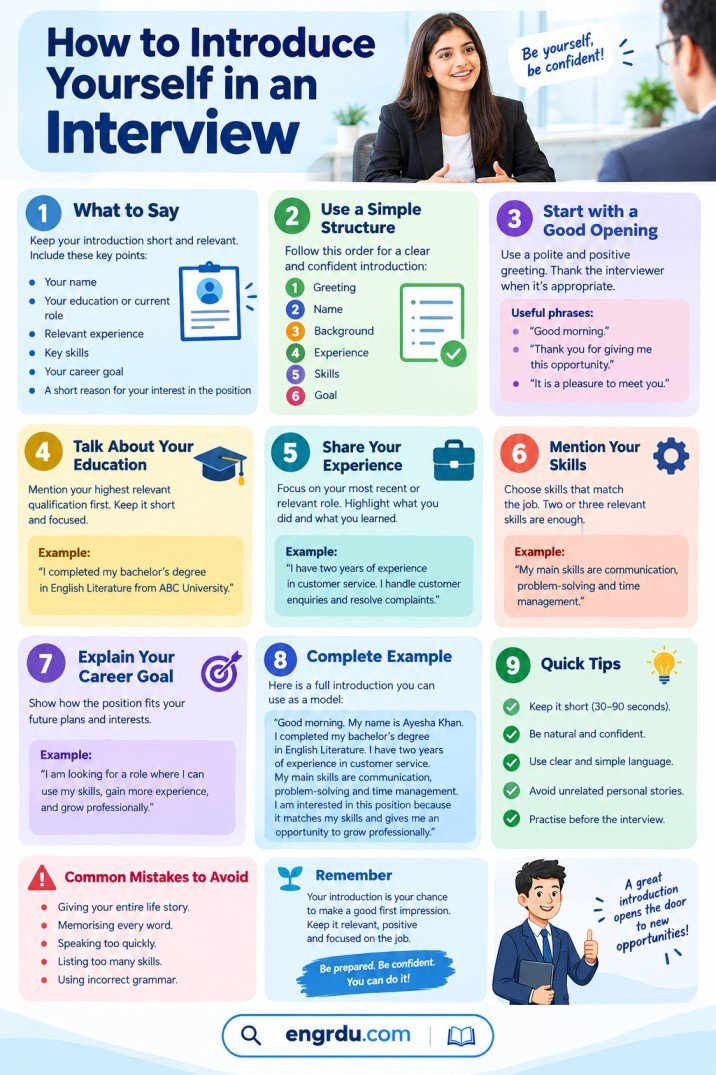
How to Introduce Yourself in an Interview
How to Talk About Your Education
Mention your highest relevant qualification first. You can include your subject, institution, or graduation year when it is useful.
Example for a Student
“I am currently studying for a bachelor’s degree in Computer Science. My main areas of interest are web development and programming.”
Example for a Graduate
“I completed my bachelor’s degree in English Literature from ABC University. During my studies, I developed strong writing and communication skills.”
Example for a Recent Graduate
“I recently graduated with a degree in Accounting. My coursework gave me a strong foundation in financial reporting and data analysis.”
Do not list every school, course, or qualification unless the interviewer asks for more details.
How to Talk About Your Work Experience
If you have experience, mention your current or most recent role and focus on responsibilities related to the position.
Example
“I have three years of experience in customer service. In my current role, I handle customer enquiries, resolve complaints, and maintain customer records.”
Use Specific Work Details
Instead of:
“I have experience in marketing.”
Say:
“I have two years of experience in digital marketing, including social media management, content planning, and basic SEO.”
Specific details make your introduction more useful and credible.
How to Mention Your Skills
Choose skills that match the job. Usually, two or three relevant skills are enough.
Common Interview Skills
- Communication
- Teamwork
- Time management
- Problem-solving
- Leadership
- Customer service
- Computer skills
- Organisation
- Research
- Writing
- Data analysis
Example
“My strongest skills are communication, problem-solving, and time management. I am also comfortable working independently and as part of a team.”
Avoid giving a long list of skills without examples or relevance to the position.
How to Explain Your Career Goal
Your career goal should show why the position interests you and how it fits your professional plans.
Example
“I am looking for a position where I can use my communication skills, gain more experience in customer service, and grow professionally.”
For a Fresh Graduate
“As a recent graduate, I am looking for an opportunity where I can apply my academic knowledge and develop practical skills.”
For an Experienced Professional
“I am looking for a role where I can use my management experience and take on greater responsibility.”
Complete Interview Introduction Examples
Example 1: Fresh Graduate
“Good morning. My name is Hamza Ahmed. I recently completed my bachelor’s degree in Business Administration. During my studies, I developed strong communication, teamwork, and computer skills. I also completed an internship in sales, where I learned how to communicate with customers and prepare sales reports. I am interested in this position because it matches my skills and gives me an opportunity to grow professionally.”
Example 2: Experienced Candidate
“Good morning. My name is Fatima Khan. I have five years of experience in accounting. In my current position, I prepare financial reports, manage records, and assist with monthly accounts. I am organised, detail-oriented, and comfortable working with accounting software. I am now looking for a position where I can take on greater responsibility and contribute my experience to a growing company.”
Example 3: Teacher
“Good morning. My name is Ayesha Malik. I have a bachelor’s degree in English and three years of experience teaching English to school students. I enjoy creating practical classroom activities and helping students improve their speaking and writing skills. I am interested in this position because it matches my teaching experience and professional goals.”
Example 4: Customer Service Position
“Good afternoon. My name is Bilal Ahmed. I have two years of experience in customer service. My responsibilities include answering customer questions, handling complaints, and maintaining customer records. I have strong communication and problem-solving skills, and I work well under pressure. I am interested in this role because I enjoy helping customers and working with people.”
Short Self-Introduction Examples
A short introduction is useful when the interviewer expects a brief answer.
For a Fresher
“My name is Ali. I recently completed my degree in Computer Science. I have strong programming and problem-solving skills, and I am looking for an opportunity to begin my professional career in software development.”
For an Experienced Candidate
“My name is Sara. I have four years of experience in digital marketing, particularly in content marketing and social media. I am now looking for a role where I can use my experience and take on new responsibilities.”
For a School or College Student
“My name is Ahmed. I am a student of Class 10. I am interested in science and technology, and I enjoy working on school projects that involve computers and research.”
Introduction Examples for Different Situations
Self-Introduction for a Job Interview
“Good morning. My name is Usman Khan. I have a degree in Information Technology and two years of experience in technical support. I help users solve software and hardware problems and maintain computer systems. I am interested in this position because it matches my technical experience and gives me an opportunity to develop further.”
Self-Introduction for an Internship Interview
“My name is Zainab. I am currently studying Business Administration. I am interested in marketing and have worked on several university projects related to market research. I am applying for this internship to gain practical experience and develop my professional skills.”
Self-Introduction for a Teaching Interview
“Good morning. My name is Hina. I have a degree in Education and two years of teaching experience. I enjoy creating engaging lessons and supporting students who need extra help. I am interested in this position because I want to contribute to a supportive learning environment.”
Self-Introduction for a First Job
“Good morning. My name is Hassan. I recently completed my bachelor’s degree in Commerce. Although I am starting my professional career, I have developed strong communication, teamwork, and computer skills through university projects and volunteer work. I am eager to apply these skills in a professional environment.”
How Long Should an Interview Introduction Be?
A self-introduction should usually take 30 to 90 seconds.
The exact length depends on your experience and the interviewer’s question.
| Candidate | Suitable Length |
|---|---|
| School or college student | 20–40 seconds |
| Fresher | 30–60 seconds |
| Experienced candidate | 45–90 seconds |
| Senior professional | 60–90 seconds |
If the interviewer asks for more information, expand on your education, experience, achievements, or skills.
What to Include and What to Leave Out
Include
- Relevant education
- Current or recent job
- Relevant experience
- Job-related skills
- Important achievements
- Career interests
- Reason for applying
Leave Out
- Unrelated personal stories
- Family history
- Very detailed hobbies
- Salary expectations unless asked
- Negative comments about previous employers
- Information already obvious from your CV
Common Mistakes in an Interview Introduction
Avoid these common problems:
- Giving your entire life story: Focus on information related to the interview.
- Memorising every word: Know your main points instead of sounding rehearsed.
- Speaking too quickly: Use a natural pace and short pauses.
- Listing too many skills: Choose skills that match the position.
- Using incorrect grammar: Practise common interview sentences before the interview.
Useful Interview Phrases
These phrases can help you build your introduction naturally.
| Purpose | Useful Phrase |
|---|---|
| Greeting | “Good morning. It is a pleasure to meet you.” |
| Education | “I completed my degree in…” |
| Experience | “I have three years of experience in…” |
| Current role | “I am currently working as…” |
| Skills | “My main strengths are…” |
| Career goal | “I am looking for an opportunity to…” |
| Interest | “I am interested in this position because…” |
| Closing | “I look forward to contributing to the team.” |
Practice Exercise
Complete the introduction using the correct words.
- “Good morning. My ______ is Ahmed.”
- “I recently ______ my bachelor’s degree in business administration.”
- “I have two years of ______ in customer service.”
- “My main ______ are communication and teamwork.”
- “I am interested in this ______ because it matches my experience.”
Build Your Own Introduction
Complete these sentences with your information:
“Good morning. My name is ______.
I am currently ______ / I recently completed ______.
I have ______ years of experience in ______.
My main skills are ______ and ______.
I am interested in this position because ______.”
Answers
- name
- completed
- experience
- skills
- position
FAQs
How do I introduce myself in an interview?
Start with your name, then briefly mention your education or role, relevant experience, skills, and career goal related to the position.
What should I say first in an interview?
Begin with a polite greeting, thank the interviewer when appropriate, and state your name before giving your professional background.
How long should my self-introduction be?
Keep your introduction around 30 to 90 seconds, depending on your experience, the position, and the interviewer’s expectations.
What should a fresher say in an interview introduction?
A fresher should mention education, relevant projects or internships, useful skills, career interests, and why the position matches their goals.
How can I introduce myself without work experience?
Focus on your education, projects, internships, volunteer work, skills, and willingness to apply your knowledge in a professional position.
Should I mention my hobbies in an interview introduction?
Mention hobbies only when they are relevant to the position or when the interviewer specifically asks about your interests.
Should I memorise my interview introduction?
Practise your main points rather than memorising every sentence so your introduction sounds natural and flexible.
What should I avoid when introducing myself in an interview?
Avoid long personal stories, unrelated information, negative comments, excessive skill lists, and answers that sound completely memorised.
Conclusion
How to Introduce Yourself in an Interview becomes easier when you follow a clear structure: greeting, name, background, experience, skills, and career goal. Keep your answer relevant to the position, use natural English, and practise your main points before the interview. A short, organised introduction can help you start the conversation with confidence.