In this blog post, you will learn about countable nouns and how they work in English. Countable nouns are words for things we can count, such as books, students, and apples. They are important because they help you use numbers, articles, and plurals correctly. When you understand countable nouns, your grammar becomes more accurate and your sentences sound natural. This knowledge improves your speaking, reading, writing, and listening skills. As you read further, you will discover practical rules and examples that help you use English grammar with greater confidence.
Countable Nouns Definition and Examples
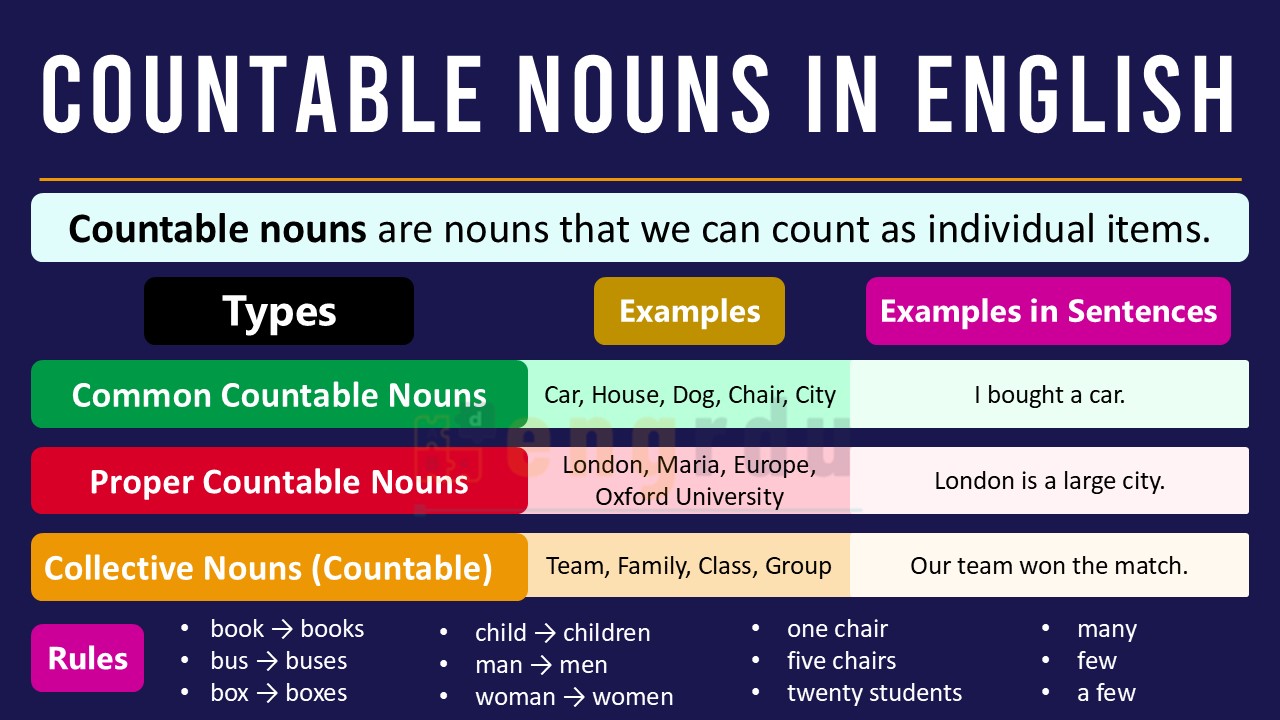
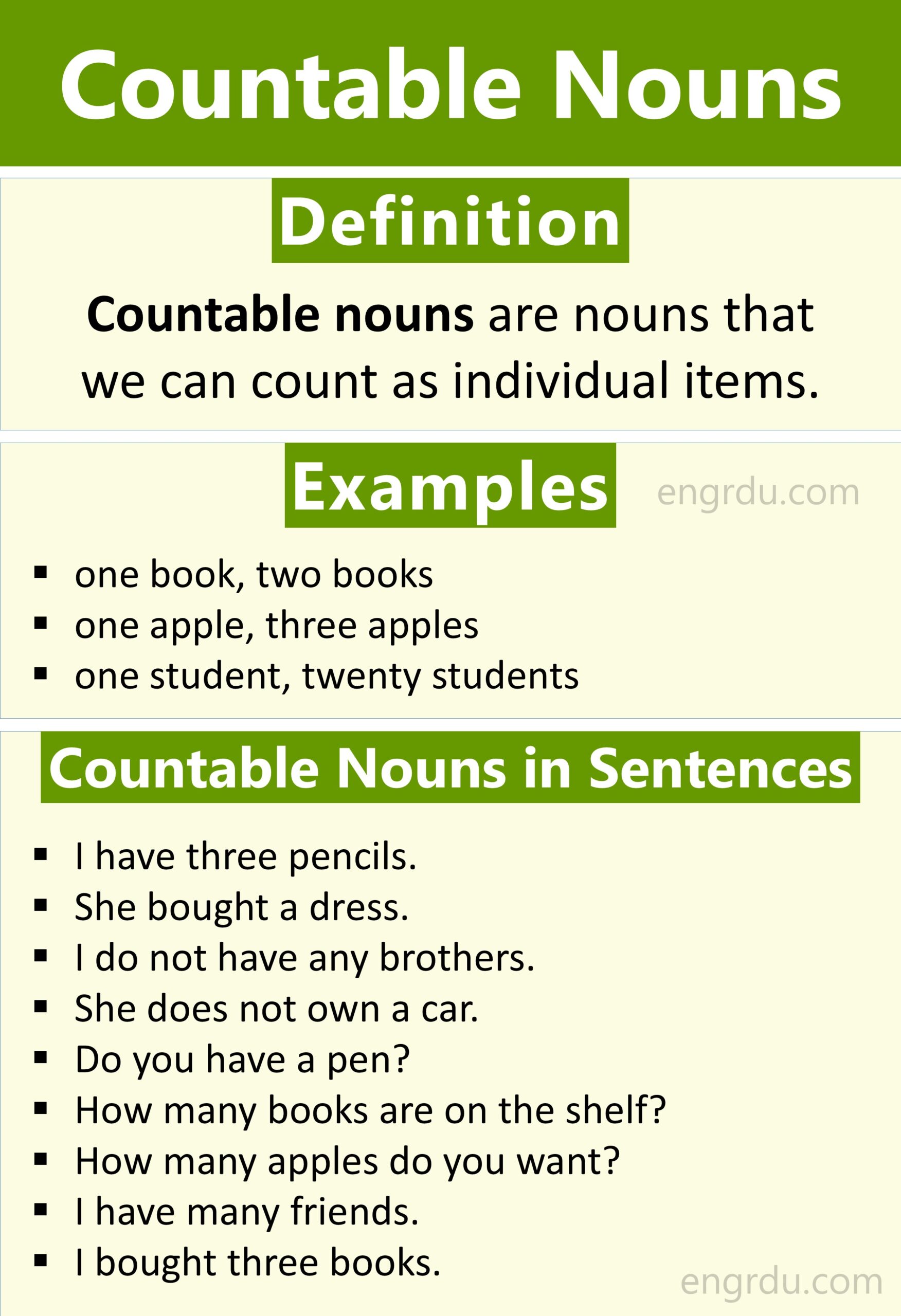
Countable nouns are nouns that we can count as individual items. They have both singular and plural forms.
For example:
- one book, two books
- one apple, three apples
- one student, twenty students
If you can add a number before a noun, it is usually a countable noun.
We can also use articles like a and an with singular countable nouns:
- a pen
- an orange
- a teacher
Countable nouns are common in everyday English. We use them when talking about objects, people, and ideas that can be separated and items we can count one by one.
Types of Countable Nouns
Countable nouns can be grouped into different categories. Understanding these categories helps learners recognise them easily.
Common Countable Nouns
These are general names for things.
Examples:
- car
- house
- dog
- chair
- city
Sentence examples:
- I bought a car.
- She has two dogs.
Proper Countable Nouns
These are specific names of people, places, or organisations. They begin with capital letters.
Examples:
- London
- Maria
- Europe
- Oxford University
Even though they are countable, we usually do not use “a” or “an” before most proper nouns.
Correct:
London is a large city.
Not correct:
a London
Collective Nouns (Countable)
Some collective nouns are also countable because they refer to a group as one unit.
Examples:
- team
- family
- class
- group
Sentence examples:
- Our team won the match.
- There are three teams in the competition.
Here, “team” can be counted: one team, two teams.
Rules and Usage of Countable Nouns
Let us look at the most important grammar rules step by step.
Rule 1: Singular and Plural Forms
Singular form = one item
Plural form = more than one item
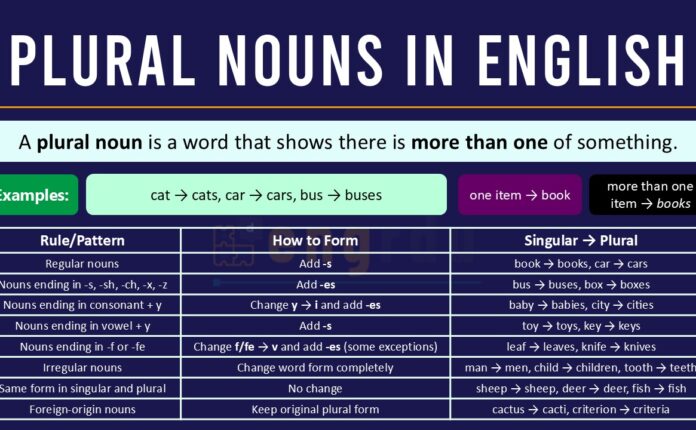
Most nouns add -s or -es in the plural.
- book → books
- bus → buses
- box → boxes
Some nouns are irregular:
- child → children
- man → men
- woman → women
- tooth → teeth
Tip: Always learn irregular plurals carefully. They do not follow normal spelling rules.
Rule 2: Using Articles (a, an, the)
We use a or an only with singular countable nouns.
- I saw a bird.
- She ate an apple.
We use the with both singular and plural when we talk about something specific.
- The book on the table is mine.
- The students in my class are friendly.
We do not use “a” or “an” with plural nouns.
Incorrect:
- I have a books.
Correct:
- I have books.
- I have two books.
Rule 3: Using Numbers
Countable nouns can be used with numbers.
- one chair
- five chairs
- twenty students
If you can use a number before a noun, it is countable.
Rule 4: Quantifiers with Countable Nouns
We use certain words with plural countable nouns:
- many
- few
- a few
- several
- a lot of
Examples:
- She has many friends.
- There are a few mistakes in your homework.
- Several students asked questions.
We do not use “much” with countable nouns in positive sentences.
Incorrect:
I have much books.
Correct:
I have many books.
Examples of Countable Nouns in Sentences
Let us look at different sentence types.
Affirmative Sentences
- I have three pencils.
- She bought a dress.
- We visited two museums in Paris.
- They adopted a puppy.
Negative Sentences
- I do not have any brothers.
- She does not own a car.
- There are not many chairs in the room.
- He did not buy a ticket.
Question Sentences
- Do you have a pen?
- How many books are on the shelf?
- Did she bring any sandwiches?
- Are there any students in the classroom?
Notice how “how many” is used with countable nouns.
Correct:
How many apples do you want?
Not correct:
How much apples do you want?
Common Mistakes with Countable Nouns
Many learners make similar errors. Let us correct them.
Mistake 1: Using “much” Instead of “many”
Incorrect:
I have much friends.
Correct:
I have many friends.
Use “many” with countable nouns.
Mistake 2: Forgetting Plural -s
Incorrect:
I bought three book.
Correct:
I bought three books.
Always add plural endings when the number is more than one.
Mistake 3: Using “a” with Plural Nouns
Incorrect:
She has a two sisters.
Correct:
She has two sisters.
Do not use “a” with plural nouns.
Mistake 4: Confusing Countable and Uncountable Nouns
Incorrect:
I need an advice.
Correct:
I need some advice.
“Advice” is uncountable. You cannot count it as “one advice”.
Countable vs Uncountable Nouns
Many learners confuse these two grammar categories. Here is a simple comparison table:
| Feature | Countable Nouns | Uncountable Nouns |
|---|---|---|
| Can we count them? | Yes | No |
| Singular and plural forms? | Yes | Usually no plural |
| Use “a/an”? | Yes (singular only) | No |
| Use with numbers? | Yes | No |
| Examples | book, apple, chair | water, sugar, information |
Examples:
Countable:
I have two bags.
Uncountable:
I need some water.
Understanding this difference improves your grammar accuracy in exams and daily communication.
Tips for Learners
Here are practical tips to help you master countable nouns.
1. Learn Nouns with Their Form
When you learn a new noun, check:
- Is it countable?
- What is its plural form?
Example:
- student → students
- child → children
2. Practise with Real Objects
Look around your room. Name five things you can count:
- chair
- book
- phone
- window
- pen
Make sentences:
- There are four windows in my house.
3. Use “How Many” in Questions
Practise asking:
- How many brothers do you have?
- How many languages can you speak?
4. Keep a Vocabulary Notebook
Write nouns in two columns:
Countable | Uncountable
book | water
idea | information
This method helps you avoid common grammar mistakes.
5. Read and Listen to Real English
Notice how countable nouns are used in:
- news articles
- school textbooks
- conversations
- British and European English materials
Exposure builds natural understanding.
Conclusion
Countable nouns are an essential part of English grammar. They name things we can count one by one. They have singular and plural forms, can be used with numbers, and follow clear rules with articles and quantifiers like “many” and “few”.
When you understand these rules, your sentences become more accurate and natural. Keep practising with real examples from daily life. Grammar improves step by step, and every correct sentence builds your confidence.
Read More