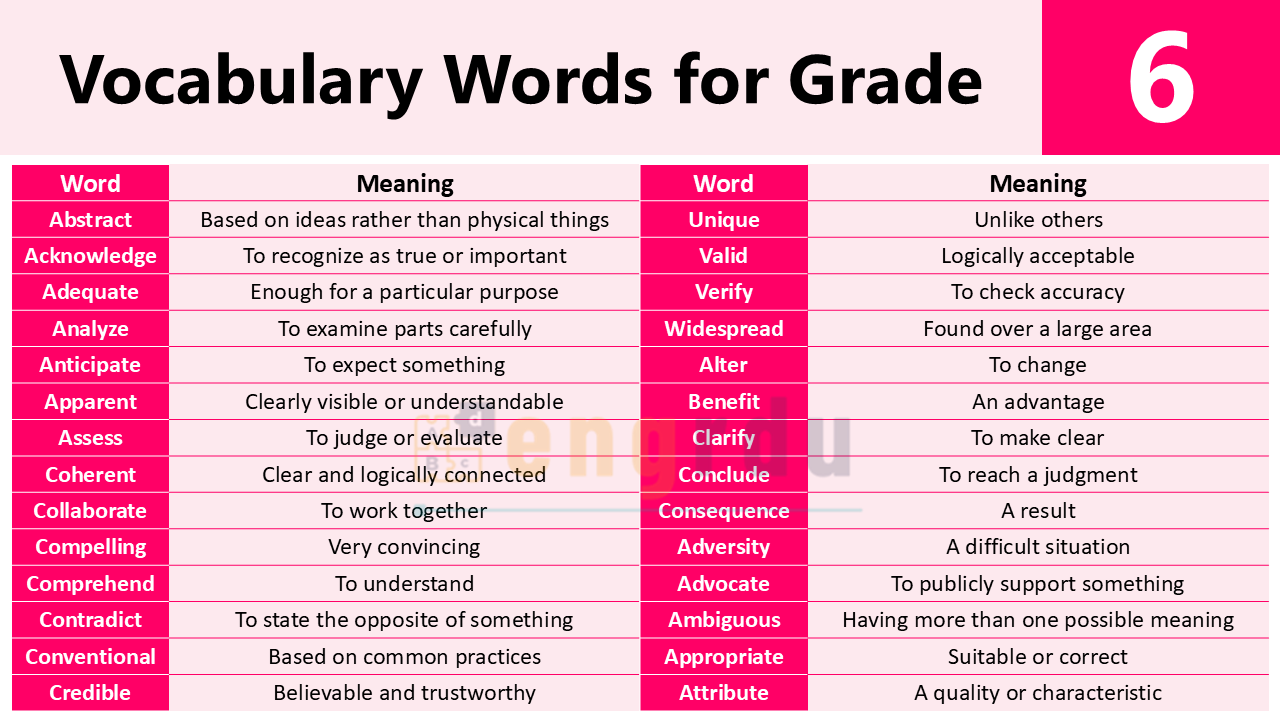

Sixth grade brings a noticeable change in the kind of English students read and write. Stories become more complex, textbooks introduce academic language, and students are expected to explain ideas rather than simply identify them.
This collection of 6th grade vocabulary words gives learners more precise language for describing people, analyzing texts, discussing evidence, understanding science, explaining history, and communicating their own ideas. Every word includes a clear meaning and a practical sentence.
500+ Words for a Growing Grade 6 Vocabulary
The words below are selected for sixth-grade learners, including school students, ESL learners, and anyone building an intermediate English vocabulary.
A–C: 6th Grade Vocabulary Words
- Abandon – To leave someone or something behind.
Example: “The family had to abandon the damaged house.” - Absorb – To take in or soak up something.
Example: “Plants absorb water through their roots.” - Abstract – Related to an idea rather than a physical object.
Example: “Justice is an abstract idea.” - Accumulate – To gather or increase over time.
Example: “Snow began to accumulate on the road.” - Adequate – Good enough for a particular need or purpose.
Example: “We had adequate food for the journey.” - Adjacent – Next to or very close to something.
Example: “Our classroom is adjacent to the library.” - Alter – To change something.
Example: “We altered the plan because of the weather.” - Anticipate – To expect something to happen.
Example: “We anticipate heavy traffic this evening.” - Apparent – Easy to see or understand.
Example: “It became apparent that we had taken the wrong road.” - Appropriate – Suitable or correct for a particular situation.
Example: “Wear appropriate clothing for the weather.” - Arbitrary – Based on personal choice rather than a clear reason or rule.
Example: “The decision seemed arbitrary to the students.” - Acquire – To get or gain something.
Example: “She acquired new skills through practice.” - Beneficial – Producing a helpful result.
Example: “Regular reading is beneficial for language development.” - Capable – Having the ability to do something.
Example: “He is capable of solving the problem.” - Cautious – Careful to avoid danger or mistakes.
Example: “Be cautious when crossing the busy street.” - Clarify – To make something easier to understand.
Example: “Could you clarify your answer?” - Coherent – Clear, logical, and easy to understand.
Example: “She gave a coherent explanation of the event.” - Collapse – To fall down suddenly or lose strength.
Example: “Part of the old wall collapsed during the storm.” - Compel – To force or strongly encourage someone to do something.
Example: “The evidence compelled us to change our opinion.” - Concentrate – To give your full attention to something.
Example: “I need to concentrate on my homework.” - Confine – To keep someone or something within a particular area or limit.
Example: “The injured bird was confined to a small cage.” - Conflict – A serious disagreement or struggle.
Example: “The novel centers on a conflict between two families.” - Contradict – To state the opposite of something or disagree with it.
Example: “His second statement contradicted his first answer.” - Crucial – Extremely important to a result or situation.
Example: “Good communication is crucial to teamwork.” - Cumulative – Increasing as more things are added.
Example: “The cumulative effect of small improvements was impressive.”
D–F: 6th Grade Vocabulary Words
- Decline – To become less, weaker, or lower; also to politely refuse.
Example: “The number of visitors began to decline.” - Demonstrate – To show clearly by action, evidence, or example.
Example: “The experiment demonstrates how heat affects water.” - Deny – To say that something is not true or did not happen.
Example: “He denied breaking the window.” - Derive – To get something from a particular source.
Example: “Many English words derive from Latin.” - Detect – To discover or notice something.
Example: “The machine can detect smoke.” - Diminish – To become smaller, weaker, or less important.
Example: “The sound diminished as the train moved away.” - Distinguish – To recognize a difference between things.
Example: “Can you distinguish fact from opinion?” - Distribute – To give or deliver something among several people or places.
Example: “The teacher distributed the worksheets.” - Diverse – Including many different types.
Example: “The school has a diverse group of students.” - Emphasize – To give special importance to something.
Example: “The speaker emphasized the need for honesty.” - Encounter – To meet or experience something unexpectedly.
Example: “We encountered heavy rain during our trip.” - Equivalent – Equal in value, meaning, or importance.
Example: “One kilometer is equivalent to 1,000 meters.” - Evident – Clear or easy to notice.
Example: “It was evident that she had practiced.” - Exclude – To leave someone or something out.
Example: “The price excludes delivery charges.” - Expand – To become larger or make something larger.
Example: “Heat causes the metal to expand.” - Explicit – Clearly stated and leaving little doubt.
Example: “The teacher gave explicit instructions.” - Facilitate – To make an action or process easier.
Example: “The diagram facilitates understanding.” - Fluctuate – To change repeatedly between higher and lower levels.
Example: “Temperatures fluctuate throughout the year.” - Formulate – To develop or create a plan, idea, or method.
Example: “The students formulated a plan for the project.” - Frequent – Happening often.
Example: “Frequent practice improves pronunciation.”
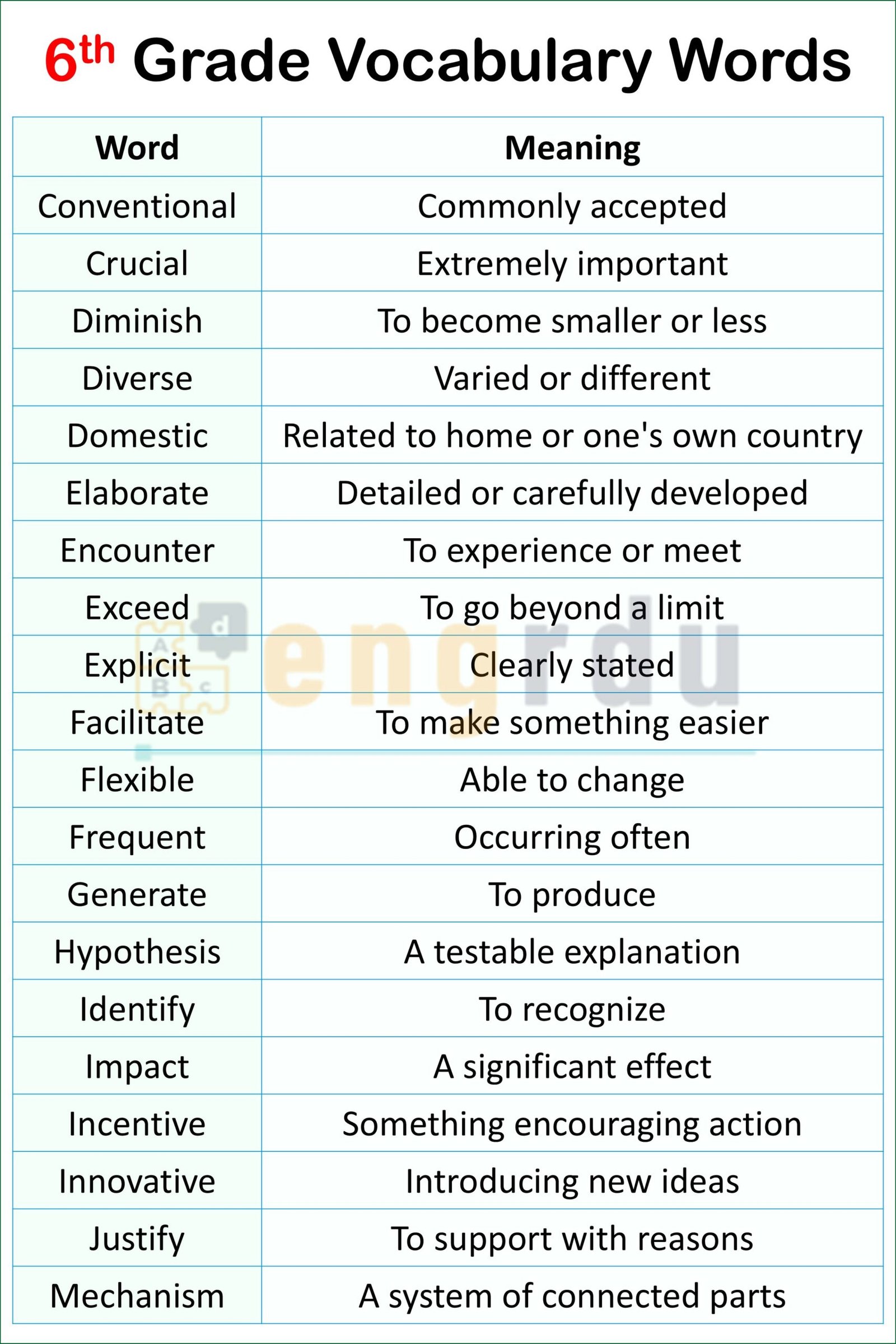
6th Grade Vocabulary Words with Meanings and PDF
G–I: 6th Grade Vocabulary Words
- Generate – To produce or create something.
Example: “Solar panels generate electricity.” - Illustrate – To explain something using examples, pictures, or details.
Example: “The diagram illustrates the water cycle.” - Imply – To suggest something without saying it directly.
Example: “His expression implied that he was worried.” - Incorporate – To include something as part of a whole.
Example: “The project incorporates information from several sources.” - Indicate – To show, point out, or suggest something.
Example: “Dark clouds indicate that rain may be coming.” - Infer – To reach a conclusion from evidence or clues.
Example: “We can infer that the character is nervous.” - Inevitable – Certain to happen.
Example: “Some changes are inevitable as children grow.” - Interpret – To explain or understand the meaning of something.
Example: “Students interpreted the poem in different ways.” - Investigate – To examine something carefully to discover facts.
Example: “Scientists investigate causes of disease.” - Isolate – To separate something from others.
Example: “The scientist isolated the substance for testing.” - Justify – To give reasons or evidence supporting an idea or action.
Example: “You must justify your answer with evidence.” - Logical – Based on clear reasoning.
Example: “She gave a logical explanation.” - Maintain – To keep something in a particular condition or continue it.
Example: “It is important to maintain a healthy routine.” - Modify – To change something slightly.
Example: “We modified our plan after receiving new information.” - Neglect – To fail to give proper care or attention.
Example: “If you neglect the plant, it may die.” - Obtain – To get something.
Example: “We obtained permission before entering the building.” - Observe – To watch carefully.
Example: “Students observed the behavior of the insects.” - Perceive – To notice or understand something.
Example: “People may perceive the same event differently.” - Precise – Exact and accurate.
Example: “The scientist recorded precise measurements.” - Proceed – To continue or move forward.
Example: “After checking the instructions, we proceeded with the experiment.”
J–L: 6th Grade Vocabulary Words
- Justify – To explain why something is reasonable or correct.
Example: “Can you justify your choice?” - Legitimate – Reasonable, lawful, or genuine.
Example: “The website is a legitimate source of information.” - Likewise – In the same way.
Example: “Ali enjoys science; likewise, his sister loves experiments.” - Literal – Having the exact basic meaning of words.
Example: “The literal meaning of the sentence is easy to understand.” - Manipulate – To control or handle something skillfully.
Example: “The scientist manipulated one variable during the experiment.” - Mature – Fully developed or behaving in a responsible way.
Example: “She gave a mature response to the criticism.” - Mediate – To help people solve a disagreement.
Example: “The teacher helped mediate the argument.” - Modify – To make a small change to something.
Example: “We modified the design to make it stronger.” - Neutral – Not supporting either side of a disagreement.
Example: “The judge remained neutral during the discussion.” - Notion – An idea or belief about something.
Example: “He had the notion that the task would be easy.” - Objective – Based on facts rather than personal feelings.
Example: “Try to give an objective opinion.” - Obvious – Easy to see, understand, or recognize.
Example: “It was obvious that the box was empty.” - Oppose – To disagree with or resist something.
Example: “Some residents oppose the new plan.” - Outcome – The final result of an event or action.
Example: “We were pleased with the outcome.” - Perspective – A particular way of viewing something.
Example: “The story is told from the child’s perspective.” - Relevant – Closely connected to the subject.
Example: “Include only relevant details in your answer.” - Respond – To answer or react to something.
Example: “She responded calmly to the question.” - Significant – Important or meaningful.
Example: “The invention had a significant effect on society.” - Specify – To state something clearly and exactly.
Example: “Please specify which topic you selected.” - Valid – Based on good reasons or acceptable evidence.
Example: “That is a valid argument.”
A Vocabulary for Stronger Descriptions
Sixth-grade writing becomes more effective when students choose adjectives that communicate exactly what they mean.
- Arrogant – Thinking you are better or more important than others.
Example: “His arrogant behavior annoyed his teammates.” - Bizarre – Very strange or unusual.
Example: “We heard a bizarre noise outside.” - Brilliant – Extremely clever or impressive.
Example: “She had a brilliant solution to the problem.” - Compassionate – Showing concern for people who are suffering.
Example: “The compassionate student helped the injured animal.” - Dramatic – Very noticeable, exciting, or sudden.
Example: “There was a dramatic change in the weather.” - Elaborate – Detailed and carefully developed.
Example: “The artist created an elaborate design.” - Exceptional – Much better than usual.
Example: “She showed exceptional talent in music.” - Fragile – Easily broken or damaged.
Example: “Handle the fragile glass carefully.” - Hostile – Unfriendly or aggressive.
Example: “The explorers faced hostile conditions.” - Immense – Extremely large.
Example: “The ocean is an immense body of water.” - Ordinary – Normal and not unusual.
Example: “It looked like an ordinary day at first.” - Remarkable – Unusual or impressive.
Example: “She made remarkable progress in a few months.” - Rigid – Stiff or not easily changed.
Example: “The rules were too rigid for the situation.” - Severe – Very serious, strong, or harsh.
Example: “The region experienced severe flooding.” - Subtle – Small or difficult to notice.
Example: “There was a subtle change in his expression.” - Temporary – Lasting for only a limited time.
Example: “The road closure is temporary.” - Unpredictable – Difficult to know what will happen.
Example: “Mountain weather can be unpredictable.” - Vulnerable – Easily harmed or affected.
Example: “Young plants are vulnerable to extreme cold.”
6 Grade Vocabulary for Reading Literature
Sixth graders encounter characters, conflicts, themes, symbolism, and different points of view in increasingly complex texts.
- Antagonist – A character or force that works against the main character.
Example: “The antagonist creates problems for the hero.” - Atmosphere – The feeling or mood created by a story or place.
Example: “The dark forest created a mysterious atmosphere.” - Characterization – The way an author shows a character’s personality.
Example: “The author’s characterization makes the hero seem courageous.” - Climax – The most intense or important point in a story.
Example: “The rescue scene is the climax of the novel.” - Conflict – A struggle between opposing people, ideas, or forces.
Example: “The main conflict is between the two brothers.” - Dialogue – Conversation between characters in a story.
Example: “The dialogue reveals how the characters feel.” - Narrator – The person or voice telling a story.
Example: “The narrator describes the events from her own perspective.” - Plot – The connected events that form a story.
Example: “The plot becomes more complicated after the discovery.” - Setting – The time and place in which a story happens.
Example: “The setting is a small village in the mountains.” - Symbol – Something that represents another idea or meaning.
Example: “The dove is often used as a symbol of peace.” - Theme – The central message or idea explored in a story.
Example: “Courage is one of the novel’s main themes.” - Tone – The author’s attitude toward the subject or audience.
Example: “The writer uses a serious tone when discussing the accident.” - Protagonist – The main character in a story.
Example: “The protagonist must overcome several obstacles.” - Suspense – A feeling of excitement or uncertainty about what will happen.
Example: “The author creates suspense by hiding the character’s next move.” - Foreshadowing – Clues that suggest something will happen later.
Example: “The strange sound is an example of foreshadowing.”
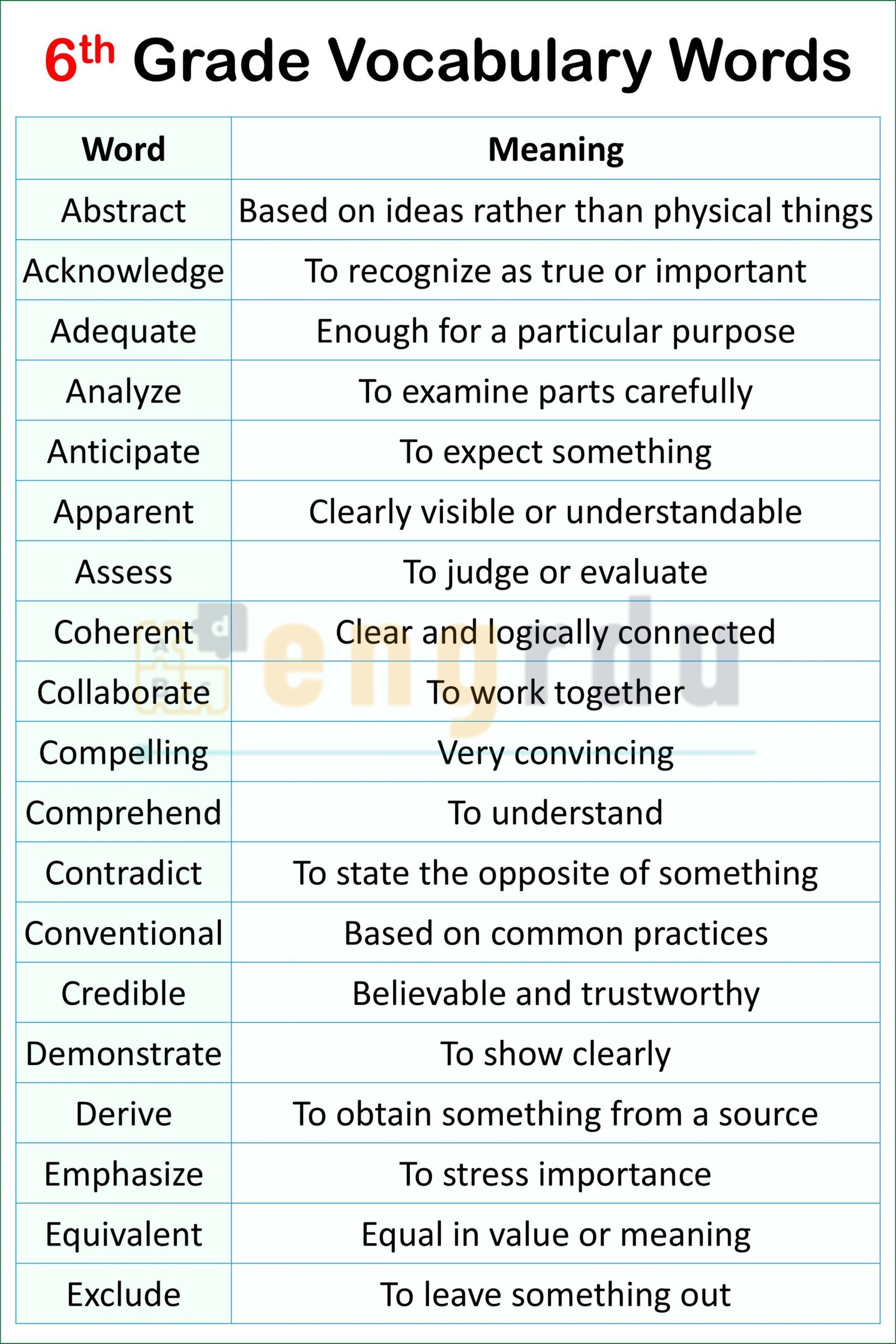
6th Grade Vocabulary Words
Mathematics Vocabulary for Grade 6
Mathematics has its own language. Understanding these words can make written problems much easier.
- Absolute Value – The distance of a number from zero.
Example: “The absolute value of -8 is 8.” - Coefficient – A number multiplied by a variable.
Example: “In 5x, the coefficient is 5.” - Denominator – The bottom number of a fraction.
Example: “The denominator tells us how many equal parts there are.” - Equation – A mathematical statement showing that two expressions are equal.
Example: “Solve the equation 2x + 4 = 10.” - Estimate – To find an approximate answer.
Example: “Estimate the total before calculating it exactly.” - Expression – A combination of numbers, variables, and operations.
Example: “3x + 5 is an algebraic expression.” - Factor – A number that divides another number evenly.
Example: “Three is a factor of twelve.” - Fraction – A number representing part of a whole.
Example: “One-half is a fraction.” - Integer – A whole number that may be positive, negative, or zero.
Example: “-4 is an integer.” - Mean – The average of a set of numbers.
Example: “The mean of 4, 6, and 8 is 6.” - Multiple – A number produced by multiplying a number by a whole number.
Example: “18 is a multiple of 3.” - Numerator – The top number of a fraction.
Example: “In 3/5, the numerator is 3.” - Percentage – A number expressed as a part of 100.
Example: “Twenty-five percent means 25 out of 100.” - Ratio – A comparison between two quantities.
Example: “The ratio of boys to girls is 2:3.” - Variable – A letter or symbol representing an unknown value.
Example: “In x + 4 = 9, x is the variable.”
Science Terms Every Sixth Grader Should Recognize
- Adaptation – A feature or behavior that helps an organism survive.
Example: “Thick fur is an adaptation that helps some animals survive cold weather.” - Atmosphere – The layer of gases surrounding a planet.
Example: “Earth’s atmosphere contains oxygen and other gases.” - Cell – The basic structural unit of a living organism.
Example: “The human body contains trillions of cells.” - Compound – A substance formed when two or more elements chemically combine.
Example: “Water is a compound made from hydrogen and oxygen.” - Density – The amount of matter contained in a certain space.
Example: “The density of an object can affect whether it floats.” - Ecosystem – Living organisms interacting with one another and their environment.
Example: “A forest is a complex ecosystem.” - Element – A pure substance made of one type of atom.
Example: “Gold is a chemical element.” - Evaporation – The process in which a liquid changes into a gas.
Example: “Heat speeds up evaporation.” - Friction – A force that resists motion when surfaces rub together.
Example: “Friction helps shoes grip the ground.” - Gravity – The force that attracts objects toward one another.
Example: “Gravity pulls objects toward Earth’s surface.” - Hypothesis – A possible explanation that can be tested.
Example: “Our hypothesis was that sunlight would increase plant growth.” - Molecule – A group of atoms joined together.
Example: “A water molecule contains two hydrogen atoms and one oxygen atom.” - Photosynthesis – The process by which plants use light to make food.
Example: “Plants perform photosynthesis using sunlight.” - Variable – A factor that can change in an experiment.
Example: “We changed one variable while keeping the others the same.” - Volume – The amount of space an object or substance occupies.
Example: “We measured the volume of the container.”
History and Social Studies Vocabulary for Six Graders
- Alliance – An agreement between groups or countries to work together.
Example: “The countries formed an alliance during the conflict.” - Authority – The power or right to make decisions and enforce rules.
Example: “The government has authority to create laws.” - Civilization – An organized society with developed systems, culture, and institutions.
Example: “The ancient civilization developed advanced farming methods.” - Democracy – A system of government in which people have a role in choosing leaders.
Example: “Citizens participate in a democracy by voting.” - Economy – The system through which goods and services are produced, exchanged, and used.
Example: “Tourism is important to the local economy.” - Empire – A group of territories or countries controlled by one ruler or government.
Example: “The Roman Empire covered a large area.” - Government – The system that makes and carries out decisions for a country or community.
Example: “The government provides public services.” - Immigration – The process of moving to another country to live.
Example: “Immigration has shaped many modern societies.” - Independence – Freedom from control by another country or authority.
Example: “The country celebrated its independence.” - Revolution – A major and often sudden change in government or society.
Example: “The revolution changed the country’s political system.” - Treaty – A formal agreement between countries or groups.
Example: “The countries signed a peace treaty.” - Territory – An area of land controlled by a government or group.
Example: “The explorers entered unfamiliar territory.” - Trade – The buying, selling, or exchanging of goods and services.
Example: “Trade connected communities across the region.” - Migration – The movement of people or animals from one place to another.
Example: “Bird migration occurs during certain seasons.” - Heritage – Traditions, history, and cultural features passed from earlier generations.
Example: “The museum preserves the cultural heritage of the region.”
6th Grade Vocabulary Words for Geography
- Altitude – The height of a place above sea level.
Example: “The village has a high altitude.” - Climate – The usual weather conditions of a place over a long period.
Example: “The desert has a dry climate.” - Coast – The land next to a sea or ocean.
Example: “Many fishing villages are located along the coast.” - Equator – An imaginary line around Earth halfway between the poles.
Example: “The equator receives strong sunlight throughout the year.” - Hemisphere – Half of Earth.
Example: “Pakistan is in the Northern Hemisphere.” - Latitude – Distance north or south of the equator, measured in degrees.
Example: “Latitude helps us locate places on Earth.” - Longitude – Distance east or west of the Prime Meridian, measured in degrees.
Example: “Longitude and latitude help identify a location.” - Region – An area with shared geographical or cultural features.
Example: “The northern region has cooler weather.” - Relief – The differences in elevation and shape of land.
Example: “The map shows the relief of the mountainous region.” - Terrain – The physical features and surface of an area of land.
Example: “The rough terrain made travel difficult.”
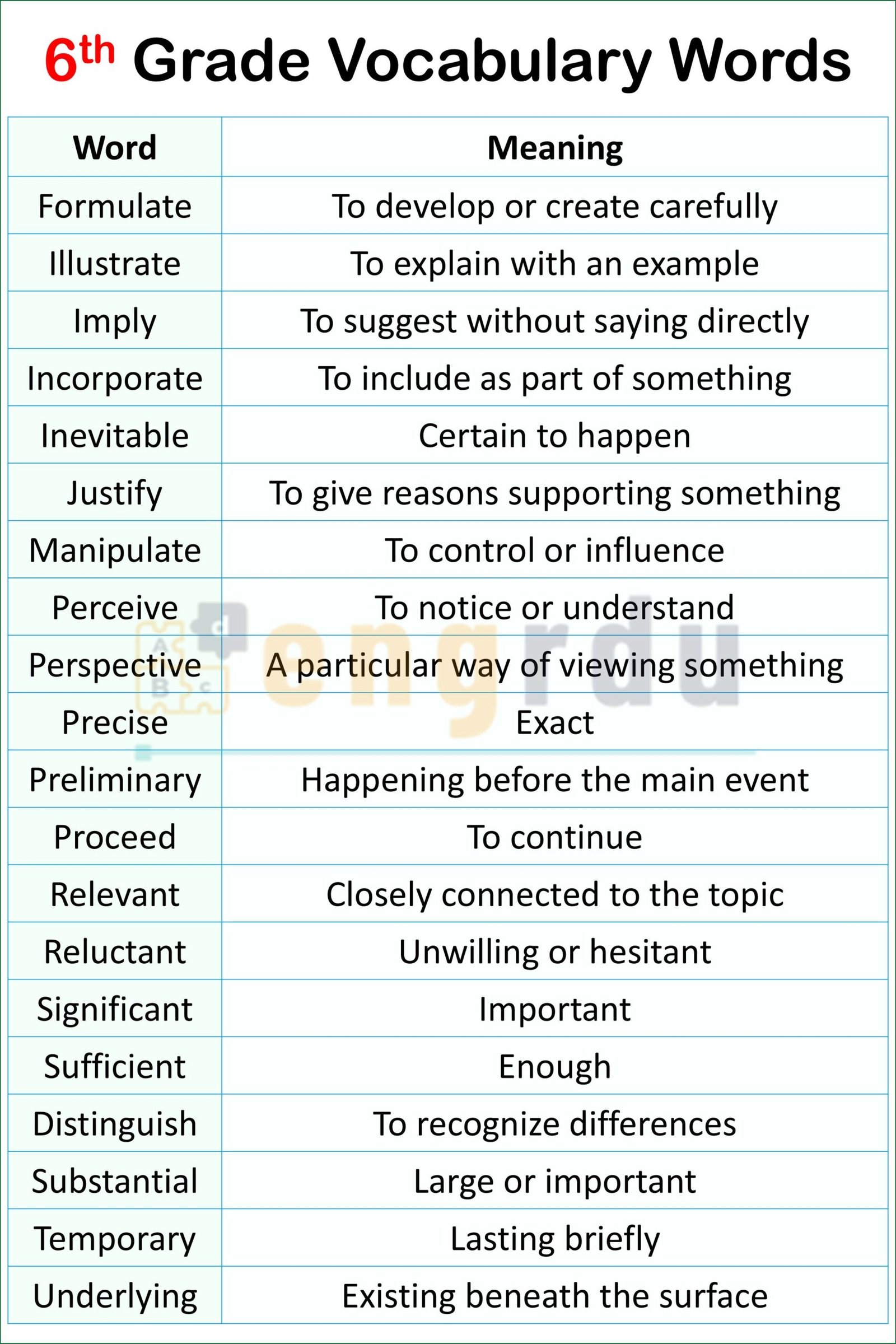
Six Grade Vocabulary Words
6th Grade Words for Arguments, Opinions, and Evidence
Students should learn how to express an opinion and support it with reasons.
- Claim – A statement that someone says is true.
Example: “Her claim was supported by several facts.” - Counterargument – An argument that disagrees with another argument.
Example: “The writer included a counterargument before giving a response.” - Evidence – Information or facts that support a claim.
Example: “Use evidence from the article to support your answer.” - Opinion – A belief or personal view about something.
Example: “In my opinion, the book has a strong ending.” - Reason – A cause or explanation for something.
Example: “Give one reason for your choice.” - Statement – Something said or written clearly.
Example: “The final statement summarized the speaker’s position.” - Support – To provide evidence or reasons for an idea.
Example: “The examples support the author’s argument.” - Viewpoint – A person’s particular opinion or way of seeing something.
Example: “The article presents a different viewpoint.” - Persuade – To convince someone to think or act in a certain way.
Example: “The advertisement tries to persuade people to buy the product.” - Refute – To prove that an argument or statement is incorrect.
Example: “The new evidence helped refute the original claim.”
Transition Words for Grade 6 Writing
These words help students connect sentences and paragraphs logically.
- Accordingly – In a way that is appropriate to the situation.
Example: “The weather changed, and we acted accordingly.” - Although – Used to introduce an idea that contrasts with another.
Example: “Although the task was difficult, we completed it.” - Consequently – As a result.
Example: “He missed the bus; consequently, he arrived late.” - Despite – Without being affected by something.
Example: “Despite the rain, the match continued.” - Eventually – In the end, after some time.
Example: “Eventually, the team found a solution.” - However – Used to introduce a contrasting idea.
Example: “The road was long; however, the journey was enjoyable.” - In contrast – Used to show a difference.
Example: “Cats are often independent. In contrast, dogs may seek more attention.” - Meanwhile – During the same period.
Example: “Meanwhile, the other students prepared their presentation.” - Similarly – In a similar way.
Example: “Both solutions work similarly.” - Therefore – For that reason.
Example: “The evidence was weak; therefore, we rejected the claim.” - Whereas – Used to compare two different things or situations.
Example: “My brother likes science, whereas I prefer history.” - Nevertheless – Despite what has just been said.
Example: “The journey was tiring; nevertheless, we enjoyed it.”
Six Grade Vocabulary for Everyday Problems and Decisions
- Compromise – An agreement in which each side gives up something.
Example: “We reached a compromise about where to go.” - Consequence – A result that follows an action.
Example: “Every decision has a consequence.” - Dilemma – A difficult situation requiring a choice between possibilities.
Example: “I faced a dilemma when both friends needed my help.” - Obstacle – Something that prevents or slows progress.
Example: “Lack of time was the biggest obstacle.” - Priority – Something considered more important than other things.
Example: “Finishing the assignment is my first priority.” - Resolution – A solution to a problem or disagreement.
Example: “The two sides reached a resolution.” - Risk – The possibility that something harmful or unwanted may happen.
Example: “There is a risk of slipping on the wet floor.” - Alternative – Another choice or possibility.
Example: “We need an alternative route.” - Challenge – Something that tests ability or requires effort.
Example: “Learning a new language can be a challenge.” - Strategy – A carefully planned way to achieve a goal.
Example: “Our strategy helped us finish the project on time.”
6th Grade Words for Emotions and Behavior
- Apprehensive – Worried or nervous about something that may happen.
Example: “She felt apprehensive before the interview.” - Content – Satisfied and comfortable.
Example: “The child felt content after finishing his work.” - Desperate – Feeling a strong need or desire for something.
Example: “The hikers were desperate for water.” - Embarrassed – Feeling ashamed or uncomfortable.
Example: “He was embarrassed by his mistake.” - Empathetic – Able to understand another person’s feelings.
Example: “An empathetic friend listens when you are upset.” - Envious – Wanting something another person has.
Example: “She felt envious of her friend’s new bicycle.” - Frustrated – Annoyed because something is difficult or unsuccessful.
Example: “I became frustrated when the computer froze.” - Hesitant – Unsure about doing something.
Example: “He was hesitant to answer the difficult question.” - Optimistic – Expecting a positive result.
Example: “She remained optimistic about the team’s chances.” - Pessimistic – Expecting a negative result.
Example: “He was pessimistic about finishing the project.” - Resentful – Feeling anger because of unfair treatment.
Example: “He became resentful after being blamed unfairly.” - Sympathetic – Showing care for someone who is experiencing difficulty.
Example: “My teacher was sympathetic when I explained the problem.” - Triumphant – Feeling or showing great happiness after success.
Example: “The triumphant team lifted the trophy.” - Vulnerable – Easily hurt, harmed, or affected.
Example: “The young animal was vulnerable without its mother.”
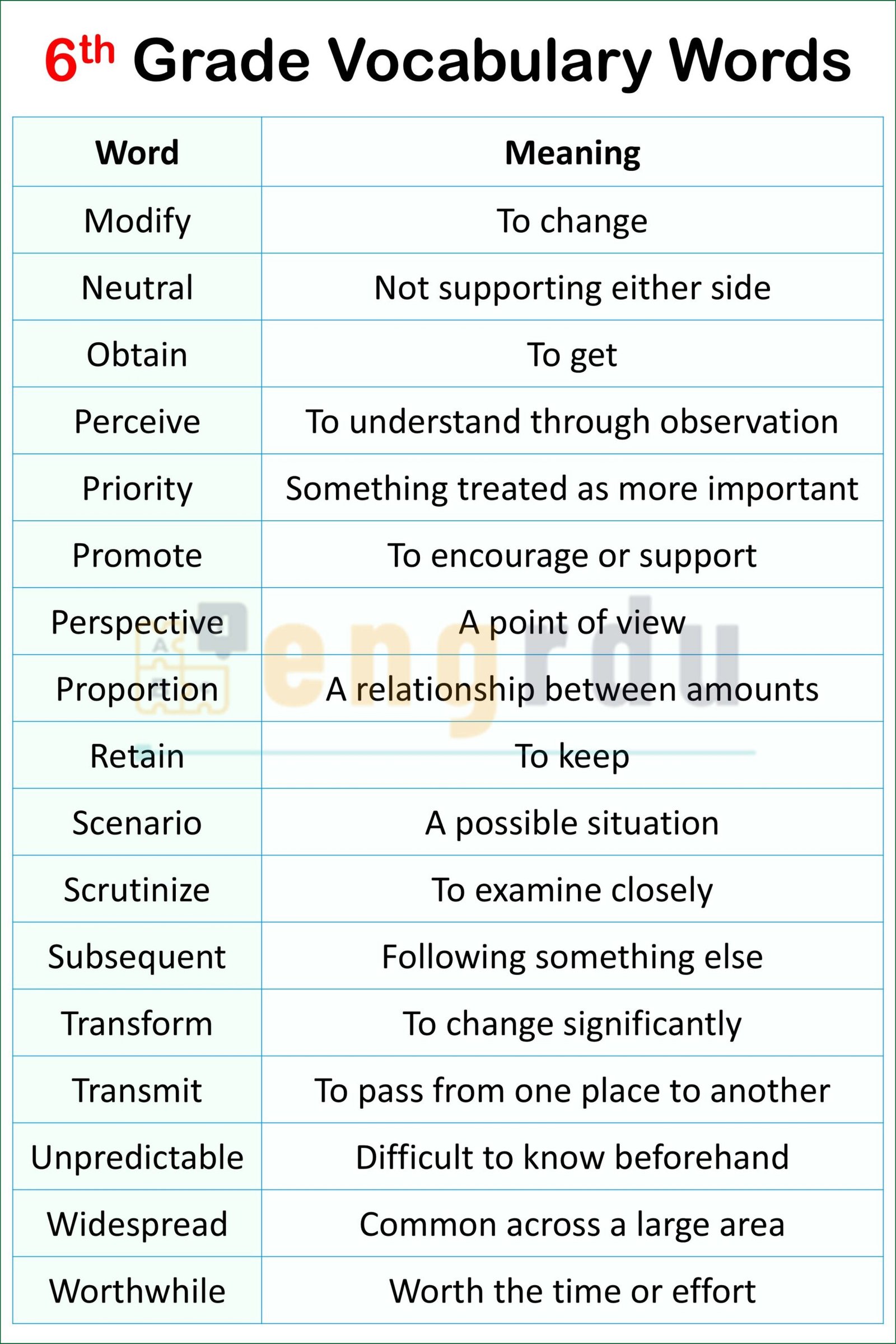
Vocabulary for Six Grade Students
6th Grade Vocabulary for Nature, Earth, and the Environment
- Conservation – Protection and careful use of natural resources.
Example: “Forest conservation helps protect wildlife.” - Contaminate – To make something dirty or unsafe by adding harmful substances.
Example: “Chemicals can contaminate drinking water.” - Deforestation – The removal of large areas of forest.
Example: “Deforestation destroys habitats.” - Erosion – The gradual wearing away of soil or rock.
Example: “Heavy rain can cause soil erosion.” - Extinction – The complete disappearance of a species.
Example: “Scientists are working to prevent animal extinction.” - Fossil – Preserved remains or traces of an ancient living thing.
Example: “We found a fossil in the museum.” - Geological – Related to Earth’s rocks, land, and physical history.
Example: “The area has unusual geological features.” - Natural Resource – Something from nature that people can use.
Example: “Forests are valuable natural resources.” - Renewable – Able to be naturally replaced.
Example: “Wind is a renewable source of energy.” - Species – A group of similar organisms that can reproduce.
Example: “Scientists discovered a rare species of frog.” - Sustainable – Able to continue without causing serious environmental harm.
Example: “The community is looking for sustainable farming methods.” - Habitat – The natural home of an organism.
Example: “Wetlands provide habitat for many birds.”
Technology and Modern Life Vocabulary for Six Graders
- Artificial – Made by people rather than occurring naturally.
Example: “The stadium uses artificial grass.” - Automate – To make a process operate with little human control.
Example: “The company uses machines to automate some tasks.” - Cybersecurity – The protection of computers, networks, and information from digital threats.
Example: “Strong passwords are part of good cybersecurity.” - Digital – Using electronic technology to store or process information.
Example: “We received a digital copy of the document.” - Device – A piece of equipment designed for a particular purpose.
Example: “A tablet is a useful digital device.” - Innovation – A new idea, method, or invention.
Example: “The invention was an important innovation.” - Network – A connected group of computers, people, or systems.
Example: “The school uses a computer network.” - Online – Connected to or available through the internet.
Example: “We completed the assignment online.” - Technology – Tools, machines, and methods created to solve problems or perform tasks.
Example: “Technology has changed how students learn.” - Virtual – Existing or taking place through digital technology rather than physically.
Example: “We attended a virtual meeting.”
Words That Make 6th Grade Writing More Exact
Compare a basic sentence with a more precise one.
Basic:
“The storm was bad.”
More precise:
“The severe storm caused significant damage to several buildings.”
Basic:
“The boy looked at the machine.”
More precise:
“The student carefully examined the machine.”
Basic:
“The problem was hard.”
More precise:
“The complex problem required a logical solution.”
Useful replacements include:
- Good → beneficial, effective, valuable
- Bad → harmful, severe, negative
- Big → enormous, immense, substantial
- Small → tiny, limited, minimal
- Look → observe, examine, inspect
- Show → demonstrate, reveal, indicate
- Get → obtain, acquire, receive
- Change → alter, modify, transform
- Think → consider, reflect, evaluate
- Help → assist, support, facilitate
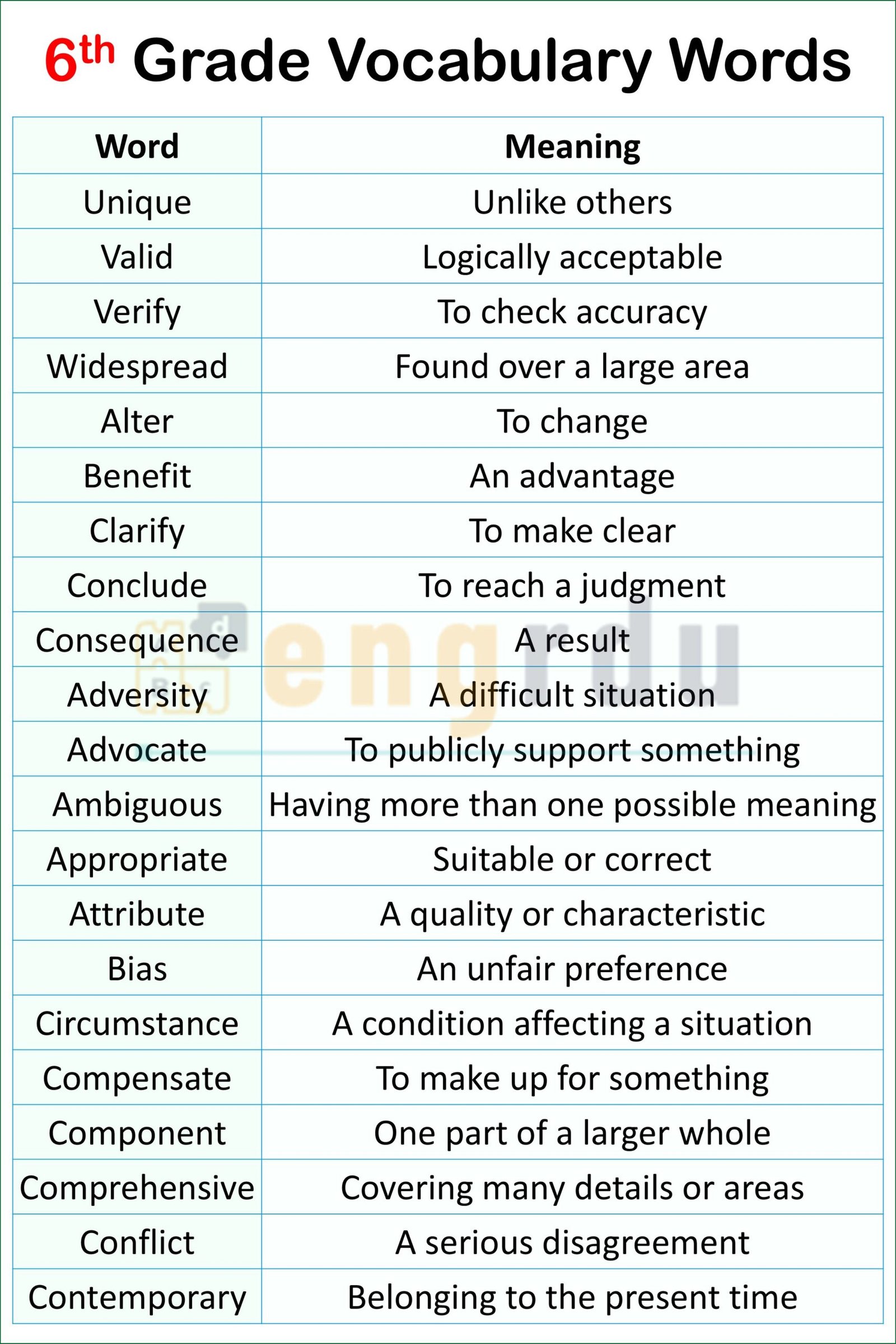
Vocabulary Words for 6 Grader Students
Common Grade 6 Vocabulary Confusions
- Adapt / Adopt – Adapt means to change for a new situation; adopt means to take something as your own or begin using it.
- Compliment / Complement – A compliment is praise; a complement is something that completes or improves another thing.
- Principal / Principle – A principal can be a school leader; a principle is a basic rule or belief.
- Stationary / Stationery – Stationary means not moving; stationery means writing materials.
- Affect / Effect – Affect is usually a verb meaning influence; effect is usually a noun meaning result.
Build Sentences Instead of Memorizing Lists
Vocabulary becomes stronger when students actively use new words.
Take the word obstacle.
Meaning: Something that makes progress difficult.
Instead of memorizing only the definition, create several contexts:
- “The fallen tree was an obstacle.”
- “Fear can become an obstacle to success.”
- “Lack of practice was an obstacle for the player.”
Now consider perspective:
- “The story is written from the child’s perspective.”
- “Try to understand the problem from your friend’s perspective.”
- “Travel can change your perspective.”
This shows an important Grade 6 skill: one word can work in several different situations.
A Short Reading Practice for Six Graders
Read this paragraph and notice the vocabulary in context:
The students decided to investigate the pollution in a nearby stream. They observed the water carefully and collected evidence. Their initial hypothesis was that waste from nearby buildings was contaminating the stream. After analyzing the evidence, they concluded that several factors were responsible. They presented their findings to the community and suggested a sustainable solution.
Words used in the paragraph include:
- Investigate – examine carefully to discover facts.
- Observe – watch carefully.
- Evidence – facts or information supporting an idea.
- Hypothesis – a possible explanation that can be tested.
- Contaminate – make something unsafe or polluted.
- Analyze – examine carefully.
- Conclude – reach a decision based on information.
- Factor – something that contributes to a result.
- Sustainable – able to continue without causing serious harm.
6th Grade Vocabulary Words: Practice Exercise
Choose the best word for each sentence.
Word Bank:
infer, adjacent, significant, dilemma, facilitate, perspective, renewable, contradict, coherent, acquire, consequence, fluctuate, justify, vulnerable, alternative
- The library is ______ to the science laboratory.
- Solar energy is a ______ source of power.
- The writer gave a ______ explanation that was easy to follow.
- We can ______ the character’s feelings from her actions.
- The two reports ______ each other.
- Practice can help students ______ new skills.
- The storm had a ______ effect on the town.
- She faced a difficult ______ when both choices had disadvantages.
- We need an ______ plan if this one fails.
- Please ______ your answer with evidence.
- Prices may ______ during the year.
- The diagram will ______ understanding of the process.
- The child was ______ because he was alone.
- Try to understand the issue from another person’s ______.
- Every action can have a ______.
Answers:
- adjacent
- renewable
- coherent
- infer
- contradict
- acquire
- significant
- dilemma
- alternative
- justify
- fluctuate
- facilitate
- vulnerable
- perspective
- consequence
How to Learn 6th Grade Vocabulary Words Effectively
At Grade 6, vocabulary learning should move beyond copying definitions. Students need to understand meaning, context, word relationships, and usage.
Read widely
Read novels, news written for young readers, science texts, biographies, and informational articles.
Keep a personal word collection
When you meet an unfamiliar word, write:
- The word
- Its meaning
- One synonym
- One opposite, when appropriate
- Your own sentence
Study word parts
Prefixes, suffixes, and roots can provide clues.
For example:
un + predictable
- un- = not
- predictable = able to be expected
Therefore, unpredictable means difficult to know in advance.
Practice speaking
Use new words during normal conversations.
Instead of:
“I think this is important.”
Try:
“I think this is significant because it affects everyone.”
Instead of:
“Let’s find another way.”
Try:
“Let’s consider an alternative.”
A Useful 6th Grade Vocabulary Checklist
A student is making good progress when they can:
- Understand unfamiliar words from context.
- Explain a word without simply repeating its dictionary definition.
- Use academic vocabulary in written answers.
- Recognize synonyms and antonyms.
- Identify multiple meanings of familiar words.
- Use evidence to explain an interpretation.
- Understand common prefixes, suffixes, and roots.
- Choose precise words instead of repeating basic vocabulary.
- Recognize subject-specific terms in science and mathematics.
- Use transition words to connect ideas.
- Distinguish commonly confused words.
- Apply new vocabulary naturally in conversation.
FAQs About 6th Grade Vocabulary Words
What type of vocabulary should students learn in sixth grade?
Students should learn everyday, academic, literary, scientific, mathematical, historical, and descriptive words that support reading, writing, speaking, and comprehension.
Are Grade 6 vocabulary words harder than Grade 5 words?
Generally, yes. Sixth-grade vocabulary introduces more abstract concepts, sophisticated verbs, academic terminology, literary language, and words requiring careful understanding of context.
How can students remember difficult vocabulary?
Students can connect words with examples, personal experiences, word families, synonyms, visual clues, and repeated use in speaking and writing.
What are good vocabulary activities for sixth graders?
Useful activities include context-clue exercises, vocabulary journals, word maps, sentence writing, reading challenges, synonym games, and short quizzes.
Why should students learn academic vocabulary?
Academic vocabulary helps students understand textbooks, questions, instructions, essays, experiments, historical sources, and explanations across different school subjects.
What is the difference between a hypothesis and a theory?
A hypothesis is a proposed explanation that can be tested, while a scientific theory is a well-supported explanation developed from substantial evidence.
How do context clues help with unfamiliar words?
Context clues are nearby words or ideas that provide information about an unfamiliar word’s likely meaning and help readers understand it.
How can reading improve Grade 6 vocabulary?
Regular reading exposes students to unfamiliar words in meaningful contexts, showing how vocabulary is used naturally rather than only providing isolated definitions.
Should sixth graders learn vocabulary from different subjects?
Yes. Learning vocabulary from literature, science, mathematics, geography, history, and technology prepares students for the language they encounter throughout school.
How many new words should a sixth grader learn each week?
There is no universal number, but learning a manageable group deeply and using each word repeatedly is generally more effective than memorizing large lists without context.
Final Thoughts on 6th Grade Vocabulary Words
A strong sixth-grade vocabulary gives students the language they need to explain, compare, analyze, question, evaluate, and communicate more clearly.
Words such as infer, justify, interpret, significant, coherent, perspective, hypothesis, consequence, sustainable, acquire, distinguish, and formulate represent an important step beyond the vocabulary commonly used in earlier elementary grades.
The goal is not to make students use complicated words simply to sound advanced. The goal is to help them select the most accurate word for what they want to say.
When students encounter a new word through reading, understand it from context, check its meaning, create their own sentence, and use it again, vocabulary becomes part of their active English.
This stronger word knowledge will help them handle the increasingly demanding reading and writing tasks they will meet in Grades 7, 8, 9, and 10.
Explore More Vocabulary By Level
- 10th Grade Words with Meanings with PDF
- 600+ 9th Grade Vocabulary Words with PDF
- 500+ 8th Grade Vocabulary Words with PDF
- 700+ 7th Grade Vocabulary Words with PDF
- 300+ 5th Grade Vocabulary Words with PDF
- 300+ 4th Grade Vocabulary Words with PDF
- 250+ 3rd Grade Vocabulary Words with PDF
- 2nd Grade Vocabulary Words with with PDF
- Vocabulary Words for 1st Grade with PDF