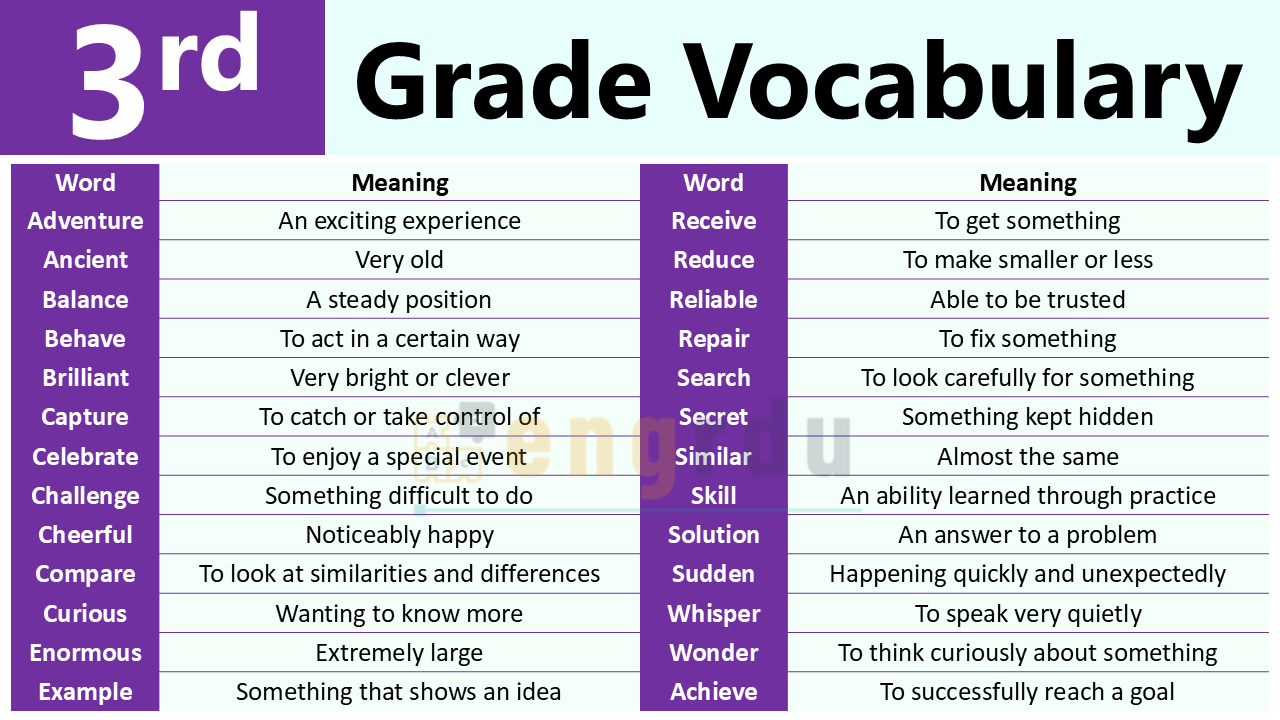

Third grade is an important stage for vocabulary growth. Children begin reading longer stories, explaining their thoughts, and writing more detailed sentences. 3rd grade vocabulary words help students move beyond basic descriptions and communicate with greater accuracy.
This collection of third grade vocabulary words includes action words, describing words, academic terms, nature vocabulary, feelings, and useful words found in children’s books and classroom conversations. Each meaning is short and each example shows how a student can naturally use the word.
A Quick Look at Third-Grade Vocabulary
At this level, students should encounter words that help them:
- Describe people, places, and objects more precisely.
- Explain what happened and why it happened.
- Talk about feelings and personal experiences.
- Understand stories and informational texts.
- Give opinions and support them with simple reasons.
- Connect events using words such as although, instead, while, and because.
- Replace very common words with more precise vocabulary.
Core Vocabulary Every 3rd Grader Should Meet
These words appear frequently in children’s books, school activities, conversations, and everyday writing.
- Adventure – An exciting experience that often involves something new or unusual.
Example: “Our camping trip was a great adventure.” - Appear – To come into sight or become visible.
Example: “The moon began to appear after sunset.” - Avoid – To stay away from someone or something.
Example: “We should avoid walking on the wet floor.” - Balance – The ability to stay steady without falling.
Example: “I used my arms to keep my balance.” - Behavior – The way a person or animal acts.
Example: “His kind behavior made everyone happy.” - Believe – To think that something is true.
Example: “I believe your story.” - Borrow – To take something for a while and return it later.
Example: “Can I borrow your pencil?” - Cause – The person or thing that makes something happen.
Example: “Heavy rain was the cause of the flooding.” - Celebrate – To do something special for an important event.
Example: “We will celebrate Grandma’s birthday tonight.” - Choice – Something that you decide to have or do.
Example: “You have a choice between two books.” - Compare – To look at two or more things to see how they are alike or different.
Example: “Let’s compare the two pictures.” - Complete – To finish something.
Example: “Please complete your homework before dinner.” - Create – To make something new.
Example: “We created a poster for our classroom.” - Curious – Wanting to learn or know more about something.
Example: “The curious child asked many questions.” - Decide – To choose after thinking about something.
Example: “I cannot decide which book to read.” - Describe – To tell what someone or something is like.
Example: “Can you describe your new puppy?” - Different – Not the same as another person or thing.
Example: “Our answers are different.” - Discover – To find or learn something for the first time.
Example: “We discovered a beautiful trail in the forest.” - Effort – The energy used to do something.
Example: “Your effort helped you finish the project.” - Example – Something that shows what another thing is like.
Example: “Can you give me an example?”
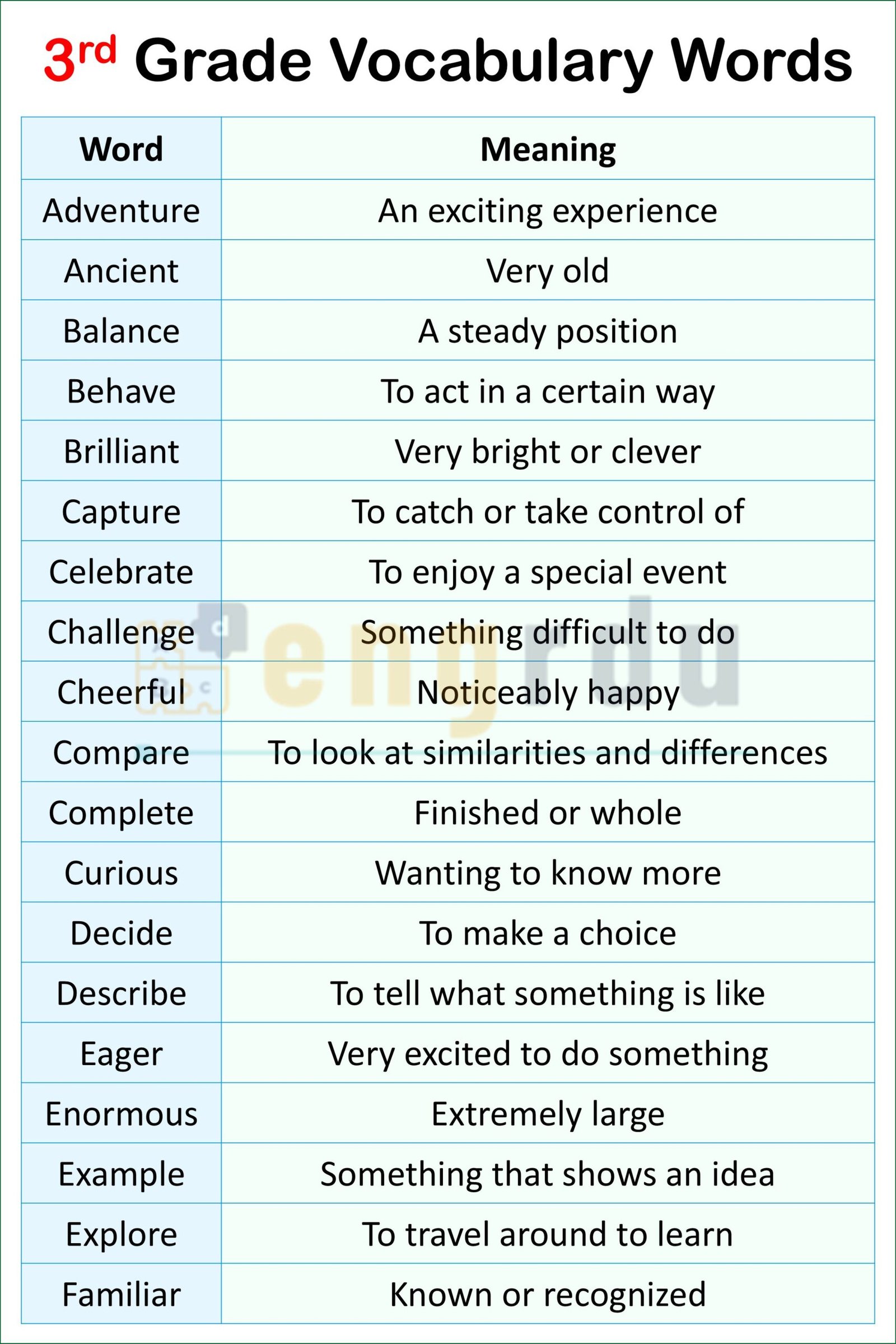
3rd Grade Vocabulary Words
Words That Make Writing More Interesting
Third graders often know basic adjectives but can make their writing stronger by learning more precise descriptive vocabulary.
Appearance and Size
- Ancient – Very old; from a long time ago.
Example: “We learned about an ancient city in history class.” - Enormous – Extremely large.
Example: “An enormous whale appeared near the boat.” - Narrow – Not wide.
Example: “We walked along a narrow path.” - Rough – Having an uneven surface.
Example: “The rough rock hurt my hand.” - Smooth – Having an even surface.
Example: “The stone feels smooth.” - Tiny – Very small.
Example: “A tiny insect landed on my notebook.”
Quality and Condition
- Brilliant – Very bright or very clever.
Example: “The stars looked brilliant in the dark sky.” - Fragile – Easily broken or damaged.
Example: “Be careful with this fragile glass.” - Messy – Untidy or not clean.
Example: “My desk is messy after the art project.” - Peaceful – Quiet and calm.
Example: “The garden is a peaceful place.” - Powerful – Having a lot of strength or force.
Example: “The powerful wind shook the trees.” - Useful – Helpful for a particular purpose.
Example: “This dictionary is useful for my homework.”
Verbs That Help Tell Better Stories
Strong verbs make stories easier to imagine. These words help children explain exactly what characters are doing.
- Approach – To move closer to someone or something.
Example: “We watched the dog approach the gate.” - Celebrate – To do something enjoyable for a special event.
Example: “The family celebrated after the team won.” - Chase – To run after someone or something.
Example: “The puppy chased the ball.” - Collect – To bring things together.
Example: “We collect leaves for our science project.” - Escape – To get away from a place or situation.
Example: “The rabbit escaped from the garden.” - Examine – To look at something carefully.
Example: “The students examined the leaves.” - Gather – To bring people or things together.
Example: “We gathered around the teacher.” - Imagine – To form a picture or idea in your mind.
Example: “Imagine flying over the mountains.” - Investigate – To look for facts about something.
Example: “The students investigated the strange footprints.” - Observe – To watch something carefully.
Example: “We observed the birds from the window.” - Prepare – To get ready for something.
Example: “I need to prepare for tomorrow’s test.” - Protect – To keep someone or something safe.
Example: “Trees help protect the soil.” - Rescue – To save someone or something from danger.
Example: “The firefighter rescued the kitten.” - Search – To look carefully for someone or something.
Example: “We searched the room for the missing key.” - Whisper – To speak very quietly.
Example: “Please whisper while the baby sleeps.”
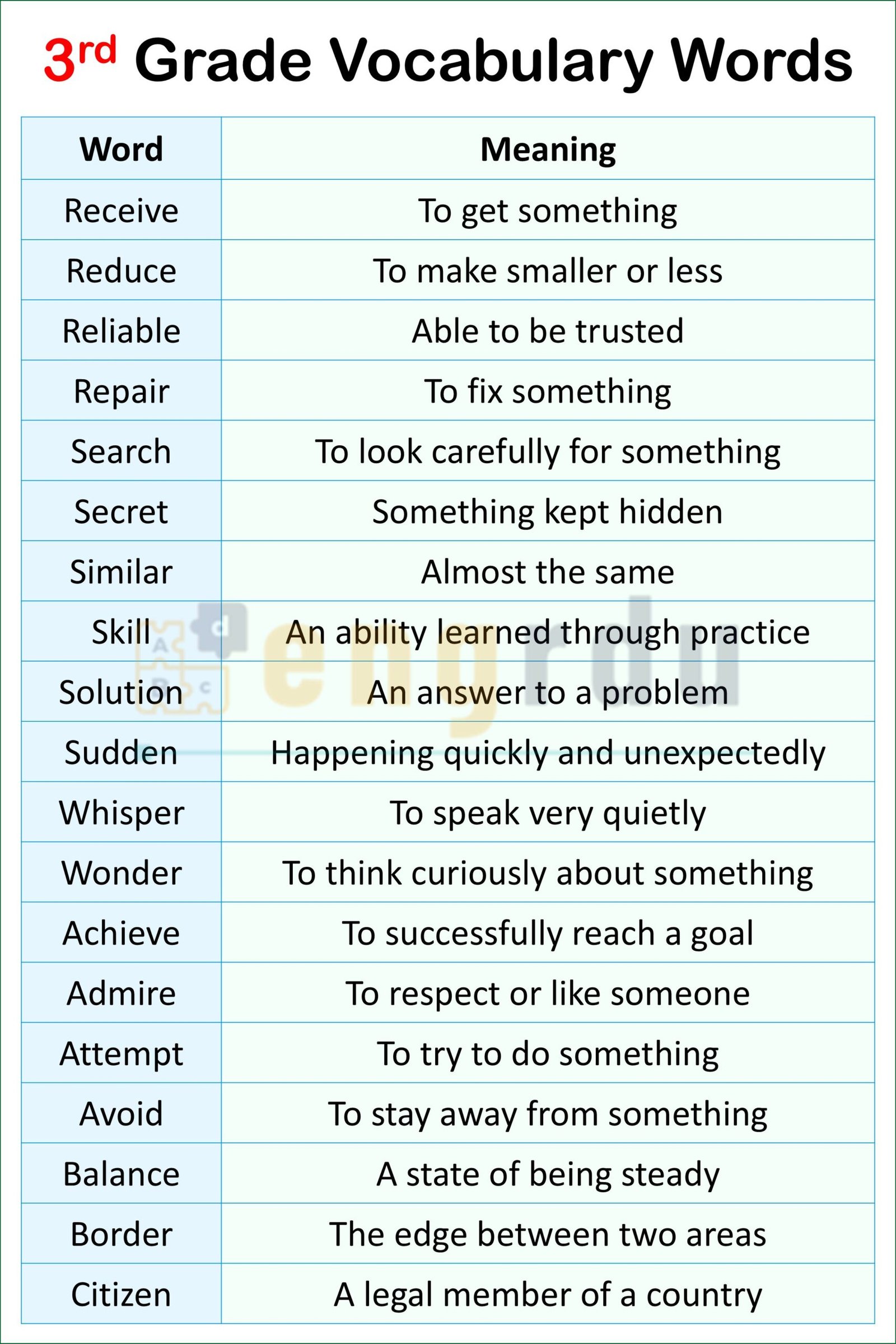
Third Grade Vocabulary Words for Kids
Third-Level Vocabulary for Feelings and Character
Children at this age can begin describing emotions and personality with greater detail.
- Anxious – Worried or nervous about something.
Example: “I felt anxious before my first performance.” - Confident – Feeling sure about your abilities.
Example: “She felt confident before the spelling test.” - Disappointed – Sad because something did not happen as expected.
Example: “I was disappointed when the picnic was canceled.” - Generous – Willing to give or share with others.
Example: “My generous friend shared her lunch with me.” - Honest – Always telling the truth.
Example: “Please be honest about what happened.” - Impatient – Finding it difficult to wait calmly.
Example: “The impatient child asked when lunch would be ready.” - Jealous – Feeling unhappy because someone has something you want.
Example: “He felt jealous when his brother received a new toy.” - Proud – Feeling pleased about something you or someone else achieved.
Example: “I am proud of my science project.” - Responsible – Expected to take care of something properly.
Example: “I am responsible for feeding the dog.” - Selfish – Caring too much about yourself and not enough about others.
Example: “It is selfish to keep all the toys for yourself.” - Thoughtful – Showing care about other people’s feelings.
Example: “It was thoughtful of Mia to make me a card.” - Worried – Thinking something bad might happen.
Example: “Dad was worried when I came home late.”
3rd Grade School Vocabulary Beyond the Basics
Third graders encounter more academic language as lessons become longer and more detailed.
- Answer – A response to a question.
Example: “I wrote my answer on the worksheet.” - Author – The person who writes a book or story.
Example: “The author wrote a story about a lost dog.” - Chapter – One main section of a book.
Example: “We read the next chapter together.” - Conclusion – The ending or final idea of something.
Example: “Write a conclusion for your report.” - Evidence – Facts or information that help show something is true.
Example: “Use evidence from the story to support your answer.” - Fact – Something that is known to be true.
Example: “It is a fact that plants need water to grow.” - Information – Facts or details about something.
Example: “The book gives us information about space.” - Opinion – What someone thinks or believes about something.
Example: “In my opinion, this is the best story.” - Paragraph – A group of sentences about one main idea.
Example: “Write one paragraph about your favorite animal.” - Problem – Something that needs to be solved.
Example: “We worked together to solve the problem.” - Reason – An explanation for why something happens or why someone thinks something.
Example: “What is your reason for choosing this book?” - Solution – An answer to a problem.
Example: “We found a solution to the problem.” - Subject – A topic or area studied at school.
Example: “Science is my favorite subject.” - Topic – The main subject being discussed or studied.
Example: “The topic of today’s lesson is animals.”
3rd Grader Words for Reading and Understanding Stories
These vocabulary terms frequently appear when children discuss characters, events, and story structure.
- Character – A person, animal, or figure in a story.
Example: “My favorite character is the brave girl.” - Event – Something that happens.
Example: “The next event in the story surprised us.” - Beginning – The first part of something.
Example: “The beginning of the story introduces the characters.” - Middle – The part between the beginning and the end.
Example: “Something exciting happens in the middle of the story.” - Ending – The final part of something.
Example: “The story has a happy ending.” - Setting – The time and place where a story happens.
Example: “The setting is a small village.” - Journey – A trip from one place to another.
Example: “The hero began a long journey.” - Mystery – Something that is difficult to understand or explain.
Example: “The missing necklace became a mystery.” - Narrator – The person or voice that tells a story.
Example: “The narrator tells us what happened next.” - Predict – To say what you think will happen next.
Example: “Can you predict the ending?”
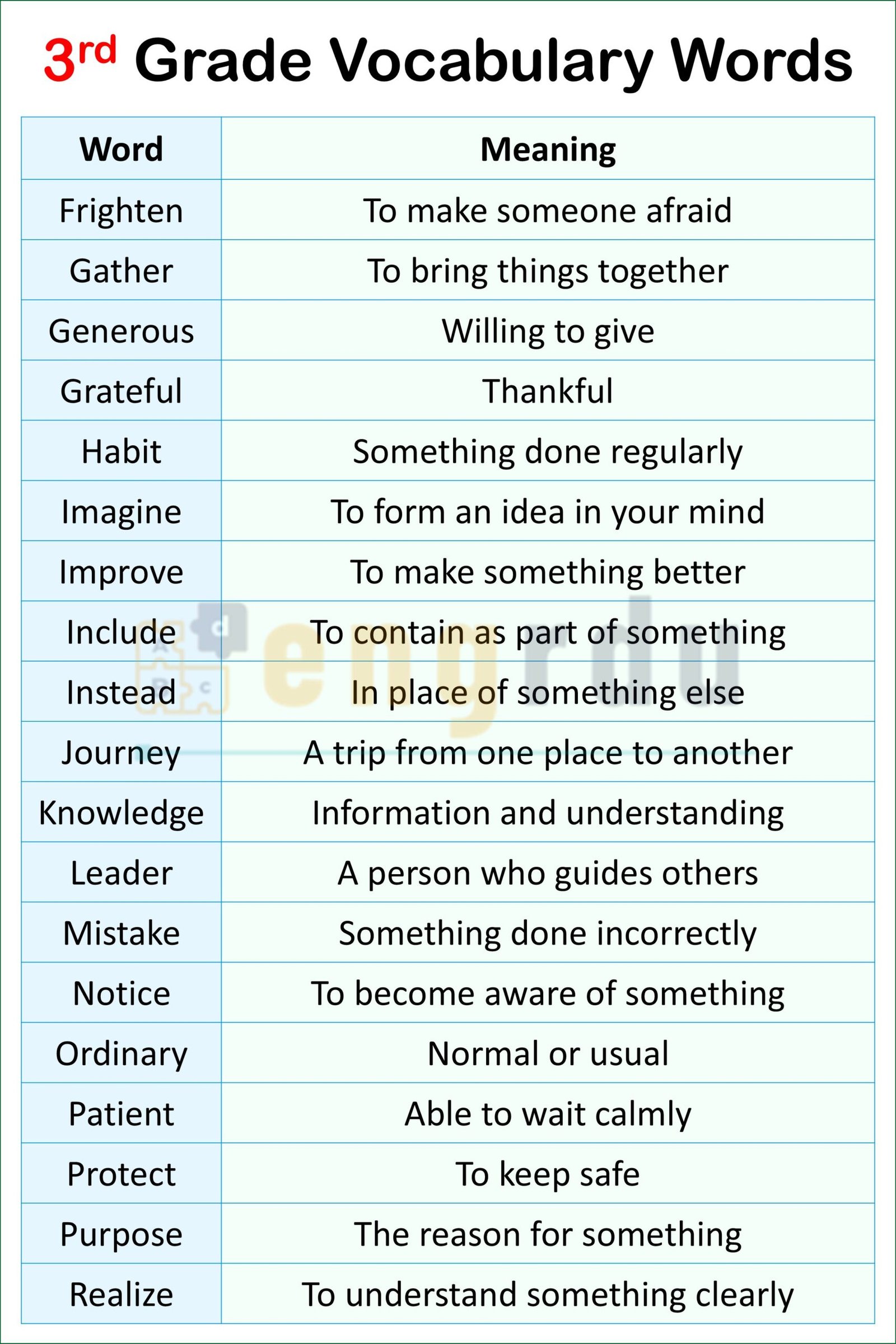
Vocabulary Words for Third Graders
Vocabulary for 3rd Grade about Nature, Animals, and the World
Third graders can use these words when reading science texts or talking about the natural world.
- Climate – The usual weather of a place over a long period.
Example: “The desert has a dry climate.” - Environment – The natural world and surroundings in which people, animals, and plants live.
Example: “We should keep our environment clean.” - Habitat – The natural home of a plant or animal.
Example: “The forest is the bear’s habitat.” - Natural – Existing in nature rather than being made by people.
Example: “The waterfall is a natural feature.” - Ocean – A very large area of salt water.
Example: “Whales live in the ocean.” - Planet – A large body that travels around a star.
Example: “Earth is the planet where we live.” - Season – One of the four main parts of the year.
Example: “Flowers grow during the spring season.” - Shelter – A place that provides protection from weather or danger.
Example: “The birds found shelter in the tree.” - Species – A group of similar living things that can reproduce.
Example: “Scientists discovered a new species of frog.” - Survive – To continue living despite danger or difficulty.
Example: “Some animals survive in very cold places.” - Temperature – A measure of how hot or cold something is.
Example: “The temperature dropped during the night.” - Wild – Living or growing naturally rather than being cared for by people.
Example: “We saw wild birds near the lake.”
Time, Place, and Direction Words for 3rd Graders
These words help students explain where and when something happens.
- Already – Before now or before a particular time.
Example: “I have already finished my homework.” - During – At some point within a period of time.
Example: “Please stay quiet during the lesson.” - Earlier – Before the present time or before another event.
Example: “I saw him earlier today.” - Eventually – After some time or after several events.
Example: “Eventually, we found the missing puppy.” - Immediately – At once; without waiting.
Example: “Come inside immediately when it starts raining.” - Nearby – Not far away.
Example: “There is a small store nearby.” - Often – Many times or frequently.
Example: “I often read before bed.” - Rarely – Not often.
Example: “We rarely eat dessert during the week.” - Suddenly – Quickly and unexpectedly.
Example: “Suddenly, the lights went out.” - Towards – In the direction of something.
Example: “We walked towards the river.”
Food, Health, and Daily Life Vocabulary for 3rd Grade Students
These terms are useful for conversations about meals, habits, and taking care of ourselves.
- Appetite – The desire to eat food.
Example: “I have a big appetite after swimming.” - Breakfast – The first meal of the day.
Example: “I ate eggs for breakfast.” - Healthy – Good for your body or health.
Example: “Fresh fruit is a healthy snack.” - Hygiene – Practices that help keep the body clean and healthy.
Example: “Good hygiene includes washing your hands.” - Medicine – Something used to treat an illness or health problem.
Example: “The doctor gave me medicine.” - Nourish – To provide food or other things needed for healthy growth.
Example: “Healthy foods nourish our bodies.” - Rest – To relax or stop activity so your body can recover.
Example: “You should rest after a busy day.” - Routine – A usual way of doing things regularly.
Example: “Brushing my teeth is part of my morning routine.” - Thirsty – Wanting or needing something to drink.
Example: “I am thirsty after playing outside.” - Tired – Needing rest or sleep.
Example: “I feel tired after the long walk.”
Useful Words for Talking and Sharing Ideas for 3rd Level Students
These words help children participate in conversations, discussions, and classroom activities.
- Agree – To have the same opinion as another person.
Example: “I agree with your answer.” - Argue – To speak angrily because you disagree.
Example: “The two children began to argue over the toy.” - Explain – To make something clear by giving details.
Example: “Can you explain how you solved it?” - Mention – To talk or write about something briefly.
Example: “She mentioned the school trip.” - Promise – To say that you will definitely do something.
Example: “I promise to return your book tomorrow.” - Suggest – To give an idea for someone to consider.
Example: “I suggest we start with the easy questions.” - Agreeable – Pleasant and willing to cooperate.
Example: “Tom was agreeable to the new plan.” - Reply – To answer someone.
Example: “Please reply to my question.” - Request – To ask for something politely.
Example: “I made a request for another sheet of paper.” - Warn – To tell someone about possible danger or trouble.
Example: “Mom warned me not to touch the hot pan.”
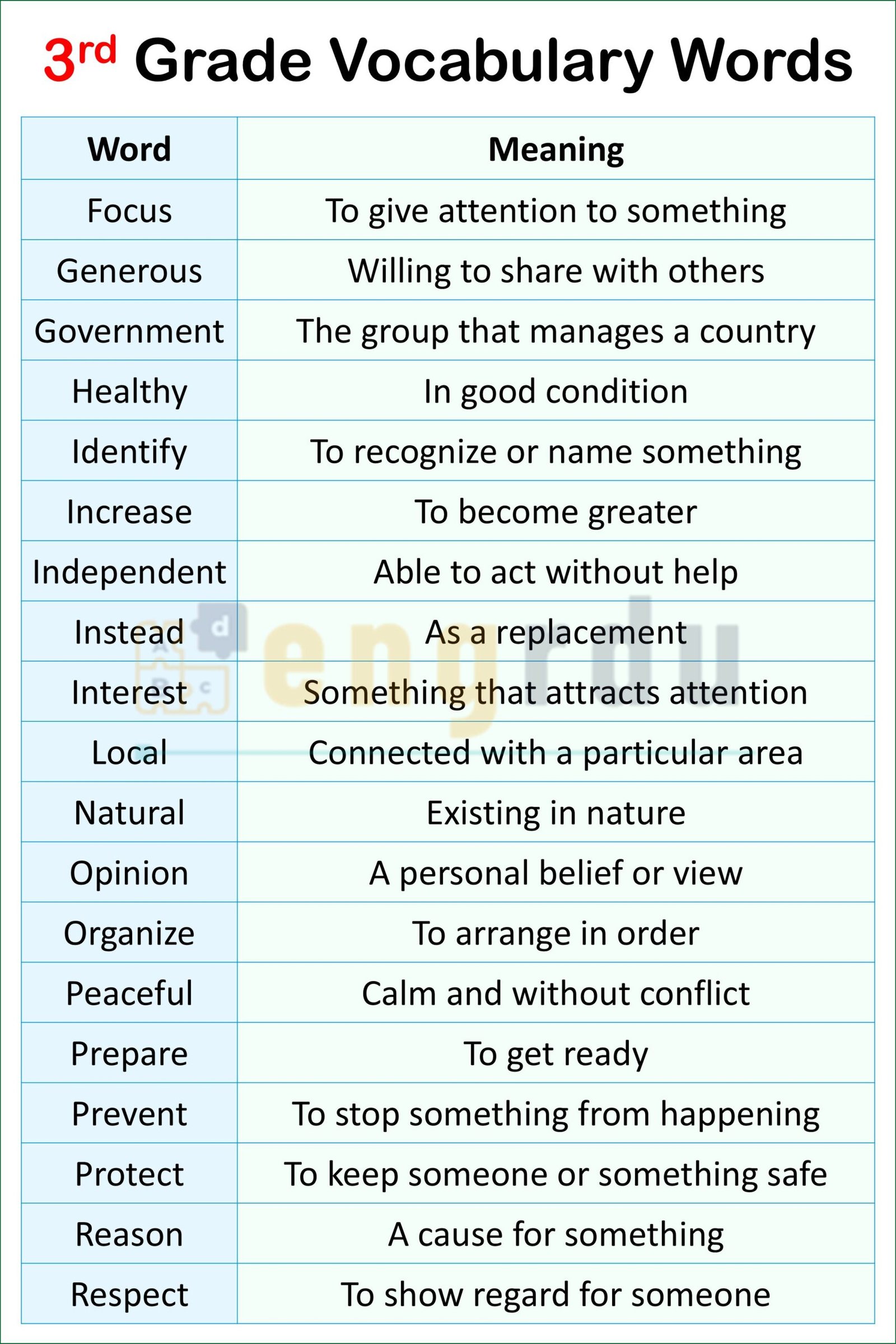
Vocabulary Words for 3rd Grade PDF
3rd Grade Vocabulary: Useful Word Relationships
Understanding how words relate to one another makes reading and writing easier.
Synonyms
- Angry / Furious – Feeling very upset or mad.
Example: “Dad was angry about the broken window.” - Big / Enormous – Very large.
Example: “An enormous tree stood beside the house.” - Brave / Courageous – Not allowing fear to stop you from doing something.
Example: “The courageous firefighter helped the family.” - Begin / Start – To do something for the first time or begin an activity.
Example: “The movie will start soon.” - Quiet / Silent – Making little or no sound.
Example: “The classroom became silent.”
Antonyms
- Accept / Refuse – To agree to receive something versus saying no to it.
Example: “She accepted the gift but refused the money.” - Arrive / Depart – To reach a place versus leave it.
Example: “The train arrived at noon and departed later.” - Increase / Decrease – To become greater versus become smaller.
Example: “The temperature may increase during the afternoon.” - Remember / Forget – To keep something in your mind versus fail to remember it.
Example: “Remember your homework so you do not forget it.” - Success / Failure – A good result versus an unsuccessful result.
Example: “Practice can lead to success after a failure.”
3rd Grader Words That Connect Sentences
Third graders can make their writing clearer by using connecting words.
- Although – Used to introduce a difference or contrast.
Example: “Although it was raining, we went outside.” - Also – In addition to something else.
Example: “I like apples, and I also like oranges.” - Instead – In place of someone or something else.
Example: “I wanted juice, but I drank water instead.” - However – Used to show a contrast between ideas.
Example: “The road was long; however, we enjoyed the trip.” - Therefore – For that reason or because of that.
Example: “It was raining; therefore, we stayed inside.” - Unless – Except if something happens.
Example: “We will go outside unless it rains.”
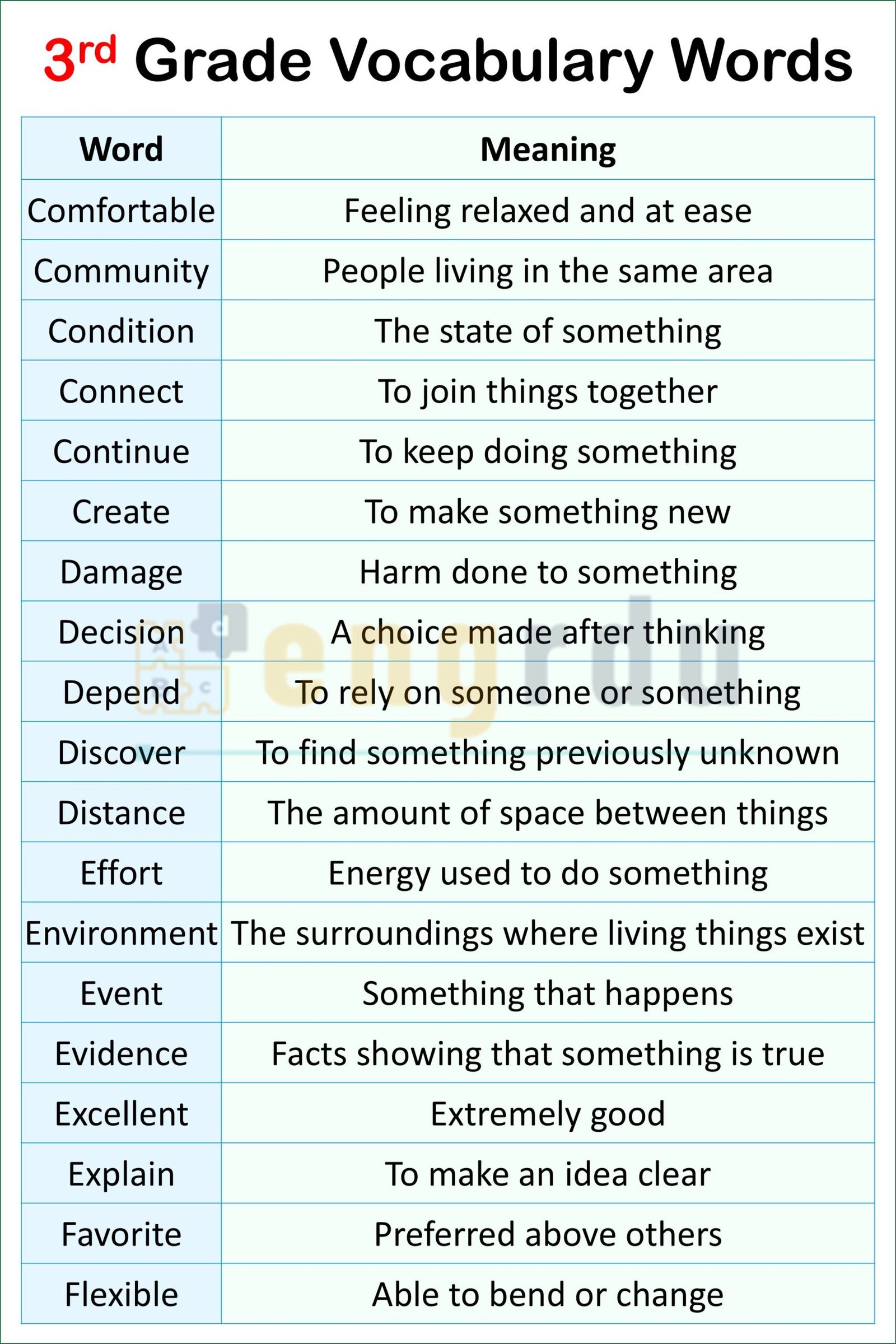
Third Grade Vocabulary Words with Meanings
Common Confusions in 3rd Grade Vocabulary
Some English words look or sound alike, so students may mix them up.
- Accept / Except – Accept means to receive or agree; except means not including something.
- Then / Than – Then relates to time; than is commonly used when comparing things.
- Quiet / Quite – Quiet means making little noise; quite means fairly or very.
- Lose / Loose – Lose means to misplace or not win; loose means not tight.
- Weather / Whether – Weather refers to conditions outside; whether introduces a choice or possibility.
A Short Vocabulary Challenge for 3rd Grade Students
Complete each sentence with the best word:
curious — habitat — predict — generous — approach — evidence — routine — suddenly
- The forest is the tiger’s natural ______.
- The ______ child wanted to know how the machine worked.
- Can you ______ what will happen next?
- My morning ______ includes brushing my teeth.
- The dog began to ______ the boy.
- We need ______ from the story to support our answer.
- My ______ friend shared her lunch.
- ______, the lights went off.
Answers:
- habitat
- curious
- predict
- routine
- approach
- evidence
- generous
- Suddenly
A Simple Way to Practice Third-Grade Words
Instead of asking children to memorize long lists, give each word a purpose.
Read it → understand it → hear it → say it → use it.
For example, when learning investigate, a parent or teacher might say:
“Scientists investigate questions by looking carefully for information.”
Then ask:
“What could you investigate?”
A child might answer:
“I could investigate why some plants grow faster than others.”
This kind of practice helps students connect a vocabulary word with an actual idea rather than remembering its definition only for a test.
What Makes Third-Grade Vocabulary More Advanced?
Third-grade vocabulary starts introducing words that carry more specific meanings.
Compare these examples:
- Grade 1: The dog is big.
- Grade 2: The huge dog ran across the yard.
- Grade 3: The enormous dog quickly approached the gate.
The third-grade sentence gives the reader more information and uses vocabulary that describes size, movement, and direction more precisely.
Students also begin encountering academic words such as compare, describe, evidence, conclusion, predict, solution, and investigate. These words are useful across many subjects, not only English.
FAQs About Third Graders’ Vocabulary
What is the main purpose of third-grade vocabulary?
Third-grade vocabulary helps children understand more complex texts and express ideas with greater precision when speaking and writing.
What types of words are taught in Grade 3?
Grade 3 commonly introduces descriptive adjectives, stronger verbs, academic terms, emotion words, science vocabulary, and words used to connect ideas.
How can reading improve a child’s vocabulary?
Reading exposes children to unfamiliar words in context, allowing them to understand meanings through surrounding sentences, pictures, and story events.
Should third graders learn dictionary skills?
Yes. Learning how to use a child-friendly dictionary can help students check definitions, spelling, pronunciation, word forms, and example usage.
What is a good vocabulary activity for Grade 3?
Word sorting works well: students can group vocabulary into synonyms, antonyms, nouns, verbs, adjectives, feelings, animals, or school terms.
How can a child use new vocabulary in writing?
Encourage the child to replace repeated basic words with more precise choices and then check whether the new word fits the sentence meaning.
Why are academic vocabulary words important in Grade 3?
Academic words help children understand instructions and explain ideas in subjects such as English, science, mathematics, and social studies.
How often should third-grade vocabulary be reviewed?
Regular short reviews are more useful than occasional long sessions. Reusing words in reading, conversation, and writing strengthens understanding.
Conclusion
Building 3rd Grade Vocabulary Words is about helping children become more precise readers, writers, speakers, and listeners. Words such as curious, investigate, compare, approach, evidence, habitat, responsible, predict, and discover give students language for explaining ideas and understanding increasingly detailed texts.
The strongest vocabulary learning happens when children meet words repeatedly and use them in meaningful sentences and conversations. As students move from Grade 3 toward higher grades, their vocabulary can gradually become more descriptive, academic, and abstract.
Explore More Vocabulary By Level
- 10th Grade Words with Meanings with PDF
- 600+ 9th Grade Vocabulary Words with PDF
- 500+ 8th Grade Vocabulary Words with PDF
- 700+ 7th Grade Vocabulary Words with PDF
- 500+ 6th Grade Vocabulary Words with PDF
- 300+ 5th Grade Vocabulary Words with PDF
- 300+ 4th Grade Vocabulary Words with PDF
- 2nd Grade Vocabulary Words with with PDF
- Vocabulary Words for 1st Grade with PDF