
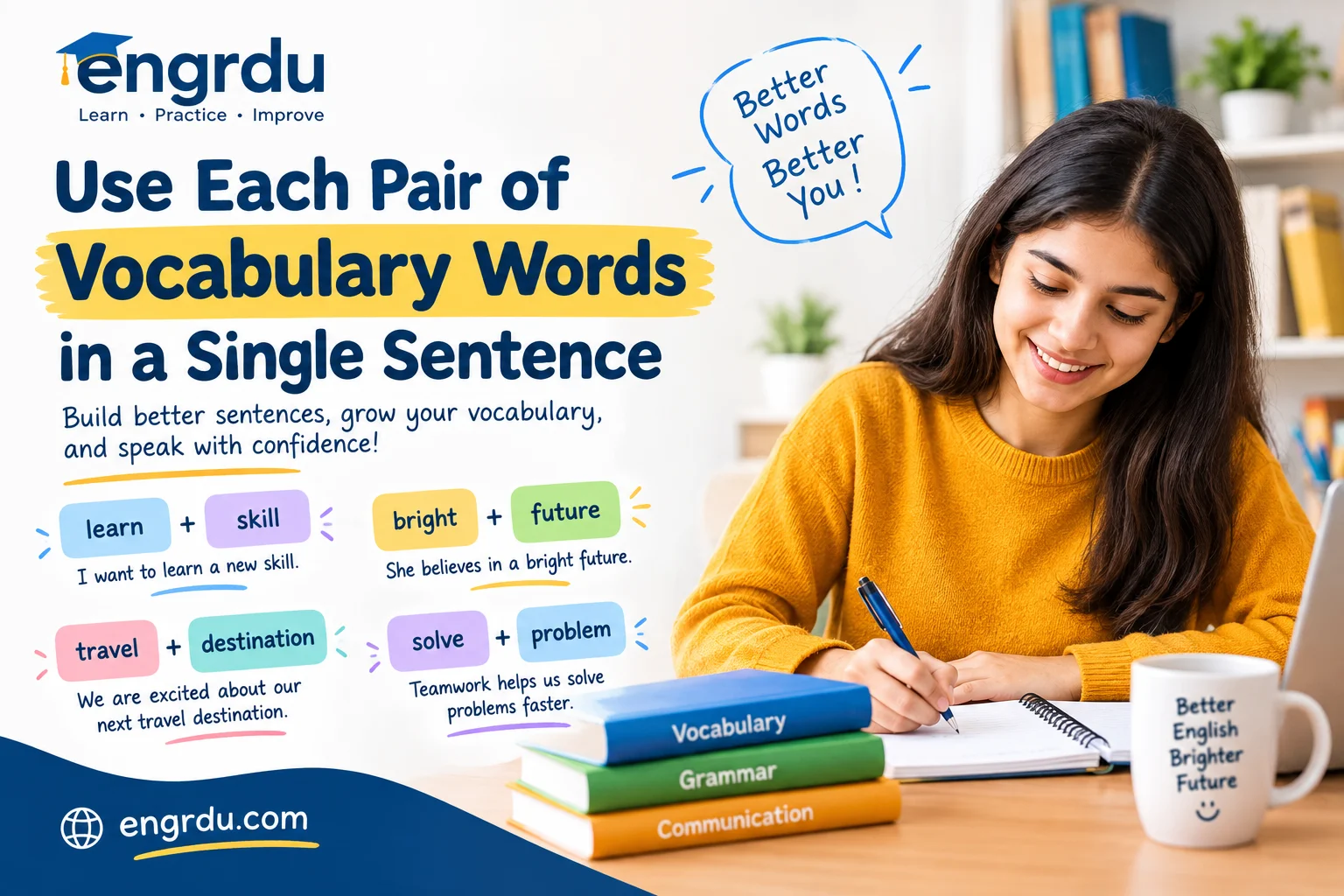

Use Each Pair of Vocabulary Words in a Single Sentence is a useful vocabulary practice activity that teaches learners how to connect two words naturally in context. Instead of memorizing isolated definitions, students combine both words in one complete sentence to improve word usage, sentence formation, grammar, and speaking skills.
For example, with the words observe and careful, you could write: “Be careful when you observe the birds near the lake.” The sentence gives both words a clear context and shows how they work together.
This exercise works well for elementary, intermediate, and ESL learners because it turns vocabulary learning into practical sentence practice.
What Does “Use Each Pair of Vocabulary Words in a Single Sentence” Mean?
This activity asks you to take two vocabulary words and use both of them correctly in one sentence.
The goal is not to place the words together randomly. The sentence should make sense, use correct grammar, and show the meanings of both words clearly.
For example:
- Pair: borrow + library
- Sentence: “I went to the library to borrow a science book.”
Both words appear in one sentence, and their relationship is easy to understand.
Another example:
- Pair: nervous + interview
- Sentence: “Mina felt nervous before her job interview.”
The sentence gives the reader enough context to understand how the words are connected.
What This Exercise Helps You Practice
- Understanding vocabulary in context
- Writing complete sentences
- Choosing suitable grammar
- Using nouns, verbs, adjectives, and adverbs correctly
- Learning natural word combinations
- Improving speaking confidence
- Remembering new vocabulary for longer
- Building practical English sentences
Structure Of The Vocabulary Sentence Exercise
A basic exercise has three parts:
1. Vocabulary Pair
Two words are provided.
Example:
repair + bicycle
2. Sentence Formation
Use both words in the same sentence.
Example:
“I need to repair my bicycle before the race.”
3. Meaningful Context
The sentence should show what the words mean through their relationship.
Weak example:
“I repair bicycle and beautiful.”
The sentence is grammatically incorrect and does not create a clear connection.
Better example:
“My brother helped me repair my bicycle after the chain broke.”
The second sentence gives a natural situation and uses both vocabulary words correctly.
How To Use Two Vocabulary Words in One Sentence
You can connect a vocabulary pair in several ways. The best method depends on the meanings and grammatical roles of the words.
Use One Word as the Main Action
One word can describe the action while the other gives more information.
- Pair: carry + fragile
- Sentence: “Please carry the fragile glass carefully.”
Here, carry is the action and fragile describes the glass.
Join Two Ideas With “And”
This works when both words can describe related actions or ideas.
- Pair: collect + organize
- Sentence: “We collect old photographs and organize them by year.”
Use One Word To Explain Another
A noun and adjective often work naturally together.
- Pair: crowded + station
- Sentence: “The crowded station became quieter after the last train left.”
Use A Cause-and-Effect Relationship
One word can explain why something happened.
- Pair: delay + traffic
- Sentence: “The traffic caused a delay on our way to school.”
Use A Time Relationship
The two words can appear in different parts of the sentence.
- Pair: prepare + exam
- Sentence: “I prepare carefully before every difficult exam.”
Use A Contrast
Some word pairs work well with but, although, or however.
- Pair: expensive + durable
- Sentence: “The shoes are expensive, but they are durable enough for daily use.”
Complete Examples Of Vocabulary Word Pairs
The following examples show how two vocabulary words can work naturally in one sentence.
1: Admire + Talent
- Sentence: “Many students admire Sara because of her musical talent.”
- Meaning: Admire means to respect or appreciate someone or something. Talent means a natural skill.
2: Ancient + Temple
- Sentence: “Tourists visited an ancient temple during their trip.”
- Meaning: Ancient describes something from a very old period. A temple is a place used for religious worship.
3: Borrow + Permission
- Sentence: “Always ask for permission before you borrow someone’s belongings.”
- Meaning: Borrow means to take something temporarily and return it later. Permission means approval to do something.
4: Calm + Storm
- Sentence: “The sea became calm after the storm moved away.”
- Meaning: Calm means peaceful or without much movement. A storm is a period of strong wind, rain, snow, or other severe weather.
5: Curious + Machine
- Sentence: “The curious student examined the strange machine.”
- Meaning: Curious means eager to know or learn something. A machine is a device that performs a task.
6: Delicious + Recipe
- Sentence: “My aunt shared a delicious recipe for vegetable soup.”
- Meaning: Delicious means very pleasant to taste. A recipe gives instructions for preparing food.
7: Encourage + Effort
- Sentence: “Good teachers encourage students to value their own effort.”
- Meaning: Encourage means to give support or confidence. Effort means the energy used to do something.
8: Famous + Painter
- Sentence: “The museum displayed a portrait by a famous painter.”
- Meaning: Famous means known by many people. A painter is someone who creates paintings.
9: Gather + Information
- Sentence: “We gathered useful information before making a decision.”
- Meaning: Gather means to collect. Information means facts or knowledge about something.
10: Honest + Opinion
- Sentence: “Please give me your honest opinion about my presentation.”
- Meaning: Honest means truthful. An opinion is a personal view or belief.
11: Improve + Pronunciation
- Sentence: “Daily speaking practice can improve your pronunciation.”
- Meaning: Improve means to make something better. Pronunciation is the way a word is spoken.
12: Journey + Destination
- Sentence: “We enjoyed the journey even before reaching our final destination.”
- Meaning: A journey is travel from one place to another. A destination is the place where someone is going.
13: Patient + Nurse
- Sentence: “The patient thanked the nurse for answering his questions.”
- Meaning: A patient is a person receiving medical care. A nurse provides care and support to patients.
14: Protect + Environment
- Sentence: “Small daily choices can help protect the environment.”
- Meaning: Protect means to keep someone or something safe. The environment includes the natural world around us.
15: Reliable + Friend
- Sentence: “A reliable friend keeps promises and offers help when needed.”
- Meaning: Reliable means dependable. A friend is someone you know, like, and trust.
16: Solve + Problem
- Sentence: “The team worked together to solve the problem.”
- Meaning: Solve means to find an answer or solution. A problem is something that needs to be dealt with.
17: Useful + Advice
- Sentence: “My teacher gave me useful advice about preparing for the test.”
- Meaning: Useful means helpful. Advice means a suggestion about what someone should do.
18: Visit + Museum
- Sentence: “We plan to visit the museum during our school trip.”
- Meaning: Visit means to go to a place for a period of time. A museum is a place where objects of historical, scientific, or cultural interest are displayed.
Vocabulary Pairs For Everyday Conversation
Vocabulary practice becomes more valuable when the sentences sound like things people actually say.
Here are practical word pairs for daily speaking.
At Home
- clean + kitchen: “I need to clean the kitchen before dinner.”
- wash + dishes: “Can you wash the dishes after lunch?”
- prepare + breakfast: “Dad usually prepares breakfast on Sundays.”
- repair + shelf: “I need to repair the shelf in my room.”
- lock + door: “Please lock the door before you leave.”
At School
- complete + assignment: “I finished my assignment before class.”
- explain + lesson: “Our teacher explained the lesson clearly.”
- practice + spelling: “We practice spelling words every morning.”
- borrow + pencil: “May I borrow your pencil for a minute?”
- answer + question: “Ali raised his hand to answer the question.”
With Friends
- invite + party: “I invited my friends to the party.”
- share + idea: “Let me share an idea with you.”
- enjoy + company: “We always enjoy each other’s company.”
- trust + friend: “You can trust a good friend with important information.”
- discuss + plan: “Let’s discuss the plan before we start.”
While Shopping
- compare + price: “I usually compare the price before buying anything.”
- choose + size: “I need to choose the right size.”
- return + item: “Can I return the item if it does not fit?”
- check + quality: “Always check the quality before you pay.”
- save + money: “Cooking at home can help you save money.”
During Travel
- pack + luggage: “I still need to pack my luggage.”
- book + ticket: “We booked our train tickets online.”
- follow + map: “We followed the map to find the hotel.”
- reach + destination: “We reached our destination before sunset.”
- carry + passport: “Remember to carry your passport.”
Vocabulary Practice For Elementary Learners
Elementary learners should begin with short and familiar sentence patterns.
A useful structure is:
Subject + verb + word 1 + word 2
Examples:
- Pair: feed + rabbit
“I feed the rabbit every morning.” - Pair: open + window
“Please open the window.” - Pair: wear + jacket
“I wear my jacket when it is cold.” - Pair: draw + picture
“Emma likes to draw a picture.” - Pair: kick + ball
“The boy kicked the ball across the field.”
Useful Sentence Starters
Young learners can also use these starters:
- “I use ___ to ___.”
- “I like ___ because it is ___.”
- “We saw ___ near the ___.”
- “My ___ can help me ___.”
- “I need to ___ before ___.”
- “She ___ when she sees ___.”
These patterns reduce the difficulty of sentence formation while still requiring learners to think about word meaning and grammar.
Vocabulary Practice For Intermediate Learners
Intermediate learners can create longer sentences and show stronger relationships between the two words.
Try patterns such as:
- “Although ___, ___.”
- “Because ___, ___.”
- “When ___, ___.”
- “If ___, ___.”
- “The reason ___ is that ___.”
- “After ___, ___.”
Examples:
- Pair: cautious + decision
“She made a cautious decision after reviewing all the available information.” - Pair: flexible + schedule
“A flexible schedule makes it easier to manage unexpected changes.” - Pair: appreciate + support
“I really appreciate your support during a difficult week.” - Pair: reduce + waste
“Families can reduce waste by reusing containers and bags.” - Pair: discover + opportunity
“Volunteering can help students discover a new learning opportunity.”
Pronunciation And Word-Form Awareness
Using vocabulary correctly also means noticing how words sound and how their forms change.
Some English words look or sound similar but have different meanings.
Advice And Advise
- Advice is a noun.
- Advise is a verb.
- Advice: /ədˈvaɪs/
- Advise: /ədˈvaɪz/
Example:
- “My coach gave me useful advice and advised me to practice regularly.”
Affect And Effect
These two words are commonly confused.
- Affect is usually used as a verb.
- Effect is usually used as a noun.
Example:
- “Lack of sleep can affect your mood and have a negative effect on your concentration.”
Practicing confusing word pairs in one sentence can make the difference between similar words easier to remember.
Common Mistakes When Using Vocabulary Pairs
- Using only one word: Both vocabulary words must appear in the same sentence.
- Ignoring word type: Check whether each word is a noun, verb, adjective, or adverb.
- Creating an unnatural connection: The sentence should show a meaningful relationship between the words.
- Using incorrect grammar: Make sure verb tense, subject-verb agreement, articles, and prepositions are correct.
- Changing the meaning: Do not force a word into a sentence where its meaning does not fit.
Practice Exercises: Use Each Pair In One Sentence
Write one complete sentence for each pair. Use both vocabulary words in the same sentence.
- arrange + meeting
- bright + curtain
- calculate + distance
- celebrate + achievement
- discover + village
- empty + basket
- feed + squirrel
- generous + neighbor
- handle + equipment
- ignore + warning
- journey + companion
- maintain + balance
- notice + pattern
- prevent + accident
- quiet + hallway
- replace + battery
- reduce + noise
- select + material
- support + community
- transfer + file
Answers To The Practice Exercises
More than one answer can be correct. The important point is to use both words naturally and accurately.
- “I called the office to arrange a meeting with the manager.”
- “The bright curtain made the small room feel warmer.”
- “We used a map to calculate the distance between the two towns.”
- “The school held a ceremony to celebrate the student’s achievement.”
- “We were excited to discover a quiet village near the mountain.”
- “Please put the empty bottles in the basket.”
- “The children watched the mother feed the squirrel.”
- “Our generous neighbor brought fresh fruit for everyone.”
- “Only trained workers should handle the heavy equipment.”
- “You should never ignore a warning from the safety officer.”
- “My brother was my closest companion during the long journey.”
- “Regular exercise can help you maintain a healthy balance.”
- “The researcher began to notice a pattern in the results.”
- “Wearing protective gear can help prevent an accident.”
- “The students walked quietly through the hallway.”
- “I need to replace the battery in my remote control.”
- “Closing the windows can reduce the noise from the street.”
- “Please select a strong material for the outdoor project.”
- “Local volunteers support the community in many ways.”
- “I need to transfer the file to my laptop.”
How To Check Your Own Sentences
Before considering your answer complete, check five things.
- Both words are present: Make sure you did not accidentally leave one out.
- Both meanings fit: The words should be used according to their correct meanings.
- Grammar is correct: Check tense, word order, articles, and prepositions.
- The sentence sounds natural: Read it aloud to hear whether it feels like normal English.
- The context is clear: A reader should understand the sentence without needing extra explanation.
Tips For Better Vocabulary Sentence Practice
Start With The Easier Word
Identify the word that is easier to use. Build the sentence around it first, then add the second word.
Think About The Relationship
Ask yourself what relationship the two words can have.
They might show:
- An action and an object
- A person and a place
- A quality and a noun
- A cause and a result
- Two related actions
- A problem and a solution
- A time or place relationship
Use Natural Collocations
A collocation is a group of words that commonly appear together in English.
For example:
- make a decision
- take a break
- solve a problem
- give advice
- save money
- reach a destination
Learning common word combinations helps your sentences sound more natural.
Read The Sentence Aloud
Speaking the sentence after writing it adds another layer of practice. It helps you remember pronunciation, rhythm, and word order.
Change The Sentence Pattern
Do not always begin with “I.”
Try:
- “The teacher…”
- “My brother…”
- “After lunch…”
- “Because of the rain…”
- “When we arrived…”
- “Our school…”
Different sentence openings give you more control over English.
Why This Vocabulary Exercise Is Useful
Using two vocabulary words in one sentence is more active than memorizing a list of definitions.
The exercise helps learners:
- Connect words with meaningful situations
- Understand vocabulary through context
- Practice grammar at the same time
- Improve sentence-writing ability
- Strengthen speaking practice
- Notice natural word combinations
- Remember vocabulary through repeated use
It is also useful for classroom assignments, homework, vocabulary notebooks, ESL lessons, and independent English practice.
How Teachers Can Use This Activity
Teachers can adapt the exercise for different age groups and ability levels.
For Younger Learners
Provide:
- Two familiar words
- A sentence starter
- A picture or situation
- A short answer model
Example:
Words: apple + hungry
Starter: “I eat an apple when…”
For Intermediate Students
Give learners:
- Two less familiar words
- A required tense
- A sentence length target
- A specific situation
Example:
Words: reduce + expense
Instruction: Write one sentence in the present tense about managing household spending.
For Classroom Speaking Practice
Students can:
- Read the two words aloud
- Create a sentence individually
- Share the sentence with a partner
- Listen for grammar errors
- Create a second sentence using a different structure
This turns vocabulary practice into both writing and speaking work.
FAQs About Using Vocabulary Pairs In One Sentence
What does it mean to use two vocabulary words in one sentence?
It means writing one grammatically correct sentence that includes both provided vocabulary words in a meaningful context.
Why should students use two vocabulary words in one sentence?
This activity helps students understand context, practice grammar, connect meanings, and use new vocabulary more naturally.
Can the two vocabulary words be in different parts of a sentence?
Yes. The words can appear anywhere in the sentence as long as both are used correctly and the sentence is meaningful.
Can one vocabulary word be a noun and the other a verb?
Yes. Mixing word types is common. For example, “We discussed the plan before lunch.”
How long should a vocabulary sentence be?
A sentence can be short or long, but it should clearly use both words. Elementary learners can write short sentences, while intermediate learners can add more detail.
Is it okay to use conjunctions between the two words?
Yes. Words such as and, but, because, although, when, and while can help create a natural connection.
Can there be more than one correct answer?
Yes. Vocabulary sentence exercises usually have many possible answers. A correct answer should use both words naturally and follow standard grammar.
How can I improve at making vocabulary sentences?
Learn the meaning and word type first, then think of a familiar situation and create a sentence that connects both words naturally.
Conclusion
Using each pair of vocabulary words in a single sentence is an effective way to move from memorizing vocabulary to actually using it. Learners practice meaning, grammar, sentence formation, context, pronunciation, and everyday communication at the same time.
Start with short sentences, build natural connections between the two words, and gradually use longer sentence patterns. Regular practice makes new vocabulary easier to recognize, remember, write, and use in conversation.