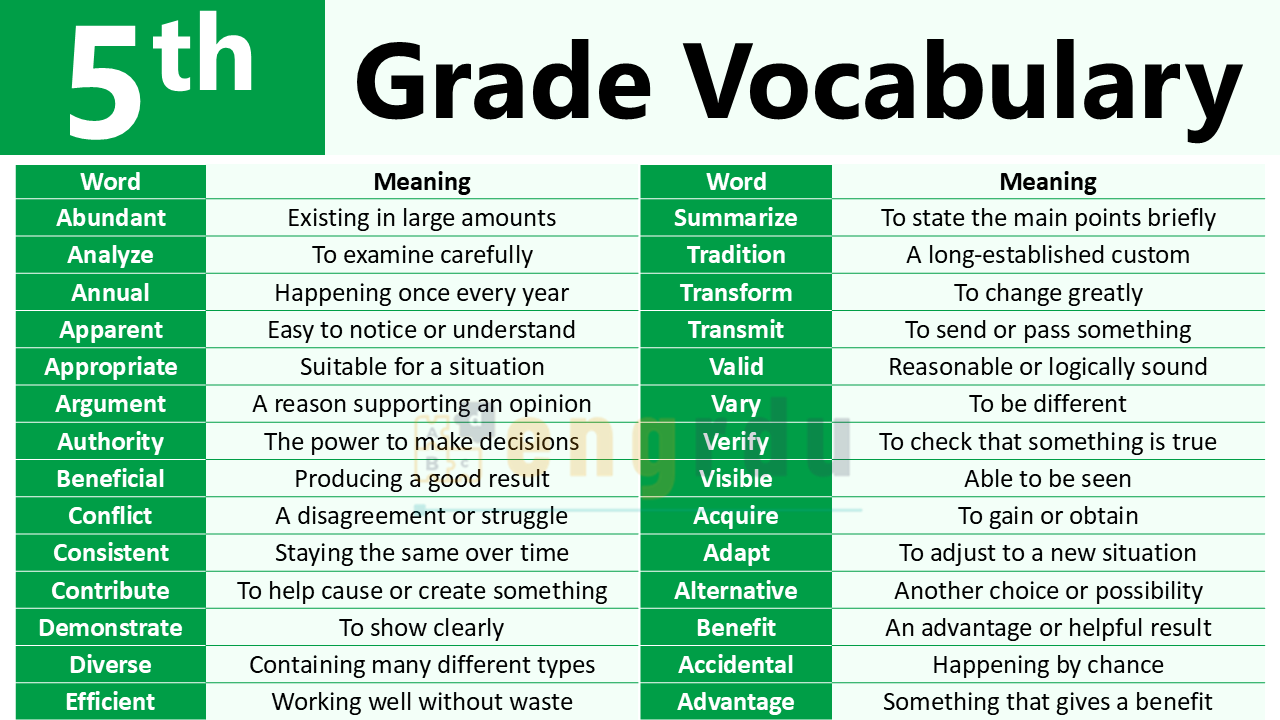

By fifth grade, students are expected to understand more than basic everyday English. They begin reading longer novels, nonfiction passages, biographies, science texts, and historical accounts. Their writing also requires more specific, descriptive, and academic vocabulary.
This collection of 5th grade vocabulary words introduces learners to useful words they can actually encounter at school and in everyday communication. Each word has a clear meaning and a natural example sentence to show how it is used.
What Changes in Fifth-Grade Vocabulary?
At Grade 5, vocabulary begins moving from mostly concrete words toward words that describe ideas, relationships, behavior, evidence, causes, opinions, and abstract concepts.
For example:
- Grade 3: look → Grade 5: observe
- Grade 3: show → Grade 5: demonstrate
- Grade 3: help → Grade 5: assist
- Grade 3: think about → Grade 5: consider
- Grade 3: important → Grade 5: significant
- Grade 3: problem → Grade 5: obstacle
These stronger words give students more choices when speaking and writing. To read more about the 3rd grade vocabulary words, you may visit this page: 3rd Grade Vocabulary Words with Meanings
300+ Fifth-Grade Vocabulary Words
The following vocabulary is organized by meaning and use rather than alphabetically, making it easier for students to understand how different groups of words work.
Words for Thinking and Understanding
- Analyze – To examine something carefully to understand its parts or meaning.
Example: “We analyzed the character’s actions in the story.” - Assume – To believe something is true without having complete proof.
Example: “I assumed the store was open because the lights were on.” - Conclude – To reach an opinion or decision after thinking about information.
Example: “We concluded that the plant needed more sunlight.” - Consider – To think carefully about something before making a decision.
Example: “Please consider all the choices before answering.” - Determine – To find out or decide something.
Example: “The experiment helped us determine which soil was best.” - Examine – To look at something carefully.
Example: “The doctor examined the injured arm.” - Identify – To recognize or name something correctly.
Example: “Can you identify the main idea?” - Infer – To reach an idea based on clues and information.
Example: “From her smile, I inferred that she was happy.” - Interpret – To explain the meaning of something.
Example: “We interpreted the character’s words differently.” - Recognize – To know someone or something because you have seen or learned about it before.
Example: “I recognized the song as soon as it started.” - Reflect – To think carefully about something that happened.
Example: “I reflected on what I learned from the project.” - Understand – To know the meaning of something.
Example: “I understand why the character made that choice.” - Evaluate – To judge something after considering its qualities or evidence.
Example: “We evaluated the two solutions.” - Predict – To say what you think will happen based on available information.
Example: “I predict that the storm will arrive tonight.” - Question – To ask about something because you want information or clarification.
Example: “I questioned whether the answer was correct.”
Strong Verbs for Better Writing
Fifth graders can replace very general verbs with more exact choices. These words make narratives, reports, and explanations more informative.
- Accomplish – To successfully complete something.
Example: “She accomplished her goal after weeks of practice.” - Demonstrate – To show clearly how something works or is done.
Example: “The teacher demonstrated the experiment.” - Describe – To explain what someone or something is like.
Example: “Describe the setting in your own words.” - Establish – To create, set up, or prove something.
Example: “The opening paragraph establishes the story’s setting.” - Generate – To produce or create something.
Example: “The wind turbines generate electricity.” - Illustrate – To explain or show something with an example or picture.
Example: “This diagram illustrates how the machine works.” - Maintain – To keep something in good condition or continue doing it.
Example: “We must maintain a clean classroom.” - Participate – To take part in an activity.
Example: “Everyone should participate in the group discussion.” - Respond – To answer or react to something.
Example: “She responded politely to the question.” - Select – To choose something from several possibilities.
Example: “Please select one topic for your report.” - Transform – To change something into a different form.
Example: “The artist transformed the empty room into a colorful studio.” - Contribute – To give something such as time, effort, or ideas to a group or activity.
Example: “Everyone contributed an idea to the project.” - Investigate – To carefully search for information about something.
Example: “The students investigated the cause of the problem.” - Communicate – To share information, ideas, or feelings.
Example: “Good leaders communicate clearly with their teams.” - Cooperate – To work together toward a shared goal.
Example: “The students cooperated to finish the model.”
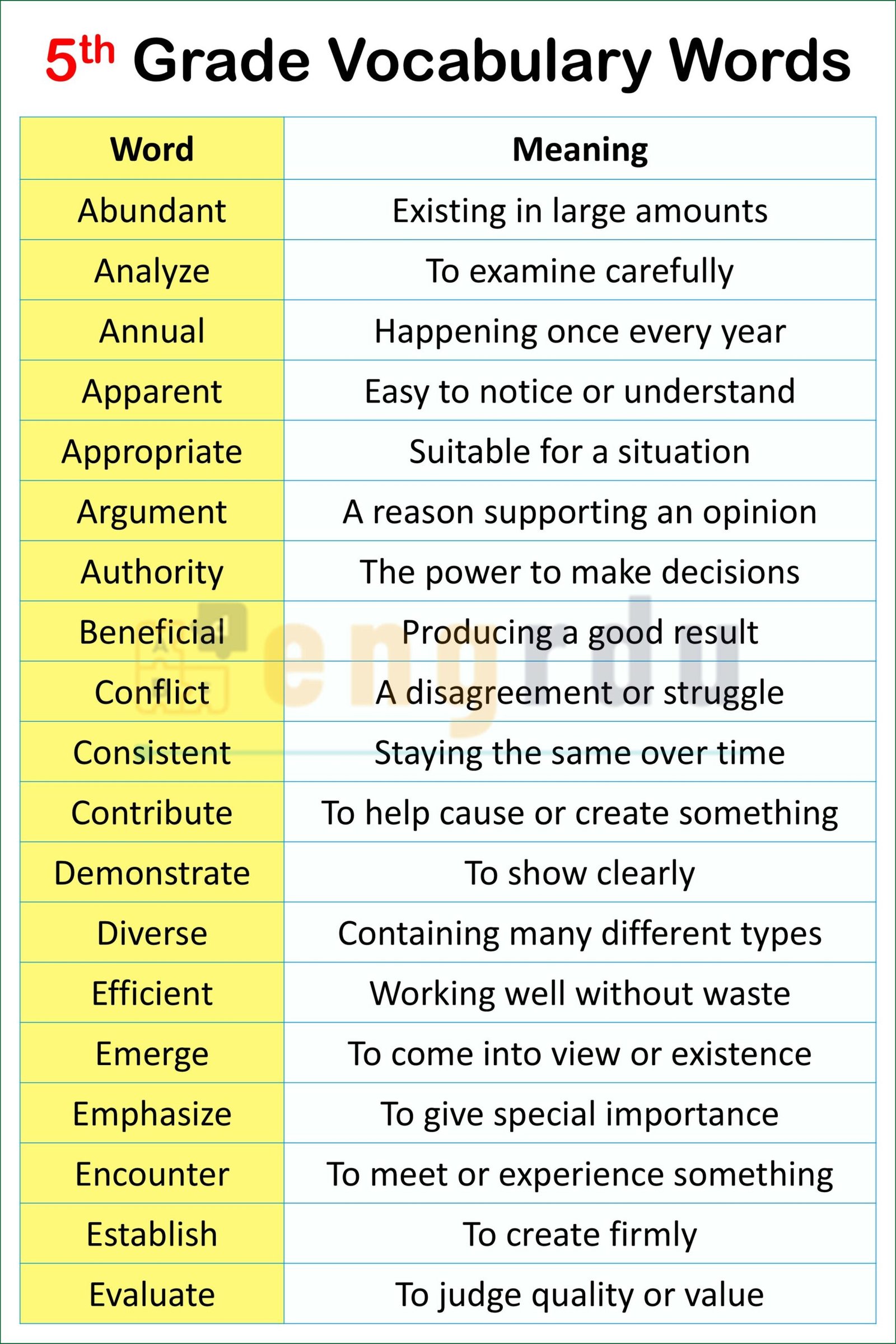
5th Grade Vocabulary Words
Vocabulary for Describing People and Personal Qualities
These adjectives help students move beyond basic descriptions such as nice, bad, good, or smart.
- Ambitious – Having a strong desire to achieve something.
Example: “The ambitious student wanted to become a scientist.” - Compassionate – Caring about other people’s suffering and wanting to help.
Example: “The compassionate girl helped the injured bird.” - Confident – Feeling sure about your abilities or decisions.
Example: “He felt confident before giving his speech.” - Considerate – Thinking about other people’s feelings and needs.
Example: “It was considerate of Sara to lower her voice.” - Determined – Having a strong decision to achieve a goal.
Example: “The determined runner finished the race.” - Dependable – Able to be trusted to do what is expected.
Example: “My older brother is dependable when I need help.” - Generous – Willing to give or share with others.
Example: “The generous family donated books to the school.” - Humble – Not thinking that you are better than others.
Example: “Although she won the prize, she remained humble.” - Independent – Able to do things without needing much help.
Example: “The student became more independent with her homework.” - Persistent – Continuing to try despite difficulty.
Example: “His persistent practice improved his piano skills.” - Responsible – Able to be trusted to complete duties properly.
Example: “I am responsible for taking care of the classroom plants.” - Sincere – Honest and genuine in feelings or words.
Example: “She gave me a sincere apology.” - Thoughtful – Showing care and consideration for others.
Example: “It was thoughtful of him to remember my birthday.” - Reliable – Consistently dependable or trustworthy.
Example: “Our reliable bus arrives on time every morning.” - Resourceful – Good at finding clever ways to solve problems.
Example: “The resourceful student used old boxes to build a model.”
Words That Describe Emotions More Precisely
Instead of repeatedly using happy, sad, or angry, students can choose words that communicate a more exact feeling.
- Anxious – Worried or nervous about what might happen.
Example: “I felt anxious before the competition.” - Astonished – Extremely surprised.
Example: “We were astonished by the magician’s performance.” - Confused – Unable to understand something clearly.
Example: “I was confused by the complicated instructions.” - Disappointed – Sad because something was not as expected.
Example: “He was disappointed when the game was canceled.” - Embarrassed – Feeling uncomfortable or ashamed about something.
Example: “I felt embarrassed after making a mistake in front of the class.” - Enthusiastic – Very excited and interested in something.
Example: “The students were enthusiastic about the school trip.” - Frustrated – Annoyed because something is difficult or unsuccessful.
Example: “She felt frustrated when the computer stopped working.” - Grateful – Feeling thankful.
Example: “I am grateful for your help.” - Nervous – Worried or afraid about something that may happen.
Example: “He was nervous before his presentation.” - Reluctant – Not willing or eager to do something.
Example: “I was reluctant to speak in front of the audience.” - Satisfied – Pleased because something has met your expectations.
Example: “I was satisfied with my test result.” - Thrilled – Extremely excited or pleased.
Example: “She was thrilled to receive the award.”
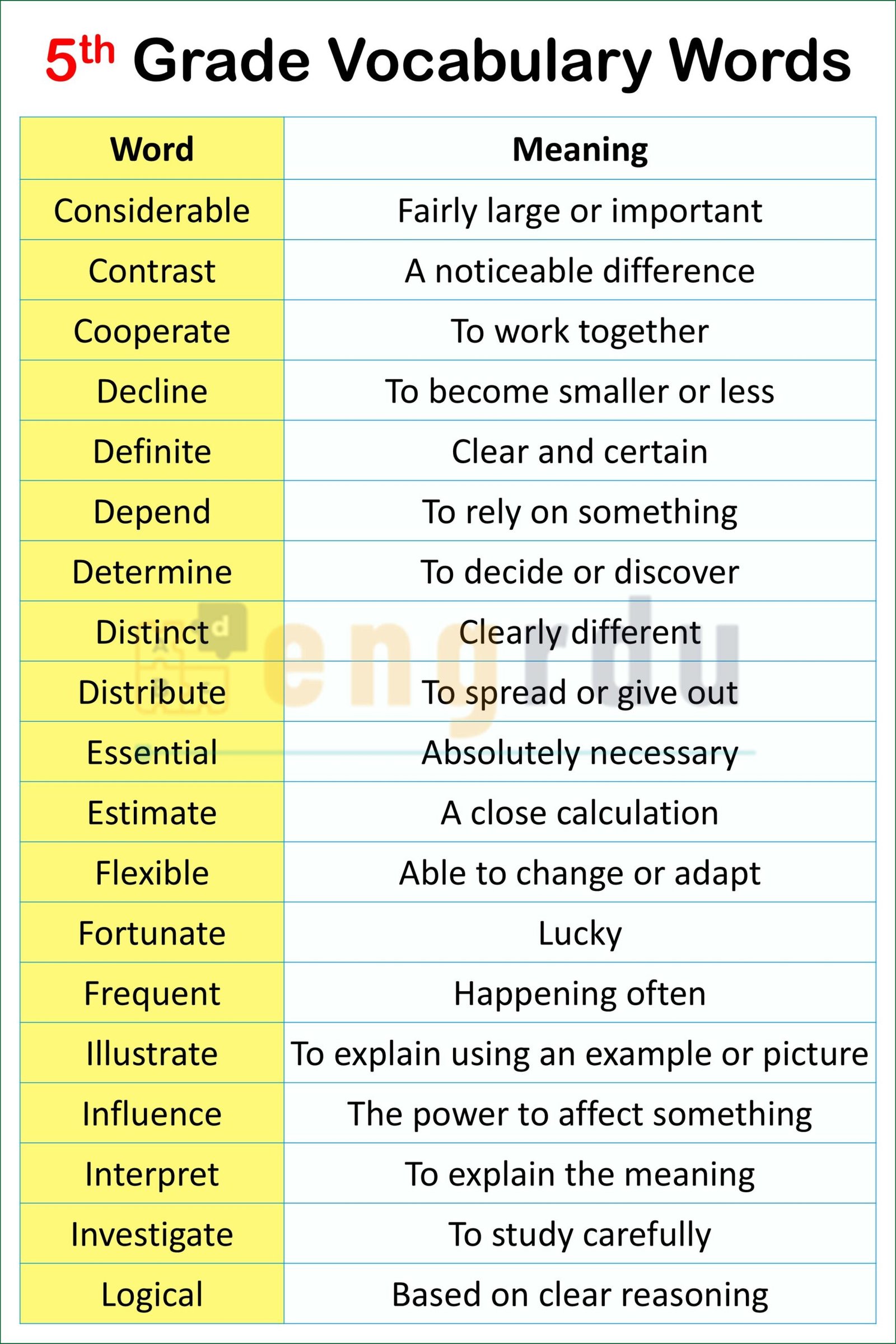
5th Grader Vocabulary Words with PDF
Academic Words You Will See Across Subjects
Some vocabulary is not limited to English class. Students encounter these terms in almost every subject.
- Approach – A way of dealing with or thinking about something.
Example: “We tried a different approach to solve the problem.” - Category – A group of things that share similar qualities.
Example: “Birds belong to a different category from mammals.” - Concept – An idea or general understanding of something.
Example: “The teacher explained the concept with an example.” - Context – The words or situation surrounding something that help explain its meaning.
Example: “I understood the unfamiliar word from its context.” - Factor – Something that influences a result or situation.
Example: “Weather was an important factor in our decision.” - Function – The purpose or job of something.
Example: “The function of the heart is to pump blood.” - Method – A particular way of doing something.
Example: “This method makes the calculation easier.” - Process – A series of actions or steps that produce a result.
Example: “Learning to read is a gradual process.” - Purpose – The reason why something exists or is done.
Example: “The purpose of this activity is to practice vocabulary.” - Structure – The way parts are arranged or organized.
Example: “We studied the structure of the paragraph.” - Strategy – A plan used to achieve a goal.
Example: “Reading the question twice is a useful test-taking strategy.” - Technique – A particular way of doing something skillfully.
Example: “The artist used a new painting technique.”
Reading Vocabulary for Grade 5
Reading comprehension becomes more demanding in fifth grade. Students need words that help them discuss stories, informational texts, and authors’ choices.
- Argument – A set of reasons supporting an idea or opinion.
Example: “The author gives a strong argument for protecting forests.” - Author – The person who writes a book, article, or story.
Example: “The author describes life in a small village.” - Claim – An idea or statement that someone says is true.
Example: “The writer makes a claim about the benefits of exercise.” - Evidence – Facts, examples, or information that support an idea.
Example: “Use evidence from the passage in your answer.” - Inference – A conclusion reached from clues and information.
Example: “Our inference was that the character was worried.” - Main Idea – The most important point of a passage or text.
Example: “The main idea is that teamwork can solve difficult problems.” - Perspective – A particular way of viewing or understanding something.
Example: “The story is told from the child’s perspective.” - Theme – A central message or idea in a story.
Example: “Friendship is an important theme in the novel.” - Summary – A shortened statement containing the main points.
Example: “Write a summary of the chapter.” - Sequence – The order in which events or steps happen.
Example: “Put the events in the correct sequence.” - Character – A person, animal, or figure in a story.
Example: “The main character learns from her mistake.” - Plot – The series of events that make up a story.
Example: “The plot becomes more exciting near the end.”
Science Vocabulary for Fifth Graders
Science introduces students to words that describe matter, living things, Earth, energy, and scientific investigation.
- Atom – A very small unit that makes up matter.
Example: “Everything around us is made of tiny atoms.” - Cell – The basic unit that makes up living things.
Example: “Plants and animals are made of cells.” - Chemical – A substance with particular properties and a particular composition.
Example: “Water is a chemical substance made of hydrogen and oxygen.” - Ecosystem – A community of living things and their surroundings.
Example: “A pond is an ecosystem containing plants, animals, and water.” - Energy – The ability to cause movement or change.
Example: “The Sun provides energy for life on Earth.” - Evaporate – To change from a liquid into a gas.
Example: “Water begins to evaporate when it is heated.” - Gravity – The force that pulls objects toward Earth or another body.
Example: “Gravity keeps us on the ground.” - Matter – Anything that has mass and takes up space.
Example: “Water, air, and rocks are forms of matter.” - Organism – A living thing.
Example: “A butterfly is a living organism.” - Renewable – Able to be naturally replaced or restored.
Example: “Solar energy is a renewable source of energy.” - Species – A group of similar living organisms.
Example: “Scientists study different species of birds.” - Variable – Something that can change in an experiment or situation.
Example: “Temperature was the variable we changed.”
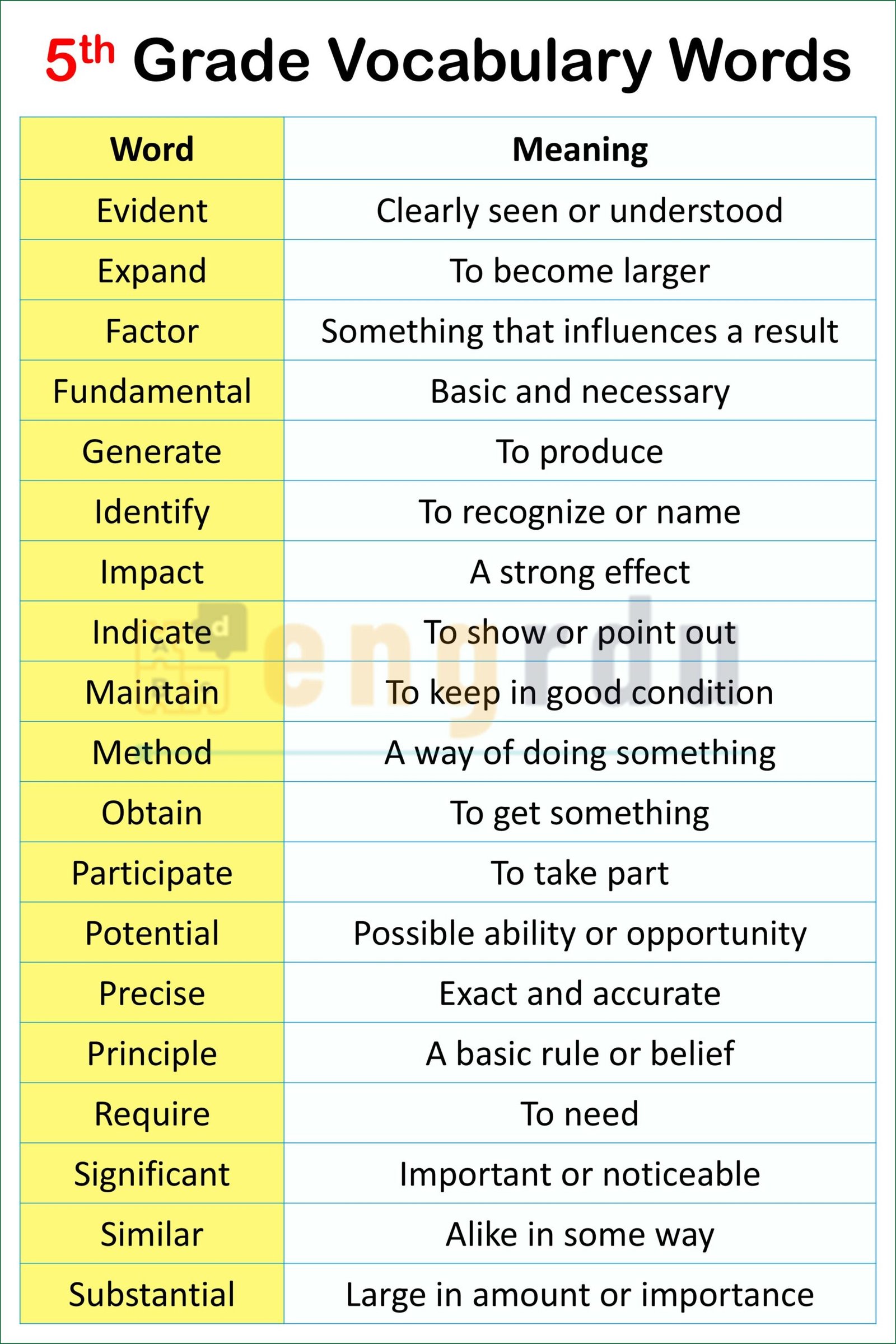
Fifth Grade Vocabulary Words with PDF
Geography and History Words for Fifth Graders
Fifth-grade reading often includes maps, civilizations, historical events, and different communities.
- Civilization – An organized society with its own culture, government, and way of life.
Example: “The ancient civilization built impressive cities.” - Colony – A place controlled and settled by another country.
Example: “The lesson explained how the colony was governed.” - Continent – One of Earth’s large land areas.
Example: “Asia is the largest continent.” - Culture – The customs, beliefs, arts, and way of life of a group.
Example: “Food can tell us a lot about a culture.” - Economy – The system through which people produce, buy, and sell goods and services.
Example: “Farming plays an important role in the local economy.” - Government – The system or group that manages a country or community.
Example: “The government creates laws for the country.” - Immigrate – To move to another country to live there.
Example: “Her grandparents immigrated to the country many years ago.” - Region – A particular area of a country or the world.
Example: “This region receives very little rainfall.” - Settlement – A place where people establish a community.
Example: “The settlers built a small settlement near the river.” - Territory – An area of land controlled by a person, group, or government.
Example: “The explorers entered unfamiliar territory.” - Tradition – A custom or practice passed from one generation to another.
Example: “Making special food is a family tradition.” - Resource – Something useful that people can use or benefit from.
Example: “Water is an important natural resource.”
Environment and Nature Terms for 5th Grade Students
Environmental vocabulary becomes increasingly important as students learn about conservation and Earth’s natural systems.
- Conservation – The careful protection and use of natural resources.
Example: “Water conservation is important during dry seasons.” - Consume – To use, eat, or drink something.
Example: “People consume water every day.” - Deforestation – The removal of large areas of trees.
Example: “Deforestation can destroy animal habitats.” - Endangered – At risk of disappearing because very few remain.
Example: “The tiger is endangered in some parts of the world.” - Extinct – No longer existing anywhere in the world.
Example: “Dinosaurs are extinct animals.” - Habitat – The natural home of a plant or animal.
Example: “Pollution can damage a fish’s habitat.” - Pollution – Harmful substances that make the environment dirty or unsafe.
Example: “Air pollution can affect people’s health.” - Recycle – To process used materials so they can be used again.
Example: “We recycle paper at school.” - Sustainable – Able to continue without seriously damaging natural resources.
Example: “Solar power is a sustainable source of energy.” - Waste – Unwanted material that is thrown away or not used properly.
Example: “We should reduce food waste.”
Fifth Grader Words for Problems, Solutions, and Decisions
These words are useful when students explain situations and suggest ways to solve problems.
- Advantage – Something that gives a person or thing a benefit.
Example: “One advantage of walking is that it provides exercise.” - Alternative – Another choice or possibility.
Example: “We need an alternative plan because the road is closed.” - Compromise – An agreement in which each side gives up something.
Example: “The two friends reached a compromise.” - Consequence – A result that follows an action.
Example: “Being late can have consequences at school.” - Difficulty – A problem or condition that makes something hard.
Example: “We had some difficulty finding the correct address.” - Obstacle – Something that makes progress difficult.
Example: “The fallen tree was an obstacle on the path.” - Option – One possible choice.
Example: “You have three options for your project.” - Solution – A way of solving a problem.
Example: “We finally found a solution.” - Outcome – The final result of an event or situation.
Example: “Everyone was pleased with the outcome.” - Priority – Something that is more important than other things.
Example: “Finishing my homework is my first priority.”
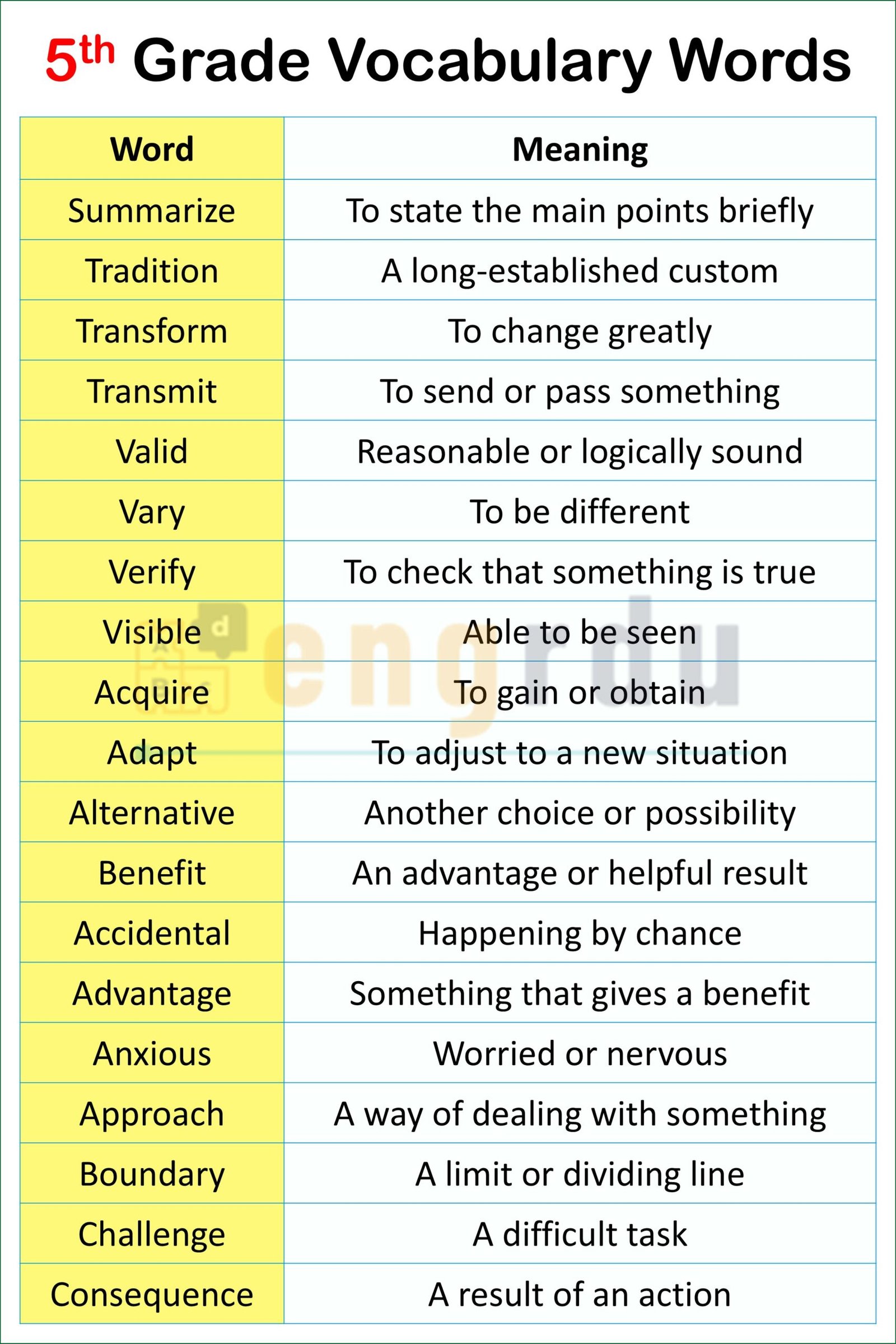
Vocabulary Words for 5th Grader Students
5th Grade Vocabulary for Speaking and Discussions
Students in Grade 5 increasingly need to explain opinions and participate in group conversations.
- Agree – To have the same opinion.
Example: “I agree with your point.” - Clarify – To make something easier to understand.
Example: “Could you clarify what you mean?” - Debate – A formal discussion in which people express different opinions.
Example: “Our class held a debate about school uniforms.” - Emphasize – To give special importance to something.
Example: “The teacher emphasized the importance of honesty.” - Explain – To make an idea clear by giving information.
Example: “Can you explain your answer?” - Persuade – To convince someone to do or believe something.
Example: “She tried to persuade her parents to let her join the club.” - Recommend – To suggest something as a good choice.
Example: “I recommend this book to anyone who enjoys mysteries.” - State – To express an idea clearly.
Example: “Please state your opinion.” - Support – To provide reasons or evidence for an idea.
Example: “Use facts to support your argument.” - Suggest – To offer an idea for someone to consider.
Example: “I suggest taking the earlier bus.”
5th Grade Adverbs and Connecting Words for Mature Writing
These words help students connect ideas and show relationships between events.
- Although – Used to introduce a contrast.
Example: “Although it was cold, we played outside.” - Consequently – As a result of something.
Example: “He forgot his umbrella; consequently, he got wet.” - Eventually – In the end, after some time.
Example: “Eventually, the lost hikers found their way home.” - Fortunately – In a lucky or helpful way.
Example: “Fortunately, nobody was injured.” - However – Used to introduce an opposing idea.
Example: “The test was difficult; however, I finished it.” - Meanwhile – During the same period of time.
Example: “Meanwhile, the other students prepared the room.” - Therefore – For that reason.
Example: “The road was flooded; therefore, we stayed home.” - Instead – In place of something else.
Example: “I wanted to walk, but we went by bus instead.” - Similarly – In a similar way.
Example: “Both animals live in forests and behave similarly.” - Nevertheless – Despite what was just mentioned.
Example: “The journey was difficult; nevertheless, we enjoyed it.”
Fifth Grade Words That Describe Size, Quality, and Conditions
Precise adjectives help fifth graders create stronger descriptions.
- Complex – Having many connected parts and not being easy to understand.
Example: “The machine has a complex design.” - Enormous – Extremely large.
Example: “An enormous tree stood near the river.” - Fragile – Easily broken or damaged.
Example: “The glass ornament is fragile.” - Gradual – Happening slowly over time.
Example: “There was a gradual change in temperature.” - Harsh – Very unpleasant, severe, or difficult.
Example: “The explorers survived the harsh weather.” - Mysterious – Difficult to explain or understand.
Example: “We heard a mysterious sound outside.” - Precise – Exact and accurate.
Example: “The scientist recorded precise measurements.” - Significant – Important or meaningful.
Example: “The discovery was a significant moment in history.” - Temporary – Existing for only a short time.
Example: “The classroom is in a temporary building.” - Vast – Extremely large in area or amount.
Example: “The explorers crossed a vast desert.”
Word Families to Help Students Learn Faster in 5th Grade
Learning related words can help students understand how English words change form.
Create
- Create – To make something new.
Example: “We created a model of the solar system.” - Creative – Able to produce new and original ideas.
Example: “Mia has a creative way of solving problems.” - Creation – Something that has been created.
Example: “The painting is her latest creation.”
Decide
- Decide – To make a choice.
Example: “We need to decide where to go.” - Decision – A choice that has been made.
Example: “That was a difficult decision.”
Educate
- Educate – To teach or give knowledge.
Example: “Schools educate children about the world.” - Education – The process of learning and teaching.
Example: “Education can open many opportunities.”
Explore
- Explore – To investigate or travel through a place.
Example: “We explored the museum.” - Exploration – The act of exploring.
Example: “Space exploration requires advanced technology.”
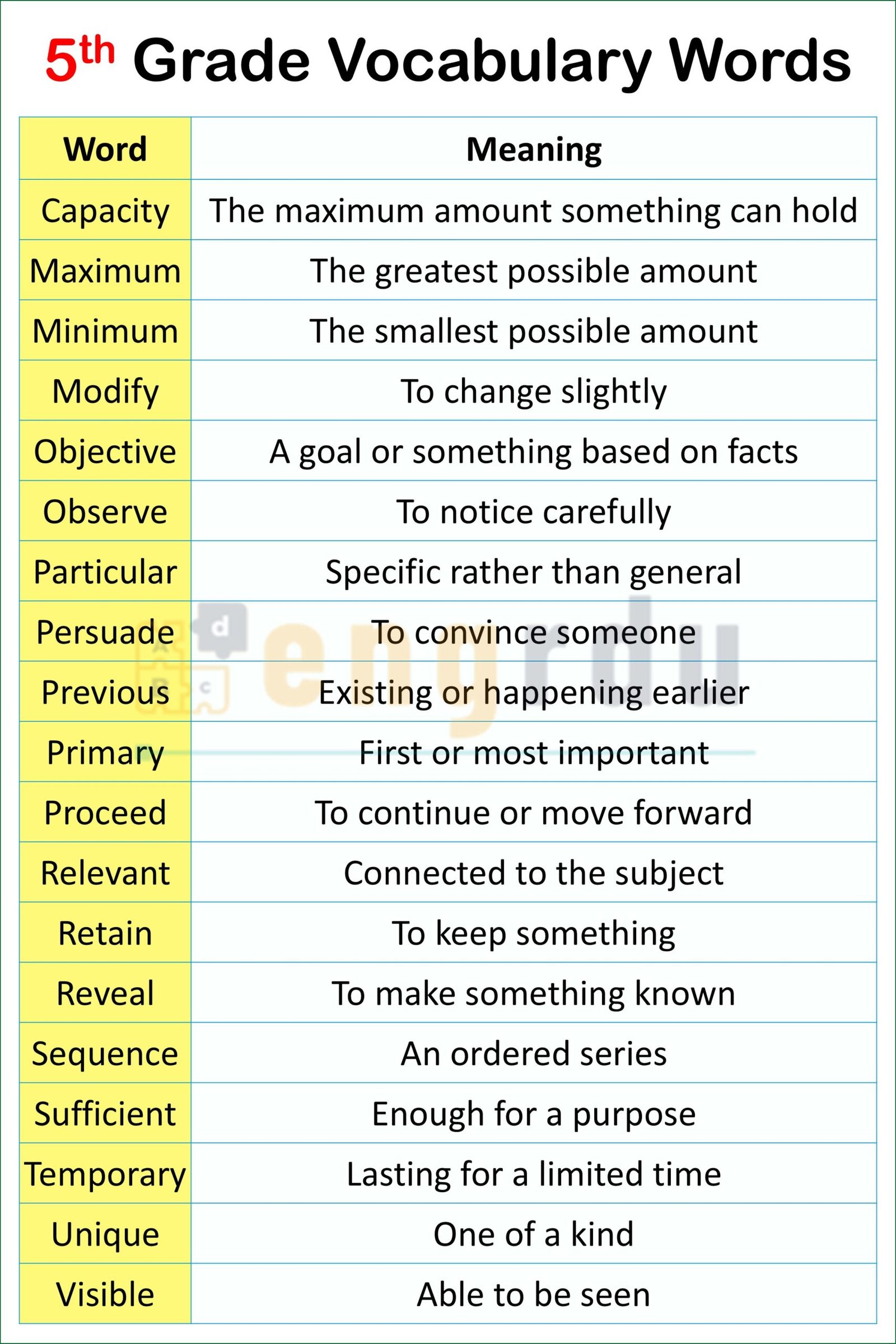
Vocabulary Words for Fifth Grader Students
Fifth Grade Level Homophones and Similar Words
At fifth-grade level, students should become more careful about words that sound alike or look similar.
- Principal / Principle – Principal can mean the head of a school; principle means a basic rule or belief.
- Stationary / Stationery – Stationary means not moving; stationery means writing materials.
- Their / There / They’re – Their shows ownership; there refers to a place; they’re means “they are.”
- Your / You’re – Your shows ownership; you’re means “you are.”
- Its / It’s – Its shows ownership; it’s means “it is” or “it has.”
Challenge Words for Fifth-Grade Readers
These words are slightly more advanced but useful when students encounter challenging novels and nonfiction.
- Accumulate – To gather or collect over time.
Example: “Leaves accumulate on the ground during autumn.” - Beneficial – Producing a helpful or positive result.
Example: “Regular exercise is beneficial to the body.” - Contradict – To say or show that something is not true or correct.
Example: “The second report contradicts the first one.” - Diverse – Including many different types of people or things.
Example: “The city has a diverse population.” - Essential – Necessary or very important.
Example: “Water is essential for life.” - Frequent – Happening often.
Example: “Frequent practice improved her reading.” - Gradually – Slowly over a period of time.
Example: “The sky gradually became darker.” - Observe – To watch carefully.
Example: “Scientists observe animals to learn about their behavior.” - Potential – Possible ability or possibility for future development.
Example: “The young player has great potential.” - Relevant – Closely connected to the subject being discussed.
Example: “Please include only relevant information in your report.” - Require – To need something.
Example: “Plants require water and sunlight.” - Significant – Important enough to deserve attention.
Example: “The invention had a significant effect on transportation.” - Specific – Clearly identified or defined.
Example: “Please give a specific example.” - Visible – Able to be seen.
Example: “The moon was clearly visible.” - Unique – Different from everything else of its kind.
Example: “Every snowflake has a unique pattern.”
Everyday Sentences Using Grade 5 Vocabulary
Vocabulary becomes useful when students can naturally bring it into ordinary conversations.
At school
“Can you clarify the instructions for this assignment?”
At home
“I need to determine which clothes I should pack.”
During a science project
“We need to observe the plants every day.”
While reading
“I think the author’s main argument is about protecting wildlife.”
During a disagreement
“Let’s find a compromise that works for both of us.”
Talking about a decision
“We should consider all the options first.”
Talking about the environment
“We need to conserve water because it is a valuable resource.”
These examples show that academic vocabulary does not have to stay inside a textbook. Many of these words are useful in normal conversations too.
How to Tell If a Word Is Right for the Sentence
Knowing a definition is only one part of vocabulary learning. Students should also understand context.
Consider the word significant:
- “The discovery was significant.” ✓
- “I ate a significant sandwich.” ✗
The word generally describes something important or meaningful, not simply something large.
Now consider observe:
- “We observed the birds.” ✓
- “I observed my homework.” ✗
You observe something by watching or examining it carefully.
A useful question to ask is:
“Does this word make sense with the thing I am describing?”
Quick Grade 5 Vocabulary Practice
Choose the best word for each sentence.
Word bank:
infer, sustainable, compromise, significant, participate, obstacle, precise, perspective, conserve, consequence, analyze, enthusiastic
- We should ______ water during a drought.
- The students were excited to ______ in the competition.
- The fallen tree became an ______ on the road.
- Please give a ______ measurement.
- The two friends reached a ______ after discussing the problem.
- We can ______ the character’s feelings from her actions.
- Solar power can be a ______ energy source.
- The discovery was ______ to the history of the town.
- The students will ______ the poem carefully.
- The author’s ______ was different from the character’s.
- Every action has a ______.
- The children were ______ about the school trip.
Practice Answers:
- conserve
- participate
- obstacle
- precise
- compromise
- infer
- sustainable
- significant
- analyze
- perspective
- consequence
- enthusiastic
A Practical Grade 5 Vocabulary Routine
A fifth grader can learn new vocabulary without trying to memorize dozens of definitions in one sitting.
Use the “word in context” method
Step 1: Find the word
Meet the word while reading a story, article, lesson, or assignment.
Step 2: Guess the meaning
Look at the surrounding sentence and make a reasonable guess.
Step 3: Check the meaning
Use a dictionary or ask a teacher to confirm it.
Step 4: Make your own sentence
Connect the word to something familiar.
Step 5: Use it again
Try using the word in conversation or writing later in the week.
For example:
Word: persistent
Meaning: Continuing to try despite difficulty.
Student sentence:
“I was persistent and finally learned how to ride my bicycle.”
This approach teaches both meaning and usage, which makes vocabulary easier to remember.
Grade 5 Vocabulary: A Quick Level Check
A fifth grader should gradually become comfortable with words from several levels.
Everyday vocabulary
Words used regularly in conversation:
- borrow
- decision
- favorite
- journey
- mistake
- problem
- responsible
Academic vocabulary
Words frequently used in school:
- analyze
- evidence
- conclusion
- context
- process
- structure
- evaluate
Subject vocabulary
Words connected with specific subjects:
- ecosystem
- gravity
- civilization
- continent
- resource
- matter
- habitat
More advanced descriptive vocabulary
Words that make writing more precise:
- significant
- mysterious
- persistent
- resourceful
- compassionate
- enormous
- precise
The goal is not to make every sentence sound complicated. Good vocabulary means choosing the right word for the intended meaning.
FAQs About Fifth-Grade Vocabulary
How many vocabulary words should a fifth grader know?
There is no single required number. Students should steadily expand their vocabulary through reading, classroom instruction, conversation, and writing.
What makes Grade 5 vocabulary different from Grade 4?
Fifth-grade vocabulary generally includes more abstract concepts, academic terms, precise verbs, subject-specific language, and words used to explain relationships between ideas.
Should fifth graders learn words from science and social studies?
Yes. Subject-specific vocabulary helps students understand textbooks, classroom discussions, instructions, experiments, historical events, and informational passages.
How can students figure out an unfamiliar word while reading?
Students can examine surrounding sentences, look for examples or contrasts, identify familiar word parts, and then check a dictionary for confirmation.
Why are synonyms useful for fifth-grade students?
Synonyms give students more precise word choices and help them avoid repeating the same words throughout an essay or conversation.
What does context mean in vocabulary?
Context is the surrounding language or situation that provides clues about what an unfamiliar word means.
Should Grade 5 students study prefixes and suffixes?
Yes. Understanding common prefixes, suffixes, and word roots can help students work out the meanings of unfamiliar words.
How can parents practice fifth-grade vocabulary at home?
Parents can discuss new words during reading, ask children to explain them, and encourage them to use the words naturally in conversations or short writing activities.
Conclusion
Fifth grade marks an important step in vocabulary development. Students begin using language to analyze information, explain ideas, evaluate evidence, describe emotions, discuss problems, and understand increasingly complex texts.
Words such as determine, interpret, demonstrate, significant, persistent, perspective, consequence, sustainable, resourceful, and analyze give learners more precise ways to communicate.
The best vocabulary learning does not come from memorizing definitions alone. Students should meet words in context, understand their meanings, hear and say them, and use them in their own sentences. This prepares them for the increasingly academic vocabulary they will encounter in Grades 6–10.
Explore More Vocabulary By Level
- 10th Grade Words with Meanings with PDF
- 600+ 9th Grade Vocabulary Words with PDF
- 500+ 8th Grade Vocabulary Words with PDF
- 700+ 7th Grade Vocabulary Words with PDF
- 500+ 6th Grade Vocabulary Words with PDF
- 300+ 4th Grade Vocabulary Words with PDF
- 250+ 3rd Grade Vocabulary Words with PDF
- 2nd Grade Vocabulary Words with with PDF
- Vocabulary Words for 1st Grade with PDF