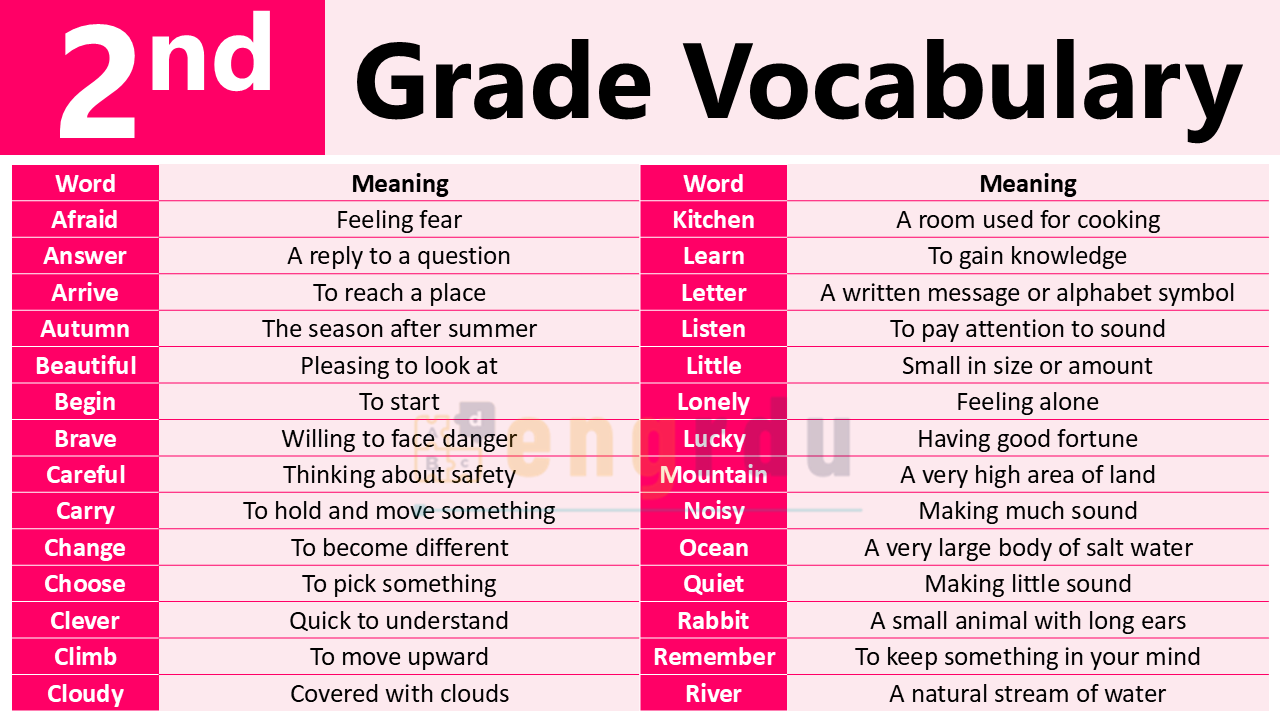

By second grade, children are ready to move beyond very basic words and learn vocabulary that helps them describe ideas, explain actions, talk about experiences, and understand stories. The best 2nd grade vocabulary words are common enough to use in daily life but give children more ways to express themselves.
This collection of vocab words for 1st graders has been replaced here with a slightly more advanced second-grade level. The words below are suitable for school learners, ESL students, and children building their English vocabulary through reading and conversation.
What Should a Second Grader Learn in Vocabulary?
A second grader should gradually learn words connected with school, family, nature, feelings, actions, descriptions, time, and everyday experiences.
At this level, children can also begin learning words that have similar meanings, opposites, and slightly more precise ways of describing something.
A Strong Start: Everyday Words Children Can Use
These words are common in children’s conversations but give them more expressive choices than very basic Grade 1 vocabulary.
- Brave – Not afraid to face something difficult or frightening.
Example: “You were brave when you spoke in front of the class.” - Careful – Taking care to avoid mistakes or danger.
Example: “Be careful when you cross the road.” - Clever – Good at learning, thinking, or solving problems.
Example: “That was a clever way to solve the puzzle.” - Choose – To decide which person or thing you want.
Example: “You can choose one book to take home.” - Comfortable – Feeling relaxed and free from discomfort.
Example: “This chair is comfortable.” - Different – Not the same as another person or thing.
Example: “My new shoes are different from my old ones.” - Early – Before the expected or usual time.
Example: “We arrived early for school.” - Favorite – Liked more than other things of the same kind.
Example: “Blue is my favorite color.” - Helpful – Willing or able to help.
Example: “Thank you for being helpful.” - Important – Having great value or meaning.
Example: “It is important to listen to your teacher.” - Ready – Prepared to do something.
Example: “I am ready for the test.” - Safe – Protected from danger or harm.
Example: “Stay in a safe place.” - Special – Different from others in a good or important way.
Example: “Today is a special day.” - Strong – Having physical power or strength.
Example: “The strong boy carried the box.” - Useful – Helpful for a particular purpose.
Example: “This map is useful when we travel.”
People, Places, and Things Around Us
Children encounter these nouns in stories, classrooms, homes, shops, parks, and other familiar places.
- Address – The details that tell where someone lives.
Example: “Please write your home address here.” - Bridge – A structure built over a road, river, or other space.
Example: “We walked across the bridge.” - Corner – The place where two sides or lines meet.
Example: “The store is around the corner.” - Crowd – A large group of people together.
Example: “A crowd gathered near the stage.” - Garden – An area where flowers, vegetables, or other plants grow.
Example: “Grandpa grows tomatoes in his garden.” - Library – A place where people can read or borrow books.
Example: “We went to the library after class.” - Market – A place where people buy and sell things.
Example: “Mom bought fruit at the market.” - Neighbor – A person who lives near you.
Example: “Our neighbor has a friendly dog.” - Village – A small community or group of houses.
Example: “My grandparents live in a small village.” - Visitor – Someone who comes to see a person or place.
Example: “We have a visitor at school today.”
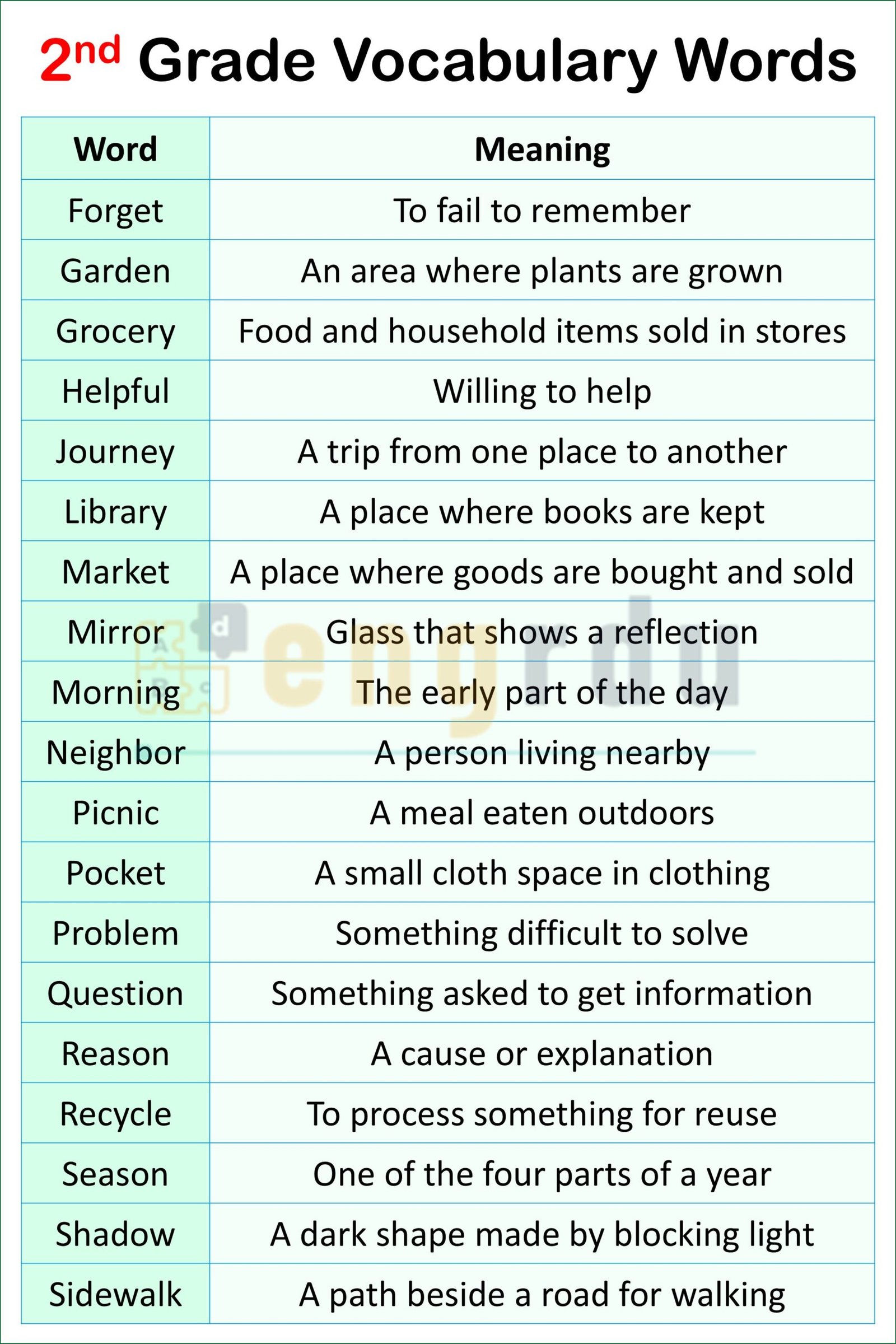
Vocabulary Words for Second Graders
Words That Help Children Describe What They See
Describing words allow students to make their speaking and writing more detailed.
- Bright – Giving off a lot of light.
Example: “The bright sun was shining.” - Calm – Quiet and peaceful.
Example: “The lake is calm today.” - Crowded – Filled with many people or things.
Example: “The bus was crowded this morning.” - Deep – Extending far down from the top or surface.
Example: “The water is too deep to stand in.” - Empty – Containing nothing.
Example: “The box is empty.” - Gentle – Kind and careful rather than rough.
Example: “Be gentle with the baby.” - Heavy – Weighing a lot.
Example: “This bag is too heavy for me.” - Huge – Very large.
Example: “We saw a huge elephant at the zoo.” - Narrow – Not wide.
Example: “The path is narrow.” - Noisy – Making a lot of sound.
Example: “The classroom became noisy during break.” - Quiet – Making very little sound.
Example: “Please be quiet during the story.” - Smooth – Having an even surface without rough parts.
Example: “The stone feels smooth.” - Tiny – Very small.
Example: “I found a tiny insect on the leaf.” - Warm – Having a comfortably high temperature.
Example: “The soup is warm now.”
Action Vocabulary: Words That Show What Happens
Second graders can expand their vocabulary by learning more precise verbs instead of using the same basic action words repeatedly.
- Arrive – To reach a place.
Example: “We arrive at school at eight o’clock.” - Carry – To hold and move something from one place to another.
Example: “Can you carry this bag for me?” - Catch – To stop and hold something that is moving through the air.
Example: “Try to catch the ball.” - Collect – To bring things together.
Example: “We collect leaves for our science project.” - Climb – To move upward using your hands and feet.
Example: “The children climbed the tree.” - Discover – To find something or learn something for the first time.
Example: “We discovered a bird’s nest in the garden.” - Follow – To go behind or after someone or something.
Example: “Follow me to the classroom.” - Gather – To bring people or things together.
Example: “Please gather your books.” - Hurry – To move or act quickly.
Example: “Hurry, or we will miss the bus.” - Invite – To ask someone to come somewhere or take part in something.
Example: “I will invite Sara to my party.” - Notice – To see or become aware of something.
Example: “Did you notice the rainbow?” - Protect – To keep someone or something safe.
Example: “Trees help protect the soil.” - Return – To go or give something back to a place or person.
Example: “Please return the book tomorrow.” - Search – To look carefully for something.
Example: “I searched my room for my missing shoe.” - Share – To give part of something to another person.
Example: “Please share your crayons with your brother.”
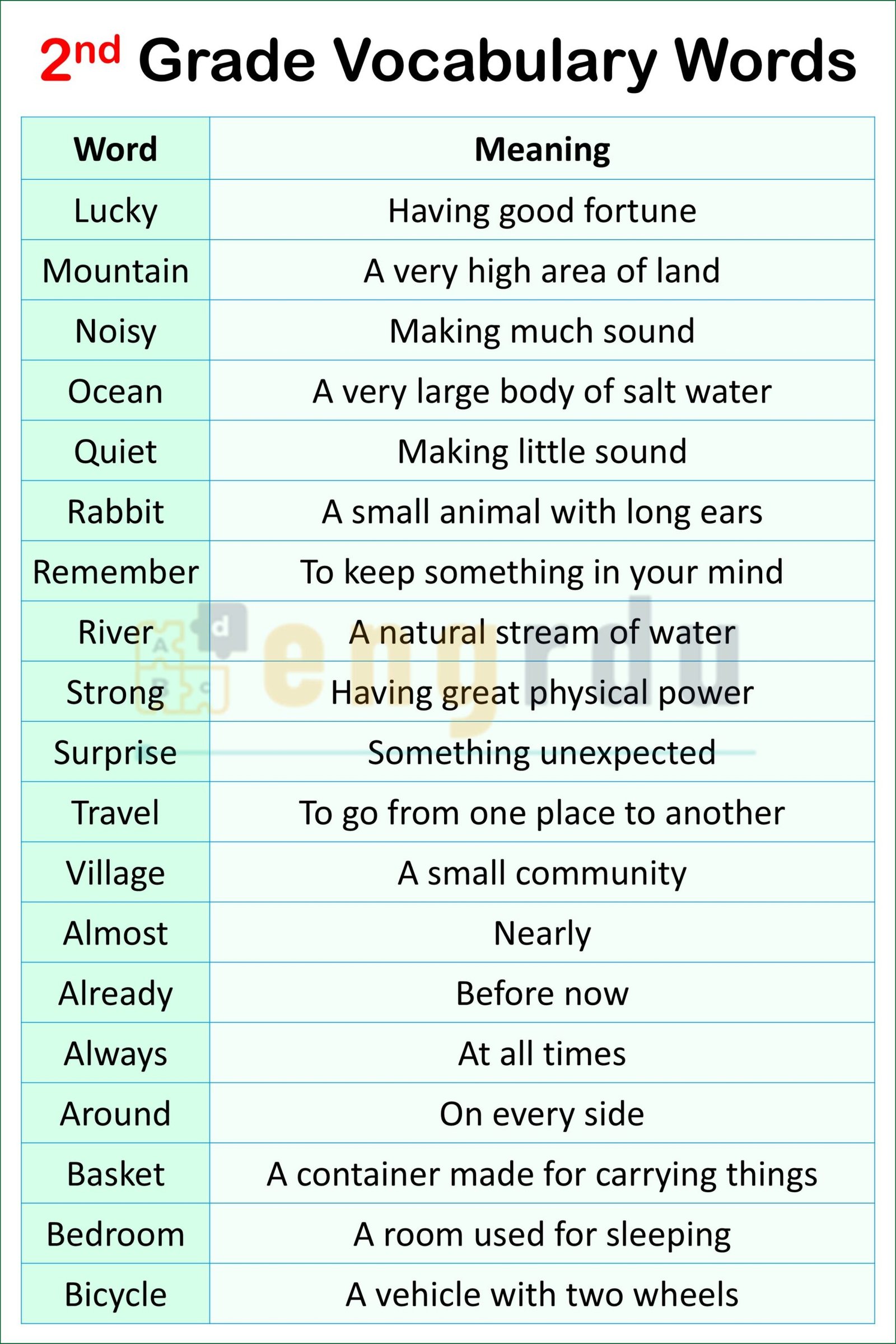
2nd Grade Vocabulary Words with Meanings
Feelings and Personal Qualities
Children need more than “happy” and “sad” to explain how they feel and how other people behave.
- Afraid – Feeling fear or worry about something.
Example: “I was afraid when I heard the loud noise.” - Cheerful – Happy and positive.
Example: “Our cheerful teacher greeted us with a smile.” - Disappointed – Sad because something did not happen as hoped.
Example: “I was disappointed when the game was canceled.” - Excited – Very happy and eager about something.
Example: “We are excited about the school trip.” - Friendly – Kind and pleasant toward others.
Example: “Our new neighbor is very friendly.” - Nervous – Worried or slightly afraid about something.
Example: “I felt nervous before my first speech.” - Patient – Able to wait calmly.
Example: “Please be patient while I finish my work.” - Proud – Feeling happy about something you or someone else has done.
Example: “Dad was proud of my good grade.” - Surprised – Feeling something unexpected has happened.
Example: “I was surprised to see my friend at the park.” - Thankful – Feeling grateful for something.
Example: “I am thankful for your help.”
School Words That Build Better Reading Skills
School vocabulary becomes more varied in Grade 2 as students read longer stories and complete more detailed classroom tasks.
- Chapter – One of the main sections of a book.
Example: “We read the next chapter in class.” - Example – Something that shows what a person or thing is like.
Example: “Can you give me an example?” - Explain – To make something clear by giving information.
Example: “Can you explain your answer?” - Group – A number of people or things together.
Example: “Work with your group.” - Idea – A thought, plan, or suggestion.
Example: “I have an idea for our project.” - Learn – To gain knowledge or a new skill.
Example: “We learn new words every week.” - Practice – To do something repeatedly to improve a skill.
Example: “I practice reading every evening.” - Project – A piece of planned schoolwork.
Example: “Our science project is about plants.” - Story – A description of events involving real or imaginary people or things.
Example: “The story was about a lost puppy.” - Subject – An area of study at school.
Example: “Science is my favorite subject.”
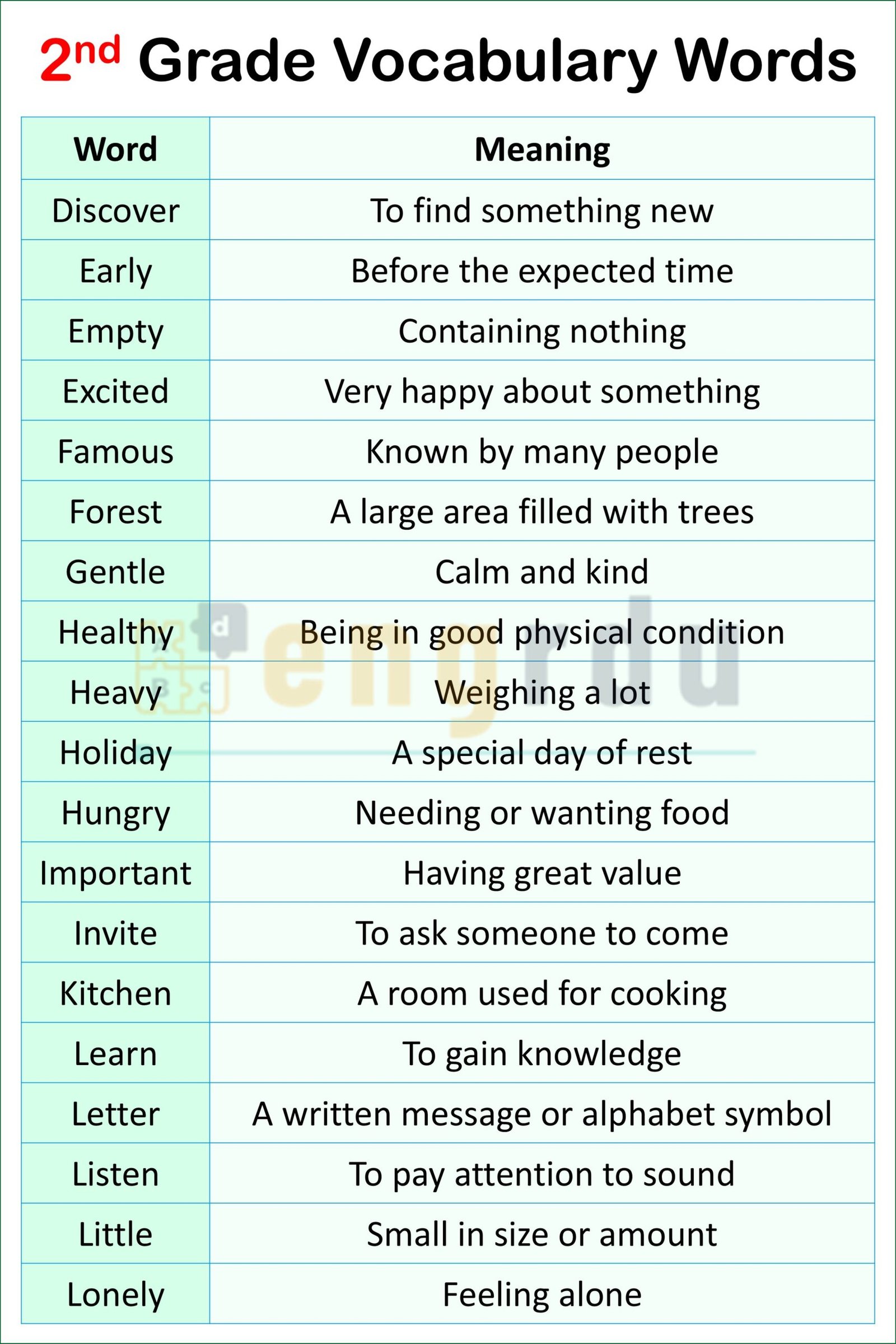
Vocabulary Words for 2nd Graders
Nature and Science Vocabulary for Grade 2
These words help students talk about animals, plants, weather, and the natural world.
- Bloom – To produce flowers.
Example: “The roses bloom in spring.” - Branch – A part of a tree that grows from the trunk.
Example: “A bird sat on the branch.” - Earth – The planet where we live.
Example: “Earth has land and water.” - Forest – A large area covered with many trees.
Example: “Many animals live in the forest.” - Grow – To become bigger or develop.
Example: “Plants grow when they get water and sunlight.” - Insect – A small animal with six legs and usually wings.
Example: “A butterfly is an insect.” - Nest – A place where a bird lays eggs and raises its young.
Example: “The bird built a nest in the tree.” - Plant – A living thing that usually grows in soil and needs water and light.
Example: “This plant needs more water.” - Season – One of the four parts of the year: spring, summer, autumn, or winter.
Example: “Winter is my favorite season.” - Weather – The condition of the air outside at a particular time.
Example: “The weather is sunny today.”
Food, Shopping, and Daily Life
These words are useful when children talk about meals, shopping, and activities outside school.
- Breakfast – The first meal of the day.
Example: “I had eggs for breakfast.” - Dinner – A meal usually eaten in the evening.
Example: “Dinner is ready.” - Fresh – Recently made, picked, or prepared.
Example: “These apples are fresh.” - Healthy – Good for your health.
Example: “Fruit is a healthy snack.” - Money – Coins and paper used to buy things.
Example: “I have enough money for the book.” - Price – The amount of money needed to buy something.
Example: “What is the price of this toy?” - Snack – A small amount of food eaten between meals.
Example: “I brought a banana for a snack.” - Store – A place where people buy things.
Example: “We went to the store for milk.” - Thirsty – Wanting or needing a drink.
Example: “I am thirsty after running.” - Hungry – Wanting or needing food.
Example: “I am hungry after school.”
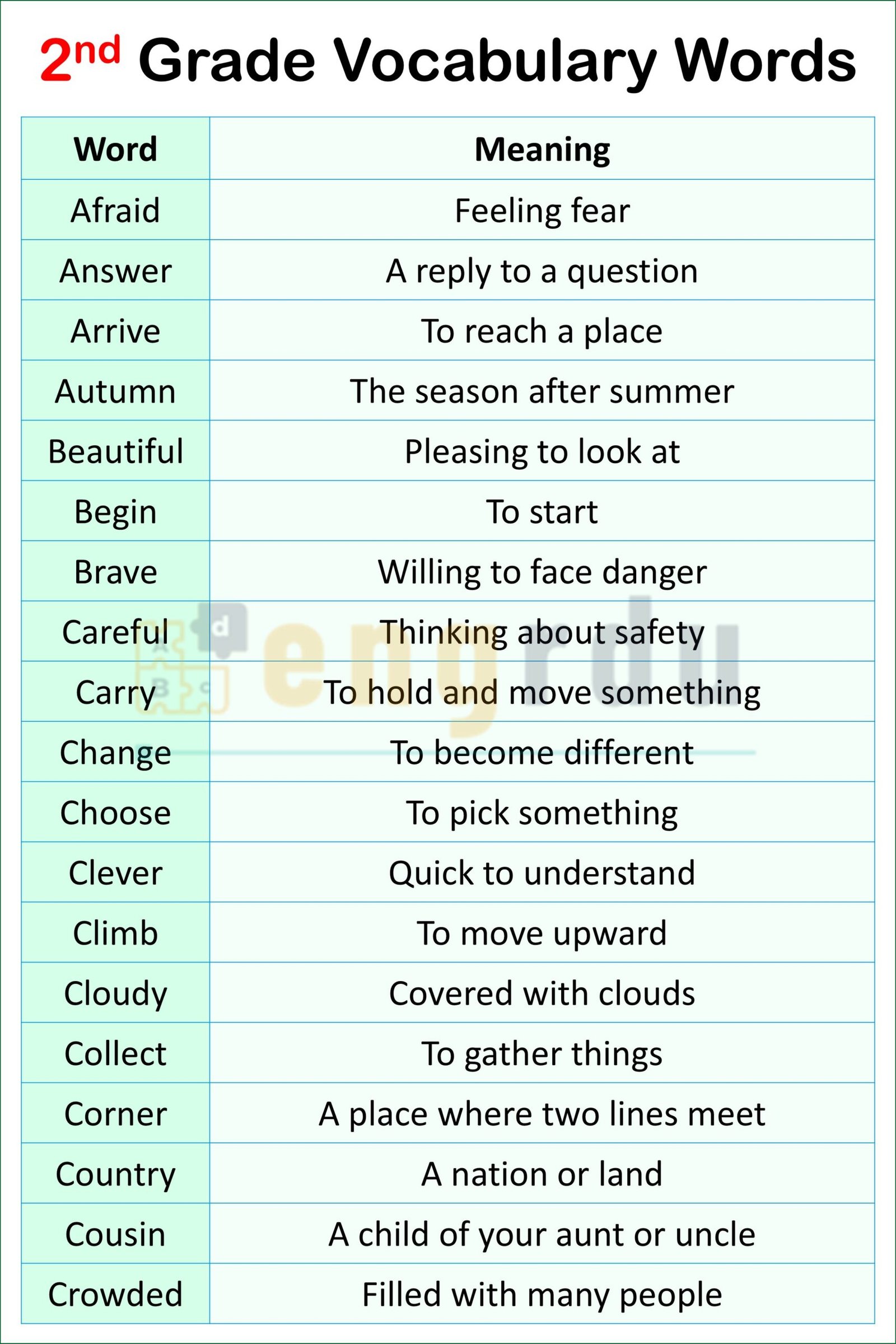
2nd Grade Vocabulary Words
Time and Sequence Words
Knowing these words helps children tell stories, describe routines, and explain what happened.
- Before – Earlier than something else.
Example: “Wash your hands before dinner.” - After – Later than something else.
Example: “We played after school.” - Already – Before now or before the expected time.
Example: “I have already finished my homework.” - Finally – At the end of a series of events.
Example: “Finally, we reached the top of the hill.” - First – Coming before all others.
Example: “First, wash your hands.” - Next – Coming immediately after something else.
Example: “Next, put the paper on the desk.” - Soon – In a short time from now.
Example: “The bus will arrive soon.” - Sometimes – On some occasions but not always.
Example: “I sometimes read before bed.” - Usually – Most of the time.
Example: “I usually walk to school.” - Yesterday – The day before today.
Example: “We visited Grandma yesterday.”
Words That Help Children Connect Ideas
These small but powerful words make children’s sentences more complete and help them explain reasons and choices.
- Because – Used to give a reason.
Example: “I stayed home because I was sick.” - But – Used to show a difference or contrast.
Example: “I like the toy, but it is expensive.” - If – Used to talk about a condition.
Example: “If it rains, we will stay inside.” - So – Used to show a result.
Example: “I was hungry, so I ate a sandwich.” - Then – Used to show what happens next.
Example: “Finish your work, then you can play.” - While – During the time that something else happens.
Example: “I listened to music while I cleaned my room.”
Pairs of Words Worth Learning Together
Learning related words helps children understand meaning and choose the right word when speaking or writing.
- Above – In a higher position.
Example: “The clock is above the door.” - Below – In a lower position.
Example: “The shoes are below the bed.” - Begin – To start something.
Example: “The movie will begin soon.” - Finish – To complete something.
Example: “I will finish my homework before dinner.” - Loud – Making a lot of sound.
Example: “The music is too loud.” - Quiet – Making little or no sound.
Example: “The library is quiet.” - Near – A short distance away.
Example: “The school is near my house.” - Far – A long distance away.
Example: “The airport is far from here.” - Strong – Having a lot of strength.
Example: “The strong wind moved the branches.” - Weak – Not having much strength.
Example: “The weak plant needs more care.”
Easy Synonyms for Second Graders
Synonyms are words with similar meanings. Introducing a few pairs can help children make their writing less repetitive.
- Big / Large – Greater than usual in size.
Example: “We saw a large dog at the park.” - Small / Tiny – Little in size.
Example: “A tiny bird sat on the wall.” - Happy / Glad – Feeling pleased or joyful.
Example: “I am glad you came.” - Fast / Quick – Moving or happening in a short time.
Example: “The rabbit is quick.” - Smart / Clever – Good at thinking and learning.
Example: “She is clever at solving puzzles.” - Quiet / Silent – Making little or no sound.
Example: “The room became silent.”
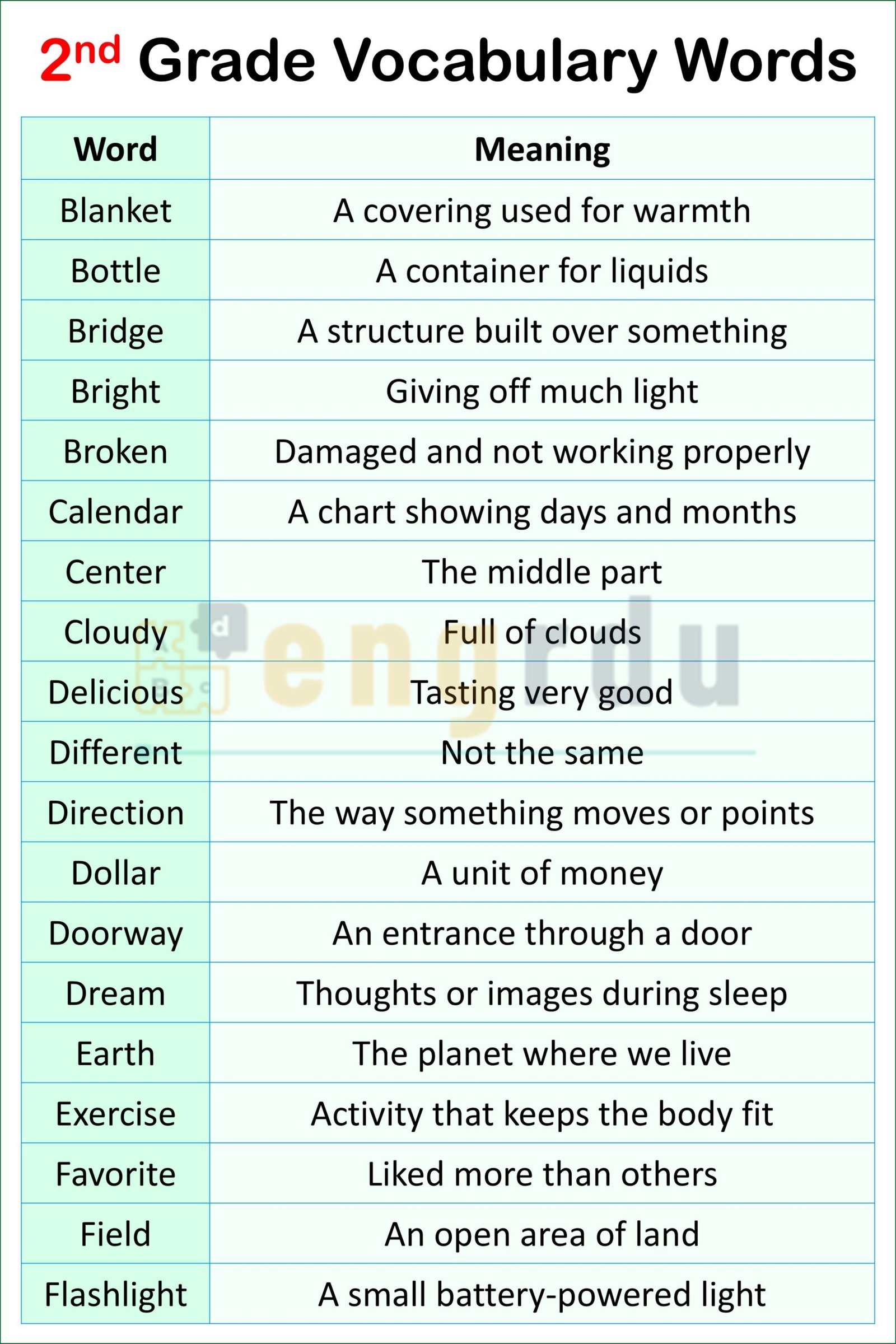
Second Grade Vocabulary Words with PDF
20 Useful 2nd Grade Vocabulary Words
These additional words give students more variety in everyday speaking and writing.
- Agree – To have the same opinion as someone.
Example: “I agree with your idea.” - Almost – Very nearly, but not completely.
Example: “I am almost ready.” - Broken – Damaged so that something does not work properly.
Example: “My pencil is broken.” - Build – To make something by putting parts together.
Example: “We built a tower with blocks.” - Care – To feel that someone or something is important.
Example: “I care about my family.” - Change – To become different or make something different.
Example: “The weather can change quickly.” - Common – Found or seen often.
Example: “Dogs are common pets.” - Enjoy – To like something and have a good time doing it.
Example: “I enjoy reading stories.” - Enough – As much as is needed.
Example: “Do we have enough food?” - Forget – To fail to remember something.
Example: “Do not forget your homework.” - Guess – To give an answer without knowing for sure.
Example: “Can you guess what is in the box?” - Imagine – To form a picture or idea in your mind.
Example: “Imagine living in a castle.” - Kindness – The quality of being caring and helpful.
Example: “Her kindness made me smile.” - Lucky – Having something good happen by chance.
Example: “I was lucky to find my lost toy.” - Remember – To keep something in your mind or bring it back to mind.
Example: “Remember to bring your notebook.” - Save – To keep something for later use.
Example: “Save some cake for your sister.” - Solve – To find an answer to a problem.
Example: “Can you solve this math problem?” - Special – Better, different, or more important than usual.
Example: “You made a special card for Grandma.” - Together – With another person or group.
Example: “Let’s work together.” - Wonderful – Very good or pleasing.
Example: “We had a wonderful day at the park.”
How to Help a Child Remember New Words
Vocabulary grows naturally when children meet the same words in different situations. A child might first hear “protect” in a story, see it in a science lesson, and later use it while talking about animals.
Try these approaches:
- Read a short story and talk about unfamiliar words.
- Ask the child to describe objects around the house.
- Use new vocabulary during ordinary conversations.
- Ask questions such as “What does this word mean?” and “Can you use it in a sentence?”
- Group words by topics such as food, school, animals, and feelings.
- Review older vocabulary instead of introducing new words every day.
- Encourage children to keep a small personal word list.
Quick Practice: Can You Choose the Right Word?
Choose from brave, neighbor, protect, crowded, discover, hungry, finally, library.
- We went to the ______ to borrow some books.
- My ______ lives next door.
- I was ______ after playing football.
- The bus was ______ with people.
- We should ______ animals and their homes.
- The explorers hoped to ______ something new.
- The firefighter was ______.
- ______, we reached our destination.
Answers
- library
- neighbor
- hungry
- crowded
- protect
- discover
- brave
- Finally
How Is 2nd Grade Vocabulary Different from 1st Grade?
Second-grade vocabulary builds on the basic words children learned earlier. Instead of only naming familiar objects and actions, students begin using words that help them explain, describe, compare, and connect ideas.
For example:
- Grade 1: The dog is big.
- Grade 2: The huge dog carefully followed the little boy.
The second sentence gives the child more vocabulary choices and communicates more information.
FAQs About Vocabulary for 2nd Graders
What vocabulary skills are expected in Grade 2?
Grade 2 students should understand and use increasingly varied nouns, verbs, adjectives, and connecting words while reading, speaking, and writing.
Which words should a child learn by the end of second grade?
Children should develop a broad collection of common words related to school, home, nature, feelings, actions, descriptions, stories, and everyday experiences.
How do vocabulary words improve reading?
Knowing more words helps children understand stories, follow information, recognize meaning from context, and express what they understood after reading.
Should second graders learn synonyms and antonyms?
Yes. Simple synonym and antonym pairs help children understand relationships between words and make their speaking and writing more varied.
How can parents practice Grade 2 vocabulary at home?
Parents can read together, discuss new words, ask children questions, and encourage them to use unfamiliar vocabulary in their own sentences.
What are some challenging words for Grade 2?
Words such as discover, protect, disappointed, comfortable, important, patient, explain, and collect provide useful challenges without being too advanced.
How can ESL students learn second-grade vocabulary?
ESL learners benefit from pictures, repetition, short conversations, stories, gestures, and examples that connect each new word with familiar experiences.
Is memorizing vocabulary lists enough?
No. Children learn words more effectively when they understand their meanings and repeatedly use them while speaking, reading, listening, and writing.
Conclusion
The right 2nd Grade Vocabulary Words help children move from basic naming and action words toward richer communication. Words such as discover, protect, explain, patient, comfortable, disappointed, gather, and notice give students more ways to describe their world.
The goal is not to memorize hundreds of definitions. It is to understand words, recognize them in reading, and use them naturally. Regular reading, classroom activities, conversation, and sentence practice can steadily build a strong vocabulary for Grade 2 learners.
Explore More Vocabulary By Level
- 10th Grade Words with Meanings with PDF
- 600+ 9th Grade Vocabulary Words with PDF
- 500+ 8th Grade Vocabulary Words with PDF
- 700+ 7th Grade Vocabulary Words with PDF
- 500+ 6th Grade Vocabulary Words with PDF
- 300+ 5th Grade Vocabulary Words with PDF
- 300+ 4th Grade Vocabulary Words with PDF
- 250+ 3rd Grade Vocabulary Words with PDF
- Vocabulary Words for 1st Grade with PDF