
Learning Vocabulary Words for 1st Grade helps children understand classroom instructions, read short stories, describe people and things, and talk about everyday activities. At this age, children learn best when a new word is connected to something they can see, do, hear, or talk about.
These 1st grade vocabulary words include common nouns, action words, describing words, feeling words, and everyday expressions. The examples use natural language that first graders can hear and use at home, at school, and with friends.
What Are 1st Grade Vocabulary Words?
1st grade vocabulary words are common English words that children typically learn and use during their first year of elementary school. They help children build basic reading, speaking, listening, and writing skills.
Good first-grade vocabulary usually includes words for people, places, objects, actions, colors, feelings, animals, food, school, and everyday activities.
Vocabulary Words for 1st Grade
Here is a large collection of easy words for first graders, with short meanings and sentences that show how each word is used.
A–C Vocabulary Words
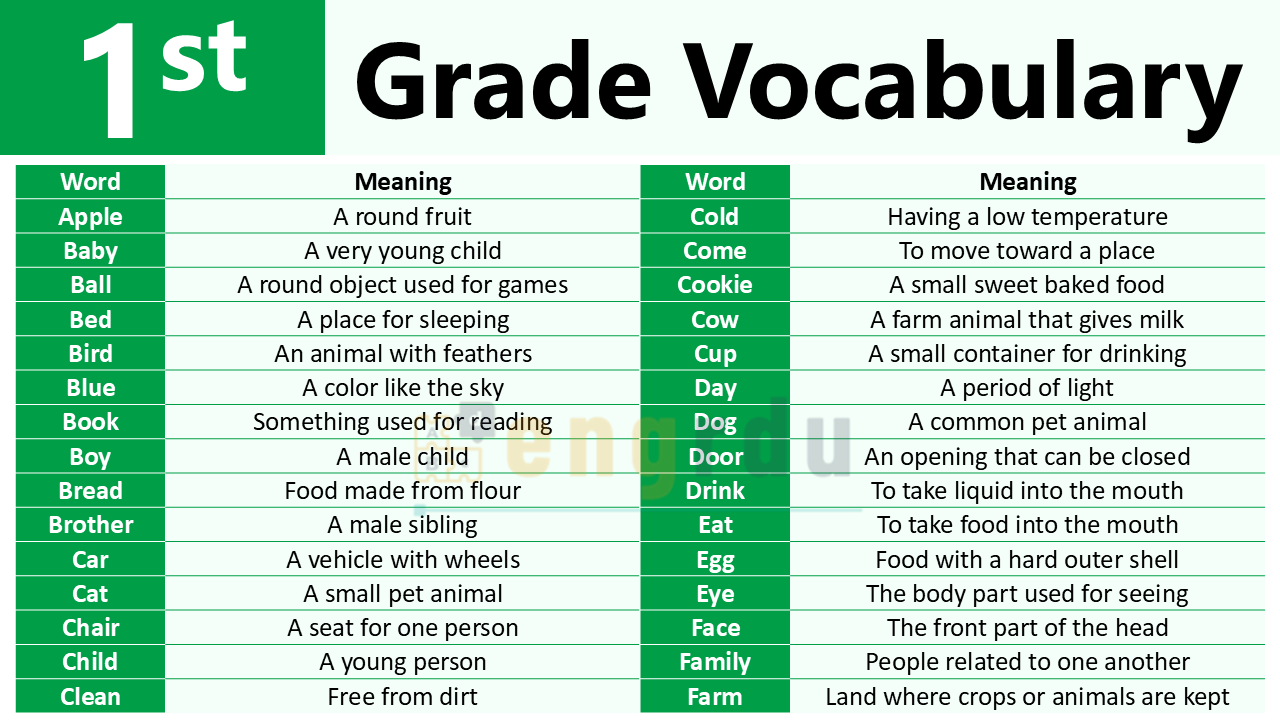
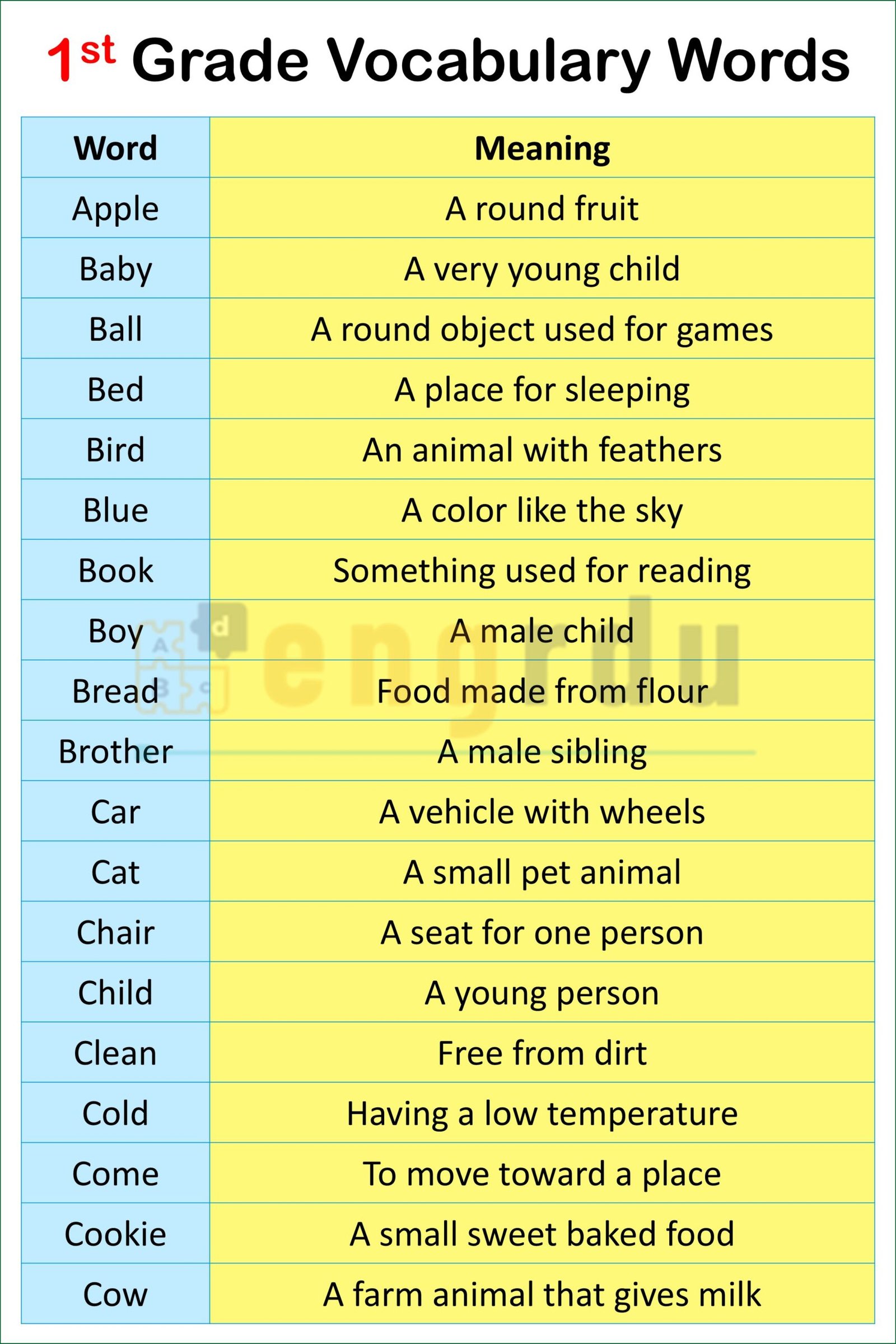
- Apple – A round fruit that can be red, green, or yellow.
Example: I ate an apple after school. - Baby – A very young child.
Example: The baby is sleeping. - Ball – A round object used for playing games.
Example: Please throw me the ball. - Bed – A piece of furniture used for sleeping.
Example: I am ready for bed. - Big – Large in size.
Example: That is a big dog. - Bird – An animal with feathers, wings, and a beak.
Example: A bird is sitting in the tree. - Blue – A color like the sky on a clear day.
Example: My bag is blue. - Book – Something with pages that we read.
Example: Can I read this book? - Boy – A male child.
Example: The boy is playing outside. - Bread – A food made from flour and usually baked.
Example: I want some bread for breakfast. - Bus – A large vehicle that carries people.
Example: I take the bus to school. - Cake – A sweet baked food often eaten at celebrations.
Example: We had cake at my birthday party. - Car – A vehicle with four wheels.
Example: My father drives a car. - Cat – A small animal often kept as a pet.
Example: The cat is under the chair. - Chair – A seat for one person.
Example: Please sit on the chair. - Child – A young person.
Example: Every child needs care. - Clean – Free from dirt.
Example: My hands are clean. - Cold – Having a low temperature.
Example: The water is cold. - Come – To move toward a person or place.
Example: Come here, please. - Cow – A large farm animal that gives milk.
Example: The cow is eating grass.
D–F Vocabulary Words
- Dance – To move your body to music.
Example: Let’s dance to this song. - Day – The time when there is light from the sun.
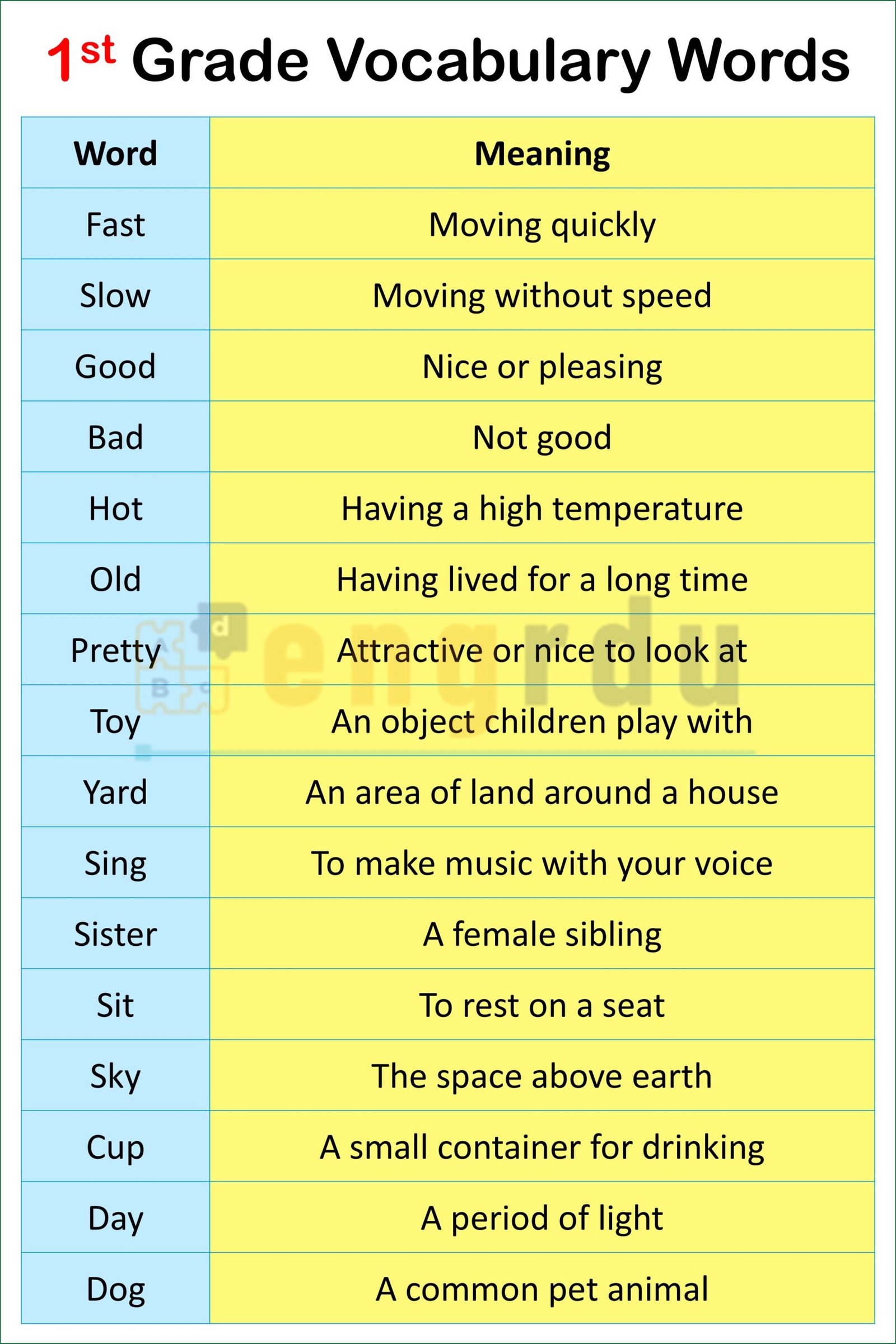
Example: We play outside during the day. - Dog – A common animal kept as a pet.
Example: My dog likes to run. - Door – The part of a building that opens and closes for entering or leaving.
Example: Please close the door. - Down – Toward a lower place or position.
Example: Sit down, please. - Draw – To make a picture with a pencil, pen, or other tool.
Example: I like to draw flowers. - Drink – To take liquid into your mouth and swallow it.
Example: Please drink some water. - Eat – To put food in your mouth and swallow it.
Example: We eat lunch at noon. - Egg – A food produced by birds such as chickens.
Example: I had an egg for breakfast. - Eye – The body part used for seeing.
Example: My eye hurts. - Face – The front part of your head.
Example: Wash your face before bed. - Family – A group of people who are related to one another.
Example: I love my family. - Fast – Moving quickly.
Example: The rabbit can run fast. - Find – To discover or see something you were looking for.
Example: I cannot find my pencil. - Food – Things that people or animals eat.
Example: We need food for dinner. - Foot – The part of the body at the end of the leg.
Example: My foot is wet. - Friend – A person you like and enjoy spending time with.
Example: Ali is my best friend. - Funny – Making you laugh.
Example: That story is funny.
1st Grade Vocabulary Words
G–I Vocabulary Words
- Game – An activity played for fun.
Example: Do you want to play a game? - Garden – A place where plants and flowers grow.
Example: Grandma has flowers in her garden. - Give – To hand something to another person.
Example: Please give me the pencil. - Go – To move from one place to another.
Example: We go to school every day. - Good – Pleasant, helpful, or of a suitable kind.
Example: You did a good job. - Green – A color like grass or many leaves.
Example: The leaves are green. - Girl – A female child.
Example: The girl is reading a book. - Happy – Feeling good or pleased.
Example: I am happy today. - Hat – Something worn on the head.
Example: Put on your hat. - Hand – The part of the body at the end of the arm.
Example: Raise your hand. - Help – To make something easier for someone.
Example: Can you help me? - Home – The place where a person lives.
Example: I am going home. - Hot – Having a high temperature.
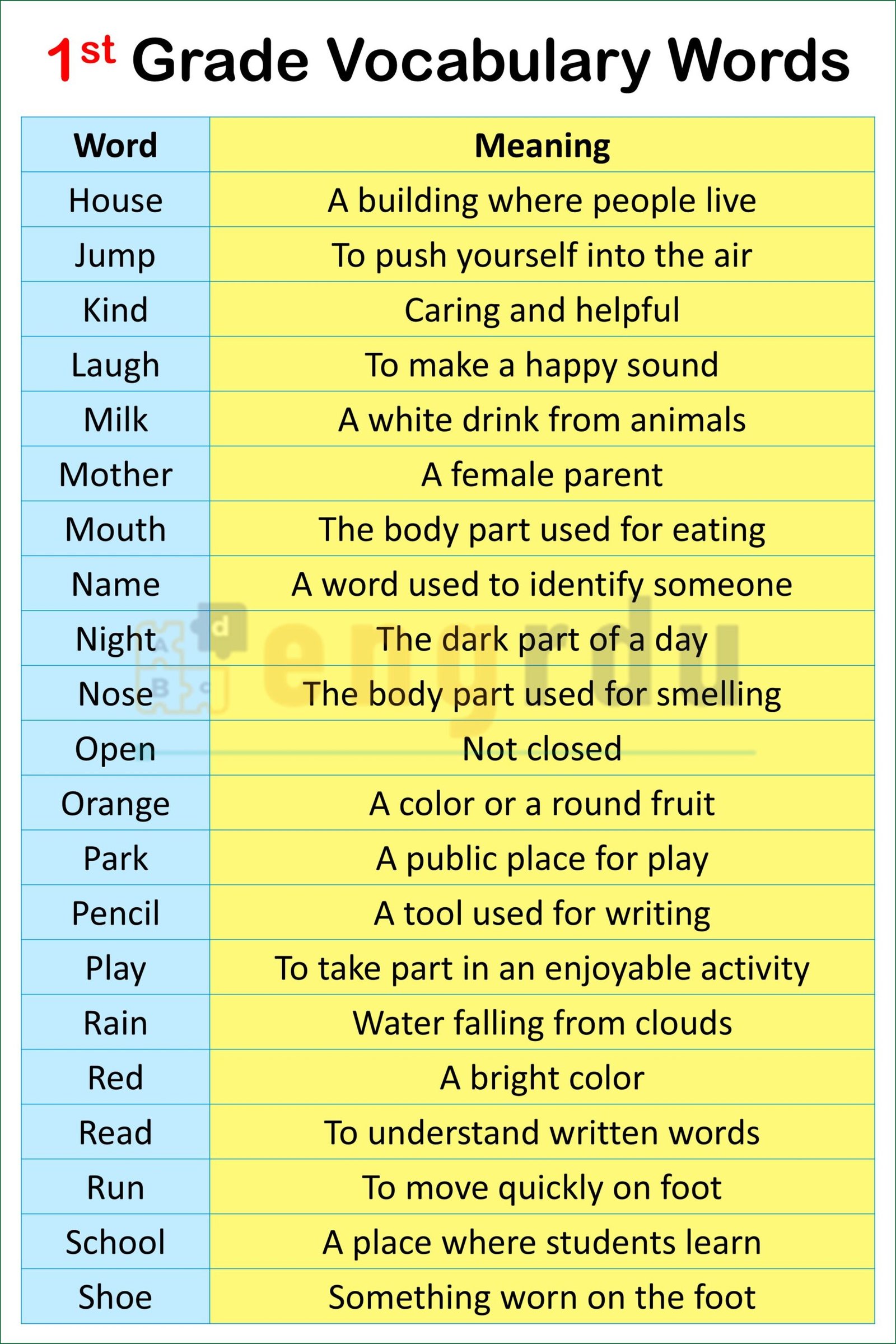
Example: The soup is hot. - House – A building where people live.
Example: Their house is near the school. - Jump – To push yourself off the ground and move into the air.
Example: The children jump over the rope. - Ice – Frozen water.
Example: Put some ice in my drink. - Inside – In or toward the inner part of something.
Example: Come inside because it is raining.
J–L Vocabulary Words
- Jump – To move upward from the ground.
Example: Watch me jump. - Kind – Friendly and caring toward others.
Example: Sara is kind to everyone. - Kitchen – A room where food is prepared.
Example: Mom is in the kitchen. - Laugh – To make a happy sound when something is funny.
Example: We laugh at the funny joke. - Learn – To gain knowledge or a new skill.
Example: I want to learn English. - Leg – The body part used for standing and walking.
Example: My leg is tired. - Like – To enjoy something or someone.
Example: I like apples. - Little – Small in size.
Example: I saw a little bird. - Look – To use your eyes to see something.
Example: Look at the picture. - Lunch – A meal eaten around the middle of the day.
Example: I eat lunch at school.
First Grader Vocabulary Words
M–O Vocabulary Words
- Make – To create or prepare something.
Example: Let’s make a paper boat. - Milk – A white drink that comes from animals such as cows.
Example: I drink milk in the morning. - Mom – A child’s mother.
Example: My mom made breakfast. - Moon – The bright object we can see in the night sky.
Example: The moon looks bright tonight. - Morning – The early part of the day.
Example: I brush my teeth every morning. - Mother – A female parent.
Example: My mother helps me with my homework. - Name – The word used to identify a person or thing.
Example: What is your name? - Night – The time when it is dark and people often sleep.
Example: I read a story at night. - Open – To move something so that it is not closed.
Example: Open the window, please. - Orange – A round fruit or a color between red and yellow.
Example: I ate an orange. - Outside – In or toward the area that is not inside.
Example: The children are playing outside.
P–R Vocabulary Words
- Paper – A thin material used for writing or drawing.
Example: Give me a piece of paper. - Park – A public place where people can play or relax.
Example: We went to the park. - Pen – A tool used for writing with ink.
Example: I need a blue pen. - Pencil – A writing tool with a material that can be erased.
Example: Sharpen your pencil. - Play – To take part in an activity for enjoyment.
Example: Can we play outside? - Please – A polite word used when asking for something.
Example: Please pass me the book. - Pretty – Attractive or nice to look at.
Example: Your dress is pretty. - Quick – Moving or happening fast.
Example: Be quick or we will be late. - Read – To look at written words and understand them.
Example: I can read this story. - Red – A color like an apple or a rose.
Example: She has a red bag. - Run – To move quickly on your feet.
Example: The children run in the playground.
S–Z Vocabulary Words
- Sad – Feeling unhappy.
Example: I feel sad when my friend leaves. - School – A place where children learn.
Example: I go to school every morning. - See – To notice something with your eyes.
Example: I can see a bird. - Sit – To rest on a chair or another surface.
Example: Please sit here. - Small – Little in size.
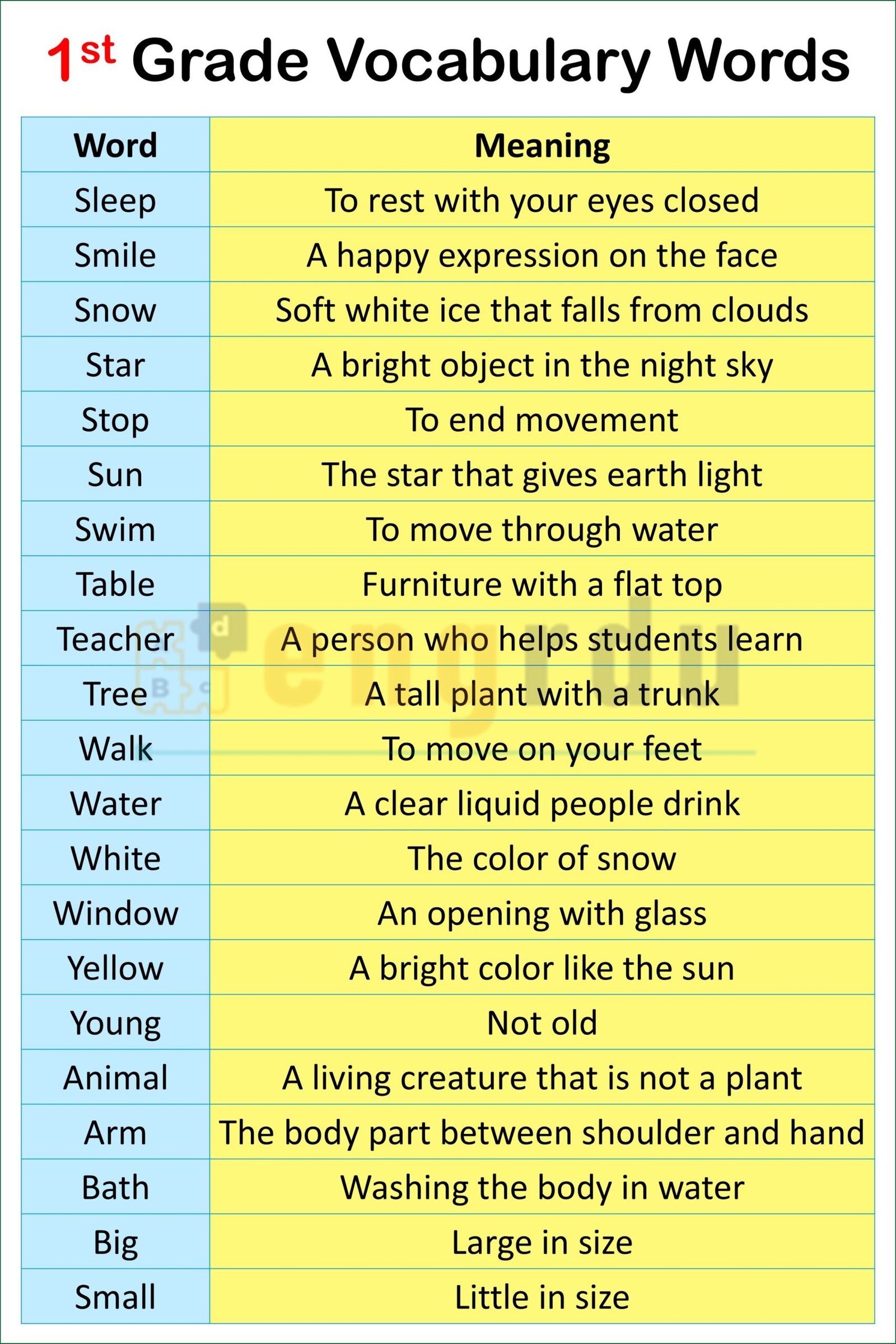
Example: The puppy is small. - Smile – To make a happy expression with your mouth.
Example: Please smile for the picture. - Snow – Soft white ice that falls from the sky in cold weather.
Example: The children are playing in the snow. - Song – A piece of music that people sing.
Example: We sang a song in class. - Stand – To be upright on your feet.
Example: Please stand in a line. - Stop – To finish moving or doing something.
Example: Stop running in the classroom. - Sun – The bright star that gives Earth light and heat.
Example: The sun is shining. - Swim – To move through water.
Example: I can swim in the pool. - Teacher – A person who teaches students.
Example: My teacher reads us a story. - Tree – A tall plant with a trunk and branches.
Example: The bird is in the tree. - Walk – To move by putting one foot in front of the other.
Example: We walk to the park. - Water – A clear liquid that people, animals, and plants need.
Example: Please give me some water. - White – A color like snow or milk.
Example: The wall is white. - Window – An opening with glass in a wall that lets in light.
Example: Look through the window. - Yellow – A bright color like the sun.
Example: I have a yellow pencil. - Young – Not old; having lived for a short time.
Example: The puppy is very young.
Vocabulary for First Grade Students
Everyday Nouns for First Graders
Nouns are naming words. Children use them constantly when talking about people, animals, places, food, toys, and objects around them.
- Bag – Something used for carrying things.
Example: My books are in my bag. - Box – A container with flat sides.
Example: Put the toy in the box. - Cup – A small container used for drinking.
Example: My cup is full of water. - Door – A movable part used to enter or leave a room.
Example: Please open the door. - House – A building where people live.
Example: Our house has three rooms. - Toy – Something made for children to play with.
Example: This is my favorite toy. - Table – Furniture with a flat top used for eating, working, or other activities.
Example: Put your book on the table. - Shoe – Something worn on the foot.
Example: My shoe is dirty. - Room – A part of a building separated by walls.
Example: My room is upstairs. - School – A place where students learn.
Example: Our school starts at eight.
Action Words for 1st Graders
Action words, also called verbs, help children describe what people and animals do.
- Ask – To say something when you want information.
Example: I want to ask a question. - Bring – To carry something to a person or place.
Example: Please bring your book. - Build – To make something by putting parts together.
Example: We build a tower with blocks. - Clap – To hit your hands together to make a sound.
Example: Clap when the song ends. - Cut – To divide something with a sharp tool.
Example: Cut the paper carefully. - Give – To hand something to someone.
Example: Give me your hand. - Listen – To pay attention to a sound.
Example: Listen to your teacher. - Read – To understand written words.
Example: I read every night. - Sing – To make music with your voice.
Example: We sing in music class. - Write – To make letters or words on paper.
Example: Write your name here.
Describing Words for First Grade with Meanings
Adjectives help children tell us what something or someone is like.
- Beautiful – Very nice to look at.
Example: The flower is beautiful. - Bright – Giving or reflecting a lot of light.
Example: The sun is bright. - Dark – Having little or no light.
Example: The room is dark. - Dirty – Not clean.
Example: My shoes are dirty. - Dry – Not wet.
Example: The towel is dry. - Heavy – Weighing a lot.
Example: This box is heavy. - Light – Not weighing much.
Example: My school bag is light today. - Long – Having a great distance from one end to another.
Example: The rope is long. - Short – Having little distance from one end to another.
Example: The pencil is short. - Soft – Pleasant to touch and not hard.
Example: The pillow is soft. - Strong – Having a lot of physical power.
Example: My dad is strong. - Tall – Having greater height than usual.
Example: That tree is tall.
Vocabulary Words for 1st Grade Kids
Feelings and Emotion Words for First Grade Students
Children also need words to explain how they feel. These words make everyday conversations clearer.
- Angry – Feeling upset or mad.
Example: I am angry because you took my toy. - Excited – Feeling very happy about something that is going to happen.
Example: I am excited about the school trip. - Happy – Feeling pleased or joyful.
Example: I am happy to see you. - Lonely – Feeling sad because you are alone.
Example: I feel lonely when my friend is away. - Proud – Feeling pleased about something you or someone else did well.
Example: Mom is proud of my drawing. - Sad – Feeling unhappy.
Example: He is sad because his toy broke. - Scared – Feeling afraid.
Example: The little boy is scared of the dark. - Surprised – Feeling something unexpected has happened.
Example: I was surprised by the gift. - Tired – Needing rest or sleep.
Example: I am tired after playing outside. - Worried – Feeling nervous about something that may happen.
Example: I am worried about my lost book.
School Vocabulary Words for 1st Graders
School words are especially useful because children hear and use them every day in the classroom.
- Class – A group of students who learn together.
Example: Our class is quiet today. - Desk – A table used by a student or teacher.
Example: My pencil is on my desk. - Homework – Schoolwork that students do at home.
Example: I finished my homework. - Lesson – A period of learning about a subject.
Example: Today’s lesson is about animals. - Question – Something you ask when you want information.
Example: I have a question. - Answer – Something you say or write in response to a question.
Example: I know the answer. - Page – One side of a sheet in a book.
Example: Open your book to page five. - Pencil – A tool used for writing and drawing.
Example: I need a pencil. - Read – To look at and understand written words.
Example: Please read the sentence. - Teacher – A person who helps students learn.
Example: Our teacher is reading a story.
Home and Family Vocabulary for First Grade Students
These words help children talk about the people and things they know best.
- Brother – A boy or man who has the same parents as you.
Example: My brother plays football. - Father – A male parent.
Example: My father is at work. - Grandma – An informal word for grandmother.
Example: My grandma makes delicious food. - Grandpa – An informal word for grandfather.
Example: I visit my grandpa on Sunday. - Mother – A female parent.
Example: My mother is cooking dinner. - Sister – A girl or woman who has the same parents as you.
Example: My sister likes to draw. - Kitchen – A room where food is prepared.
Example: Dad is in the kitchen. - Bedroom – A room used for sleeping.
Example: My bedroom is clean. - Breakfast – The first meal of the day.
Example: I eat breakfast before school. - Dinner – The main meal commonly eaten in the evening.
Example: We eat dinner together.
Nature and Animal Words for 1st Graders
Nature vocabulary gives children words for the world they see around them.
- Animal – A living thing such as a dog, bird, or elephant.
Example: A dog is my favorite animal. - Cloud – A white or gray mass in the sky made of tiny water drops.
Example: That cloud looks like a rabbit. - Flower – The colorful part of many plants.
Example: This flower is yellow. - Grass – Green plants that cover the ground.
Example: The children are sitting on the grass. - Leaf – The flat green part of a plant or tree.
Example: A leaf fell from the tree. - Rain – Water that falls from clouds.
Example: Take an umbrella because it may rain. - River – A large natural stream of flowing water.
Example: We saw a river on our trip. - Sky – The space above Earth where we see the sun, moon, and clouds.
Example: The sky is blue. - Star – A bright object in the night sky.
Example: I can see many stars tonight. - Tree – A large plant with a trunk and branches.
Example: There is a bird in the tree.
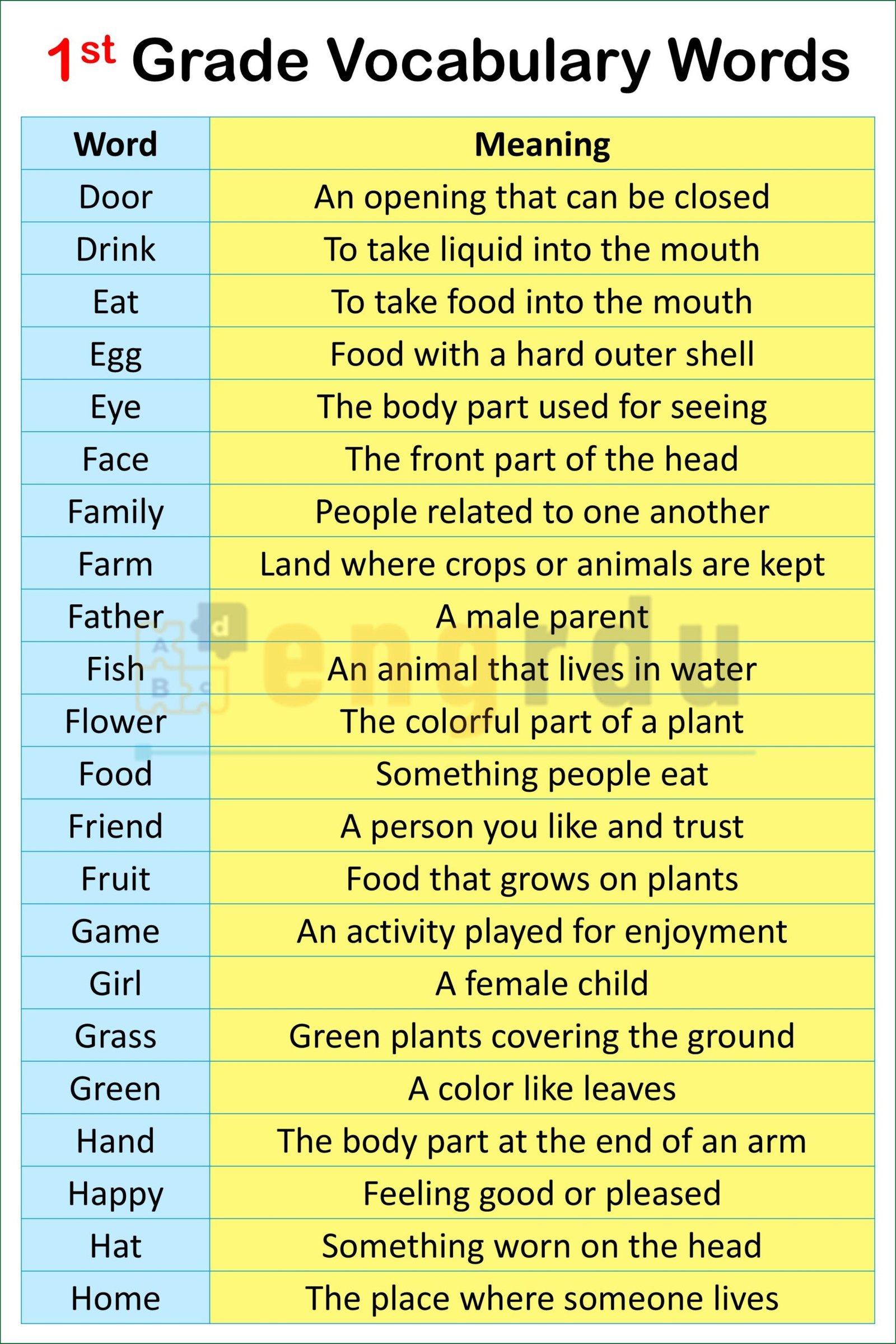
Vocabulary Words for First Graders
Useful Everyday Words and Expressions
Some vocabulary words are especially useful because children can use them in short conversations throughout the day.
- Hello – A word used when greeting someone.
Example: “Hello, Sara! How are you?” - Goodbye – A word used when leaving someone.
Example: “Goodbye, Mom. See you later.” - Thank you – A polite expression used to show appreciation.
Example: “Thank you for helping me.” - Sorry – A word used to apologize.
Example: “Sorry, I broke your pencil.” - Please – A polite word used when asking for something.
Example: “Please give me some water.” - Yes – A word used to agree or give a positive answer.
Example: “Do you like apples?” “Yes!” - No – A word used to give a negative answer or disagree.
Example: “Do you want milk?” “No, thank you.” - Maybe – Used when you are not sure.
Example: “Will you come tomorrow?” “Maybe.” - Here – In or at this place.
Example: “Come here, please.” - There – In or at that place.
Example: “Your shoes are over there.” - Now – At the present time.
Example: “I am ready now.” - Later – At a time after now.
Example: “I will play later.” - Today – This day.
Example: “Today is Monday.” - Tomorrow – The day after today.
Example: “We have a test tomorrow.” - Yesterday – The day before today.
Example: “We went to the park yesterday.”
Common Vocabulary Mistakes
Young learners sometimes confuse words that sound similar or have related meanings.
- There / Their – There refers to a place, while their shows that something belongs to people.
- Your / You’re – Your shows possession, while you’re means “you are.”
- See / Sea – See means to use your eyes; sea is a large body of salt water.
- To / Too – To often shows direction; too can mean “also” or “more than needed.”
- Hear / Here – Hear means to notice sound; here means this place.
Practice Activity
Learning a word becomes easier when children use it instead of only memorizing its meaning. Try these short activities at home or in class.
Fill in the blanks
Choose the best word: happy, school, water, dog, read
- I go to ______ every morning.
- Please give me some ______.
- My ______ likes to run.
- I like to ______ books.
- I am ______ because I won a game.
Answers
- school
- water
- dog
- read
- happy
Make Your Own Sentences
Ask the child to make one sentence with each word:
- friend
- jump
- blue
- family
- teacher
For example: My friend sits beside me.
This activity helps children move from recognizing vocabulary to using words naturally in conversation and writing.
How Many Words Should a 1st Grader Learn?
There is no single required number of vocabulary words for every first grader. Children learn vocabulary at different speeds, and vocabulary growth depends on reading, listening, classroom learning, and everyday conversation.
A better goal is to learn useful words in context rather than memorize a large list. Children should understand a word, recognize it when reading or hearing it, and gradually use it when speaking or writing.
Ways to Build First-Grade Vocabulary
- Read short children’s stories together.
- Talk about pictures and ask the child to name objects.
- Introduce a few new words each day.
- Use new vocabulary during everyday activities.
- Ask children to explain a word in their own words.
- Encourage them to make their own sentences.
- Review older words while introducing new ones.
- Use songs, stories, classroom activities, and conversations.
FAQs About Vocabulary for First Graders
What are good vocabulary words for 1st graders?
Good first-grade vocabulary includes common words such as friend, school, happy, family, animal, read, write, play, small, and beautiful.
How can I teach vocabulary to a first grader?
Teach a few useful words at a time, explain their meanings, show pictures or objects, and encourage children to use each word in their own sentences.
How many vocabulary words should a first grader know?
There is no universal number. Vocabulary development varies, so focus on understanding and using useful words rather than reaching a fixed word count.
What are easy English words for first graders?
Easy words include cat, dog, book, school, friend, happy, big, small, run, jump, eat, read, write, and play.
What vocabulary should a Grade 1 student learn?
A Grade 1 student should learn everyday vocabulary related to family, school, food, animals, actions, feelings, colors, places, and common objects.
How can children remember new vocabulary?
Children remember words better when they hear, read, see, and use them repeatedly in meaningful conversations, stories, games, and daily activities.
Why is vocabulary important in first grade?
Vocabulary helps children understand what they read and hear while giving them the words they need to communicate their thoughts, needs, feelings, and experiences.
What are common first-grade action words?
Common action words include run, jump, walk, eat, drink, read, write, listen, look, play, sing, dance, give, and help.
Conclusion
Building Vocabulary Words for 1st Grade is about giving children useful language for the world around them. Words such as school, friend, happy, read, play, family, food, animal, and home appear often in children’s conversations, books, and classroom activities.
The best approach is to teach vocabulary through meaning, repetition, reading, speaking, and everyday use. When children understand a word and use it in their own sentences, that word becomes part of their active English vocabulary.
Explore More Vocabulary By Level
- 10th Grade Words with Meanings with PDF
- 600+ 9th Grade Vocabulary Words with PDF
- 500+ 8th Grade Vocabulary Words with PDF
- 700+ 7th Grade Vocabulary Words with PDF
- 500+ 6th Grade Vocabulary Words with PDF
- 300+ 5th Grade Vocabulary Words with PDF
- 300+ 4th Grade Vocabulary Words with PDF
- 250+ 3rd Grade Vocabulary Words with PDF
- 2nd Grade Vocabulary Words with with PDF