
Fourth grade is when children’s vocabulary starts becoming more detailed and academic. Students encounter longer stories, nonfiction texts, science lessons, social studies topics, and writing assignments that require more precise words.
This collection of 4th grade vocabulary words introduces students to useful terms they can understand and use in conversation, reading, and schoolwork. The examples are written in natural English so kids can see how each word works in context.
What Vocabulary Does a 4th Grader Need?
A strong fourth-grade vocabulary includes words for describing ideas, explaining events, expressing opinions, discussing emotions, understanding texts, and learning different school subjects.
Students at this level can begin moving from very common words to more exact choices. For example, instead of always saying look, they can learn observe. Instead of big, they can use enormous. Instead of help, they can use assist.
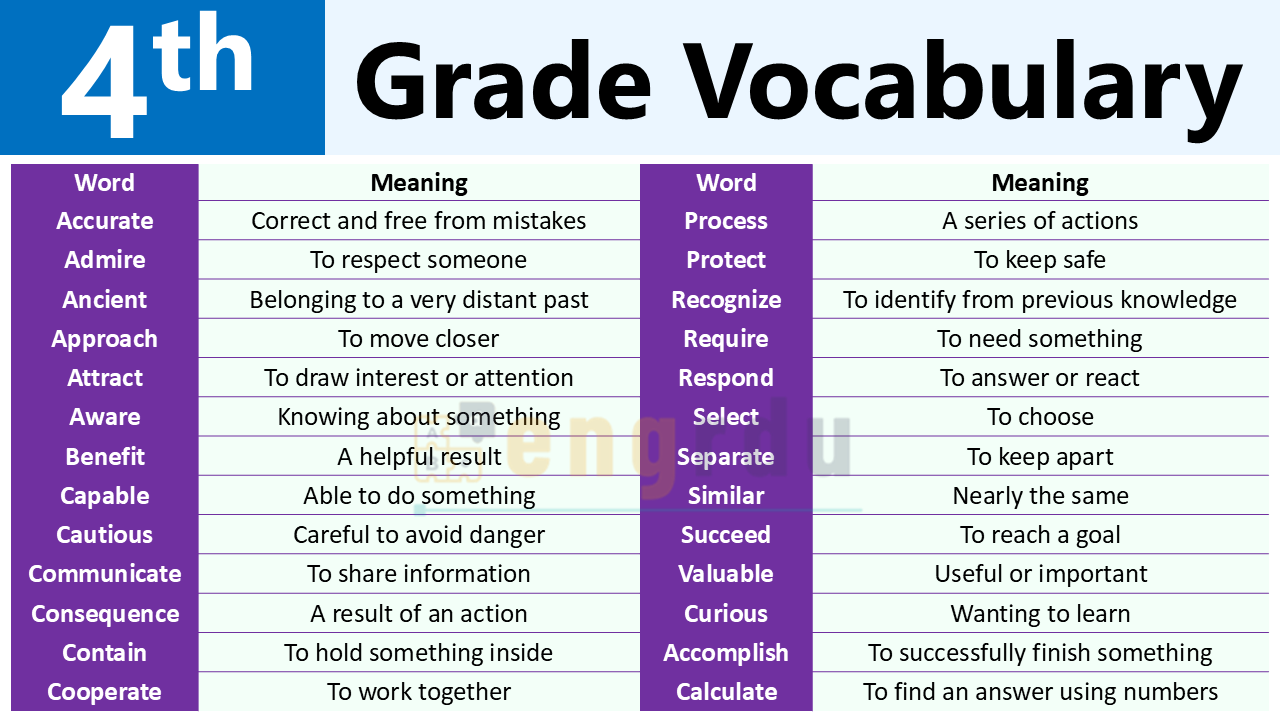
Common 4th Grade Vocabulary Words with Meanings
Here are useful words that students can encounter in stories, conversations, classroom activities, and everyday situations.
- Abundant – Existing in a large amount or plenty.
Example: “The garden has abundant flowers in spring.” - Accurate – Correct and free from mistakes.
Example: “Make sure your answer is accurate.” - Admire – To respect or like someone or something because of good qualities.
Example: “I admire my teacher because she is patient.” - Ancient – Very old and belonging to a time long ago.
Example: “We learned about ancient Egypt in class.” - Attempt – To try to do something.
Example: “I will attempt to solve the puzzle.” - Avoid – To stay away from someone or something.
Example: “We should avoid touching the hot pan.” - Benefit – Something helpful or useful that comes from an action.
Example: “Exercise has many benefits.” - Brilliant – Very clever or very bright.
Example: “She had a brilliant idea for the project.” - Cautious – Careful because there may be danger.
Example: “Be cautious when walking on the wet floor.” - Challenge – Something difficult that requires effort.
Example: “The difficult puzzle was a challenge.” - Communicate – To share information, thoughts, or feelings.
Example: “People communicate by speaking and writing.” - Compete – To try to win against another person or group.
Example: “Our team will compete in the school race.” - Confuse – To make someone unable to understand something clearly.
Example: “The difficult question confused me.” - Consider – To think carefully about something.
Example: “Please consider my suggestion.” - Courage – The ability to face fear or difficulty.
Example: “It took courage to speak before the crowd.” - Curious – Wanting to learn or know more.
Example: “The curious student asked many questions.” - Determine – To find out or decide something.
Example: “We need to determine the answer.” - Difficult – Not easy to do or understand.
Example: “The final question was difficult.” - Eager – Very excited and ready to do something.
Example: “The students were eager to begin the experiment.” - Efficient – Working well without wasting time or effort.
Example: “This new method is more efficient.”
Alternative Words for Fourth Grader Students
Fourth graders can make their writing stronger by learning more precise alternatives to common words.
Instead of “big”
- Large – Greater than average in size.
Example: “A large tree stood beside the house.” - Enormous – Extremely large.
Example: “An enormous whale appeared near the boat.” - Massive – Very large and heavy.
Example: “The massive rock blocked the path.”
Instead of “look”
- Observe – To watch something carefully.
Example: “We observed the birds from the window.” - Examine – To look at something closely.
Example: “The scientist examined the plant.” - Notice – To become aware of something.
Example: “Did you notice the rainbow?”
Instead of “help”
- Assist – To help someone do something.
Example: “Can you assist me with this box?” - Support – To help someone succeed or manage a difficulty.
Example: “My family supports me when I have a problem.”
Instead of “say”
- Explain – To make something clear by giving information.
Example: “Please explain your answer.” - Mention – To talk about something briefly.
Example: “She mentioned her new project.” - Announce – To tell people something officially or publicly.
Example: “The teacher announced the winner.”
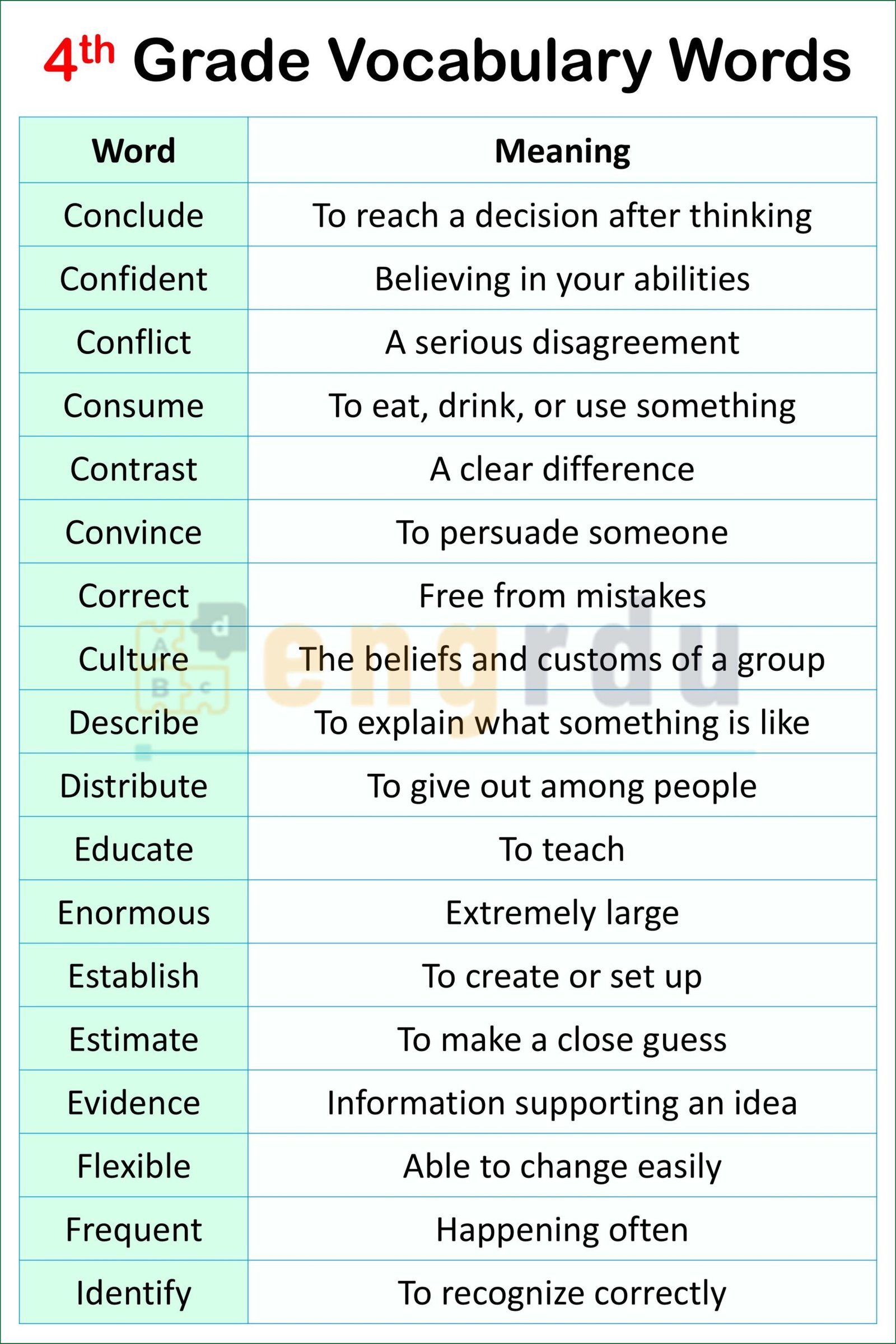
4th Grade Vocabulary Words PDF
4th Graders Vocabulary for Stronger Storytelling
These words help fourth graders describe events, characters, places, and actions when writing stories.
- Beginning – The first part of something.
Example: “The beginning of the story introduces the main character.” - Conflict – A problem or disagreement between people or groups.
Example: “The story’s conflict began when the friends lost the map.” - Destination – The place where someone is going.
Example: “Our destination was a small village.” - Encounter – To meet someone or experience something unexpectedly.
Example: “We encountered a deer during our walk.” - Explore – To travel around or investigate a place to learn about it.
Example: “The children explored the old forest.” - Journey – A trip from one place to another.
Example: “The family began a long journey.” - Mystery – Something that is difficult to explain or understand.
Example: “The missing key became a mystery.” - Rescue – To save someone or something from danger.
Example: “The firefighters rescued the trapped dog.” - Struggle – To have difficulty doing or achieving something.
Example: “The little bird struggled to fly.” - Unexpected – Not expected or predicted.
Example: “An unexpected storm changed our plans.”
Character Words: Understanding People Better
A character’s personality can be described with more than just good or bad. These words help students understand people in stories and everyday life.
- Ambitious – Wanting strongly to achieve something.
Example: “The ambitious student wanted to win the science competition.” - Cheerful – Happy and positive.
Example: “Our cheerful neighbor always smiles.” - Generous – Willing to give or share with others.
Example: “The generous boy shared his lunch.” - Honest – Telling the truth and not cheating or stealing.
Example: “An honest person tells the truth.” - Independent – Able to do things without needing much help.
Example: “She is becoming more independent with her schoolwork.” - Loyal – Showing strong support for someone or something.
Example: “The dog remained loyal to its owner.” - Patient – Able to wait without becoming upset.
Example: “Be patient while your friend finishes speaking.” - Polite – Having good manners.
Example: “It is polite to say thank you.” - Reliable – Someone or something that can be trusted to do what is expected.
Example: “Sara is reliable and always finishes her work.” - Selfish – Caring mainly about yourself rather than others.
Example: “It is selfish to keep all the food for yourself.” - Thoughtful – Showing care for other people’s feelings or needs.
Example: “It was thoughtful of him to help his friend.” - Determined – Having made a strong decision to achieve something.
Example: “She was determined to finish the race.”
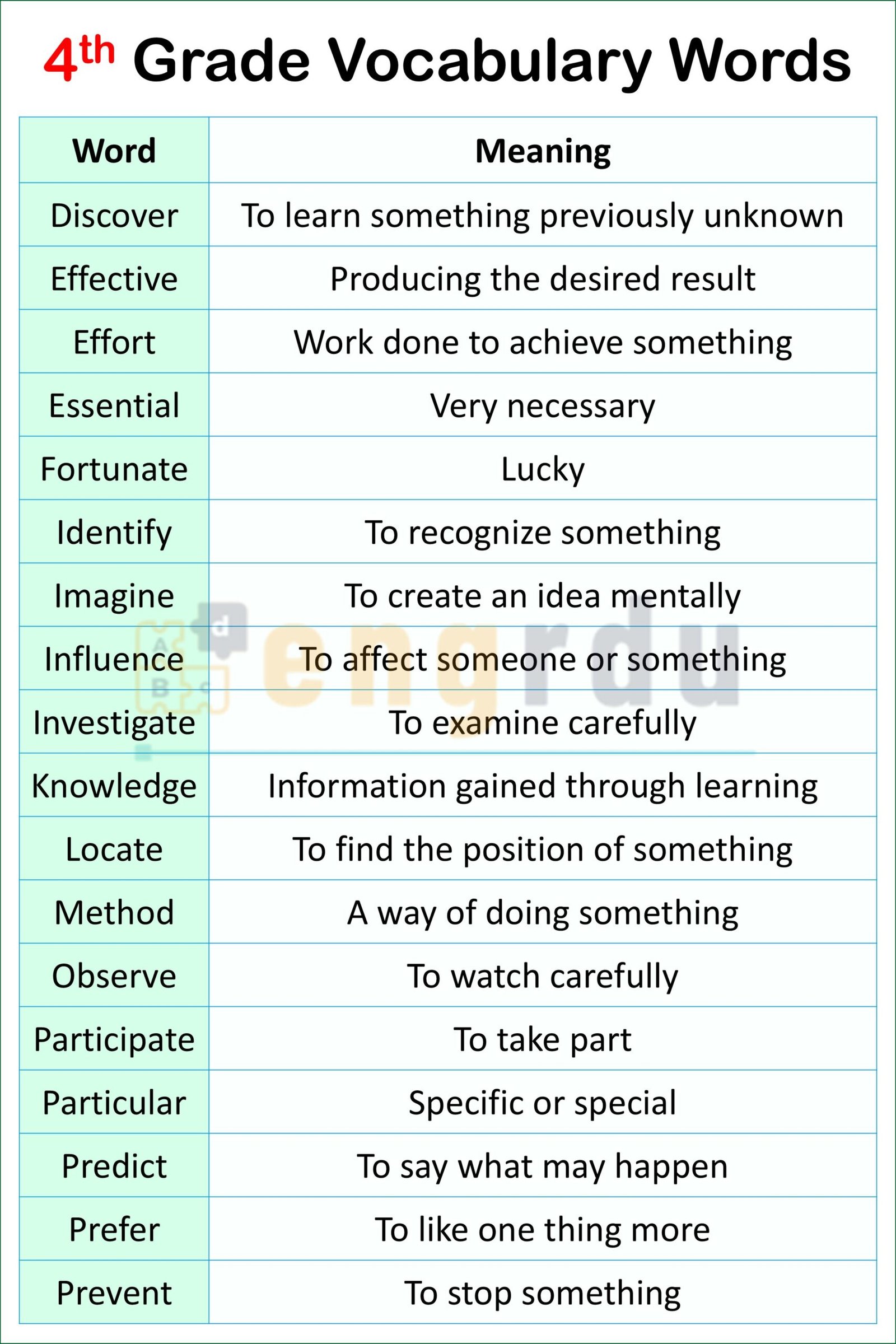
4th Grade Vocabulary Words with Meanings and Examples
4th Grade Words for Feelings and Reactions
Fourth graders can use these words to describe emotions more precisely.
- Amazed – Very surprised or impressed.
Example: “I was amazed by the magician’s trick.” - Anxious – Worried or nervous about something.
Example: “He felt anxious before the exam.” - Delighted – Very pleased and happy.
Example: “Grandma was delighted to see her grandchildren.” - Embarrassed – Feeling uncomfortable because of something that happened.
Example: “I felt embarrassed when I forgot my lines.” - Frustrated – Annoyed because something is difficult or not working.
Example: “I became frustrated when the computer stopped working.” - Grateful – Feeling thankful for something.
Example: “I am grateful for your kindness.” - Relieved – Feeling relaxed because something worrying has ended.
Example: “I was relieved when I found my lost bag.” - Satisfied – Pleased because something is as good as expected.
Example: “I was satisfied with my finished project.” - Terrified – Extremely frightened.
Example: “The child was terrified by the loud thunder.” - Upset – Unhappy, worried, or angry.
Example: “She was upset after losing her favorite toy.”
Academic Vocabulary for Fouth Graders
These words appear across English, science, mathematics, and social studies. Learning them makes classroom instructions easier to understand.
- Analyze – To examine something carefully to understand it.
Example: “We analyzed the picture for clues.” - Calculate – To find an answer using numbers or mathematics.
Example: “Calculate the total cost of the three books.” - Compare – To look at things to find similarities and differences.
Example: “Compare the two animals.” - Conclusion – A final idea or judgment reached after thinking about something.
Example: “Our conclusion was based on the results.” - Evidence – Facts or information that help prove something.
Example: “Use evidence from the story to support your answer.” - Explain – To make an idea clear.
Example: “Explain how you found the answer.” - Identify – To recognize or name someone or something.
Example: “Identify the main character.” - Information – Facts or details about a subject.
Example: “The book contains information about planets.” - Method – A particular way of doing something.
Example: “We used a different method to solve the problem.” - Predict – To say what you think will happen in the future.
Example: “Can you predict what will happen next?” - Result – What happens because of an action or event.
Example: “The result of the experiment surprised us.” - Summarize – To give the main points in a shorter form.
Example: “Summarize the story in three sentences.”
Science Words for Curious Fourth Graders
Science vocabulary introduces students to the language used to describe living things, matter, energy, Earth, and investigations.
- Adapt – To change or become suited to a new condition.
Example: “Some animals adapt to cold weather.” - Energy – The power needed to make things happen or move.
Example: “Plants use sunlight as a source of energy.” - Experiment – A test done to learn what happens under certain conditions.
Example: “We conducted an experiment with water and ice.” - Force – A push or pull that can change movement.
Example: “The force of the wind moved the leaves.” - Habitat – The natural home of a plant or animal.
Example: “The pond is a habitat for many frogs.” - Material – What something is made from.
Example: “Wood is a common building material.” - Observe – To watch carefully and notice details.
Example: “Observe what happens when the ice melts.” - Organism – A living thing.
Example: “A plant is a living organism.” - Process – A series of actions that produce a result.
Example: “Photosynthesis is a process used by plants.” - Temperature – A measurement of how hot or cold something is.
Example: “The temperature dropped during the night.” - Surface – The outside or top layer of something.
Example: “The water has a smooth surface.” - Survive – To continue living despite difficult conditions.
Example: “Some plants can survive without much water.”
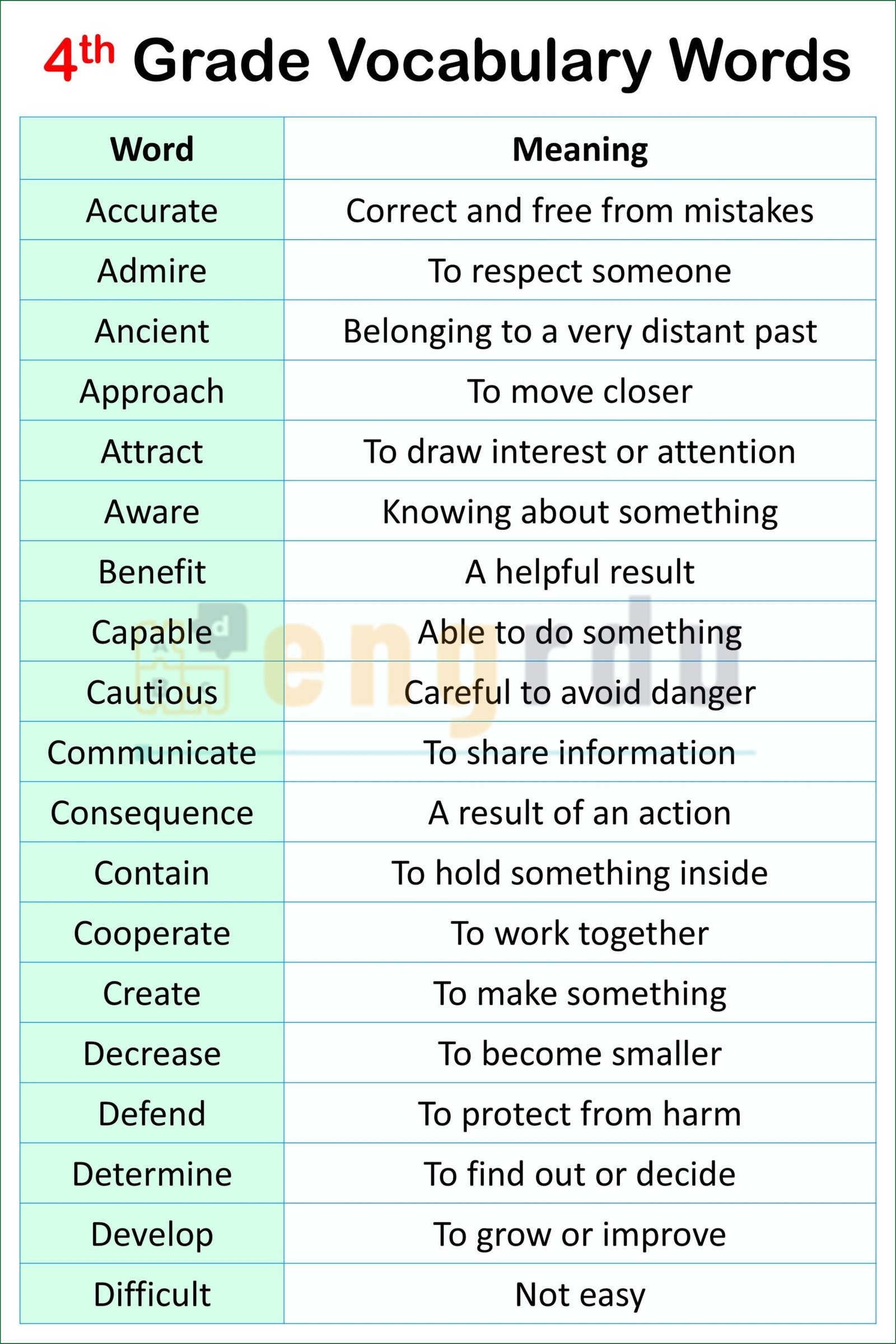
4th Grade Vocabulary Words
Social Studies and Community Vocabulary Words for 4th Graders
These terms help students discuss communities, history, geography, and how people live together.
- Community – A group of people who live or work in the same area.
Example: “Everyone can help improve the community.” - Culture – The traditions, beliefs, customs, and way of life of a group of people.
Example: “Food is an important part of culture.” - Government – The group or system that manages a country, state, or community.
Example: “The government creates rules for the country.” - History – The study of people and events from the past.
Example: “We are learning about history today.” - Leader – A person who guides or directs others.
Example: “The team leader organized the activity.” - Nation – A country and its people.
Example: “Pakistan is a nation in South Asia.” - Region – A particular area of a country or the world.
Example: “This region has a warm climate.” - Resource – Something useful that people can use.
Example: “Water is an important natural resource.” - Tradition – A custom or practice passed from one generation to another.
Example: “Eating together is a family tradition.” - Citizen – A person who legally belongs to a country.
Example: “Every citizen has rights and responsibilities.”
Nature and Environment Vocabulary for 4th Graders
Children encounter environmental vocabulary in science books, documentaries, outdoor activities, and classroom discussions.
- Conserve – To use something carefully so it is not wasted.
Example: “We should conserve water at home.” - Environment – The surroundings and natural world in which living things exist.
Example: “Plastic waste can harm the environment.” - Forest – A large area covered mainly with trees.
Example: “Many animals live in the forest.” - Pollution – Harmful substances that make air, water, or land dirty.
Example: “Pollution can harm animals.” - Recycle – To process used materials so they can be used again.
Example: “We recycle paper and plastic at school.” - Reduce – To make something smaller or use less of it.
Example: “We can reduce waste by using reusable bags.” - Protect – To keep someone or something safe from harm.
Example: “We must protect endangered animals.” - Endangered – At risk of disappearing because very few remain.
Example: “Some endangered animals need special protection.” - Natural – Existing in nature rather than being made by people.
Example: “The waterfall is a natural feature.” - Wildlife – Animals and other living things that live in nature.
Example: “The park protects local wildlife.”
Precise Words for Everyday Conversation
These words may appear in school texts, but students can also use them naturally in daily speech.
- Actually – In fact or really.
Example: “Actually, I have already finished my homework.” - Perhaps – Maybe; possibly.
Example: “Perhaps we can visit the park tomorrow.” - Probably – Very likely.
Example: “It will probably rain this evening.” - Usually – Most of the time.
Example: “I usually walk to school.” - Suddenly – Quickly and unexpectedly.
Example: “Suddenly, the dog ran into the yard.” - Luckily – In a fortunate way.
Example: “Luckily, I found my keys.” - Finally – At the end of a series of events.
Example: “Finally, we reached the top of the hill.” - Instead – In place of someone or something else.
Example: “I wanted juice, but I drank water instead.” - Perhaps – Used when something is possible but uncertain.
Example: “Perhaps Dad will come with us.” - Otherwise – If not; in a different situation.
Example: “Take an umbrella; otherwise, you may get wet.”
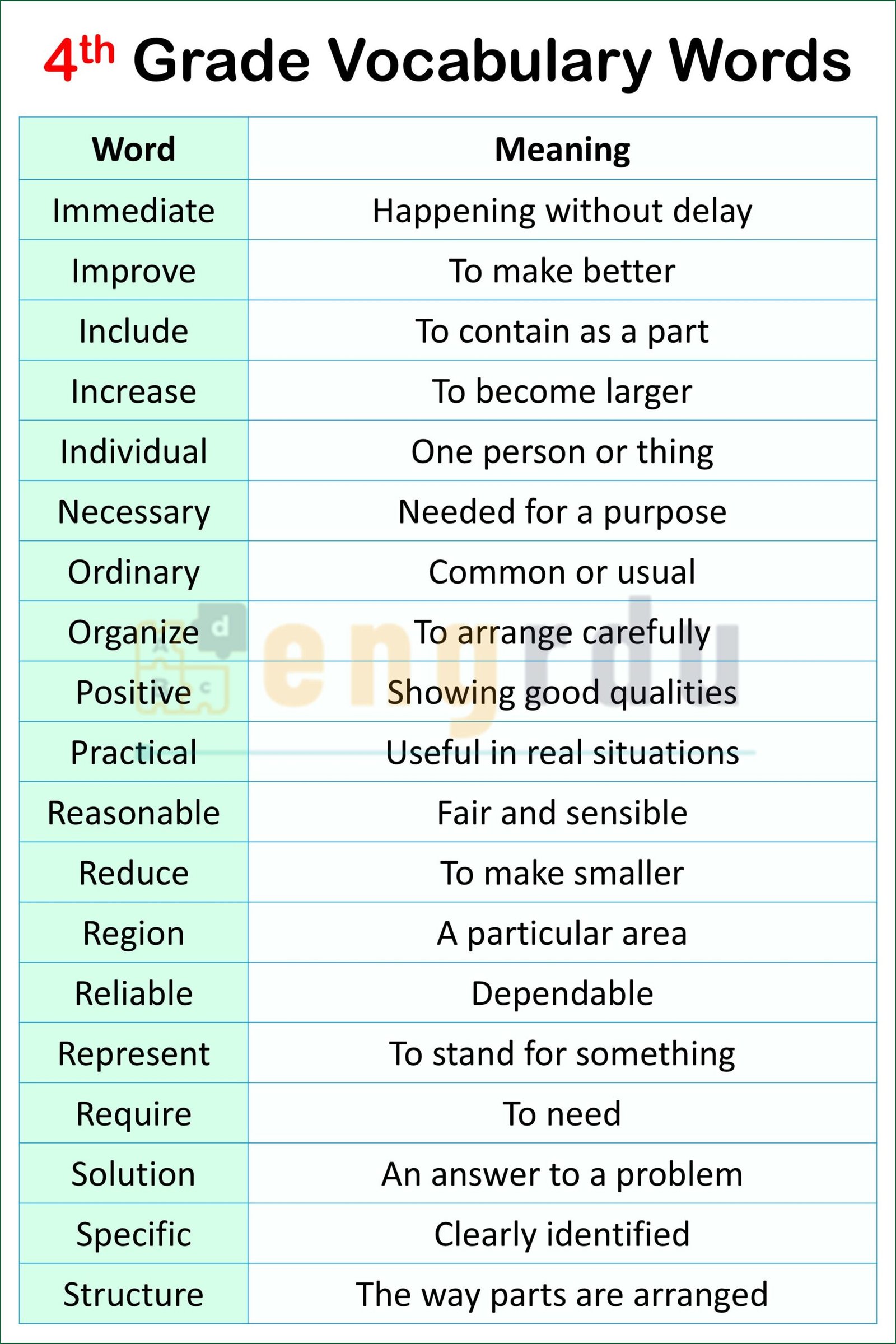
4th Grader Vocabulary with Meanings and PDF
4th Grade Vocabulary for Time and Sequence
These words help children organize events when speaking and writing.
- Previously – Before the present time or before another event.
Example: “We had previously visited that museum.” - Meanwhile – During the same period of time.
Example: “I cooked dinner while my brother, meanwhile, set the table.” - Eventually – After some time or after several events.
Example: “Eventually, we found the missing book.” - Immediately – At once or without delay.
Example: “The students immediately followed the teacher.” - Recently – Not long ago.
Example: “I recently started reading this book.” - Suddenly – In an unexpected and quick way.
Example: “Suddenly, the lights went out.” - Afterward – After something else has happened.
Example: “We went home afterward.” - Beforehand – Before an event or activity.
Example: “Pack your bag beforehand.”
Words That Explain Cause and Effect
Understanding cause and effect helps fourth graders explain why things happen.
- Cause – Something that makes another thing happen.
Example: “Heavy rain was the cause of the flooding.” - Effect – A result produced by an action or event.
Example: “One effect of exercise is that it makes the body stronger.” - Reason – An explanation for why something happens or is done.
Example: “What is the reason for your decision?” - Result – Something that happens because of an action or event.
Example: “The result of the test was surprising.” - Because – Used to give a reason.
Example: “We stayed inside because it was raining.” - Therefore – For that reason.
Example: “The road was closed; therefore, we took another route.” - Since – Because something is true or has happened.
Example: “Since it was late, we went home.” - Consequently – As a result of something.
Example: “He forgot his umbrella; consequently, he got wet.”
Word Pairs That Often Cause Confusion
Some English words look or sound alike but have different meanings.
- Advice / Advise – Advice is a suggestion; advise means to give a suggestion.
- Accept / Except – Accept means to receive or agree; except means not including.
- Affect / Effect – Affect usually means to influence; effect usually means a result.
- Quiet / Quite – Quiet means making little noise; quite means fairly or very.
- Lose / Loose – Lose means to misplace or fail to win; loose means not tight.
Synonyms to Expand a Fourth Grader’s Word Choice
Learning synonyms helps students avoid repeating the same basic word.
- Happy / Joyful – Feeling great pleasure or happiness.
Example: “The joyful children played in the garden.” - Angry / Furious – Feeling very strong anger.
Example: “He was furious when his bike was damaged.” - Small / Tiny – Very little in size.
Example: “A tiny bird sat on the branch.” - Smart / Intelligent – Good at learning and understanding things.
Example: “She is an intelligent student.” - Fast / Rapid – Moving or happening quickly.
Example: “The rapid movement surprised everyone.” - Brave / Courageous – Willing to face fear or difficulty.
Example: “The courageous child helped the injured bird.” - Begin / Commence – To start.
Example: “The class will commence at nine.” - Help / Assist – To make something easier for someone.
Example: “Can you assist me with this assignment?”
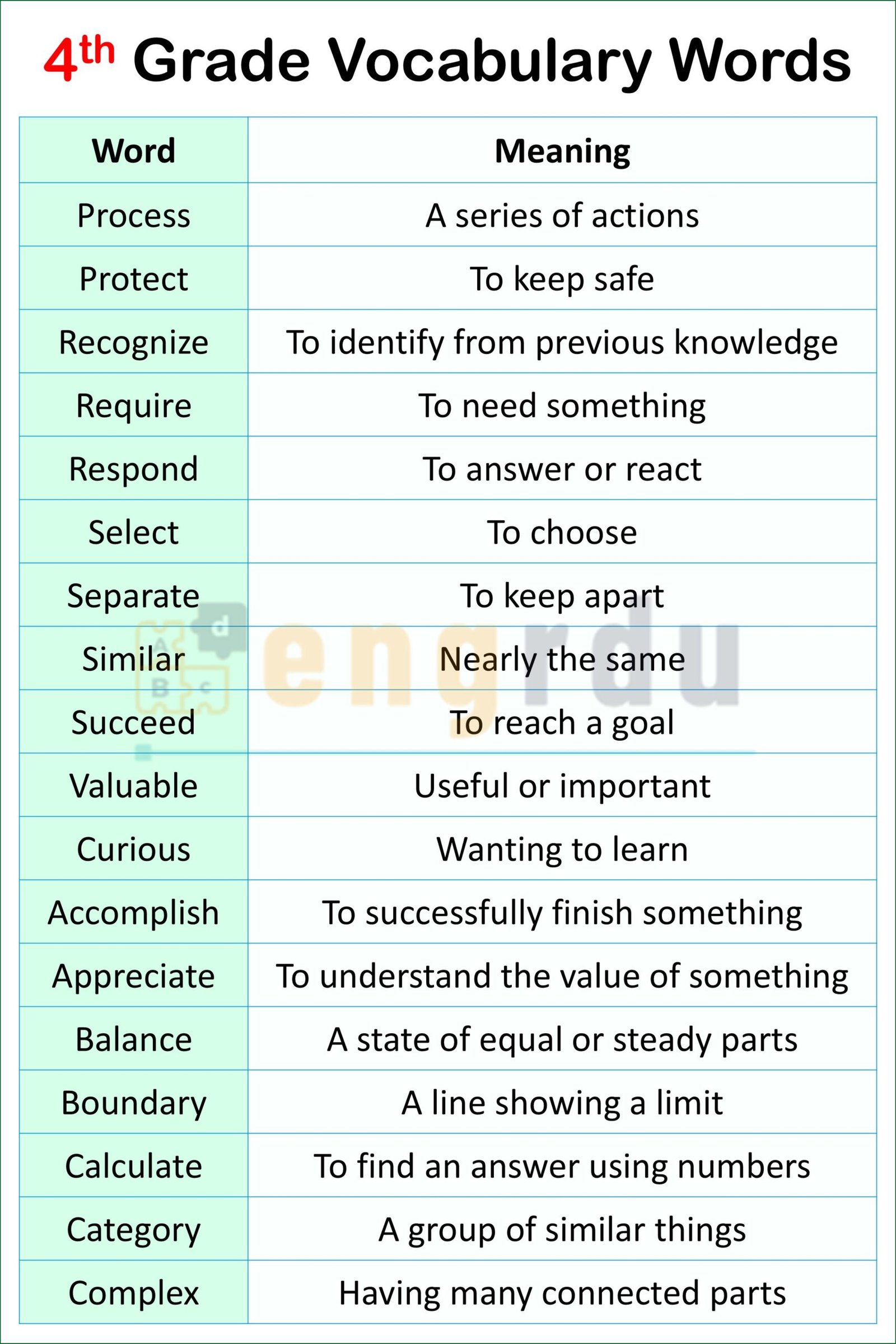
Vocabulary Words for Fourth Grade
Antonyms Every Fourth Grader Can Practice
Opposite words help students understand meaning through comparison.
- Ancient / Modern – Very old versus relating to the present or recent times.
Example: “The museum contains both ancient and modern objects.” - Arrive / Depart – To reach a place versus to leave it.
Example: “The train will arrive at noon and depart later.” - Expand / Shrink – To become larger versus become smaller.
Example: “A balloon can expand and shrink.” - Generous / Selfish – Willing to share versus unwilling to share.
Example: “A generous person thinks about others.” - Increase / Decrease – To become greater versus become smaller.
Example: “The temperature may increase during the afternoon.” - Permanent / Temporary – Lasting for a long time versus lasting for a short time.
Example: “The sign is temporary, not permanent.” - Success / Failure – A desired result versus an unsuccessful result.
Example: “Practice can turn failure into success.” - Visible / Invisible – Able to be seen versus unable to be seen.
Example: “The moon was visible through the clouds.”
A Fourth-Grade Vocabulary Mini Test
Choose the word that best completes each sentence.
Words: accurate, habitat, determined, evidence, conserve, destination, examine, generous, conflict, predict
- The forest is the tiger’s natural ______.
- We should ______ water when possible.
- The scientist will ______ the plant carefully.
- The students used ______ from the story to support their answers.
- Our final ______ was a beautiful mountain village.
- The teacher checked whether the answer was ______.
- The two characters had a ______ about the missing treasure.
- Can you ______ what will happen next?
- My ______ friend gave me half of her sandwich.
- She was ______ to finish the difficult project.
Answer Key
- habitat
- conserve
- examine
- evidence
- destination
- accurate
- conflict
- predict
- generous
- determined
Turn Vocabulary into Everyday English
A child is more likely to remember a word when it becomes part of a conversation.
For example, instead of only memorizing cautious, use it while discussing an everyday situation:
Parent: “Why are you walking slowly?”
Child: “Because the floor is wet, so I am being cautious.”
Another example uses consider:
Teacher: “Which book do you want to borrow?”
Student: “I need to consider both books before I choose one.”
Try asking children questions such as:
- “What would you investigate if you were a scientist?”
- “What makes someone reliable?”
- “What can we do to conserve water?”
- “Can you describe an unexpected event?”
- “What is one challenge you have overcome?”
These questions encourage children to use vocabulary as part of natural communication, not just as memorized definitions.
How to Build a Strong Grade 4 Vocabulary
A fourth grader does not need to memorize every unfamiliar word at once. Regular exposure and meaningful practice are more useful.
Try the 5-step word routine
1. Meet the word
Find the word in a book, lesson, conversation, or activity.
2. Understand the meaning
Explain it using language the child already understands.
3. See it in context
Read an example sentence and notice how the word works.
4. Use it aloud
Ask the child to make a sentence about something familiar.
5. Use it again later
Review the word during another conversation or writing activity.
For example, after learning abundant, a student might say:
“There were abundant flowers in the garden after the rain.”
This connects the new word with something the child can picture.
Why Grade 4 Vocabulary Matters
Vocabulary development at this stage supports more than English class. Students need to understand instructions and texts in science, mathematics, social studies, reading, and writing.
A child who understands words such as compare, evidence, result, observe, and conclusion can follow classroom tasks more easily.
Vocabulary also supports writing. Instead of writing:
“The dog went near the boy.”
a student can write:
“The cautious dog slowly approached the boy.”
The second sentence communicates a much clearer picture.
FAQs About 4th Graders Students
What should a fourth grader be able to do with vocabulary?
A fourth grader should understand unfamiliar words from context, explain common word meanings, recognize relationships between words, and use new vocabulary in speaking and writing.
What are some advanced words for Grade 4?
Useful higher-level Grade 4 words include accurate, abundant, cautious, determine, efficient, examine, evidence, reliable, significant, and investigate.
How can I make Grade 4 vocabulary easier to remember?
Connect each word with a picture, situation, story, question, or personal experience, then reuse it in conversation and writing.
Why do fourth graders need academic vocabulary?
Academic vocabulary helps students understand classroom directions and communicate ideas clearly across subjects such as science, reading, mathematics, and social studies.
What is the difference between vocabulary and spelling?
Vocabulary concerns knowing and using words and their meanings, while spelling concerns writing those words correctly.
Can fourth graders learn multiple meanings of words?
Yes. Learning multiple meanings is useful because many English words change meaning depending on the sentence and context.
What is the best way to teach difficult Grade 4 words?
Introduce difficult words in context, explain them with familiar language, provide examples, and let students use them repeatedly in meaningful situations.
How can vocabulary improve fourth-grade writing?
A wider vocabulary gives students more precise choices, allowing them to describe actions, feelings, characters, places, and ideas without repeating the same basic words.
Conclusion
4th Grade Vocabulary Words help students move toward more precise and academic English. At this stage, learners can begin using words such as accurate, cautious, determine, examine, evidence, reliable, investigate, abundant, and courageous in addition to familiar everyday vocabulary.
The most effective vocabulary practice connects each word with meaning, context, conversation, reading, and writing. When children repeatedly use new words to explain their own thoughts and experiences, those words become part of their working vocabulary and prepare them for the more advanced language they will encounter in Grades 5 and beyond.
Explore More Vocabulary By Level
- 10th Grade Words with Meanings with PDF
- 600+ 9th Grade Vocabulary Words with PDF
- 500+ 8th Grade Vocabulary Words with PDF
- 700+ 7th Grade Vocabulary Words with PDF
- 500+ 6th Grade Vocabulary Words with PDF
- 300+ 5th Grade Vocabulary Words with PDF
- 250+ 3rd Grade Vocabulary Words with PDF
- 2nd Grade Vocabulary Words with with PDF
- Vocabulary Words for 1st Grade with PDF