In this blog post, you will learn about compound nouns and how they work in everyday English. A compound noun is made when two or more words join together to form one new meaning, such as toothbrush, bus stop, or mother-in-law. These words appear in conversations, books, exams, and the workplace. When you understand compound nouns, you improve your vocabulary, spelling, and sentence building. You also speak more naturally and understand spoken English more easily. Keep reading to discover how to recognise, use, and master compound nouns with confidence.
Compound Nouns Definition and Examples
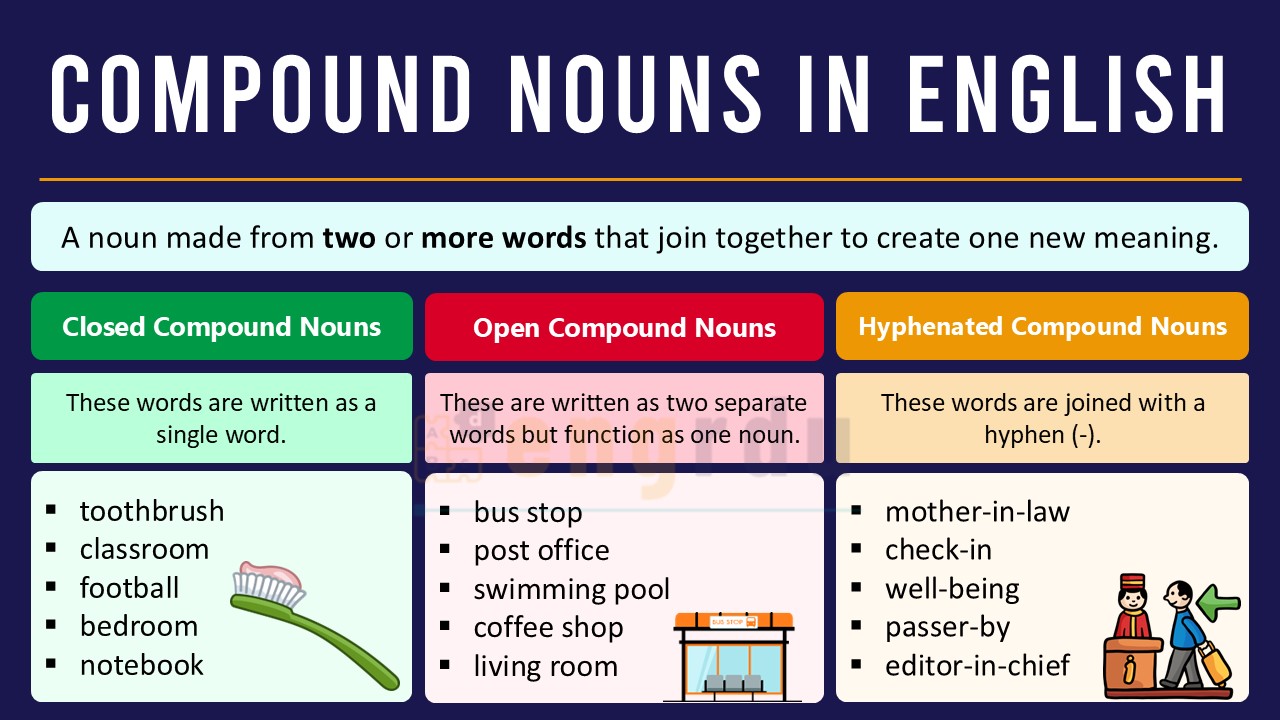
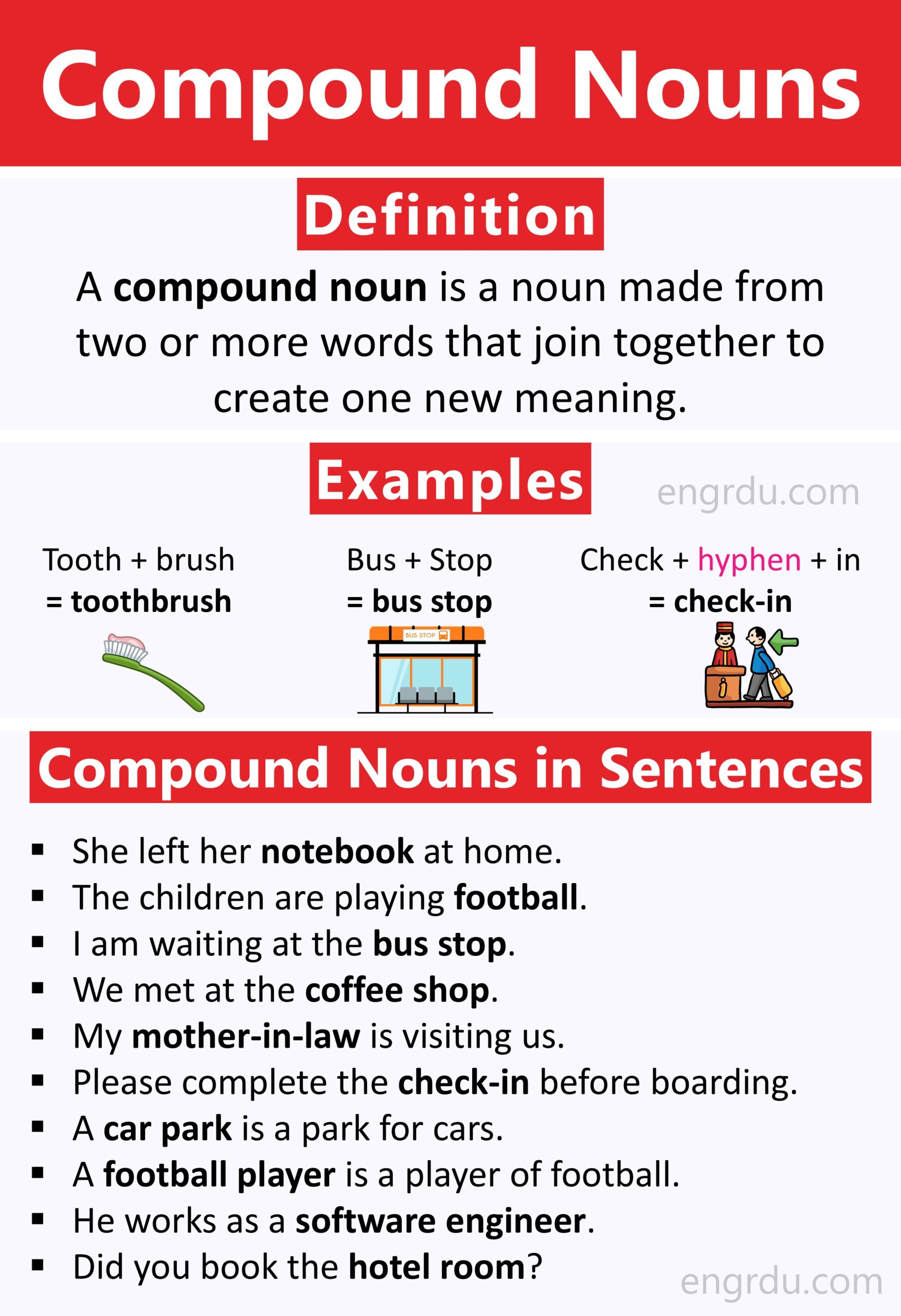
A compound noun is a noun made from two or more words that join together to create one new meaning.
When we combine words, the meaning often changes.
- Tooth + brush = toothbrush (a brush for cleaning teeth)
- Rain + coat = raincoat (a coat worn in rain)
- Bus + stop = bus stop (a place where buses stop)
The new word acts as one noun. It can be a person, place, thing, or idea.
Compound nouns are very common in British English and other varieties of English used around the world. They appear in daily speech, academic writing, and professional communication.
Types of Compound Nouns
Compound nouns can appear in three main forms. The meaning is similar, but the spelling format changes.
1. Closed (One Word)
These words are written as a single word.
Examples:
- toothbrush
- classroom
- football
- bedroom
- notebook
Example sentences:
- She left her notebook at home.
- The children are playing football.
2. Open (Two Separate Words)
These are written as two separate words but function as one noun.
Examples:
- bus stop
- post office
- swimming pool
- coffee shop
- living room
Example sentences:
- I am waiting at the bus stop.
- We met at the coffee shop.
3. Hyphenated (With a Hyphen)
These words are joined with a hyphen (-).
Examples:
- mother-in-law
- check-in
- well-being
- passer-by
- editor-in-chief
Example sentences:
- My mother-in-law is visiting us.
- Please complete the check-in before boarding.
Spelling can sometimes change over time. For example, some words start with a hyphen and later become closed compounds.
Rules and Usage of Compound Nouns
Let us look at the main rules step by step.
1: Most Common Structure
The most common pattern is:
Noun + Noun
Examples:
- school bag
- football player
- car park
- website
The first noun usually describes the second noun.
A car park is a park for cars.
A football player is a player of football.
2: Other Word Combinations
Compound nouns can also follow other patterns:
Adjective + Noun
- blackboard
- greenhouse
- full moon
Verb + Noun
- washing machine
- swimming pool
- driving licence
Noun + Verb
- sunrise
- rainfall
- haircut
3: Plural Forms
This part can be confusing for learners.
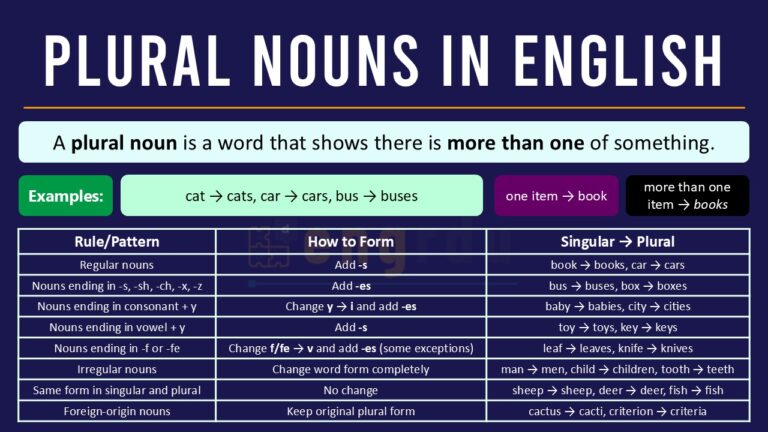
Usually, we make the main word plural.
- toothbrush → toothbrushes
- bus stop → bus stops
- school bag → school bags
But in some hyphenated compounds, the plural form changes in the middle:
- mother-in-law → mothers-in-law
- passer-by → passers-by
Tip: Ask yourself, “Which word is the main noun?” Make that word plural.
4: Stress in Pronunciation
In spoken English, compound nouns often have stress on the first word.
- GREENhouse (a glass building for plants)
- BLACKboard
But when the meaning changes, stress can change:
- green HOUSE (a house that is green in colour)
Pronunciation helps listeners understand meaning.
List of Compound Nouns in English
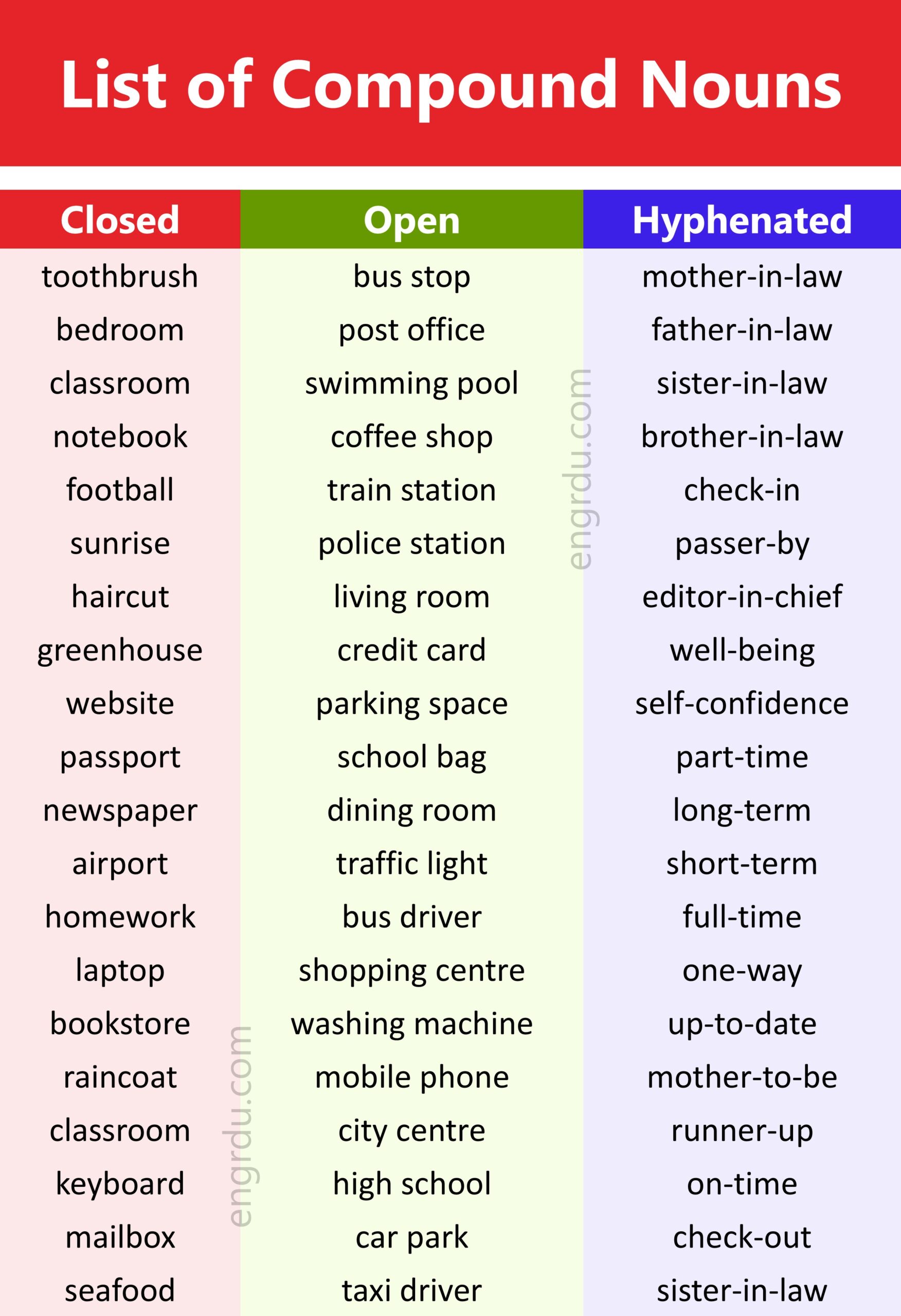
| Closed | Open | Hyphenated |
|---|---|---|
| toothbrush | bus stop | mother-in-law |
| bedroom | post office | father-in-law |
| classroom | swimming pool | sister-in-law |
| notebook | coffee shop | brother-in-law |
| football | train station | check-in |
| sunrise | police station | passer-by |
| haircut | living room | editor-in-chief |
| greenhouse | credit card | well-being |
| website | parking space | self-confidence |
| passport | school bag | part-time |
| newspaper | dining room | long-term |
| airport | traffic light | short-term |
| homework | bus driver | full-time |
| laptop | shopping centre | one-way |
| bookstore | washing machine | up-to-date |
| raincoat | mobile phone | mother-to-be |
| classroom | city centre | runner-up |
| keyboard | high school | on-time |
| mailbox | car park | check-out |
| seafood | taxi driver | sister-in-law |
Examples of Compound Nouns in Sentences
Here are different sentence types to help you understand usage clearly.
Affirmative Sentences
- She bought a new laptop bag.
- The train station is near my house.
- He works as a software engineer.
- We visited a famous bookshop in London.
Negative Sentences
- I do not have a driving licence.
- There is no parking space here.
- She did not bring her swimming costume.
Question Sentences
- Where is the nearest police station?
- Did you book the hotel room?
- Is this your credit card?
These examples show how compound nouns work naturally in everyday communication.
Common Mistakes Learners Make
Mistake 1: Wrong Spacing
Incorrect: tooth brush
Correct: toothbrush
Incorrect: bed room
Correct: bedroom
Always check a dictionary if you are unsure.
Mistake 2: Wrong Plural Form
Incorrect: mother-in-laws
Correct: mothers-in-law
Incorrect: passers-bys
Correct: passers-by
Remember to pluralise the main noun.
Mistake 3: Confusing Meaning
greenhouse ≠ green house
A greenhouse is a glass building for plants.
A green house is simply a house painted green.
Context and pronunciation matter.
Mistake 4: Adding Unnecessary Apostrophes
Incorrect: apple’s tree
Correct: apple tree
Compound nouns do not need apostrophes unless showing possession.
Compound Nouns vs Other Word Forms
Learners often confuse compound nouns with adjective + noun phrases.
| Feature | Compound Noun | Adjective + Noun |
|---|---|---|
| Meaning | New single meaning | Describes noun |
| Example | blackboard | black board |
| Stress | First word stressed | Second word stressed |
| Writing | May be one word | Usually two words |
Example:
- A blackboard is used in classrooms.
- A black board is simply a board that is black.
Understanding this difference improves both writing and speaking skills.
Tips for Learners
Here are practical strategies to master compound nouns:
- Read regularly – Notice compound nouns in books, newspapers, and websites.
- Keep a vocabulary notebook – Write new compound nouns with example sentences.
- Check spelling carefully – Use a trusted dictionary when unsure.
- Practise pronunciation – Focus on word stress.
- Learn in context – Do not memorise lists only. Use the words in real conversations.
- Group by theme – For example, travel (airport, passport, suitcase), school (classroom, homework, timetable).
Learning compound nouns step by step builds strong vocabulary and confidence.
Why Compound Nouns Are Important
Compound nouns are everywhere in English. They help us:
- Speak more naturally
- Write clearly and professionally
- Understand academic and workplace English
- Improve reading speed
- Expand vocabulary quickly
In business English, technology, travel, education, and everyday communication, compound nouns appear constantly.
For example:
- customer service
- data protection
- online banking
- social media
- climate change
Without understanding compound nouns, communication becomes difficult.
Conclusion
Compound nouns are words made by joining two or more words to create a new meaning. They can be closed, open, or hyphenated. Understanding their structure, spelling, and plural forms helps you avoid common mistakes. They improve both spoken and written English.
Start noticing compound nouns around you today. Practise using them in sentences. The more you use them, the more natural your English will become.
Read More