


A noun is a word that names a person, place, thing, or idea, such as teacher, city, book, or freedom. In this Grammar lesson, learning nouns helps you speak, write, and understand English more clearly. Using them correctly makes your sentences complete and meaningful. In this blog post, you will explore the definition, types, uses, and examples of nouns to practice and use confidently in everyday English.
Noun Definition and Examples
A noun is a word that names:
- A person
- A place
- A thing
- An animal
- An idea or feeling
In short, if you can name it, it is probably a noun.
Examples:
- Person: teacher, child, doctor
- Place: school, park, London
- Thing: book, chair, phone
- Animal: dog, cat, bird
- Idea: happiness, freedom, honesty
Nouns help us talk about the world around us and the ideas inside our minds.

Noun and Their Types Chart
Types of Nouns
English nouns are grouped into different types. Each type has a special use. Understanding these types makes your English clearer and more accurate.
Common Nouns
Common nouns name general people, places, or things. They do not start with a capital letter.
Examples:
- boy, girl
- city, country
- car, house
Sentence:
- The boy is playing in the park.
Proper Nouns
Proper nouns name specific people, places, or things. They always start with a capital letter.
Examples:
- Alex, Maria
- Paris, United State
- Monday, January
Sentence:
- Maria lives in Paris.
Concrete Nouns
Concrete nouns name things you can see, touch, hear, smell, or taste.
Examples:
- apple, music, table, rain
Sentence:
- The apple is fresh.
Abstract Nouns
Abstract nouns name ideas, feelings, or qualities. You cannot touch or see them.
Examples:
- love, fear, honesty, beauty
Sentence:
- Honesty is important in life.
Countable Nouns
Countable nouns can be counted. They have singular and plural forms.
Examples:
- one book, two books
- a chair, many chairs
Sentence:
- I bought three books.
Uncountable Nouns
Uncountable nouns cannot be counted directly. They usually do not have plural forms.
Examples:
- water, rice, sugar, information
Sentence:
- I need some water.
Collective Nouns
Collective nouns name a group of people, animals, or things.
Examples:
- team, family, class, herd
Sentence:
- The team is ready for the match.

Types of Nouns
Rules/Usage of Nouns
Here are some important rules to help you use nouns correctly.
Rule 1: Capital Letters
- Capitalise proper nouns only.
- Do not capitalise common nouns.
Correct: She studies in Oxford University.
Incorrect: She studies in university.
Rule 2: Singular and Plural Forms
Most nouns add -s or -es in plural form.
Examples:
- cat → cats
- bus → buses
Some nouns change spelling:
- child → children
- man → men
Rule 3: Articles with Nouns
Articles often come before nouns.
- a / an for singular countable nouns
- the for specific nouns
Examples:
- I have a pen.
- The pen is blue.
Rule 4: Uncountable Nouns Need Quantifiers
Do not use numbers directly with uncountable nouns.
Correct: a glass of water
Incorrect: two waters
Rule 5: Nouns as Subjects and Objects
A noun can be the subject or object in a sentence.
Subject:
- The teacher is speaking.
Object:
- I like this book.
Common Mistakes with Nouns
Mistake 1: Capitalising Common Nouns
Incorrect: I like my School.
Correct: I like my school.
Mistake 2: Using Plural with Uncountable Nouns
Incorrect: She gave me many advices.
Correct: She gave me some advice.
Mistake 3: Forgetting Articles
Incorrect: I bought book yesterday.
Correct: I bought a book yesterday.
Mistake 4: Mixing Abstract and Concrete Meaning
Incorrect: She has many happiness.
Correct: She has much happiness.
List of Nouns in English
| teacher | city | apple | happiness |
| student | park | book | honesty |
| school | shop | chair | freedom |
| friend | table | car | love |
| family | bag | dog | idea |
| mother | pen | cat | courage |
| father | phone | music | patience |
| doctor | water | food | knowledge |
| class | holiday | market | friendship |
| team | child | garden | beauty |
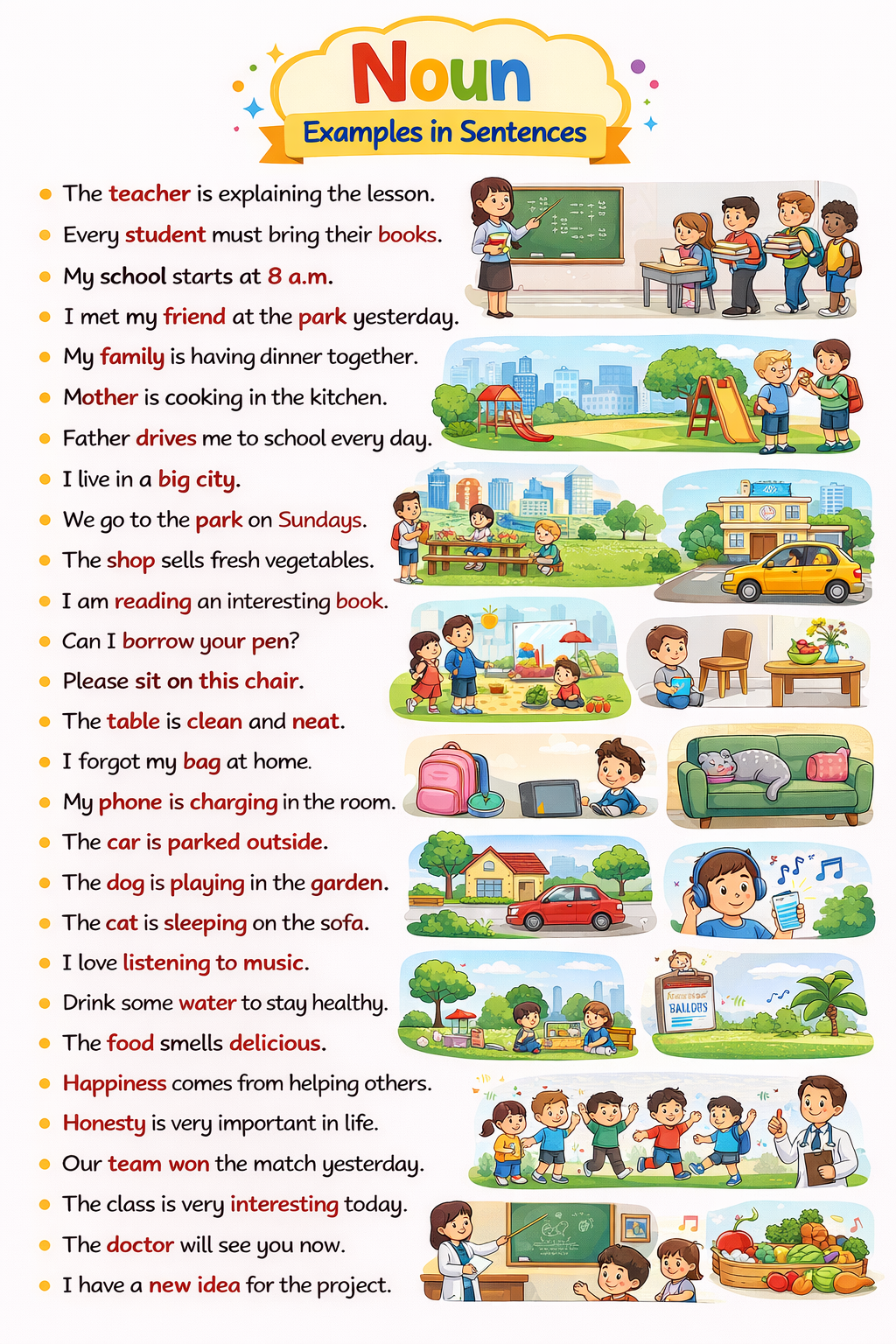
Noun in a Sentence
Here’s the list of noun examples in sentences for everyday conversation:
| Noun | Example Sentence |
|---|---|
| teacher | The teacher is explaining the lesson. |
| student | Every student must bring their books. |
| school | My school starts at 8 a.m. |
| friend | I met my friend at the park yesterday. |
| family | My family is having dinner together. |
| mother | Mother is cooking in the kitchen. |
| father | Father drives me to school every day. |
| city | I live in a big city. |
| park | We go to the park on Sundays. |
| shop | The shop sells fresh vegetables. |
| book | I am reading an interesting book. |
| pen | Can I borrow your pen? |
| chair | Please sit on this chair. |
| table | The table is clean and neat. |
| bag | I forgot my bag at home. |
| phone | My phone is charging in the room. |
| car | The car is parked outside. |
| dog | The dog is playing in the garden. |
| cat | The cat is sleeping on the sofa. |
| music | I love listening to music. |
| water | Drink some water to stay healthy. |
| food | The food smells delicious. |
| happiness | Happiness comes from helping others. |
| honesty | Honesty is very important in life. |
| team | Our team won the match yesterday. |
| class | The class is very interesting today. |
| holiday | We are planning a holiday next month. |
| market | I went to the market to buy fruits. |
| doctor | The doctor will see you now. |
| idea | I have a new idea for the project. |
Noun in a Sentence
Countable vs Uncountable Nouns
| Feature | Countable Nouns | Uncountable Nouns |
|---|---|---|
| Can be counted | Yes | No |
| Singular & plural | Yes | No plural form |
| Use numbers | Yes | No |
| Examples | books, apples | water, sugar |
Tips for Learners
- Learn nouns with example sentences.
- Group new nouns by type.
- Practise using nouns in daily speech.
- Read short stories and underline nouns.
- Use a learner’s dictionary for clarity.
- Write simple sentences using new nouns.
Conclusion
Nouns are the foundation of English grammar. They help us name people, places, things, and ideas. By learning noun types, rules, and common mistakes, you can improve both spoken and written English. Practise regularly and notice nouns in real-life situations. With time and practice, using nouns correctly will become natural and easy.
Frequently Asked Questions
What is a noun in simple words?
A noun is a word that names a person, place, thing, animal, or idea. Words like teacher, city, book, dog, and happiness are all nouns.
What are the main types of nouns in English?
The main types of nouns are common nouns, proper nouns, concrete nouns, abstract nouns, countable nouns, uncountable nouns, and collective nouns.
How do countable and uncountable nouns differ?
Countable nouns can be counted and have singular and plural forms, such as one book and two books. Uncountable nouns cannot be counted directly and usually have no plural form, such as water, rice, or information.
Why do proper nouns start with capital letters?
Proper nouns start with capital letters because they name specific people, places, days, or organisations, such as London, Maria, or Monday.
Can a noun be both a subject and an object in a sentence?
Yes, a noun can be a subject or an object. For example, in “The teacher explains the lesson,” teacher is the subject and lesson is the object.
What are common mistakes learners make with nouns?
Common mistakes include capitalising common nouns, using plural forms for uncountable nouns, and forgetting articles like a, an, or the before countable nouns.
Read More




Leave a Comment