
Understanding modal verbs for obligation helps you express duties, responsibilities, and rules clearly in English. In this Grammar lesson, learning these modals improves your speaking, writing, and reading skills. Using them correctly makes your sentences precise when talking about what must, should, or have to be done. In this blog post, you will explore the meanings and examples of modal verbs for obligation to practice and use confidently in everyday English.
Modal Verbs for Obligation: Definition and Examples
Modal verbs for obligation are words that show rules, duties, or responsibilities. They tell us what is necessary, required, or expected.
Common modal verbs for obligation include:
- Must—strong obligation or rule.
- Have to—necessity, often based on external circumstances.
- Should/Ought to—advice or recommendation.
For example:
- “You must wear a seatbelt in the car.” (strong rule)
- “I have to finish my homework before dinner.” (necessity)
- “You should exercise regularly.” (advice)
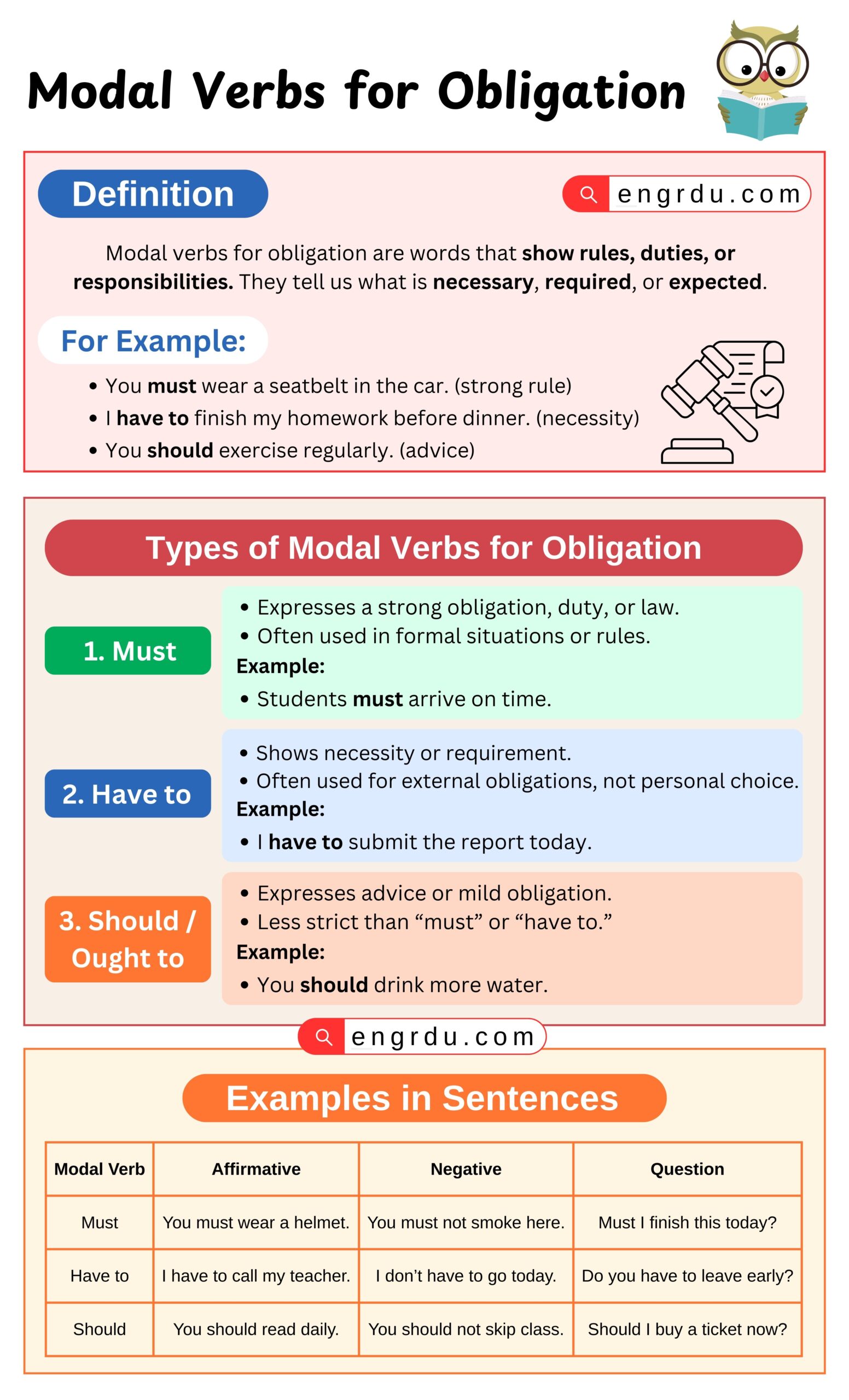
Modal Verbs for Obligation
Types of Modal Verbs for Obligation
1. Must
- Expresses a strong obligation, duty, or law.
- Often used in formal situations or rules.
Examples:
- Affirmative: “Students must arrive on time.”
- Negative: “You must not cheat in exams.”
- Question: “Must we wear uniforms every day?”
2. Have to
- Shows necessity or requirement.
- Often used for external obligations, not personal choice.
Examples:
- Affirmative: “I have to submit the report today.”
- Negative: “She doesn’t have to attend the meeting.”
- Question: “Do you have to work on weekends?”
3. Should / Ought to
- Expresses advice or mild obligation.
- Less strict than “must” or “have to.”
Examples:
- Affirmative: “You should drink more water.”
- Negative: “You should not skip breakfast.”
- Question: “Should I call him now?”
Rules of Modal Verbs for Obligation
1. Position in a Sentence
Modal verbs come before the main verb.
- Correct: “You must wear a helmet.”
- Incorrect: “You wear must a helmet.”
2. No “s” for third person
Modals never change for he/she/it.
- Correct: “He must study hard.”
- Incorrect: “He musts study hard.”
3. Negative Form
“Must not” or “should not” indicates prohibition or advice against.
- “You must not park here.”
- “You should not stay up too late.”
4. Question Form
Formed by inverting modal + subject.
- “Must I complete this today?”
- “Should we leave now?”
5. Difference between “must” and “have to”
- Must: internal obligation or speaker’s rule.
- Have to: external obligation (law, boss, school).
Affirmative, Negative, and Questions Sentences
| Modal Verb | Affirmative | Negative | Question |
|---|---|---|---|
| Must | You must wear a helmet. | You must not smoke here. | Must I finish this today? |
| Have to | I have to call my teacher. | I don’t have to go today. | Do you have to leave early? |
| Should | You should read daily. | You should not skip class. | Should I buy a ticket now? |
Common Mistakes
Using “must” instead of “have to” for external rules
- ❌ “I must pay the electricity bill.”
- ✅ “I have to pay the electricity bill.”
Adding “s” for third person
- ❌ “He musts finish homework.”
- ✅ “He must finish homework.”
Confusing “must” and “should”
- ❌ “You must exercise to stay healthy.” (too strong for advice)
- ✅ “You should exercise to stay healthy.”
Wrong word order in questions
- ❌ “You must go today?”
- ✅ “Must you go today?”
Comparisons
| Feature | Must | Have to | Should / Ought to |
|---|---|---|---|
| Strength | Strong obligation | Necessary due to external factors | Advice / mild obligation |
| Formality | Formal | Neutral | Neutral / informal |
| Negative | Must not (prohibition) | Don’t/doesn’t have to (no necessity) | Should not (advice against) |
| Example | “You must wear a helmet.” | “I have to finish work today.” | “You should sleep early.” |
Tips for Learners
- Remember: Modals never add “s”.
- Must = internal strong rule, Have to = external necessity.
- Use should for advice, not rules.
- Practice using affirmative, negative, and question forms.
- Read daily signs, rules, and instructions in English—they often use modals.
- Speak or write small sentences with modals to improve fluency.
Conclusion
Modal verbs for obligation help us talk about rules, duties, and advice in English. The main verbs are must, have to, and should/ought to. Each has a slightly different meaning and level of strictness. Remember their correct forms, positions in sentences, and negative rules. Practice with real-life examples like school, work, and daily routines. By using these modals correctly, your English becomes clearer, more natural, and easier for others to understand.
Frequently Asked Questions
What are the 5 examples of obligation?
Examples of obligation using modal verbs are: 1) You must wear a seatbelt. 2) I have to finish my homework. 3) You should eat healthy food. 4) Employees must submit reports on time. 5) Students have to attend classes regularly.
What is the verb form of obligation?
The verb forms of obligation are modal verbs like must, have to, should, and ought to, which show duty, necessity, or responsibility.
Which modal is used for immediate obligations?
The modal must is commonly used for immediate or strong obligations that require action right away.
What is the difference between must and have to?
Must expresses a strong internal obligation or rule, while have to shows an external requirement imposed by circumstances, laws, or other people.
Can should be used for obligations?
Yes, should expresses a mild obligation or advice. It is less strict than must or have to and is often used for recommendations.
How do you form negative sentences with obligation modals?
Use must not for prohibition, don’t/doesn’t have to for absence of necessity, and should not for advice against something. Example: “You must not cheat,” “I don’t have to go,” “You should not skip breakfast.”
How can I use obligation modals in questions?
Form questions by inverting the modal verb and the subject: “Must I finish this today?” “Do you have to work on weekends?” “Should we leave now?”
Read More


Leave a Comment