

In this blog post, you will learn the present perfect tense in English, including its definition, structure, and example sentences. Knowing the present perfect tense helps you understand how to talk about actions that started in the past and continue to the present or have relevance now. It also improves your speaking and writing skills because you can form sentences correctly in real-life conversations and writing. By studying the structure and examples, you can practice making positive, negative, and question sentences confidently. Learning the present perfect tense will make your English grammar stronger and easier to use in daily life.
We use the present perfect tense to talk about:
- Recent actions
- Experiences
- Things done in life
- Unfinished time (today, this week, etc.)
This article will help you learn how to use has/have + past participle (3rd form) to make correct sentences in the present perfect tense. In this blog post, we will explain the structure and simple rules so you can start using this tense in your daily English speaking and writing. This lesson is perfect for beginners who want to improve their grammar and build confidence in using correct sentence forms.
What is the Present Perfect Tense?
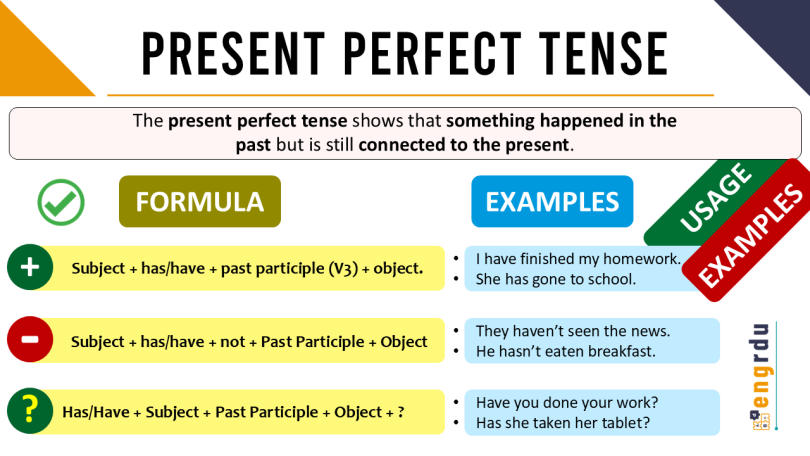
The present perfect tense shows that something happened in the past but is still connected to the present.
We use present perfect tense to:
Talk about past actions that have results now
→ I have lost my key. (I can’t open the door now)
Talk about life experiences
→ She has visited London.
Talk about recent actions
→ They have just arrived.
Talk about unfinished time
→ I have eaten two times today.
Helping Verb Rules:
| Subject | Use |
|---|---|
| I, you, we, they | have |
| He, she, it, any singular noun | has |

Present Perfect Tense in English
Structure of Present Perfect Tense
We use:
- Subject + has/have + Past Participle (3rd form of verb) + Object
Positive Sentences
Formula:
- Subject + has/have + past participle (V3) + object.
| Subject | Helping Verb | Past Participle (V3) | Object | Sentence |
|---|---|---|---|---|
| I | have | eaten | breakfast | I have eaten breakfast. |
| He | has | finished | his homework | He has finished his homework. |
| They | have | gone | to the market | They have gone to the market. |
| She | has | written | a letter | She has written a letter. |
| We | have | cleaned | the room | We have cleaned the room. |
Negative Sentences
Formula:
- Subject + has/have + not + Past Participle + Object
| Subject | Helping Verb | Past Participle (V3) | Object | Sentence |
|---|---|---|---|---|
| I | have not | seen | the movie | I have not seen the movie. |
| He | has not | finished | his homework | He has not finished his homework. |
| They | have not | visited | the zoo | They have not visited the zoo. |
| She | has not | written | the letter | She has not written the letter. |
| We | have not | cleaned | our room | We have not cleaned our room. |
Interrogative Sentences
Formula:
- Has/Have + Subject + Past Participle + Object + ?
| Helping Verb | Subject | Past Participle (V3) | Object | Sentence |
|---|---|---|---|---|
| Have | I | eaten | lunch | Have I eaten lunch? |
| Has | he | finished | his work | Has he finished his work? |
| Have | they | visited | the zoo | Have they visited the zoo? |
| Has | she | written | a letter | Has she written a letter? |
| Have | we | cleaned | the room | Have we cleaned the room? |

Structure of Present Perfect Tense
Usage of Present Perfect Tense
Use this tense when:
- The time is not exact → I have seen that movie.
- Talking about life experience → She has never flown in a plane.
- Talking about recent events → I have just finished lunch.
- Describing changes over time → He has grown taller.
Examples of Present Perfect Tense
Positive Sentences
- I have cleaned my room.
- She has made breakfast.
- They have started the project.
- He has traveled to Dubai.
- We have reached the station.
Negative Sentences
- I have not seen that movie.
- He has not called me yet.
- We have not completed the work.
- She has not met my parents.
- They have not gone to school today.
Interrogative Sentences (Questions)
- Have you done your homework?
- Has he finished the project?
- Have they called yet?
- Has she spoken to the teacher?
- Have we eaten anything today?
Time Words Used in Present Perfect Tense
| Time Word | Usage | Example Sentence |
|---|---|---|
| Just | A short time ago | I have just arrived. |
| Already | Before now | She has already eaten. |
| Yet | Until now (neg/question) | Have you finished yet? / I haven’t yet. |
| Ever | At any time (question) | Have you ever been there? |
| Never | Not at any time | I have never seen snow. |
| Since | Starting point in time | He has worked here since 2015. |
| For | Duration of time | They have lived here for 10 years. |
Tips to Remember
- Use “have” with I, you, we, they
- Use “has” with he, she, it
- Always use the 3rd form of the verb
- In questions, start with Has/Have
The present perfect tense connects the past to the present. It’s simple to learn if you remember the rules and practice with daily actions. Try to speak and write using has/have + past participle, and you will improve your grammar fast.
Read More


Leave a Comment