English has 12 tenses, and each tense helps you show time, action, and continuity in sentences. In this Grammar lesson, understanding all 12 tenses helps you speak, write, and read English more accurately. Using them correctly makes your communication clear and precise in any situation. In this blog post, you will learn all 12 tenses in the English language with a chart to practice and use them confidently in daily conversations.
What Are Tenses?
Tenses show the time of an action or situation. They help us know when something happens, how long it happens, or if it is finished or not.
English has three main times:
- Present
- Past
- Future
Each time has four forms, so there are 12 tenses in total.
Understanding English Tenses Simply
English tenses show time: past, present, or future.
Each time has four forms:
- Simple—facts, habits, routines
- Continuous—ongoing actions
- Perfect—completed actions
- Perfect Continuous—actions that started in the past and continue
Short rule:
- Simple = what happens regularly
- Continuous = what is happening now or in progress
- Perfect = what has happened before now or another time
- Perfect Continuous = what started earlier and is still happening
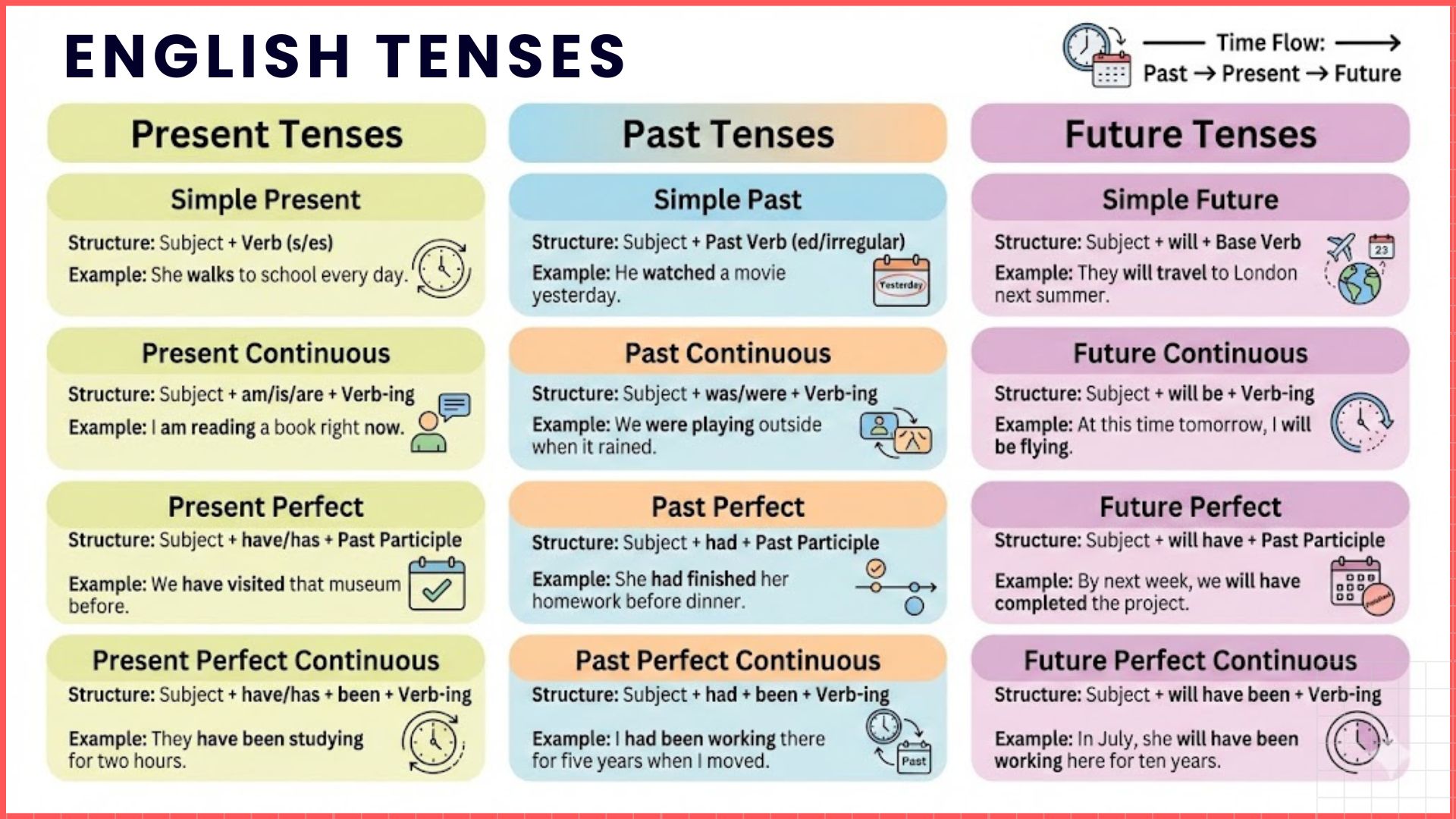
12 Tenses in the English Language
| Time | Simple | Continuous | Perfect | Perfect Continuous |
|---|---|---|---|---|
| Present | Present Simple | Present Continuous | Present Perfect | Present Perfect Continuous |
| Past | Past Simple | Past Continuous | Past Perfect | Past Perfect Continuous |
| Future | Future Simple | Future Continuous | Future Perfect | Future Perfect Continuous |
Present Tenses
1. Present Simple
Use: Habit, routine, general facts
Structure:
Subject + base verb
Example:
✔ I drink coffee every morning.
❌ I am drink coffee every morning.
Read More about: Present Simple Tense
2. Present Continuous
Use: Action happening now, temporary actions
Structure:
am / is / are + verb + ing
Example:
✔ She is studying for her exams.
❌ She studying for her exams.
You May Need to Learn about: Present Continuous
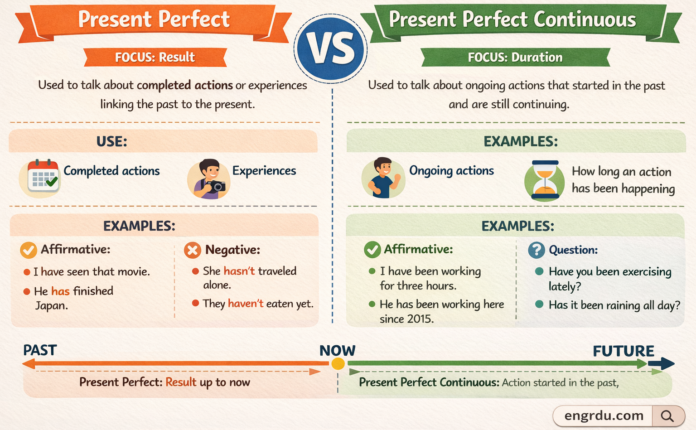
3. Present Perfect
Use: Completed action with connection to now
Structure:
has / have + past participle
Example:
✔ I have finished my homework.
❌ I have finish my homework.
Read More about: Present Perfect Tense
4. Present Perfect Continuous
Use: Action started in past and continues now
Structure:
has / have been + verb + ing
Example:
✔ I have been reading this book for two hours.
❌ I have reading this book for two hours.
Read More: Present Perfect Continuous Tense
Past Tenses
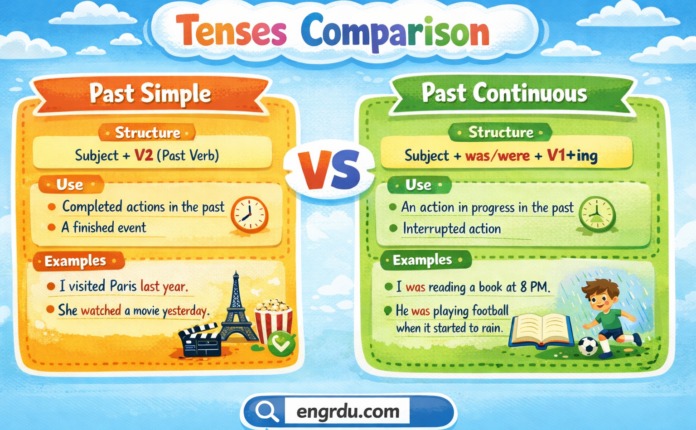
5. Past Simple
Use: Action completed in past
Structure:
verb (past form)
Example:
✔ They visited Paris last year.
❌ They visit Paris last year.
For more, read about: Past Simple Tense
6. Past Continuous
Use: Action ongoing in the past
Structure:
was / were + verb + ing
Example:
✔ I was watching TV when she called.
❌ I watched TV when she calling.
Read more about: Past Continuous Tense
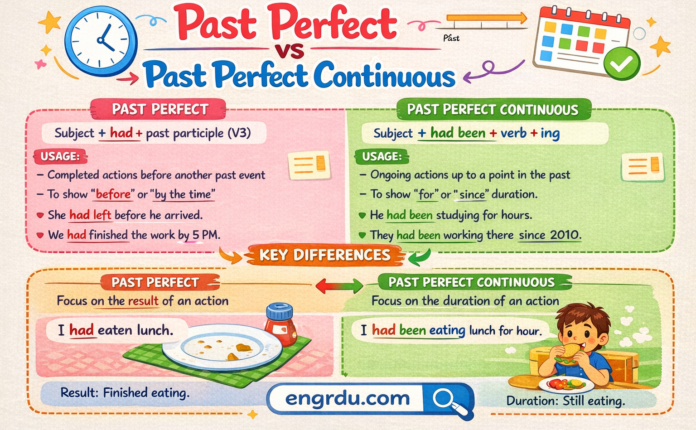
7. Past Perfect
Use: Action completed before another past action
Structure:
had + past participle
Example:
✔ I had finished my work before he arrived.
❌ I had finish my work before he arrived.
Simply explained about: Past Perfect Tense
8. Past Perfect Continuous
Use: Action started earlier in the past and continued to another past time
Structure:
had been + verb + ing
Example:
✔ I had been working for 3 hours before lunch.
❌ I had working for 3 hours before lunch.
Visit the attached link to read more about: Past Perfect Continuous Tense
Future Tenses
9. Future Simple
Use: Action that will happen
Structure:
will + base verb
Example:
✔ I will call you tomorrow.
❌ I will calling you tomorrow.
Read More about: Future Simple Tense
10. Future Continuous
Use: Action in progress at a future time
Structure:
will be + verb + ing
Example:
✔ I will be studying at 8 p.m.
❌ I will studying at 8 p.m.
Explore more about: Future Continuous Tense
11. Future Perfect
Use: Action completed before a specific future time
Structure:
will have + past participle
Example:
✔ I will have finished my project by Monday.
❌ I will have finish my project by Monday.
Read more in detail: Future Perfect Tense
12. Future Perfect Continuous
Use: Action ongoing until a future time
Structure:
will have been + verb + ing
Example:
✔ By next week, I will have been learning English for 2 years.
❌ By next week, I will have learning English for 2 years.
Read more about the Future Perfect Continuous Tense
12 Tenses Chart
| Time | Simple | Continuous | Perfect | Perfect Continuous |
|---|---|---|---|---|
| Present | I eat | I am eating | I have eaten | I have been eating |
| Past | I walked | I was walking | I had walked | I had been walking |
| Future | I will eat | I will be eating | I will have eaten | I will have been eating |
Common Mistakes Learners Make
Mistake 1: Wrong verb form
❌ She go to school yesterday
✅ She went to school yesterday
Mistake 2: Missing helping verbs
❌ I reading now
✅ I am reading now
Mistake 3: Mixing tenses
❌ I finished my work and go home
✅ I finished my work and went home
Easy Comparisons for Learners
Present Simple vs Present Continuous
Habit vs happening now
Past Simple vs Present Perfect
Finished time vs result now
Future Simple vs Future Continuous
Plan vs action in progress later
Usage of Tenses in Real Life
- Speaking: Present continuous for now, present simple for habits
- Writing: Perfect tenses for reports, emails, exams
- Exams: Look for time words: yesterday, now, tomorrow
- Global English: Clear tense usage improves communication worldwide
Tips for Learning English Tenses
- Learn one tense at a time.
- Focus on signal words (yesterday, now, tomorrow).
- Make short daily sentences.
- Practise speaking aloud.
- Revise regularly using charts.

Frequently Asked Questions
What are the 12 tenses in English?
They are Present, Past, and Future, each with Simple, Continuous, Perfect, and Perfect Continuous forms.
Which tense is easiest to use in daily life?
Present Simple, Past Simple, and Future Simple are the most common.
How can I remember all tenses?
Think of 3 times (present, past, future) and 4 forms (simple, continuous, perfect, perfect continuous).
Can I use simple instead of continuous?
Not always. Continuous shows ongoing action, simple shows habit or fact.
Why do learners mix up tenses?
Because English has many forms and similar verbs confuse learners.
How do perfect tenses work?
They show completed actions or actions connecting past to present.
How important are tenses for exams?
Very important. Tenses show correct time, clarity, and understanding in writing and speaking.
Read More