In this blog post, you will learn 100 advanced pronouns used in the English language. Knowing these pronouns helps you understand how to refer to people, things, and ideas accurately in complex sentences. It also improves your speaking and writing skills because you can construct sentences more clearly and professionally. By studying examples, you can remember how to use each pronoun correctly in different situations. Learning advanced pronouns will make your English grammar stronger, more precise, and easier to use in daily communication.
What Are Advanced Pronouns?
Advanced pronouns are special forms of pronouns used in formal writing, literature, academic work, and professional speech. They replace nouns but are more specific, formal, or precise than basic pronouns.
Example:
- Normal → This is for you.
- Advanced → This is for yourself.
Why Learn Advanced Pronouns?
- Makes writing formal and professional
- Adds clarity in meaning
- Improves communication in academic & business settings
- Helps in exams and advanced English tests
Types of Advanced Pronouns
| Type | Explanation | Example |
|---|---|---|
| Reflexive Pronouns | Show that the subject & object are the same person | He blamed himself. |
| Relative Pronouns | Connect clauses or phrases | The person who called is here. |
| Indefinite Pronouns | Refer to nonspecific people or things | Everyone is welcome. |
| Demonstrative Pronouns | Point to specific things | That is my car. |
| Interrogative Pronouns | Used for asking questions | Whom did you see? |
| Possessive Pronouns | Show ownership | The book is mine. |
| Emphatic Pronouns | Used for emphasis | I did it myself. |
| Distributive Pronouns | Refer to people/things individually | Each of them agreed. |
Normal Pronouns vs Advanced Pronouns
| Normal Pronoun | Advanced Pronoun | Sentence Example |
|---|---|---|
| I | Myself | I did it myself. |
| You | Yourself | Take care of yourself. |
| He | Himself | He prepared himself for the exam. |
| She | Herself | She taught herself to paint. |
| It | Itself | The cat cleaned itself. |
| We | Ourselves | We introduced ourselves to the new neighbors. |
| They | Themselves | They blamed themselves for the mistake. |
| My | Mine | This pen is mine. |
| Your | Yours | The choice is yours. |
| His | His own | He has his own style. |
| Her | Hers | The book is hers. |
| Its | Its own | The company has its own rules. |
| Our | Ours | The garden is ours. |
| Their | Theirs | That idea was theirs. |
| This | This one | This one is better. |
| That | That one | I prefer that one. |
| These | These ones | These ones are expensive. |
| Those | Those ones | I like those ones. |
| Who | Whoever | Whoever arrives first will win. |
| Whom | Whomever | Give the gift to whomever you want. |
| Which | Whichever | Take whichever suits you. |
| What | Whatever | Do whatever you like. |
| Each | Each one | Each one will get a prize. |
| Any | Anyone | Anyone can join the club. |
| Some | Someone | Someone is at the door. |
| None | None of them | None of them agreed. |
| Everybody | Everybody else | Everybody else was busy. |
| Anybody | Anybody else | Anybody else can take the seat. |
| Nobody | Nobody else | Nobody else knows the answer. |
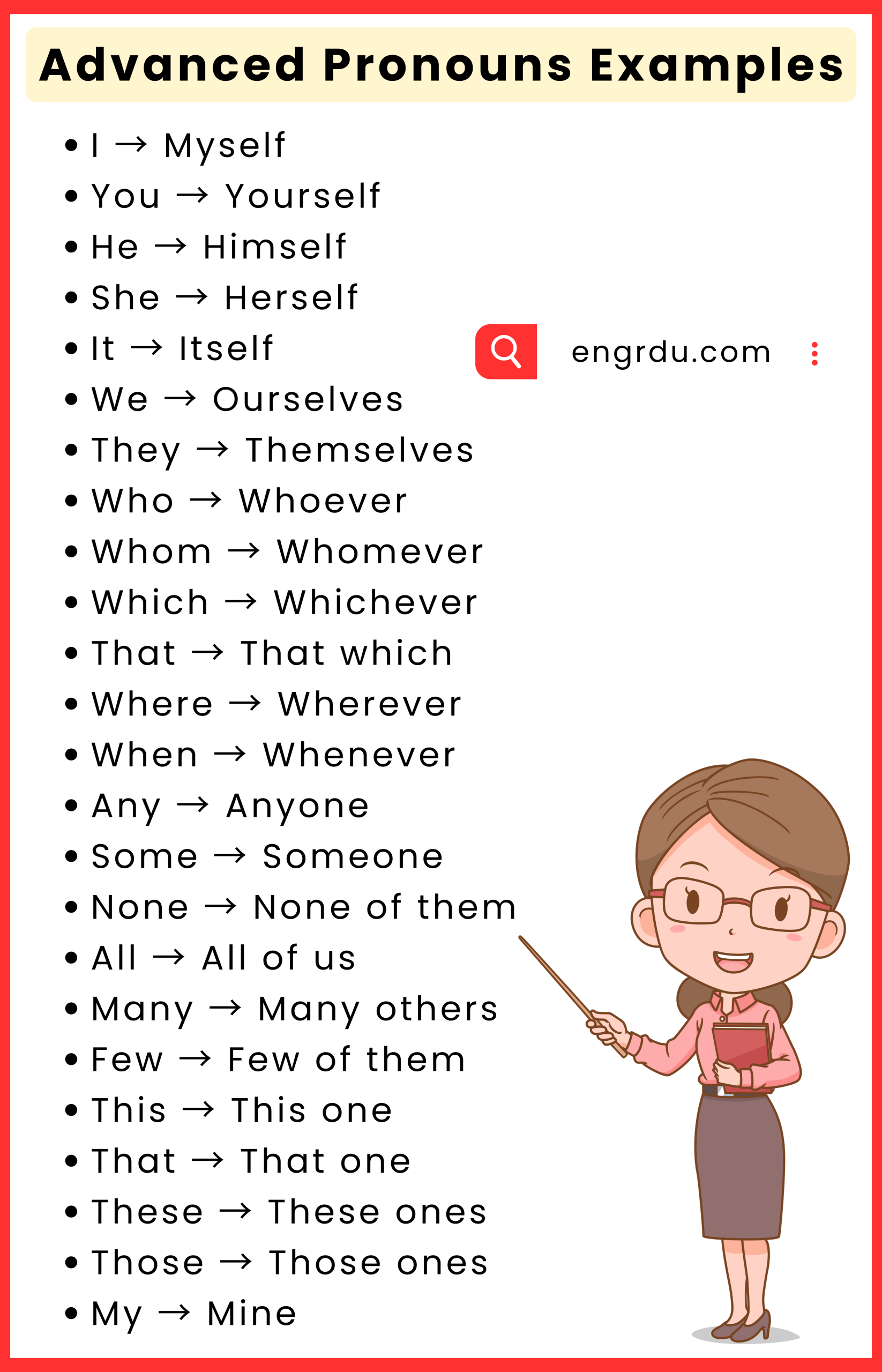
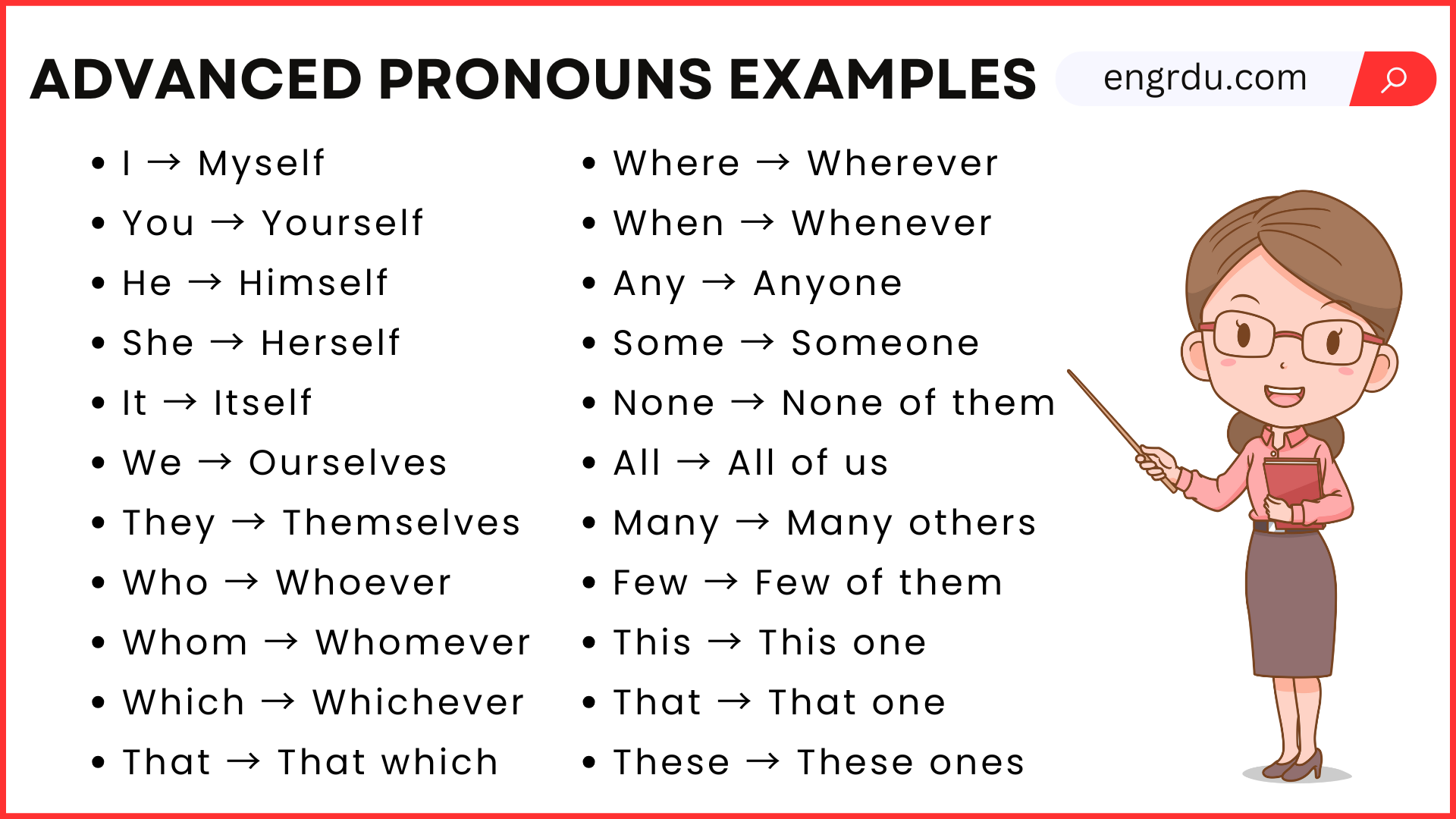
Advanced Pronouns Examples
- I → Myself
- You → Yourself
- He → Himself
- She → Herself
- It → Itself
- We → Ourselves
- They → Themselves
- Who → Whoever
- Whom → Whomever
- Which → Whichever
- That → That which
- Where → Wherever
- When → Whenever
- Any → Anyone
- Some → Someone
- None → None of them
- All → All of us
- Many → Many others
- Few → Few of them
- This → This one
- That → That one
- These → These ones
- Those → Those ones
- My → Mine
- Your → Yours
- His → His own
- Her → Hers
- Its → Its own
- Our → Ours
- Their → Theirs
- Anybody → Anybody else
- Nobody → Nobody else
- Everybody → Everybody else
- Each → Each one
- Either → Either one
- Neither → Neither one
Quick Tips to Master Advanced Pronouns
- Read formal texts like news articles & books
- Replace simple pronouns with formal ones in your writing
- Practice in daily conversations for fluency
- Do exercises where you rewrite sentences with better pronouns
Learning advanced pronouns helps you sound smarter, more formal, and professional in English. Use them in both writing and speaking, and your communication skills will improve quickly.
Read More