Tools are important in many jobs and everyday tasks. In workshops, people use different tools to build, repair, measure, and cut materials. Each tool has a special name and purpose. When English learners know these names, they can follow instructions, talk about work activities, and understand manuals or videos more easily. In this blog post, you will learn the English names of many workshop tools and see how people use them in real situations. Learning these words helps improve vocabulary, strengthens communication, and builds better speaking, reading, writing, and listening skills. As you continue reading, you will understand the names of common tools and how they are used in workshops and daily repair tasks.
What Are Workshop Tools?
Workshop tools are devices used to build, repair, measure, cut, or shape materials. Workers use them to make furniture, repair machines, and complete construction tasks.
Some tools work by hand, while others use electricity or batteries. Each tool has a specific purpose, which makes learning their names very useful.
Why Learning Workshop Tool Vocabulary Is Important
Learning workshop tool names helps English learners in several ways:
- Improves practical vocabulary
- Helps understand instructions and manuals
- Makes communication easier during repairs or construction
- Builds confidence in technical conversations
For students, builders, and DIY learners, this vocabulary is very useful in everyday life.
Basic Hand Tools Used in Workshops
Hand tools are simple tools that work without electricity. Workers control them completely by hand.
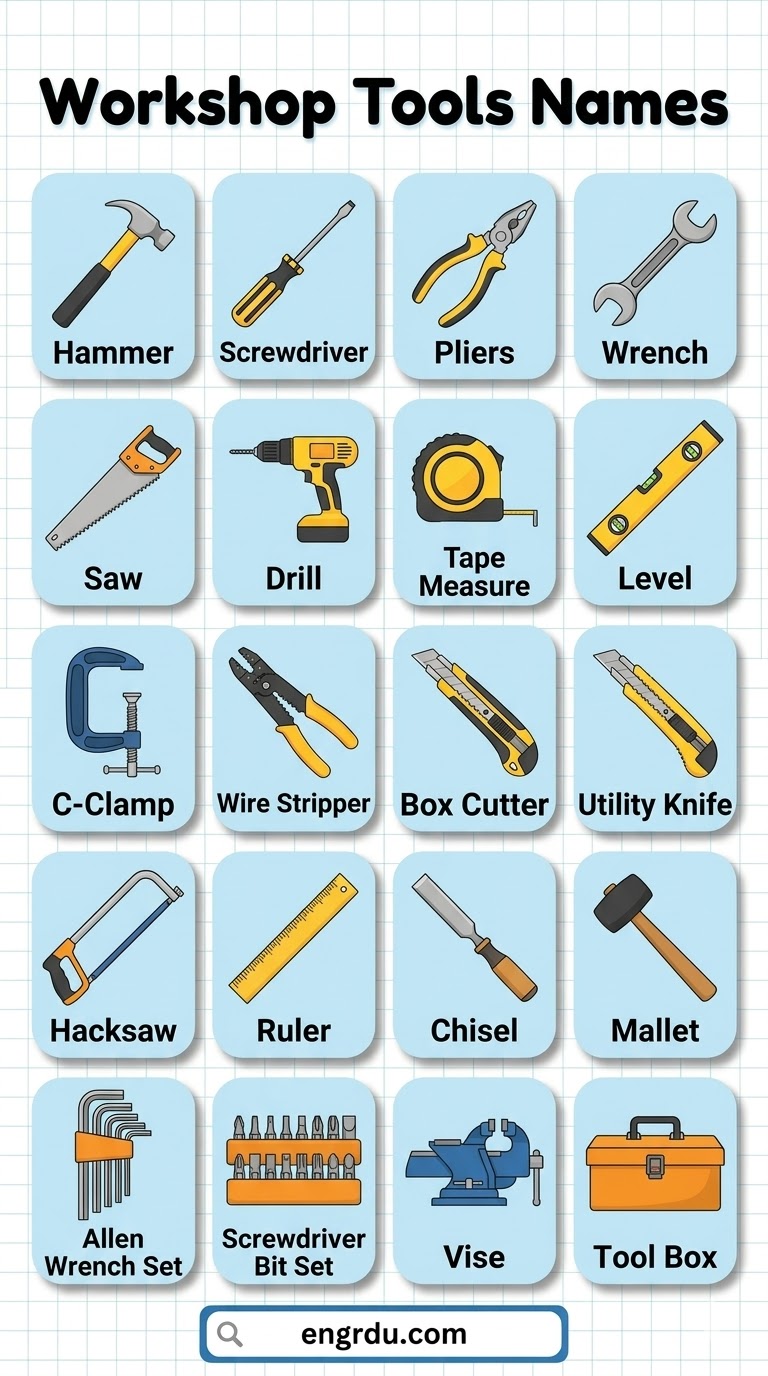
- Hammer – Used to drive nails into wood or remove them.
- Screwdriver – Tightens or loosens screws.
- Pliers – Hold, bend, or cut wires and small objects.
- Wrench – Tightens or loosens nuts and bolts.
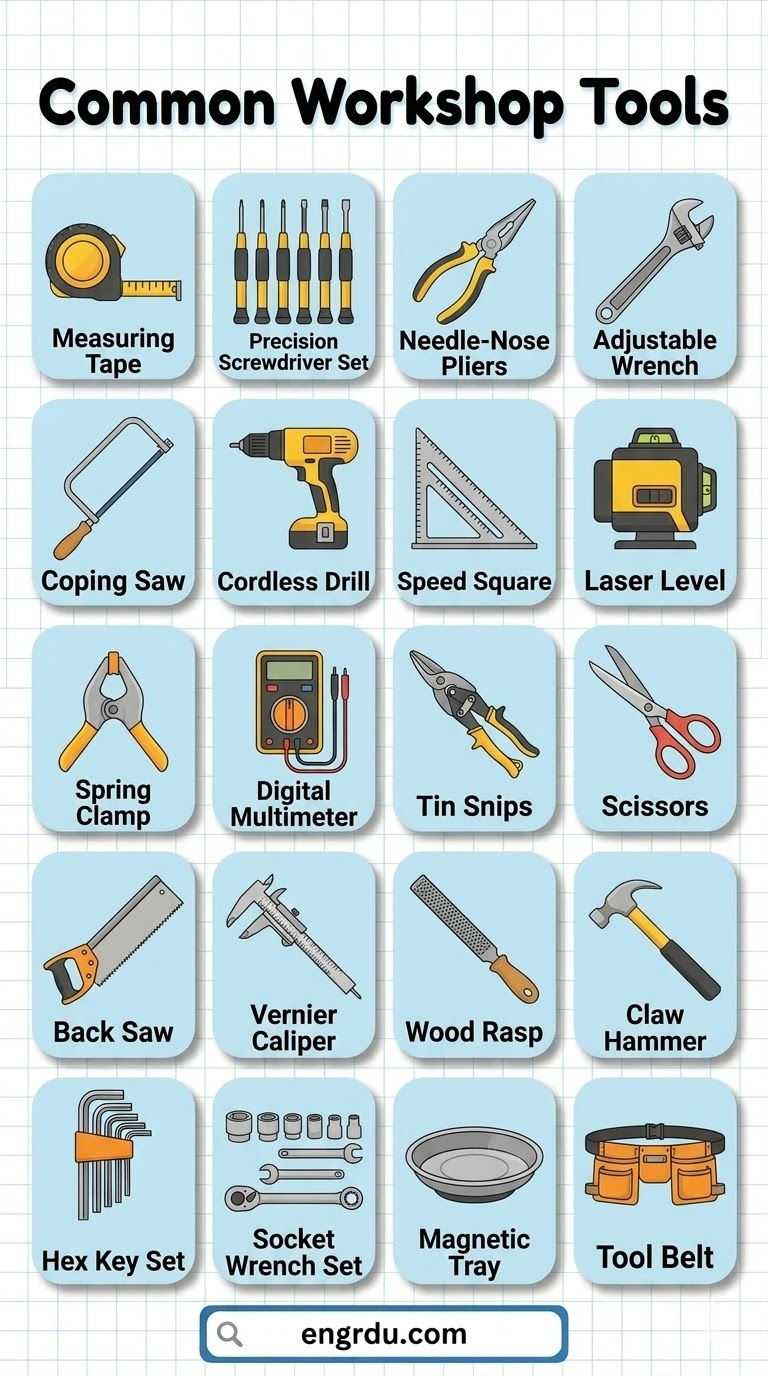
- Adjustable Wrench – A wrench with a movable jaw to fit different sizes.
- Allen Key – A small L-shaped tool used for hex screws.
- Chisel – Cuts or shapes wood and stone.
- Hand Saw – Cuts wood by hand.
- Utility Knife – Cuts cardboard, plastic, or thin materials.
- Mallet – A hammer with a soft head used for delicate work.
- File – Smooths rough edges of metal or wood.
- Clamp – Holds pieces of material tightly in place.
- Staple Gun – Drives staples into wood or fabric.
- Punch – Makes small holes in metal or leather.
- Hand Drill – Drills holes using manual rotation.
Common Measuring and Marking Tools
These tools help workers measure accurately and mark cutting lines.
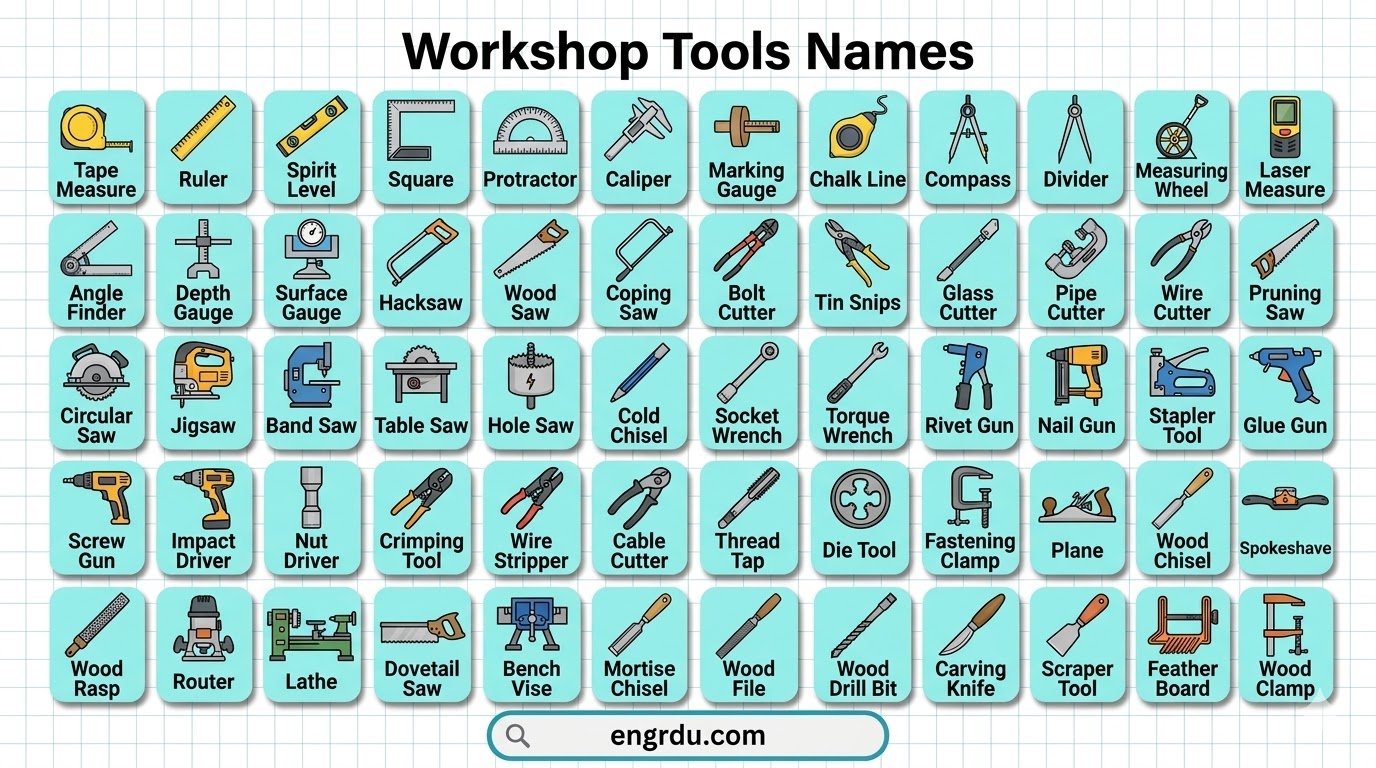
- Tape Measure – Measures length or distance.
- Ruler – Measures short, straight distances.
- Spirit Level – Checks if a surface is level or straight.
- Square – Ensures right angles when marking or cutting.
- Protractor – Measures angles.
- Caliper – Measures thickness and inside or outside distance.
- Marking Gauge – Marks lines on wood surfaces.
- Chalk Line – Draws long straight lines on surfaces.
- Compass – Draws circles or arcs.
- Divider – Measures or transfers distances between points.
- Measuring Wheel – Measures long ground distances.
- Laser Measure – Measures distance using laser technology.
- Angle Finder – Determines precise angles.
- Depth Gauge – Measures hole depth.
- Surface Gauge – Marks accurate lines on flat surfaces.
Cutting Tools Used in Workshops
Cutting tools shape materials like wood, metal, and plastic.
- Hacksaw – Cuts metal pipes and rods.
- Wood Saw – Cuts wooden boards.
- Coping Saw – Cuts curves in wood.
- Bolt Cutter – Cuts thick metal bolts or chains.
- Tin Snips – Cuts thin metal sheets.
- Glass Cutter – Scores glass for cutting.
- Pipe Cutter – Cuts metal or plastic pipes.
- Wire Cutter – Cuts electrical wires.
- Pruning Saw – Cuts small tree branches.
- Circular Saw – A power tool for fast straight cuts.
- Jigsaw – Cuts curved shapes in wood or metal.
- Band Saw – Cuts irregular shapes with a continuous blade.
- Table Saw – Used for precise straight wood cuts.
- Hole Saw – Cuts round holes in materials.
- Cold Chisel – Cuts metal surfaces.
Fastening and Assembly Tools
These tools join or hold materials together.
- Socket Wrench – Tightens bolts using removable sockets.
- Torque Wrench – Tightens bolts with precise force.
- Rivet Gun – Installs metal rivets.
- Nail Gun – Drives nails quickly into wood.
- Stapler Tool – Fixes materials with staples.
- Glue Gun – Applies melted glue for bonding.
- Screw Gun – Drives screws efficiently.
- Impact Driver – Provides strong turning force.
- Nut Driver – Tightens nuts easily.
- Crimping Tool – Joins wires and connectors.
- Wire Stripper – Removes insulation from wires.
- Cable Cutter – Cuts thick cables.
- Thread Tap – Creates threads inside holes.
- Die Tool – Cuts threads on rods.
- Fastening Clamp – Holds materials during assembly.
Woodworking Tools
Woodworkers use these tools to shape and smooth wooden pieces.
- Plane – Smooths wooden surfaces.
- Wood Chisel – Carves and shapes wood.
- Spokeshave – Shapes curved wood surfaces.
- Wood Rasp – Files wood quickly.
- Router – Cuts decorative edges in wood.
- Lathe – Spins wood for shaping.
- Dovetail Saw – Makes precise joinery cuts.
- Bench Vise – Holds wood pieces firmly.
- Mortise Chisel – Cuts square holes in wood.
- Wood File – Smooths wood edges.
- Wood Drill Bit – Drills holes in wood.
- Carving Knife – Used for detailed carving.
- Scraper Tool – Smooths fine wood surfaces.
- Feather Board – Guides wood safely during cutting.
- Wood Clamp – Holds wood pieces together while glue dries.
Metalworking Tools
These tools help workers shape and repair metal parts.
- Anvil – A heavy metal block for shaping metal.
- Forge Hammer – Shapes hot metal.
- Metal File – Smooths metal edges.
- Bench Grinder – Sharpens and polishes metal tools.
- Angle Grinder – Cuts or grinds metal.
- Metal Lathe – Shapes metal by spinning it.
- Sheet Metal Brake – Bends metal sheets.
- Metal Shears – Cuts sheet metal.
- Welding Machine – Joins metal using heat.
- Plasma Cutter – Cuts metal using plasma arc.
- Magnetic Drill – Drills holes in steel.
- Reamer – Enlarges holes accurately.
- Deburring Tool – Removes sharp edges from metal.
- Tap Wrench – Holds taps for threading holes.
- Metal Punch – Marks drilling points.
Power Tools Commonly Found in Workshops
Power tools work with electricity or batteries. They make work faster and easier.
- Electric Drill – Drills holes in wood, metal, or plastic.
- Impact Wrench – Tightens bolts with strong power.
- Power Sander – Smooths surfaces quickly.
- Rotary Tool – A small tool for cutting, grinding, and polishing.
- Power Planer – Levels wooden surfaces.
- Reciprocating Saw – Cuts materials with a back-and-forth blade.
- Heat Gun – Produces hot air for paint removal.
- Air Compressor – Powers pneumatic tools.
- Paint Sprayer – Sprays paint evenly.
- Pressure Washer – Cleans surfaces using high-pressure water.
- Cordless Screwdriver – Drives screws easily.
- Bench Drill Press – Drills precise vertical holes.
- Tile Cutter – Cuts ceramic tiles.
- Floor Polisher – Polishes floors smoothly.
- Electric Stapler – Drives staples quickly.
Safety Tools and Protective Equipment
Safety tools protect workers while they use workshop equipment.
- Safety Goggles – Protect the eyes from dust and debris.
- Work Gloves – Protect hands from cuts or heat.
- Ear Protection – Reduces loud noise from machines.
- Dust Mask – Prevents inhaling dust particles.
- Face Shield – Protects the whole face.
- Safety Helmet – Protects the head from impact.
- Steel-Toe Boots – Protect feet from heavy objects.
- Welding Helmet – Shields eyes during welding.
- Protective Apron – Protects clothes and body.
- Respirator Mask – Filters harmful air particles.
Tips to Remember Workshop Tool Vocabulary
Learning many new tool names may feel difficult at first. These simple tips can help:
- Study tools in small groups instead of all at once.
- Look at pictures of each tool while learning the word.
- Practice using the words in simple sentences.
- Repeat the vocabulary regularly to remember it longer.
- Watch workshop videos to hear real usage.
Conclusion
Workshop tools play an important role in building, repairing, and creating everyday items. Learning 100+ workshop tools names expands your English vocabulary and helps you understand practical tasks.
By studying these words step by step, learners develop better communication skills, reading ability, and technical understanding. With practice, you will quickly recognize these tools and confidently use their names in real-life conversations.
FAQs
What are workshop tools names in English?
Workshop tools names are the English words used for tools found in a workshop, such as hammer, screwdriver, drill, and wrench. Learning these words helps learners understand repair work and technical instructions.
What are the most common workshop tools names beginners should learn?
Common workshop tools names include hammer, screwdriver, pliers, wrench, drill, saw, tape measure, chisel, clamp, and level. These tools appear frequently in workshops and basic repair tasks.
What are the 10 common tools?
Ten common tools used in workshops and home repairs include: hammer, screwdriver, pliers, wrench, drill, hand saw, tape measure, level, utility knife, and clamp. These tools support basic construction, fixing, and measuring work.
What is the difference between hand tools and power tools in a workshop?
Hand tools work using human effort, such as hammers and screwdrivers. Power tools use electricity or batteries, like drills and sanders, to perform tasks faster and with less physical effort.
What are the 7 basic mechanical tools?
Seven basic mechanical tools commonly used in workshops and repair work are: hammer, screwdriver, wrench, pliers, hand saw, adjustable wrench, and tape measure. These tools help with tightening, cutting, holding, and measuring materials during mechanical tasks.
What are 10 hand tools?
Ten common hand tools are: hammer, screwdriver, pliers, wrench, chisel, hand saw, file, clamp, utility knife, and tape measure. These tools operate manually without electricity and are widely used in workshops and DIY repairs.
Where are workshop tools commonly used?
Workshop tools are commonly used in carpentry shops, metal workshops, repair garages, construction sites, and home improvement projects. They help workers cut, measure, assemble, and repair materials.
How many workshop tools names should beginners learn first?
Beginners should start with 20–30 common workshop tools names. After understanding basic tools like hammer, saw, and wrench, learners can gradually expand their vocabulary to 100 or more tools.
Related Articles: