In this blog post, you will learn about uncountable nouns, an important part of English grammar. These are words we cannot count one by one, such as water, advice, or information. Many learners feel confused about when to use much, some, or a piece of. When you understand these nouns, your grammar becomes more accurate and natural. You will speak with greater confidence, write better sentences, read texts more carefully, and listen with better understanding. Keep reading to understand the rules, common mistakes, and practical examples that will help you master this essential grammar topic.
Uncountable Nouns Definition and Examples
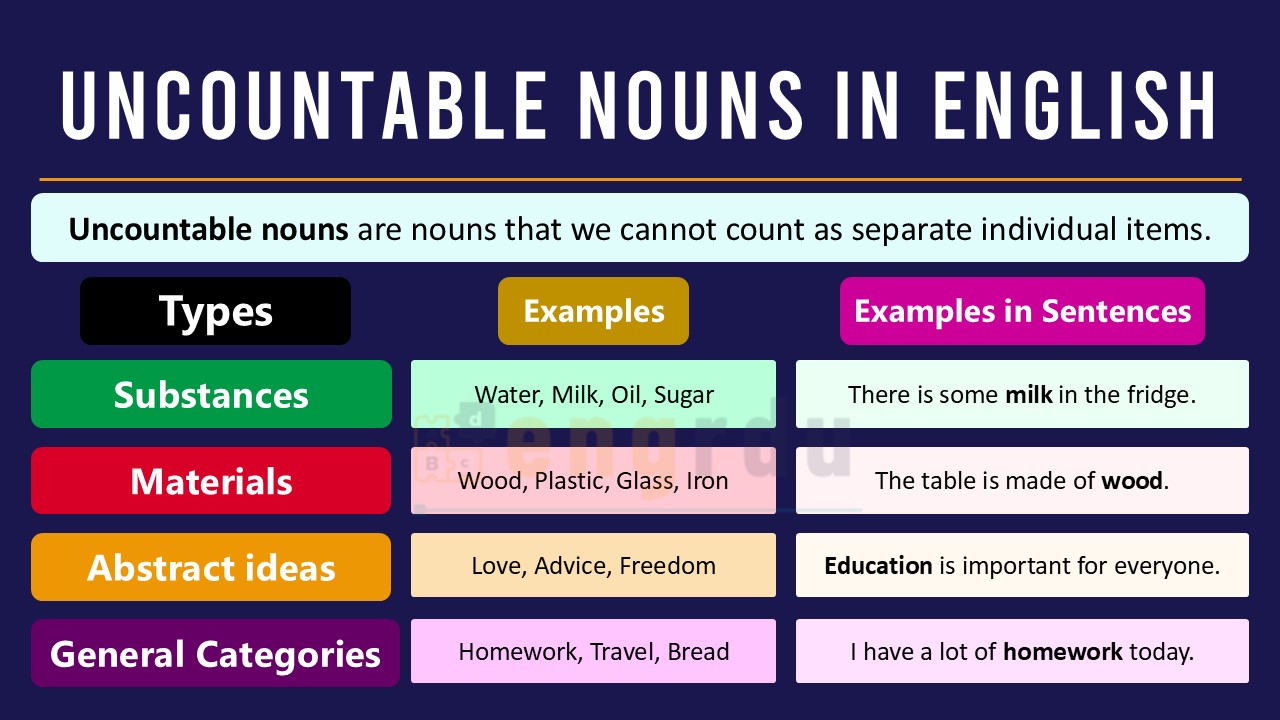
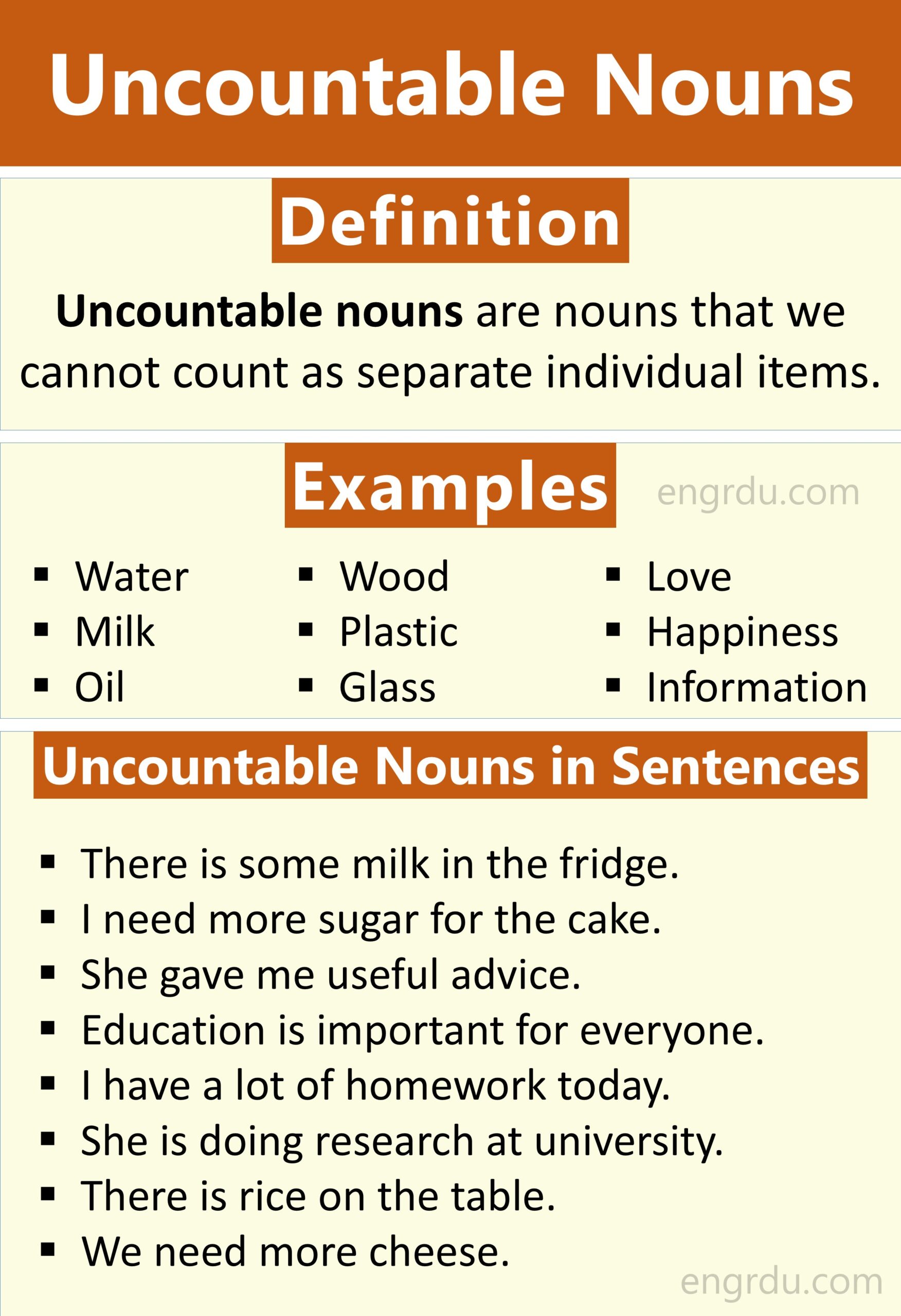
Uncountable nouns (also called non-count nouns or mass nouns) are nouns that we cannot count as separate individual items.
They usually refer to:
- Substances
- Materials
- Abstract ideas
- General categories
We cannot use numbers directly with uncountable nouns. For example:
- Water (not two waters)
- Information (not three informations)
- Advice (not an advice)
Instead, we use quantity expressions such as:
- Some water
- A piece of advice
- Much information
In simple words:
If you cannot count it as 1, 2, 3 separately, it is usually an uncountable noun.
Types of Uncountable Nouns
Uncountable nouns can be grouped into clear categories. Understanding these categories helps you recognise them easily.
Substances and Liquids
These are things that do not have clear shapes or separate parts.
Examples:
- Water
- Milk
- Oil
- Sugar
- Salt
- Coffee
- Tea
Example sentences:
- There is some milk in the fridge.
- I need more sugar for the cake.
- We do not have much water left.
We cannot say:
- Two milks (unless in informal café English, meaning two cups of milk)
- Three sugars
Materials and Natural Elements
These include raw materials and physical matter.
Examples:
- Wood
- Plastic
- Glass
- Iron
- Gold
- Sand
- Air
Example sentences:
- The table is made of wood.
- Gold is expensive.
- There is sand in my shoes.
We do not say:
- Many woods
- Two golds
Abstract Ideas and Qualities
These are ideas, emotions, or qualities that we cannot see or touch.
Examples:
- Love
- Happiness
- Information
- Knowledge
- Advice
- Education
- Freedom
Example sentences:
- She gave me useful advice.
- Education is important for everyone.
- We need more information.
These words are very common in academic English across Europe and worldwide.
Activities and Subjects
Some activities and school subjects are uncountable.
Examples:
- Homework
- Work
- Research
- Travel
- Music
- Mathematics
- English
Example sentences:
- I have a lot of homework today.
- She is doing research at university.
- Mathematics is difficult for some students.
We cannot say:
- Two homeworks
- Many researches (in general meaning)
Food (General Meaning)
Many food items are uncountable when we speak generally.
Examples:
- Bread
- Rice
- Meat
- Cheese
- Butter
Example sentences:
- I bought some bread.
- There is rice on the table.
- We need more cheese.
However, when we talk about types, they may become countable:
- Different cheeses of France
- Italian wines
Rules for Using Uncountable Nouns
Understanding the rules will help you speak and write correctly.
Rule 1: Do Not Use “A” or “An”
We cannot use a or an with uncountable nouns.
Incorrect:
- An advice
- A furniture
Correct:
- Some advice
- A piece of furniture
Rule 2: Do Not Use Plural Forms
Uncountable nouns do not usually have plural forms.
Incorrect:
- Informations
- Advices
- Luggages
Correct:
- Information
- Advice
- Luggage
Rule 3: Use Quantity Expressions
To count uncountable nouns, we use measure words.
Common expressions:
- A piece of advice
- A bottle of water
- A loaf of bread
- A cup of tea
- A kilo of rice
- A bit of information
Examples:
- She gave me two pieces of advice.
- I bought three bottles of water.
Rule 4: Use “Much” and “Little”
With uncountable nouns, we often use:
- Much
- Little
- A little
- Some
- A lot of
Examples:
- There is not much time.
- We have little money.
- I need a little help.
We do not use many with uncountable nouns.
Incorrect:
Many information
Correct:
Much information
Uncountable Nouns Examples in Sentences
Here are different sentence forms to help you practise.
Affirmative Sentences
- She has a lot of experience.
- There is some milk in the glass.
- We need more information.
- He gave me good advice.
Negative Sentences
- There is not much sugar left.
- I do not have any money.
- She did not give me any advice.
- We have little time.
Question Sentences
- How much water do you need?
- Is there any rice at home?
- Do you have any information about the course?
- How much homework do you have?
Notice we use How much, not How many.
Common Mistakes and How to Avoid Them
Learners around the world often make similar mistakes. Let us correct them.
Mistake 1: Adding “S”
Incorrect:
- Informations
- Advices
- Homeworks
Correct:
- Information
- Advice
- Homework
Tip: If you are unsure, check a good learner’s dictionary such as those published in the UK. It clearly shows whether a noun is countable or uncountable.
Mistake 2: Using “Many”
Incorrect:
- Many furniture
- Many luggage
Correct:
- Much furniture
- A lot of luggage
Mistake 3: Using “A” Incorrectly
Incorrect:
- An information
- A research
Correct:
- Some information
- Some research
- A piece of research
Countable vs Uncountable Nouns
Understanding the difference makes everything easier.
| Countable Nouns | Uncountable Nouns |
|---|---|
| Can be counted | Cannot be counted individually |
| Have plural forms | Usually no plural form |
| Use many | Use much |
| Example: books | Example: water |
| Example: apples | Example: advice |
Examples:
- I have three books.
- I have some water.
- How many students are there?
- How much sugar is there?
This comparison is very important for exams and daily communication.
Special Cases: Nouns That Can Be Both
Some nouns can be countable and uncountable, depending on meaning.
Chicken
- Uncountable (food): I ate some chicken.
- Countable (animal): There are three chickens in the farm.
Paper
- Uncountable (material): I need some paper.
- Countable (newspaper/article): I read an interesting paper.
Experience
- Uncountable (general knowledge): She has a lot of experience.
- Countable (specific event): It was an exciting experience.
Always check the meaning in context.
Tips for Learners
Here are practical strategies to master uncountable nouns:
- Learn nouns in groups (food, abstract ideas, materials).
- Use a reliable learner’s dictionary to check “C” or “U”.
- Memorise common uncountable nouns like advice, information, furniture, luggage, homework.
- Practise with “much” and “how much”.
- Listen to native speakers in films, podcasts, and classroom recordings.
- Write short sentences daily using new vocabulary.
- Notice usage in British and European English textbooks.
Consistency is more important than speed.
Why Uncountable Nouns Matter
Using uncountable nouns correctly improves:
- Academic writing
- IELTS and Cambridge exam scores
- Professional emails
- Everyday speaking
Small grammar mistakes can change how professional your English sounds. Clear grammar builds confidence.
Conclusion
Uncountable nouns are nouns that we cannot count individually. They do not usually have plural forms and do not use “a” or “an”. We use quantity expressions such as some, much, a piece of, and a lot of.
By understanding the types, rules, and common mistakes, you can avoid errors and improve your grammar. Practise regularly, read carefully, and apply what you learn in real conversations.
Mastering uncountable nouns is a small step, but it makes a big difference in your English accuracy and confidence.
Read More