When we want to show that something belongs to someone, we use possessive nouns. This is a very common part of English grammar. We use it every day in speaking and writing. For example, we say Sarah’s book or the teachers’ room. In this article, you will learn the meaning, types, rules, and common mistakes of possessive nouns in English. By the end, you will feel confident using them in real life.
Possessive Nouns Definition and Examples
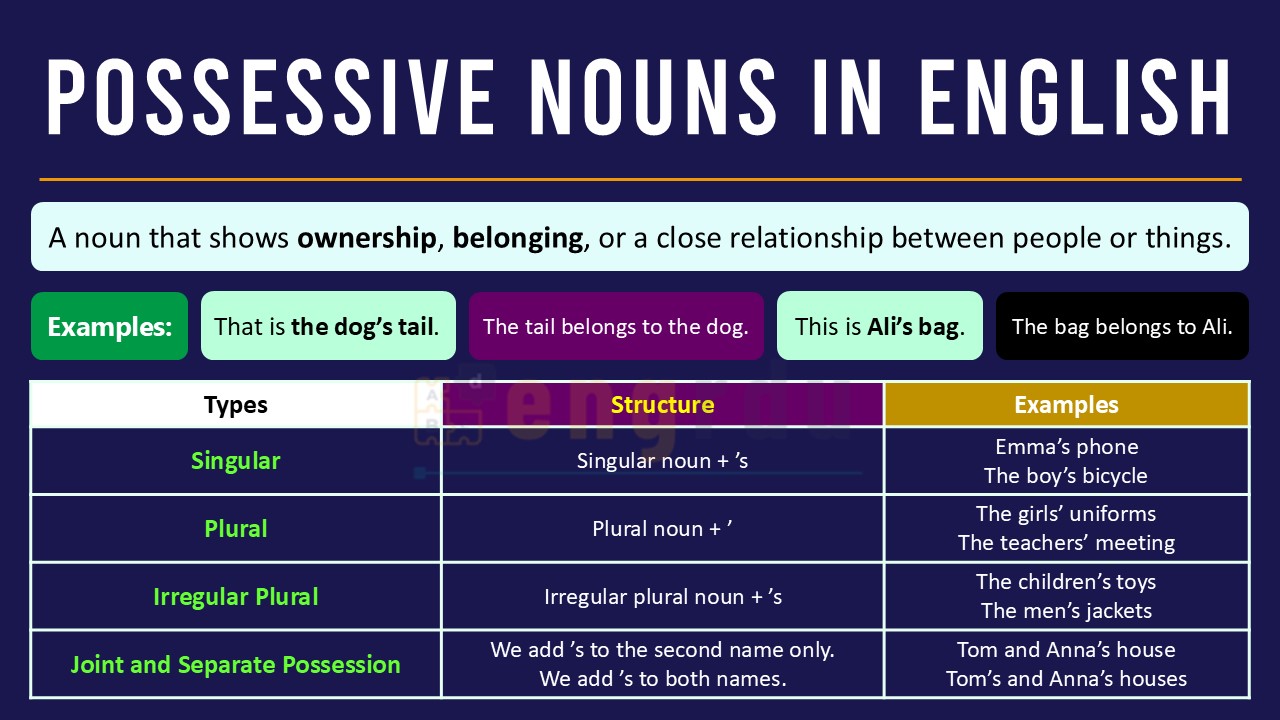
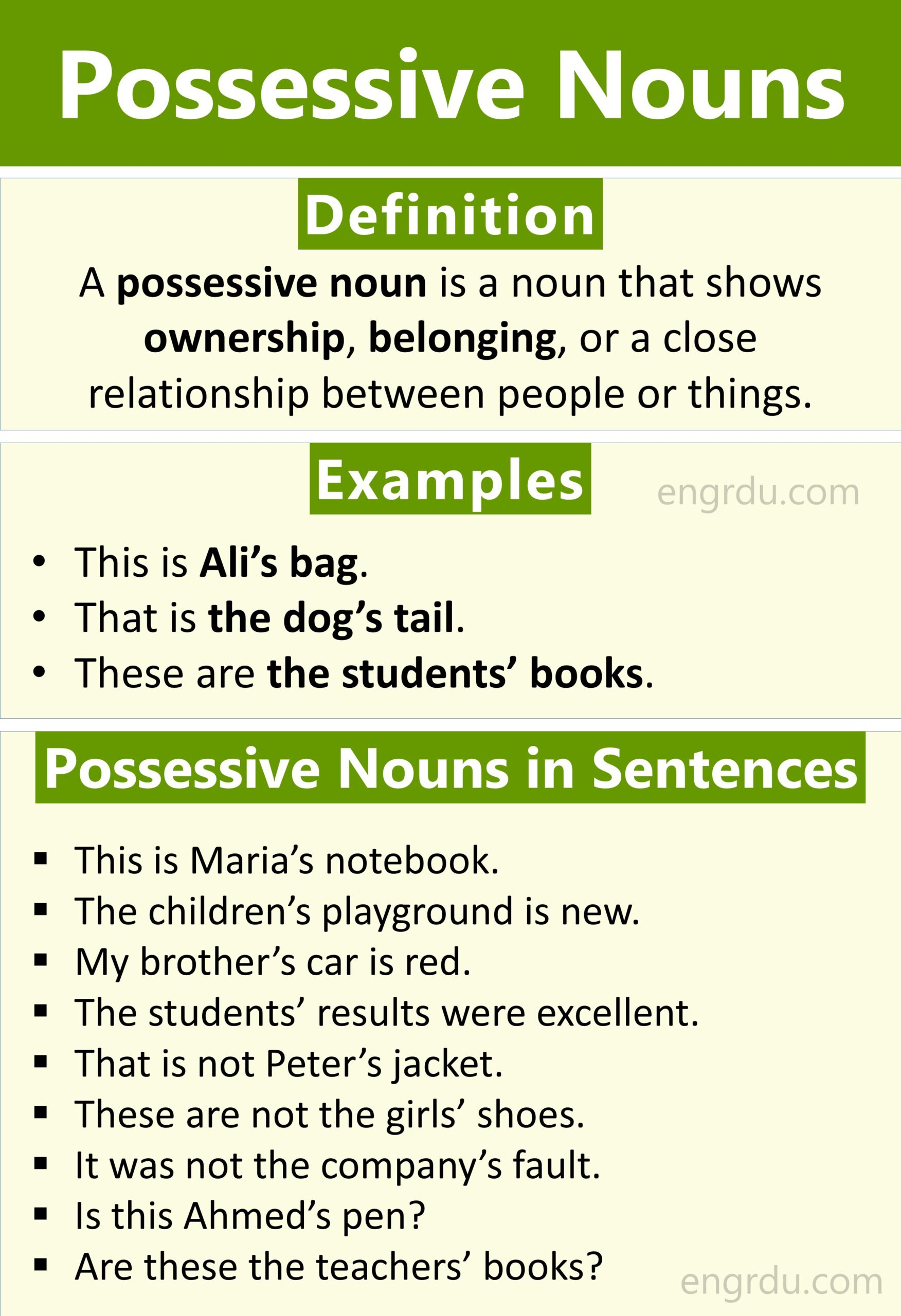
A possessive noun is a noun that shows ownership, belonging, or a close relationship between people or things.
In most cases, we add:
- ’s to a singular noun
- ’ (apostrophe only) to a plural noun ending in -s
Simple Definition:
A possessive noun shows that something belongs to someone or something.
Examples:
- This is Ali’s bag. (The bag belongs to Ali.)
- That is the dog’s tail. (The tail belongs to the dog.)
- These are the students’ books. (The books belong to the students.)
Possessive nouns are very important in both British and international English.
Types of Possessive Nouns
There are different types of possessive nouns. Let us look at them step by step.
A. Singular Possessive Nouns
We add ’s to a singular noun.
Structure:
Singular noun + ’s
Examples:
- Emma’s phone
- The boy’s bicycle
- The company’s policy
- The teacher’s desk
Even if the singular noun ends in s, we usually add ’s in modern English.
- James’s car
- The boss’s office
(Both British and international English commonly accept this form.)
B. Plural Possessive Nouns (Ending in -s)
If the plural noun already ends in -s, we only add an apostrophe (’).
Structure:
Plural noun + ’
Examples:
- The girls’ uniforms
- The teachers’ meeting
- My parents’ house
- The players’ bags
Notice: We do not add another s.
C. Irregular Plural Possessive Nouns
Some plural nouns do not end in -s (for example: children, men, women). In this case, we add ’s.
Structure:
Irregular plural noun + ’s
Examples:
- The children’s toys
- The men’s jackets
- The women’s team
- The people’s choice
D. Joint Possession and Separate Possession
Sometimes two people own something together. Sometimes they own different things.
1. Joint Possession (Shared Ownership)
We add ’s to the second name only.
- Tom and Anna’s house
(They share one house.)
2. Separate Possession (Different Things)
We add ’s to both names.
- Tom’s and Anna’s houses
(They have different houses.)
This difference is important in clear writing.
Rules and Usage of Possessive Nouns
Let us understand the rules step by step.
Rule 1: Use ’s for Singular Nouns
- The cat’s food
- My sister’s friend
- The manager’s decision
Tip: Even if the noun ends in s, add ’s in most cases.
Rule 2: Use ’ Only for Regular Plural Nouns
- The boys’ classroom
- The doctors’ lounge
- The workers’ rights
Remember: Do not write boys’s. This is incorrect.
Rule 3: Use ’s for Irregular Plurals
- The children’s park
- The women’s football team
- The men’s changing room
Rule 4: Use Possessive Nouns for Time and Distance
We often use possessive nouns to talk about time and measurement.
- A day’s work
- Two weeks’ holiday
- A year’s experience
- Five minutes’ break
This form is common in both formal and informal English.
Rule 5: Use with Places and Organisations
We also use possessive nouns with places, shops, and businesses.
- The baker’s
- The chemist’s
- The doctor’s surgery
- The school’s website
Sometimes the noun after the possessive is understood:
- I am going to the dentist’s.
(Meaning: dentist’s clinic.)
Possessive Nouns Examples in Sentences
Here are different types of sentences using possessive nouns.
Affirmative Sentences
- This is Maria’s notebook.
- The children’s playground is new.
- My brother’s car is red.
- The students’ results were excellent.
Negative Sentences
- That is not Peter’s jacket.
- These are not the girls’ shoes.
- It was not the company’s fault.
- This is not the children’s classroom.
Question Sentences
- Is this Ahmed’s pen?
- Are these the teachers’ books?
- Is that the dog’s bed?
- Whose bag is this? Is it Emma’s?
These examples show how possessive nouns work in real communication.
Common Mistakes and How to Avoid Them
Many learners make similar mistakes. Let us correct them.
Mistake 1: Confusing “its” and “it’s”
- Its = possessive (no apostrophe)
- It’s = it is / it has
Correct:
- The dog wagged its tail.
- It’s raining today.
Mistake 2: Adding ’s to Regular Plurals
Incorrect:
- The boys’s bags
Correct:
- The boys’ bags
Mistake 3: Forgetting Apostrophes
Incorrect:
- The teachers room
Correct:
- The teacher’s room (one teacher)
- The teachers’ room (many teachers)
Mistake 4: Using Possessive with Non-Living Objects Incorrectly
Sometimes learners write:
- The table’s leg
This is possible, but often we prefer:
- The leg of the table
Both are correct, but the “of” structure is common with objects.
Possessive Nouns vs Possessive Adjectives
Many learners confuse these two grammar points.
| Feature | Possessive Nouns | Possessive Adjectives |
|---|---|---|
| Example | John’s book | His book |
| Shows ownership | Yes | Yes |
| Uses apostrophes | Yes | No |
| Comes before noun | Yes | Yes |
| Based on noun or pronoun | Noun | Pronoun |
Examples:
- This is Sarah’s phone. (Possessive noun)
- This is her phone. (Possessive adjective)
Both show ownership, but the structure is different.
Tips for Learners
Here are some practical tips to improve your grammar:
- Always check if the noun is singular or plural before adding an apostrophe.
- Practise writing short sentences every day.
- Read English books and notice possessive forms.
- Listen carefully in conversations and films.
- Remember: apostrophe position is very important.
- Learn irregular plurals separately (children, men, women).
- When unsure, try using the “of” structure.
Practice makes grammar easier and more natural.
Conclusion
Possessive nouns are an essential part of English grammar. They help us show ownership, relationships, time, and measurement. We usually add ’s to singular nouns and ’ to plural nouns ending in -s. Irregular plurals take ’s. By understanding the rules and practising regularly, you can avoid common mistakes. Start using possessive nouns in your daily speaking and writing. With practice, they will become simple and natural.
Frequently Asked Questions
What are Possessive Nouns in English grammar?
Possessive Nouns are nouns that show ownership or belonging. They usually take an apostrophe and sometimes an “s”. For example, “Sara’s book” means the book belongs to Sara. They are important for clear sentence structure in both speaking and writing.
How do you form Possessive Nouns correctly?
To form Possessive Nouns, add “’s” to a singular noun, such as “the teacher’s desk”. For plural nouns ending in -s, add only an apostrophe, like “the students’ books”. Irregular plurals such as “children” take “’s”, becoming “children’s toys”.
What is the difference between Possessive Nouns and possessive adjectives?
Possessive Nouns use apostrophes, such as “John’s car”. Possessive adjectives do not use apostrophes, such as “his car” or “their house”. Both show ownership, but possessive nouns use a noun, while possessive adjectives use pronouns before a noun.
What are common mistakes when using Possessive Nouns?
Common mistakes include confusing “its” and “it’s”, writing “boys’s” instead of “boys’”, and forgetting the apostrophe in phrases like “the teachers room”. Always check whether the noun is singular or plural before adding the apostrophe.
Can Possessive Nouns be used for time and measurement?
Yes, Possessive Nouns are often used for time and measurement. Examples include “a day’s work”, “two weeks’ holiday”, and “a year’s experience”. This structure is common in formal and informal English and helps make sentences concise.
Read More