The Past Simple Tense is used to describe actions that happened and finished at a specific time in the past. In this Grammar lesson, learning the past simple tense helps you speak, write, and understand English more clearly. Using it correctly makes your sentences accurate and easy to follow when talking about past events. In this blog post, you will explore the past simple tense with examples and a chart to practice and use confidently in English.
To read more about the 12 tenses in one place, visit our 12 Tenses Chart.
What is the Past Simple Tense?
The Past Simple Tense is used to describe:
1. Actions that started and finished in the past
- I visited London last summer.
2. A sequence of past events
- She woke up, brushed her teeth, and went to school.
3. Past habits or repeated actions (sometimes)
- When I was a child, I played football every day.
Forming the Past Simple Tense
1. Affirmative Sentences
Regular verbs: Add -ed to the base verb.
- play → played
- watch → watched
Irregular verbs: Use the past form (must be memorised).
- go → went
- see → saw
Structure:
Subject + Past Verb + Object/Complement
Examples:
- I watched a movie yesterday.
- She went to the market last week.
- They played football on Sunday.
2. Negative Sentences
To make a negative sentence in Past Simple:
Subject + did not (didn’t) + base verb + Object/Complement
Examples:
- I did not (didn’t) watch a movie yesterday.
- She did not (didn’t) go to the market last week.
- They did not (didn’t) play football on Sunday.
Common Mistakes:
- ❌ I didn’t went to school.
- ✅ I didn’t go to school.
3. Question Sentences
To form questions in Past Simple:
Did + Subject + Base Verb + Object/Complement?
Examples:
- Did you watch a movie yesterday?
- Did she go to the market last week?
- Did they play football on Sunday?
Short Answers:
- Yes, I did. / No, I didn’t.
Past Simple Tense Structures
| Sentence Type | Structure | Example |
|---|---|---|
| Affirmative | Subject + Past Verb + Object | I visited Paris last year. |
| Negative | Subject + did not (didn’t) + Base Verb | I didn’t visit Paris last year. |
| Question | Did + Subject + Base Verb? | Did you visit Paris last year? |
Regular vs Irregular Verbs
Regular Verbs
Add -ed for all subjects
Examples:
- play → played
- wash → washed
- cook → cooked
Irregular Verbs
Do not follow a rule; memorisation is needed
Examples:
- go → went
- see → saw
- eat → ate
Tip: Make a list of 50+ common irregular verbs and practise them daily.
Examples of Past Simple Tense
Affirmative
- I visited Paris last year.
- She watched a movie yesterday.
- They played football on Sunday.
Negative
- I did not (didn’t) visit Paris last year.
- She did not (didn’t) watch a movie yesterday.
- They did not (didn’t) play football on Sunday.
Questions
- Did you visit Paris last year?
- Did she watch a movie yesterday?
- Did they play football on Sunday?
Common Mistakes in Past Simple
Using past form with “did”:
- ❌ I did went to school.
- ✅ I did go to school.
Forgetting -ed for regular verbs:
- ❌ I walk yesterday.
- ✅ I walked yesterday.
Confusing with Present Perfect:
- ❌ I have seen him yesterday.
- ✅ I saw him yesterday.
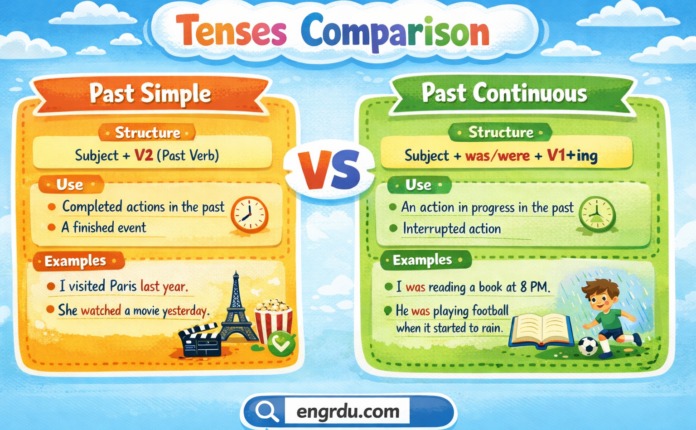
Confusing with Past Continuous:
- ❌ I watched TV when she called. (if emphasising an ongoing action use Past Continuous)
- ✅ I was watching TV when she called.
Comparison with Other Tenses
| Tense | Use | Example | Difference from Past Simple |
|---|---|---|---|
| Present Simple | Habit, routine, general truth | I go to school every day. | Present Simple talks about now or repeated actions, Past Simple talks about finished past events. |
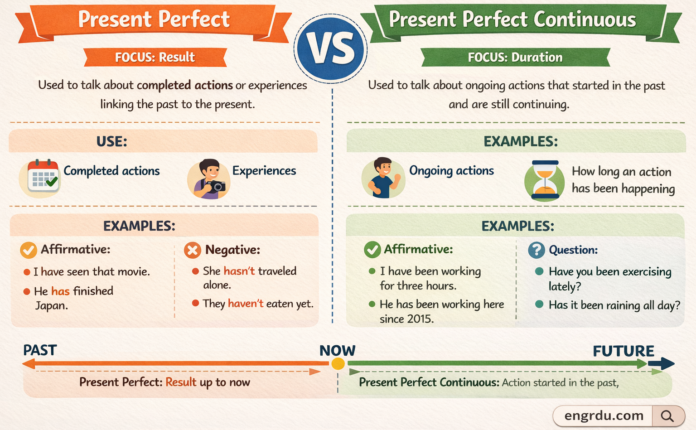
| Present Perfect | Past action with result now | I have seen that movie. | Present Perfect focuses on experience or result, Past Simple focuses on completed action at a specific time. |
| Past Continuous | Ongoing past action | I was watching TV when she called. | Past Continuous emphasizes duration, Past Simple emphasizes finished action. |
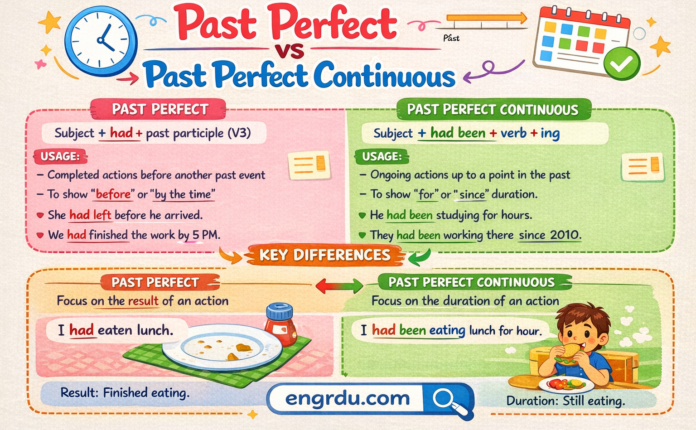
| Past Perfect | Action before another past action | I had finished my homework before dinner. | Past Perfect shows earlier past action, Past Simple is a single past event. |
Examples of Real-Life Usage
| Situation | Example Sentence |
|---|---|
| Talking about yesterday | I visited my grandmother yesterday. |
| Last week | We watched a movie last weekend. |
| Childhood habit | When I was a child, I played outside every day. |
| Sequence of past actions | He woke up, ate breakfast, and went to school. |
Tips for Learners
- Memorise irregular verbs – they are common in daily English.
- Use ‘did + base verb’ for negatives and questions.
- Practice with real-life events – yesterday, last week, last year.
- Compare with Present Perfect and Past Continuous to avoid confusion.
- Listen and read stories in English to see past tense in context.
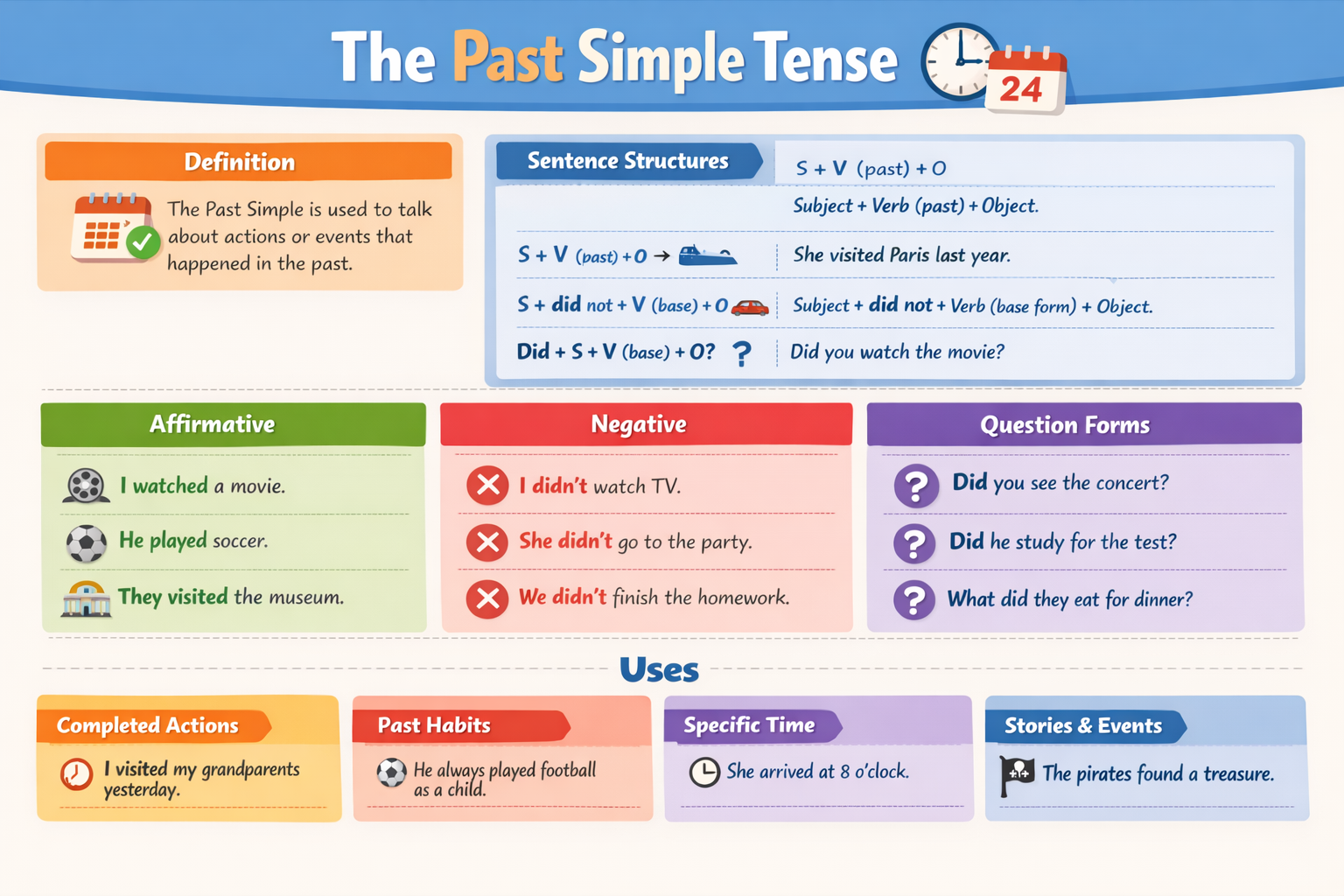
The Past Simple Tense Infographic
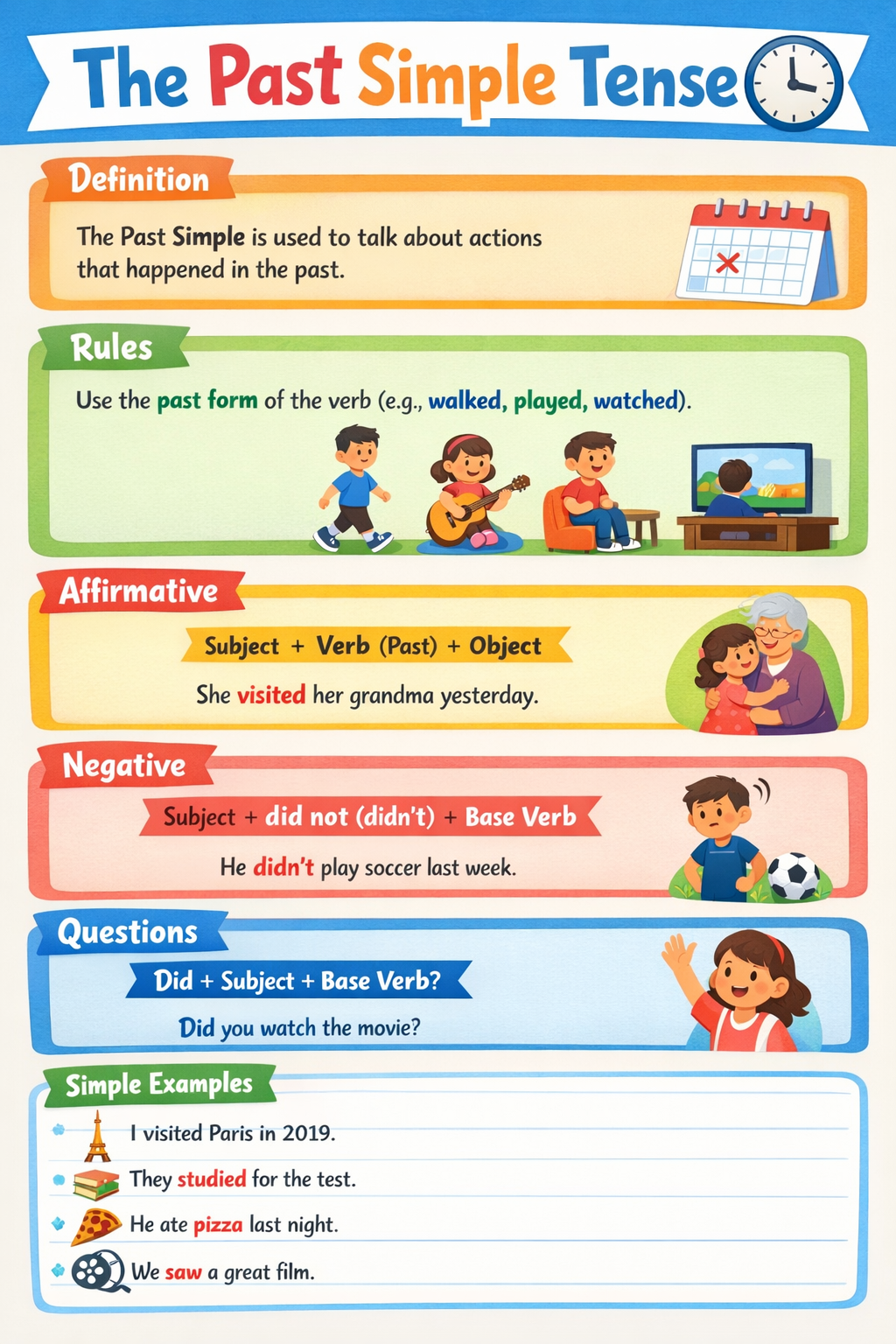
The Past Simple Tense is essential for talking about actions and events that happened and finished in the past. By learning its rules, structures, and common mistakes, you can confidently form affirmative, negative, and question sentences. Practising with regular and irregular verbs, and comparing it with other tenses like Present Perfect or Past Continuous, will help you avoid confusion. With regular practice, listening, and reading, you can use Past Simple naturally to describe past experiences, habits, and stories.
Frequently Asked Questions
What is the Past Simple Tense in English?
The Past Simple Tense is used to describe actions or events that happened in the past and are now finished. For example: I visited Paris last year.
How do you form affirmative sentences in Past Simple?
Affirmative sentences use the subject + past verb + object. For regular verbs, add -ed (played), and for irregular verbs, use their past forms (went). Example: She watched a movie yesterday.
How do you make negative sentences in Past Simple?
Use did not (didn’t) + base verb. Example: I didn’t go to school yesterday. Remember, do not use the past verb form after “did not.”
How do you ask questions in Past Simple?
Use Did + subject + base verb? Example: Did you finish your homework? Short answers can be Yes, I did or No, I didn’t.
What are common mistakes in Past Simple Tense?
Common mistakes include using past verb forms with “did” (I did went) or forgetting -ed for regular verbs (I walk yesterday). Correct usage: I did go and I walked yesterday.
When should I use Past Simple instead of Present Perfect?
Use Past Simple for completed actions at a specific time in the past. Example: I saw that movie yesterday. Present Perfect is for actions with relevance to now: I have seen that movie.
Can Past Simple describe habits in the past?
Yes, Past Simple can describe repeated actions or habits in the past. Example: When I was a child, I played football every day.
Read More