
Understanding modal verbs for possibility helps you express chances, likelihoods, and uncertainty clearly in English. In this Grammar lesson, learning these modals improves your speaking, writing, and reading skills. Using them correctly makes your sentences accurate and meaningful when talking about what might or could happen. In this blog post, you will explore the types, uses, and examples of modal verbs for possibility to practice and use confidently in everyday English.
Modal Verbs for Possibility Definition and Examples
A modal verb is a special type of verb that adds meaning to the main verb in a sentence. Modal verbs do not change form with the subject, and they are always followed by the base form of another verb.
When we talk about possibility, modal verbs show how likely or unlikely something is to happen. They help speakers express ideas like “It might rain” or “This could be true.”
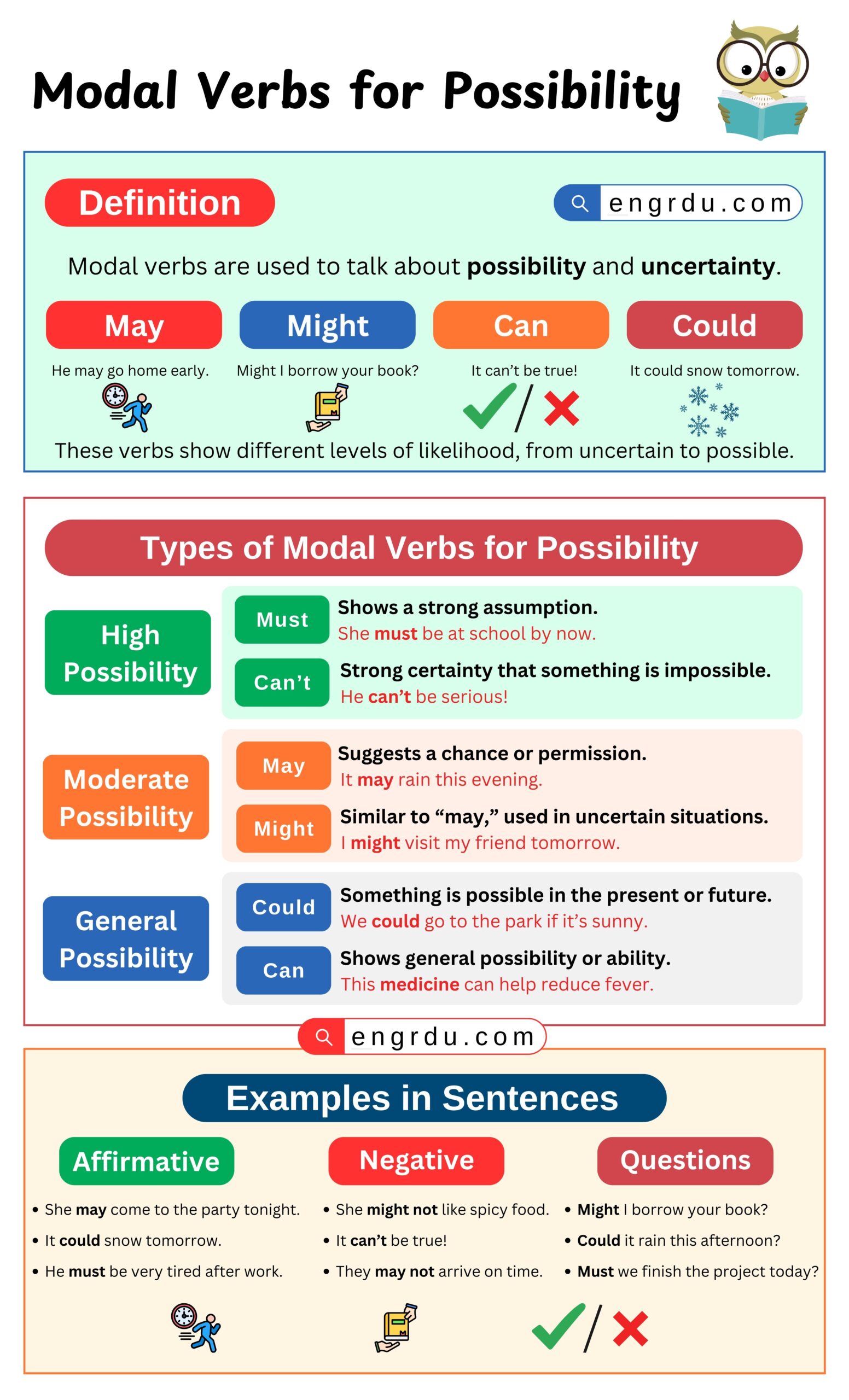
Common modal verbs for possibility include:
- May
- Might
- Could
- Can
These verbs show different levels of likelihood, from uncertain to possible.
Types of Modal Verbs for Possibility
Modal verbs for possibility can be divided into three main categories:
1. High Possibility
These modals suggest that something is very likely to happen.
Must: Shows a strong assumption.
- Example: She must be at school by now.
Can’t: Shows strong certainty that something is impossible.
- Example: He can’t be serious!
2. Moderate Possibility
These modals indicate that something could happen but it is not certain.
May: Suggests a chance or permission.
- Example: It may rain this evening.
Might: Similar to “may,” often used in uncertain situations.
- Example: I might visit my friend tomorrow.
3. General Possibility
These modals suggest that something is possible but without certainty.
Could: Shows that something is possible in the present or future.
- Example: We could go to the park if it’s sunny.
Can: Shows general possibility or ability.
- Example: This medicine can help reduce fever.
Rules of Modal Verbs for Possibility
Using modal verbs for possibility is simple if you follow these rules:
1. Follow the modal with a base verb (no -s, -ed, or -ing).
- Correct: She might come to the party.
- Incorrect: She might comes to the party.
2. Do not add “to” after the modal (except “ought to,” which is an exception).
- Correct: He may go home early.
- Incorrect: He may to go home early.
3. Use negative forms for impossibility or doubt:
- She can’t be at work now.
- It might not rain today.
4. Form questions by placing the modal before the subject:
- Could we meet tomorrow?
- Might she join the class later?
Examples of Modal Verbs for Possibility
Here are practical examples for daily use:
Affirmative Sentences
- She may come to the party tonight. (It is possible she will come.)
- It could snow tomorrow. (There is a chance of snow.)
- He must be very tired after work. (Strong assumption.)
Negative Sentences
- She might not like spicy food.
- It can’t be true!
- They may not arrive on time.
Questions
- Might I borrow your book?
- Could it rain this afternoon?
- Must we finish the project today?
These examples show how modal verbs make sentences more precise in meaning.
Common Mistakes
Many learners make mistakes with modal verbs for possibility. Here are common errors and how to fix them:
Using past tense after a modal
- Incorrect: She might went to the shop.
- Correct: She might have gone to the shop.
Adding -s or -ed to the main verb
- Incorrect: He can goes to school.
- Correct: He can go to school.
Confusing certainty with possibility
- Incorrect: She must come if she wants. (Incorrect for mild possibility)
- Correct: She may come if she wants.
Misplacing negative words
- Incorrect: She not might like pizza.
- Correct: She might not like pizza.
Comparisons with Similar Grammar Points
Sometimes modal verbs for possibility are confused with other expressions of probability.
| Modal Verb | Likelihood | Example | Similar Expression |
|---|---|---|---|
| Must | Very high | She must be tired. | I am sure she is tired. |
| Might | Low | He might join us. | It is possible he will join. |
| May | Moderate | We may leave early. | There is a chance we will leave. |
| Could | Possible | This could be the answer. | It is possible this is the answer. |
| Can | General | This can help you. | This is generally true. |
| Can’t | Impossible | He can’t be serious. | It is impossible that he is serious. |
Tips for Learners
- Understand probability levels: Decide whether your idea is certain, possible, or unlikely.
- Use context clues: Look at time, situation, and speaker tone to choose the right modal.
- Practice with everyday sentences: Talk about weather, school, or daily routines.
- Listen and repeat: English speakers use modals often; mimic their usage.
- Check negatives and questions: These are easy to get wrong, so practise them regularly.
Conclusion
Modal verbs for possibility are powerful tools in English. They allow you to show how likely something is to happen, from strong certainty to slight chance. Remember:
- Must = very likely/certain
- Might/May = possible/uncertain
- Could/Can = general possibility
By practising affirmative, negative, and question forms, you can improve your speaking, writing, and comprehension skills. Always focus on the level of possibility you want to express and remember the rules.
Frequently Asked Questions
What is the modal verb of possibility?
A modal verb of possibility is a special verb that shows how likely something is to happen. Common examples include may, might, could, must, and can.
What is an example of possibility?
An example of possibility is: It might rain tomorrow. This shows that rain is possible but not certain.
What are the modal verbs of possibility and advice?
Modal verbs of possibility include may, might, could, must, and can. For advice, we also use should and ought to.
Can possibility example sentences?
Yes. Examples: We could go to the park if it’s sunny. She might join the class later. It can be helpful to study every day.
How do modal verbs show possibility?
Modal verbs show possibility by indicating how likely or unlikely something is. For example, She must be tired shows strong certainty, while He might come shows a lower chance.
What is the difference between might and must?
Might suggests a small or uncertain possibility, e.g., He might call you later.
Must shows a strong likelihood or assumption, e.g., She must be at work now.
Can modal verbs express past possibility?
Yes. Use have + past participle to show past possibility. Example: He might have forgotten his keys shows something was possible in the past.
Read More
