
Understanding the Future Continuous Tense helps you describe actions that will be ongoing at a specific time in the future. In this Grammar lesson, learning this tense improves your speaking, writing, and reading skills. Using it correctly makes your sentences clear and accurate when talking about future events. In this blog post, you will explore the structures and examples of the future continuous tense to practice and use confidently in English.
To read more about the 12 tenses in one place, visit our 12 Tenses Chart.
What is the Future Continuous Tense?
The Future Continuous Tense is used to describe an action that will be in progress at a certain time in the future.
In simple words, it answers this question:
“What will be happening at that time?”
Basic idea
- The action starts before a future time
- The action continues during that future time
Example
- I will be studying at 8 pm tonight.
This means the study will already be in progress at 8 pm.
Forms of the Future Continuous Tense
The Future Continuous Tense has three main sentence forms:
1. Affirmative (Positive) Form
Used to say that something will be happening.
Structure:
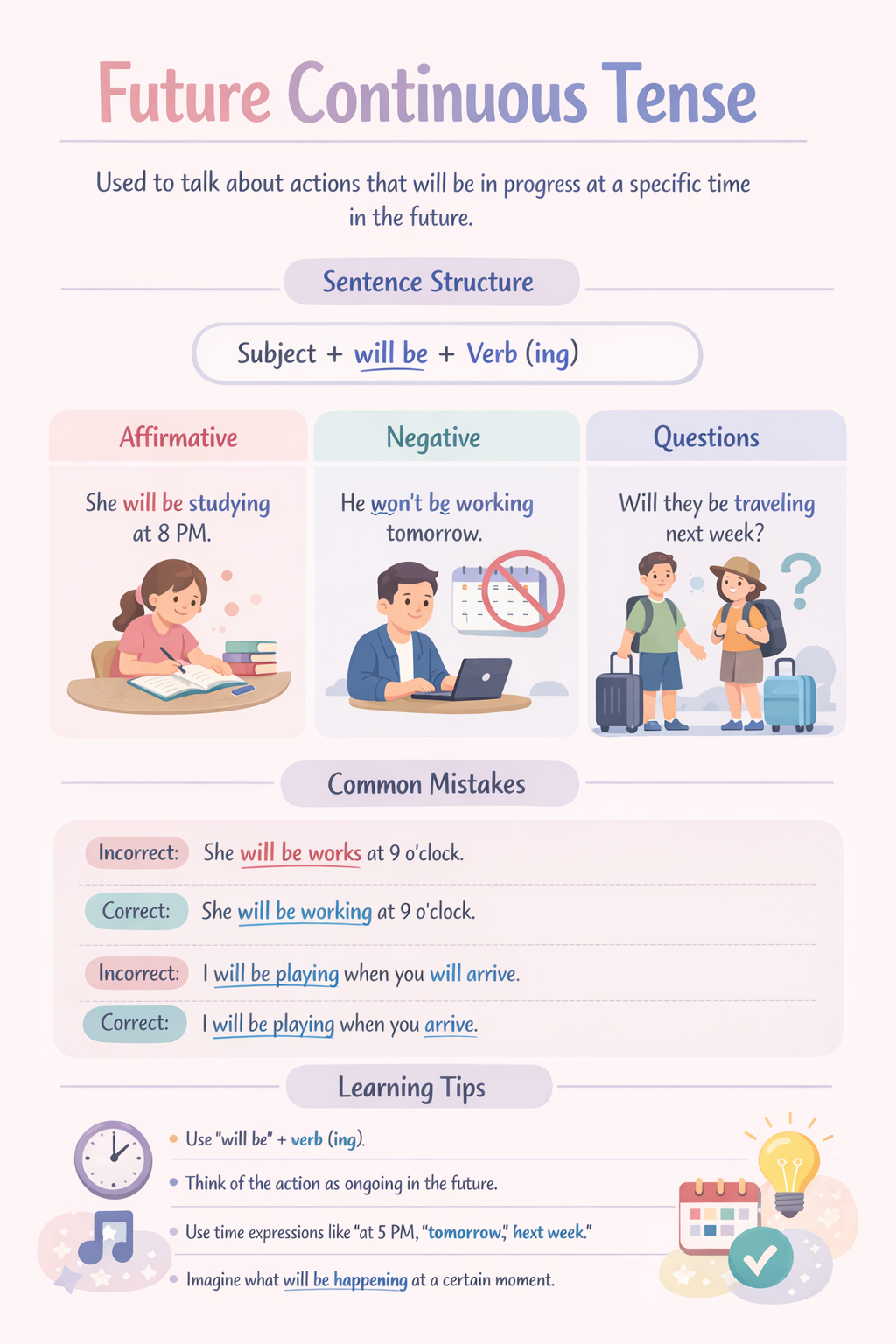
Subject + will be + verb + -ing
Examples:
- She will be working tomorrow morning.
- We will be travelling to Paris next week.
2. Negative Form
Used to say that something will not be happening.
Structure:
Subject + will not be (won’t be) + verb + -ing
Examples:
- He will not be sleeping at that time.
- They won’t be waiting for us.
3. Question Form
Used to ask politely or check future plans.
Structure:
Will + subject + be + verb + -ing?
Examples:
- Will you be using the computer tonight?
- Will she be attending the meeting tomorrow?
Usage of the Future Continuous Tense
Let us understand when and how to use this tense step by step.
1. Action in Progress at a Specific Future Time
Use the Future Continuous Tense when an action will be happening at a particular time in the future.
Examples:
- At 10 am, I will be giving a presentation.
- This time tomorrow, we will be flying to London.
Tip:
Always mention or imagine a future time.
2. Planned or Expected Future Activities
We often use this tense for activities that are already planned.
Examples:
- She will be meeting her teacher after school.
- I will be working from home next week.
3. Polite Questions About the Future
This tense sounds more polite than simple future tense.
Examples:
- Will you be joining us for dinner?
- Will you be needing any help?
This is very common in professional and social English.
4. Future Actions That Happen Naturally
Use it when the action will happen normally, without special effort.
Examples:
- Don’t call at 9 pm. I will be putting the kids to bed.
- He will be driving to work as usual.
Examples in Real-Life Situations
Affirmative Sentences
- I will be studying English tonight.
- She will be cooking dinner at 7 pm.
- We will be watching a film tomorrow evening.
- They will be staying at a hotel in Rome.
Negative Sentences
- I will not be working this weekend.
- She won’t be attending the class tomorrow.
- We will not be travelling during winter.
- He won’t be waiting for a reply.
Question Sentences
- Will you be studying late tonight?
- Will she be using the car tomorrow?
- Will they be visiting their grandparents?
- Will we be meeting again next month?
Common Mistakes and How to Avoid Them
1. Forgetting “be”
❌ I will studying at night.
✅ I will be studying at night.
Tip:
Always remember: will + be + verb-ing
2. Using the Base Verb Instead of -ing
❌ She will be work tomorrow.
✅ She will be working tomorrow.
3. Using It Without a Future Time
❌ I will be reading.
✅ I will be reading at 9 pm.
Tip:
This tense sounds clearer when a time is mentioned.
4. Confusing with Simple Future
❌ I will finish my homework at 8 pm.
✅ I will be finishing my homework at 8 pm.
Explanation:
- Will finish → focuses on completion
- Will be finishing → focuses on the process
Comparison with Similar Tenses
Future Continuous vs Simple Future (Will)
| Feature | Simple Future | Future Continuous |
|---|---|---|
| Focus | Result or decision | Ongoing action |
| Example | I will call you. | I will be calling you. |
| Use | Instant decision | Planned or ongoing |
Future Continuous vs Present Continuous
| Feature | Present Continuous | Future Continuous |
|---|---|---|
| Time | Near future | Specific future time |
| Example | I am meeting him tomorrow. | I will be meeting him at 5 pm. |
| Use | Fixed plan | Action in progress |
Exercise of Future Continuous Tense
Fill in the Blanks
Complete the sentences using the correct form of the Future Continuous Tense.
- At 9 pm tonight, I __________ (study) for my English test.
- She __________ (work) at the office tomorrow morning.
- They __________ (travel) to Madrid this time next week.
- We __________ (not / watch) TV during the exam hours.
- __________ you __________ (use) the computer this evening?
Answers:
- will be studying
- will be working
- will be travelling
- will not be watching / won’t be watching
- Will you be using
Rewrite the Sentences
Rewrite each sentence using the Future Continuous Tense.
- I will finish my homework at 8 pm.
- She will attend the meeting tomorrow morning.
- They will travel during the summer holidays.
- He will not wait for the bus at that time.
- Will you meet your teacher after school?
Answers:
- I will be finishing my homework at 8 pm.
- She will be attending the meeting tomorrow morning.
- They will be travelling during the summer holidays.
- He will not be waiting for the bus at that time.
- Will you be meeting your teacher after school?
Tips for Learners
- Think of a future clock time when using this tense.
- Practise with daily routines like work, study, and travel.
- Use it for polite questions in conversations.
- Listen to native speakers in films and interviews.
- Speak slowly and focus on correct structure.
Short practice every day improves accuracy.
Future Continuous Tense Infographic
Conclusion
The Future Continuous Tense is very useful in modern English. It helps you describe actions that will be happening at a certain time in the future. It is easy to form and sounds polite and natural. By learning its structure, rules, and common mistakes, you can use it confidently in speaking and writing. Try using it in daily conversations to improve your fluency.
Frequently Asked Questions
What is the Future Continuous Tense in English?
The Future Continuous Tense is used to talk about an action that will be in progress at a specific time in the future. It focuses on the ongoing nature of the action, not its completion.
What is the structure of the Future Continuous Tense?
The basic structure is: Subject + will be + verb + -ing. For example, She will be studying at 8 pm tonight.
When do we use the Future Continuous Tense?
We use it to describe actions happening at a particular future time, planned future activities, and polite questions about someone’s future plans.
How do you make negative sentences in the Future Continuous Tense?
Negative sentences are formed with: Subject + will not be (won’t be) + verb + -ing. For example, They won’t be travelling next week.
How do you ask questions in the Future Continuous Tense?
Questions are formed with: Will + subject + be + verb + -ing? For example, Will you be working late tomorrow?
What is the difference between Future Simple and Future Continuous?
Future Simple focuses on decisions or completed actions, while Future Continuous focuses on actions that will be ongoing at a specific future time.
What are common mistakes learners make with the Future Continuous Tense?
Common mistakes include forgetting “be”, using the base verb instead of the -ing form, or using the tense without mentioning a future time reference.
Read More