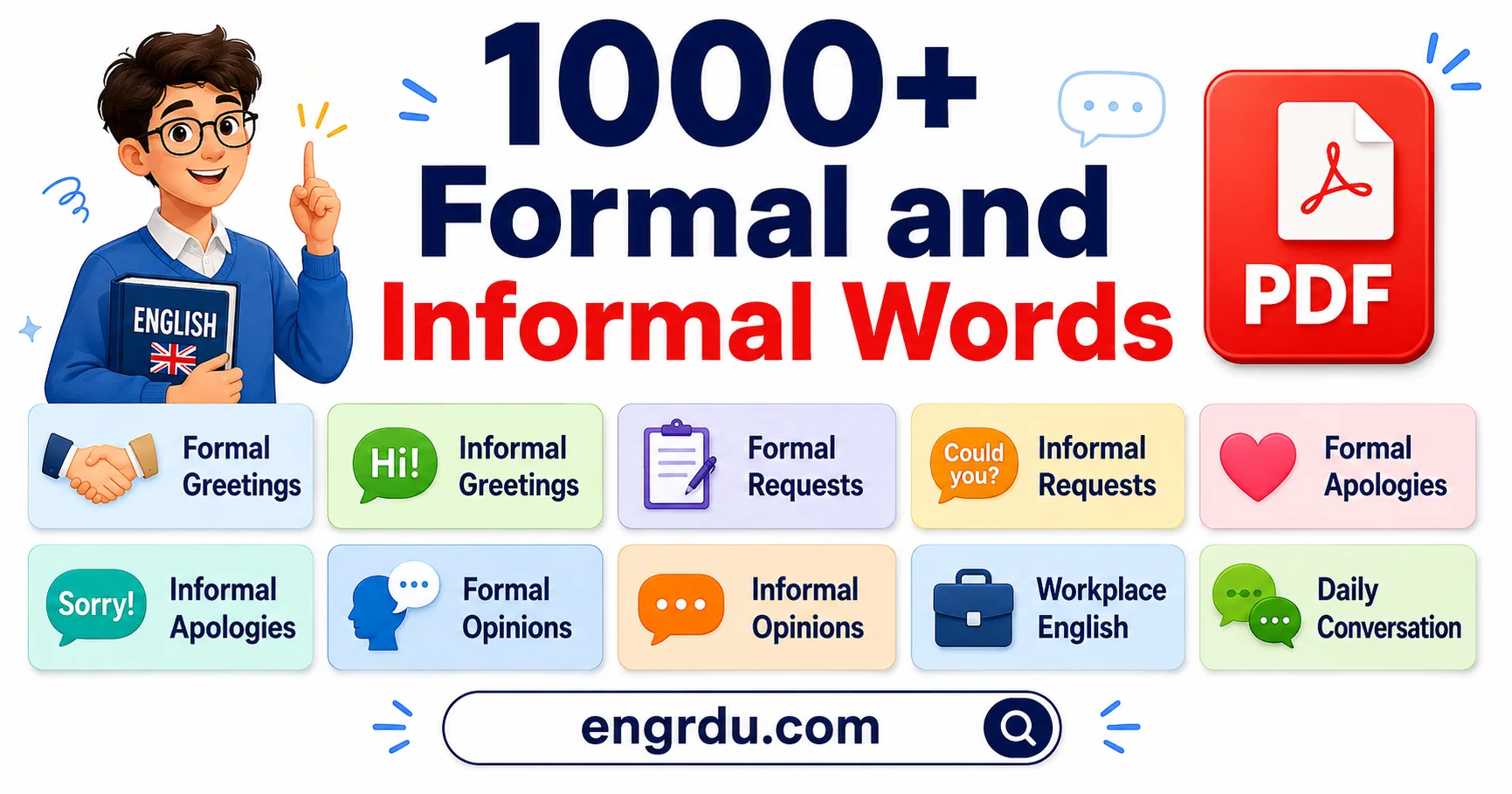

Formal and Informal Words are an important part of everyday English. We use different words depending on the situation, audience, and purpose. Formal English is common in academic writing, business emails, reports, applications, and professional communication. Informal English is more natural in conversations with friends, family, and people we know well. Learning formal vs informal words helps English learners choose the right vocabulary for speaking and writing. It also makes communication clearer, more natural, and suitable for each situation.
What Are Formal and Informal Words?
Formal words are vocabulary choices commonly used in professional, academic, official, or respectful communication. Informal words are relaxed expressions used mainly in everyday speech and casual writing.
For example:
- ask → inquire
- help → assist
- buy → purchase
- tell → inform
- need → require
The meaning is often similar, but the level of formality changes.
Formal vs Informal English
Formal and informal English are not two different languages. They are different registers, meaning different ways of using English according to the situation and audience.
| Informal English | Formal English |
|---|---|
| Natural and conversational | Professional and structured |
| Common with friends and family | Common at work and school |
| Often uses contractions | Often uses full forms |
| Uses many phrasal verbs | Often uses single-word alternatives |
| May contain slang | Usually avoids slang |
| Often uses short expressions | Often uses more precise vocabulary |
| “Can you help me?” | “Could you assist me?” |
| “I can’t come.” | “I am unable to attend.” |
Neither style is always better. Correct English means choosing the style that fits the situation.
Here’s a complete guide on: 1000+ English Idioms with Meanings
Where Do We Use Formal and Informal English?
Use formal English in situations such as:
- academic assignments
- business emails
- job applications
- reports
- presentations
- official letters
- customer complaints
- workplace meetings
- legal or administrative communication
Use informal English in situations such as:
- conversations with friends
- family messages
- casual social media posts
- friendly text messages
- everyday conversations
- relaxed discussions with classmates
1000+ Formal and Informal Words List
The vocabulary bank below contains 500+ matched formal and informal pairs, giving you more than 1000 formal and informal words and expressions. The short notes show the basic meaning or situation in which each pair is commonly used.
Everyday Actions
| Informal | Formal | Meaning / Use |
|---|---|---|
| get | obtain | Receive or acquire |
| give | provide | Supply something |
| ask | inquire | Request information |
| tell | inform | Give information |
| show | demonstrate | Make something clear |
| help | assist | Give support |
| use | utilize | Put something to use |
| fix | repair | Make something work |
| start | commence | Begin something |
| end | conclude | Bring to an end |
| stop | cease | Discontinue an action |
| try | attempt | Make an effort |
| need | require | Be necessary |
| want | desire | Wish to have |
| choose | select | Pick an option |
| check | verify | Confirm correctness |
| make | create | Produce something |
| build | construct | Make a structure |
| put | place | Position something |
| take away | remove | Move something away |
| keep | retain | Continue to have |
| leave | depart | Go away |
| go | proceed | Move forward |
| come | arrive | Reach a place |
| find | locate | Discover a position |
Common Informal Phrasal Verbs and Formal Alternatives
Formal writing often replaces conversational phrasal verbs with shorter, more precise verbs.
| Informal | Formal | Meaning / Use |
|---|---|---|
| put off | postpone | Delay something |
| find out | discover | Learn information |
| look into | investigate | Examine carefully |
| come up with | devise | Create an idea |
| go up | increase | Become higher |
| go down | decrease | Become lower |
| set up | establish | Create or organize |
| take over | assume control | Gain responsibility |
| get rid of | eliminate | Remove completely |
| carry out | conduct | Perform a task |
| point out | indicate | Draw attention to |
| bring about | cause | Make something happen |
| call off | cancel | Decide not to continue |
| back up | support | Provide evidence |
| turn down | reject | Refuse an offer |
| put up with | tolerate | Accept something unpleasant |
| run into | encounter | Meet unexpectedly |
| work out | resolve | Find a solution |
| look for | search for | Try to find |
| deal with | address | Handle a matter |
| take part | participate | Join an activity |
| go on | continue | Keep happening |
| keep on | persist | Continue doing |
| think over | consider | Think carefully |
| leave out | omit | Not include |
Speaking and Communication
| Informal | Formal | Meaning / Use |
|---|---|---|
| say | state | Express information |
| talk about | discuss | Speak about a subject |
| mention | refer to | Briefly discuss |
| answer | respond | Give a reply |
| reply | respond | Answer a message |
| explain | clarify | Make something understandable |
| point out | indicate | Direct attention |
| write down | record | Put information in writing |
| sum up | summarize | Give main points |
| bring up | raise | Introduce a topic |
| ask for | request | Politely seek something |
| call | contact | Communicate with someone |
| get in touch | contact | Establish communication |
| let someone know | notify | Give information officially |
| say sorry | apologize | Express regret |
| say thanks | express gratitude | Show appreciation |
| promise | pledge | Give a serious promise |
| agree | concur | Share the same view |
| disagree | dissent | Hold a different view |
| complain | lodge a complaint | Express dissatisfaction |
| argue | dispute | Disagree strongly |
| chat | converse | Talk casually |
| read over | review | Examine written material |
| fill in | complete | Add required information |
| leave out | exclude | Not include |
Requests, Instructions, and Responses
| Informal | Formal | Meaning / Use |
|---|---|---|
| ask | request | Seek something |
| ask about | inquire about | Seek information |
| tell | advise | Give information or guidance |
| tell someone to | instruct | Give an order |
| say yes | consent | Agree formally |
| say no | decline | Refuse politely |
| let | permit | Give permission |
| allow | authorize | Give official permission |
| stop | prohibit | Officially prevent |
| make someone | require | Make something necessary |
| remind | notify | Bring attention to |
| warn | caution | Alert about danger |
| show how | demonstrate | Explain through action |
| make clear | clarify | Remove confusion |
| ask again | reiterate a request | Repeat a request |
| wait | remain | Stay for a period |
| check | confirm | Verify information |
| send | forward | Pass something onward |
| give | submit | Present officially |
| sign | authorize | Approve formally |
| answer | acknowledge | Confirm receipt |
| promise | undertake | Commit formally |
| agree to | approve | Accept formally |
| refuse | reject | Decline something |
| take back | withdraw | Remove a statement or request |
Work and Business
| Informal | Formal | Meaning / Use |
|---|---|---|
| boss | supervisor | Person managing work |
| worker | employee | Person employed |
| coworker | colleague | Person you work with |
| job | occupation | Employment |
| job opening | vacancy | Available position |
| customer | client | Person receiving services |
| hire | employ | Give someone a job |
| fire | dismiss | End employment |
| quit | resign | Leave a job voluntarily |
| pay | remuneration | Money for work |
| money | funds | Available financial resources |
| job duties | responsibilities | Required work |
| skills | competencies | Work abilities |
| goal | objective | Desired result |
| plan | strategy | Organized approach |
| result | outcome | Final effect |
| problem | issue | Matter requiring attention |
| idea | proposal | Suggested plan |
| rules | policies | Organizational guidelines |
| deal | agreement | Business arrangement |
| team | personnel | People working together |
| help | support | Assistance |
| check performance | evaluate | Assess quality |
| comments | feedback | Response to work |
| job training | professional development | Work-related learning |
Meetings and Professional Discussions
| Informal | Formal | Meaning / Use |
|---|---|---|
| talk | discussion | Exchange of ideas |
| get together | meeting | Organized gathering |
| talk about | discuss | Consider a subject |
| bring up | raise | Introduce an issue |
| go over | review | Examine carefully |
| figure out | determine | Reach a conclusion |
| think about | consider | Examine mentally |
| agree on | approve | Accept a proposal |
| say no to | reject | Refuse a proposal |
| put forward | propose | Suggest formally |
| give ideas | contribute | Add useful input |
| write down | document | Create a written record |
| finish | conclude | End a meeting |
| start | commence | Begin formally |
| delay | defer | Move to a later time |
| talk later | reconvene | Meet again |
| join | attend | Be present |
| skip | be absent from | Not attend |
| lead | chair | Manage a meeting |
| talk first | open proceedings | Begin discussion |
| decide | resolve | Reach an official decision |
| agree completely | reach consensus | Share one decision |
| send around | circulate | Distribute information |
| follow up | pursue | Continue after discussion |
| go through | examine | Review in detail |
School and Academic English
| Informal | Formal | Meaning / Use |
|---|---|---|
| kids | children | Young people |
| teacher | instructor | Person who teaches |
| school work | coursework | Academic work |
| test | examination | Formal assessment |
| homework | assignment | Work completed outside class |
| idea | concept | Thought or principle |
| look at | examine | Study carefully |
| find out | determine | Discover through study |
| show | demonstrate | Provide evidence |
| prove | establish | Show something is true |
| talk about | discuss | Examine a topic |
| use | employ | Apply a method |
| enough | sufficient | As much as needed |
| wrong | incorrect | Not accurate |
| right | correct | Accurate |
| clear | evident | Easy to understand |
| maybe | possibly | Perhaps |
| mostly | primarily | Mainly |
| about | approximately | Nearly a number |
| first | initially | At the beginning |
| then | subsequently | Afterwards |
| last | finally | At the end |
| so | therefore | Shows a result |
| also | additionally | Adds information |
| but | however | Shows contrast |
Thinking, Knowledge, and Opinions
| Informal | Formal | Meaning / Use |
|---|---|---|
| think | consider | Examine mentally |
| believe | maintain | Hold an opinion |
| guess | assume | Accept without proof |
| know | be aware | Have knowledge |
| understand | comprehend | Grasp meaning |
| remember | recall | Bring back to mind |
| forget | fail to recall | Not remember |
| notice | observe | Become aware |
| see | perceive | Become aware of |
| look at | examine | Study closely |
| think about | reflect on | Consider deeply |
| decide | determine | Make a decision |
| pick | select | Choose |
| expect | anticipate | Think something will happen |
| worry | be concerned | Feel anxiety |
| wonder | question | Think with uncertainty |
| figure out | determine | Discover the answer |
| make sense | be coherent | Be understandable |
| imagine | envisage | Form a mental picture |
| learn | acquire knowledge | Gain information |
| realize | recognize | Become aware |
| doubt | question | Be uncertain |
| trust | rely on | Depend confidently |
| be sure | be certain | Have no doubt |
| think again | reconsider | Review a decision |
Feelings and Attitudes
| Informal | Formal | Meaning / Use |
|---|---|---|
| happy | pleased | Feeling satisfaction |
| sad | sorrowful | Feeling sadness |
| angry | irate | Very angry |
| mad | displeased | Angry or annoyed |
| afraid | apprehensive | Worried about danger |
| scared | frightened | Feeling fear |
| worried | concerned | Feeling anxiety |
| calm | composed | Emotionally controlled |
| excited | enthusiastic | Showing strong interest |
| tired | fatigued | Lacking energy |
| bored | uninterested | Not engaged |
| surprised | astonished | Very surprised |
| shocked | appalled | Strongly disturbed |
| confused | perplexed | Unable to understand |
| proud | gratified | Pleased with achievement |
| ashamed | remorseful | Feeling regret |
| kind | considerate | Thoughtful toward others |
| rude | discourteous | Not polite |
| nice | pleasant | Agreeable |
| mean | unkind | Not considerate |
| friendly | cordial | Warm and polite |
| honest | candid | Truthful |
| careful | cautious | Acting with care |
| careless | negligent | Failing to take care |
| lazy | indolent | Unwilling to work |
Relationships and Social Life
| Informal | Formal | Meaning / Use |
|---|---|---|
| hang out | socialize | Spend time with others |
| meet up | meet | Come together |
| get together | assemble | Gather in one place |
| fall out | quarrel | Have an argument |
| make up | reconcile | Become friendly again |
| break up | end a relationship | Separate as partners |
| get married | marry | Become spouses |
| ask out | invite on a date | Request a romantic meeting |
| get along | have a good relationship | Interact well |
| look after | care for | Take responsibility for |
| grow up | mature | Become an adult |
| bring up | raise | Care for a child |
| look up to | admire | Respect someone |
| put down | belittle | Make someone feel inferior |
| show off | boast | Display proudly |
| make fun of | ridicule | Mock someone |
| tell off | reprimand | Criticize for bad behavior |
| calm down | compose oneself | Become calmer |
| cheer up | encourage | Improve someone’s mood |
| help out | assist | Give support |
| stick with | remain loyal to | Continue supporting |
| count on | rely on | Depend on |
| come over | visit | Go to someone’s home |
| drop by | visit briefly | Make a short visit |
| keep in touch | maintain contact | Continue communication |
Time and Scheduling
| Informal | Formal | Meaning / Use |
|---|---|---|
| now | currently | At the present time |
| right away | immediately | Without delay |
| soon | shortly | In a short time |
| later | subsequently | Afterward |
| before | prior to | Earlier than |
| after | following | Later than |
| at the same time | simultaneously | Happening together |
| every day | daily | Each day |
| every week | weekly | Each week |
| every month | monthly | Each month |
| every year | annually | Each year |
| for now | temporarily | For a limited period |
| in the end | ultimately | Finally |
| from now on | henceforth | From this time forward |
| ahead of time | in advance | Before required time |
| on time | punctually | At the expected time |
| late | delayed | After expected time |
| a while | a period | An amount of time |
| short-lived | temporary | Lasting briefly |
| earlier | previously | At an earlier time |
| lately | recently | Not long ago |
| next | subsequent | Following |
| again | subsequently repeated | Happening another time |
| straight away | promptly | Without unnecessary delay |
| someday | eventually | At an unknown future time |
Quantity, Amount, and Degree
| Informal | Formal | Meaning / Use |
|---|---|---|
| a lot of | numerous | Many |
| lots of | substantial | Large in amount |
| a bit | slightly | To a small degree |
| kind of | somewhat | To some degree |
| really | highly | To a strong degree |
| super | extremely | Very strongly |
| enough | sufficient | As much as required |
| too much | excessive | More than acceptable |
| more | additional | Extra |
| less | reduced | Smaller amount |
| almost | nearly | Not completely |
| about | approximately | Close to a number |
| around | approximately | Roughly |
| only | solely | Exclusively |
| mostly | predominantly | Mainly |
| partly | partially | Not completely |
| fully | entirely | Completely |
| all | entire | Whole amount |
| some | certain | An unspecified amount |
| many | numerous | Large number |
| few | limited | Small number |
| big | considerable | Large in size or amount |
| tiny | minuscule | Extremely small |
| huge | enormous | Extremely large |
| common | prevalent | Frequently occurring |
Positive and Negative Qualities
| Informal | Formal | Meaning / Use |
|---|---|---|
| good | beneficial | Producing a positive result |
| bad | adverse | Producing a negative result |
| great | excellent | Very good |
| okay | acceptable | Good enough |
| cheap | inexpensive | Low in price |
| pricey | expensive | High in price |
| clean | sanitary | Hygienic |
| dirty | unsanitary | Not hygienic |
| safe | secure | Protected from harm |
| dangerous | hazardous | Likely to cause harm |
| easy | straightforward | Not difficult |
| hard | difficult | Requiring effort |
| fast | rapid | Moving quickly |
| slow | gradual | Happening slowly |
| strong | robust | Strong and effective |
| weak | fragile | Easily damaged |
| clear | unambiguous | Having one clear meaning |
| unclear | ambiguous | Open to different meanings |
| useful | valuable | Providing benefit |
| useless | ineffective | Not producing results |
| fair | equitable | Just and balanced |
| unfair | inequitable | Not fair |
| true | accurate | Correct |
| false | inaccurate | Not correct |
| weird | unusual | Not normal or expected |
Problems, Errors, and Solutions
| Informal | Formal | Meaning / Use |
|---|---|---|
| mess | disorder | Lack of organization |
| trouble | difficulty | A problem |
| bug | defect | Technical problem |
| glitch | malfunction | Temporary failure |
| mistake | error | Something incorrect |
| mix-up | misunderstanding | Confusion |
| fix | remedy | Solution |
| issue | matter | Subject requiring attention |
| danger | hazard | Possible source of harm |
| damage | deterioration | Reduction in condition |
| breakdown | failure | Loss of function |
| shortage | deficit | Insufficient amount |
| delay | postponement | Later-than-planned action |
| fight | dispute | Serious disagreement |
| complaint | grievance | Formal dissatisfaction |
| lie | falsehood | Untrue statement |
| cheat | deceive | Act dishonestly |
| steal | misappropriate | Take without permission |
| get worse | deteriorate | Become worse |
| get better | improve | Become better |
| sort out | resolve | Find a solution |
| fix | rectify | Correct a problem |
| stop | prevent | Keep from happening |
| make up for | compensate for | Balance a loss |
| handle | address | Deal with a problem |
Change and Progress
| Informal | Formal | Meaning / Use |
|---|---|---|
| go up | increase | Become higher |
| go down | decrease | Become lower |
| get bigger | expand | Increase in size |
| get smaller | contract | Decrease in size |
| speed up | accelerate | Become faster |
| slow down | decelerate | Become slower |
| make better | improve | Increase quality |
| make worse | aggravate | Increase severity |
| change | modify | Alter something |
| change completely | transform | Change greatly |
| stay | remain | Continue in one state |
| keep | maintain | Preserve a condition |
| grow | develop | Increase or progress |
| cut | reduce | Make smaller |
| add | include | Put something in |
| take away | remove | Eliminate |
| swap | substitute | Replace one thing |
| join | combine | Bring together |
| split | divide | Separate into parts |
| move | relocate | Change location |
| begin | commence | Start |
| stop | cease | End an activity |
| finish | complete | Bring to completion |
| carry on | proceed | Continue |
| happen | occur | Take place |
Travel and Movement
| Informal | Formal | Meaning / Use |
|---|---|---|
| get in | enter | Move inside |
| get out | exit | Leave |
| go away | depart | Leave a place |
| come back | return | Go back |
| go back | return | Move to previous place |
| go ahead | proceed | Continue forward |
| move on | proceed | Continue |
| get to | reach | Arrive at |
| leave | depart | Go away |
| show up | arrive | Reach a place |
| take off | depart | Aircraft leaves ground |
| touch down | land | Aircraft reaches ground |
| stop over | make a stopover | Pause during travel |
| book | reserve | Arrange in advance |
| check in | register | Confirm arrival |
| check out | complete departure | Leave accommodation |
| pick up | collect | Get a person or item |
| drop off | deliver | Take to a location |
| miss | fail to catch | Be too late |
| get lost | lose one’s way | Become unsure of location |
| get around | travel locally | Move around an area |
| head for | proceed toward | Move in a direction |
| go through | pass through | Travel through |
| cross | traverse | Move across |
| drive | operate a vehicle | Control a vehicle |
Money and Shopping
| Informal | Formal | Meaning / Use |
|---|---|---|
| buy | purchase | Pay to obtain |
| pay | settle | Pay an amount owed |
| spend | expend | Use money |
| save | set aside | Keep money for later |
| borrow | obtain a loan | Receive money temporarily |
| lend | provide a loan | Give money temporarily |
| price | cost | Amount required |
| bill | invoice | Request for payment |
| proof you bought it | proof of purchase | Purchase evidence |
| cheap | inexpensive | Low-cost |
| expensive | costly | High-cost |
| money off | discount | Reduced price |
| sale | promotion | Reduced-price period |
| good deal | favorable offer | Advantageous price |
| stuff | goods | Items for sale |
| shop | retailer | Business selling goods |
| seller | vendor | Person or company selling |
| buyer | purchaser | Person buying |
| cash | funds | Available money |
| enough money | sufficient funds | Required amount available |
| broke | without funds | Having little money |
| rich | wealthy | Having substantial money |
| pay back | repay | Return borrowed money |
| get money back | receive a refund | Recover payment |
| give money back | reimburse | Repay an expense |
Technology and the Internet
| Informal | Formal | Meaning / Use |
|---|---|---|
| log in | access | Enter a system |
| log out | terminate a session | Leave an account |
| set up | configure | Prepare a system |
| shut down | terminate | Close a system |
| turn on | activate | Start operation |
| turn off | deactivate | Stop operation |
| start up | initialize | Begin system operation |
| plug in | connect | Attach to a device |
| unplug | disconnect | Remove a connection |
| back up | create a backup | Copy data safely |
| delete | remove | Take data away |
| wipe | erase | Remove data completely |
| save | store | Keep data |
| send | transmit | Transfer information |
| get | receive | Obtain data |
| upload | transfer | Send data to a server |
| download | retrieve | Receive online data |
| click | select | Choose on screen |
| tap | select | Choose on touchscreen |
| scroll | navigate | Move through content |
| bug | software defect | Programming problem |
| crash | system failure | Sudden system stop |
| freeze | become unresponsive | Stop responding |
| hack | gain unauthorized access | Enter without permission |
| fix | troubleshoot | Find and correct problems |
Health and Medical Situations
These pairs show how everyday health vocabulary may become more formal in medical, administrative, or professional contexts.
| Informal | Formal | Meaning / Use |
|---|---|---|
| sick | ill | Unwell |
| get sick | become ill | Develop illness |
| hurt | injure | Cause physical harm |
| pain | discomfort | Unpleasant physical feeling |
| ache | pain | Persistent discomfort |
| cut | laceration | Skin wound |
| bruise | contusion | Injury under skin |
| swollen | inflamed | Enlarged due to irritation |
| throw up | vomit | Empty stomach contents |
| pass out | lose consciousness | Become unconscious |
| wake up | regain consciousness | Become conscious again |
| tired | fatigued | Lacking energy |
| dizzy | light-headed | Feeling unsteady |
| get better | recover | Return to health |
| get worse | deteriorate | Become more severe |
| check | examine | Assess medically |
| doctor | physician | Medical professional |
| meds | medication | Medicines |
| shot | injection | Medicine given by needle |
| operation | surgery | Medical procedure |
| check-up | examination | Routine health assessment |
| heal | recover | Return to normal condition |
| spread | transmit | Pass an illness |
| catch an illness | contract an illness | Become infected |
| take medicine | take medication | Use prescribed medicine |
Law and Government
| Informal | Formal | Meaning / Use |
|---|---|---|
| cops | police | Law-enforcement service |
| cop | police officer | Individual officer |
| jail | correctional facility | Place of detention |
| break the law | violate the law | Act illegally |
| rule | regulation | Official requirement |
| laws | legislation | Laws collectively |
| get arrested | be detained | Taken into custody |
| blame | accuse | Claim responsibility |
| sue | file a lawsuit | Begin legal action |
| court | tribunal | Body deciding legal matters |
| lawyer | attorney | Legal professional |
| deal | agreement | Formal arrangement |
| proof | evidence | Information supporting a claim |
| show | demonstrate | Provide supporting evidence |
| tell the truth | testify truthfully | Give truthful evidence |
| lie | make a false statement | Provide untrue information |
| steal | commit theft | Take property illegally |
| break in | enter unlawfully | Enter without permission |
| kick out | evict | Legally remove |
| ban | prohibit | Officially forbid |
| allow | permit | Officially allow |
| ask | request | Seek officially |
| order | direct | Give an official instruction |
| cancel | revoke | Officially withdraw |
| vote | cast a ballot | Take part in an election |
Home and Daily Life
| Informal | Formal | Meaning / Use |
|---|---|---|
| home | residence | Place where someone lives |
| place | residence | Home or living location |
| stuff | belongings | Personal possessions |
| things | items | Individual objects |
| get up | arise | Leave bed |
| wake up | awaken | Stop sleeping |
| go to bed | retire | Go to sleep |
| eat | consume | Take food |
| eat dinner | dine | Have a meal |
| cook | prepare | Make food |
| clean up | tidy | Put in order |
| wash clothes | launder | Clean clothing |
| throw away | discard | Get rid of |
| put away | store | Place for later |
| take out | remove | Move outside |
| turn on | activate | Start a device |
| turn off | deactivate | Stop a device |
| fix | repair | Restore working condition |
| move in | take up residence | Begin living somewhere |
| move out | vacate | Leave a residence |
| live | reside | Have a home |
| stay | reside temporarily | Live somewhere briefly |
| get ready | prepare | Make yourself ready |
| use | operate | Control equipment |
| look after | maintain | Keep in good condition |
News and Media
| Informal | Formal | Meaning / Use |
|---|---|---|
| news story | report | Reported information |
| story | account | Description of events |
| tell | report | Provide information |
| show | depict | Represent visually |
| say | state | Express information |
| claim | allege | State without confirmed proof |
| check | verify | Confirm accuracy |
| fake | false | Not genuine |
| rumor | unverified report | Unconfirmed information |
| proof | evidence | Supporting information |
| chat | interview | Question-and-answer discussion |
| photo | photograph | Still image |
| picture | image | Visual representation |
| video | recording | Recorded visual material |
| ad | advertisement | Promotional message |
| TV | television | Broadcast medium |
| paper | newspaper | Printed news publication |
| site | website | Online location |
| post | publish | Make content public |
| share | distribute | Send to others |
| go viral | gain widespread attention | Spread rapidly online |
| take down | remove | Delete published material |
| leak | disclose | Reveal confidential information |
| find out | confirm | Establish facts |
| write-up | article | Written report |
Connecting and Linking Words
Informal conversation often relies on short connectors. Formal English frequently uses more structured linking expressions.
| Informal | Formal | Meaning / Use |
|---|---|---|
| but | however | Contrast |
| so | therefore | Result |
| also | additionally | Extra information |
| plus | in addition | Adds another point |
| still | nevertheless | Contrast despite facts |
| actually | in fact | Clarification |
| basically | fundamentally | Main idea |
| maybe | perhaps | Possibility |
| probably | presumably | Likely possibility |
| of course | certainly | Strong confidence |
| for example | for instance | Introduces an example |
| like | such as | Gives examples |
| because of | due to | Gives a reason |
| even though | although | Shows contrast |
| if | provided that | Gives a condition |
| while | whereas | Compares differences |
| then | subsequently | Next in time |
| first | initially | Beginning |
| next | thereafter | Following stage |
| finally | ultimately | Final stage |
| by the way | incidentally | Adds side information |
| on the other hand | conversely | Opposite perspective |
| in other words | that is to say | Restates meaning |
| to sum up | in conclusion | Introduces summary |
| anyway | nevertheless | Returns despite contrast |
Common Informal and Formal Expressions
| Informal English | Formal English | Use |
|---|---|---|
| I want… | I would like… | Polite request |
| Can you help me? | Could you assist me? | Asking for help |
| Tell me. | Please inform me. | Requesting information |
| Sorry. | I apologize. | Expressing regret |
| Thanks. | Thank you. | Expressing gratitude |
| No problem. | You are welcome. | Replying to thanks |
| I can’t come. | I am unable to attend. | Declining attendance |
| I don’t know. | I am not aware. | Lacking information |
| I think… | In my opinion… | Giving a view |
| I agree. | I concur. | Formal agreement |
| We need to… | It is necessary to… | Expressing necessity |
| You have to… | You are required to… | Giving a requirement |
| It’s okay. | It is acceptable. | Giving approval |
| That’s wrong. | That is incorrect. | Correcting information |
| I need help. | I require assistance. | Requesting support |
| Wait a moment. | Please wait briefly. | Asking someone to wait |
| Come in. | Please enter. | Inviting entry |
| Send it to me. | Please forward it to me. | Requesting a document |
| Call me. | Please contact me. | Requesting contact |
| Check this. | Please review this. | Requesting review |
| Fix this. | Please resolve this issue. | Asking for correction |
| Let me know. | Please notify me. | Requesting an update |
| Give me more details. | Please provide further details. | Requesting information |
| I got your email. | I received your email. | Confirming receipt |
| I’ll get back to you. | I will respond shortly. | Promising a response |
More Formal and Informal English Words by Situation
Some English words are not strictly “formal” or “informal” in every sentence. Their register depends on context. The following groups help learners recognize common patterns.
Informal Words Often Replaced in Formal Writing
- a lot → considerably
- awesome → excellent
- bad → unfavorable
- big → substantial
- buy → acquire
- deal with → address
- end → terminate
- find → identify
- get → receive
- give → provide
- good → satisfactory
- help → facilitate
- keep → retain
- leave → depart
- need → require
- put → place
- show → illustrate
- start → initiate
- talk → communicate
- tell → advise
- think → consider
- try → endeavor
- use → employ
- want → request
- work together → collaborate
Formal English Words Common in Academic Writing
- analyze
- assess
- clarify
- compare
- conclude
- conduct
- confirm
- consider
- demonstrate
- determine
- evaluate
- examine
- establish
- identify
- indicate
- interpret
- investigate
- obtain
- propose
- provide
- recommend
- require
- respond
- summarize
- verify
Informal English Words Common in Conversation
- awesome
- buddy
- chat
- chill
- comfy
- cool
- dad
- folks
- guy
- hang out
- kid
- lots
- mom
- okay
- pal
- pretty
- really
- stuff
- super
- sure
- tons
- yeah
- yep
- no worries
- kind of
These are perfectly normal in casual English but may sound out of place in academic reports or official communication.
How to Choose Between Formal and Informal English
Before choosing a word, think about who will read or hear it and why you are communicating.
Use more formal vocabulary when:
- writing to an employer
- applying for a job
- writing an academic assignment
- communicating with an organization
- preparing an official report
- making a professional complaint
- addressing someone you do not know well
Use more informal vocabulary when:
- texting friends
- speaking with family
- chatting with classmates
- writing a friendly message
- having relaxed everyday conversations
For example:
Informal: “Can you send me the file?”
Formal: “Could you please forward the file to me?”
Both are correct. The second version simply sounds more professional and polite.
Formal English Is Not Always Better English
Using difficult vocabulary does not automatically make writing better. In many situations, a short everyday word is clearer than a highly formal alternative.
For example:
- use is often clearer than utilize
- help may sound more natural than facilitate
- start may be better than commence
- buy may be clearer than procure
Choose formal vocabulary when the situation requires it, not simply because the word sounds more advanced.
Common Formal and Informal Word Confusions
- Ask / inquire: Ask works almost everywhere; inquire is more formal and commonly relates to seeking information.
- Get / obtain: Get has many meanings, while obtain specifically means acquiring or receiving something.
- Tell / inform: We normally tell someone something, but inform someone of/about something.
- Say / state: Say is neutral; state sounds more official and often introduces a clear fact or position.
- Buy / purchase: Both mean paying for something, but purchase is more common in business and official writing.
FAQs About Formal and Informal Words
What are formal and informal words?
Formal words suit professional, academic, or official situations, while informal words are more relaxed and commonly used in everyday conversations with familiar people.
What is the difference between formal and informal English?
Formal English uses professional, precise vocabulary and fewer casual expressions. Informal English uses conversational vocabulary, contractions, phrasal verbs, and relaxed sentence patterns.
What are some examples of formal English words?
Common formal English words include obtain, request, assist, purchase, require, inform, investigate, demonstrate, commence, conclude, verify, and respond.
What are some examples of informal English words?
Common informal English includes get, ask, help, buy, need, tell, find out, put off, hang out, lots, stuff, and okay.
Should I use formal words in academic writing?
Yes. Academic writing generally favors precise and professional vocabulary, but you should still choose clear words rather than making every sentence unnecessarily complicated.
Can phrasal verbs be used in formal English?
Some can, but formal writing often replaces conversational phrasal verbs such as find out, put off, and look into with discover, postpone, and investigate.
Is informal English grammatically incorrect?
No. Informal English can be completely grammatical. It simply follows a more relaxed style suited to conversation, personal messages, and familiar situations.
How can I learn formal vs informal words faster?
Learn words in pairs and practice them in situations: casual conversation, professional emails, school assignments, requests, reports, and everyday spoken English.
Conclusion
Learning Formal and Informal Words helps you communicate naturally in different situations. Informal English makes everyday conversations relaxed and friendly, while formal English is useful for school, work, business, academic writing, and official communication.
Instead of memorizing isolated vocabulary, learn informal vs formal words in pairs—such as ask/inquire, help/assist, buy/purchase, tell/inform, and need/require. This makes it easier to recognize the difference between formal and informal English and choose the right vocabulary for each situation.
Download 1000+ Formal and Informal Words PDF Book
Formal_Informal_Words_PDF_Book
Explore More Helpful Resources