
Do you understand basic English but struggle to find the right words while speaking or writing?
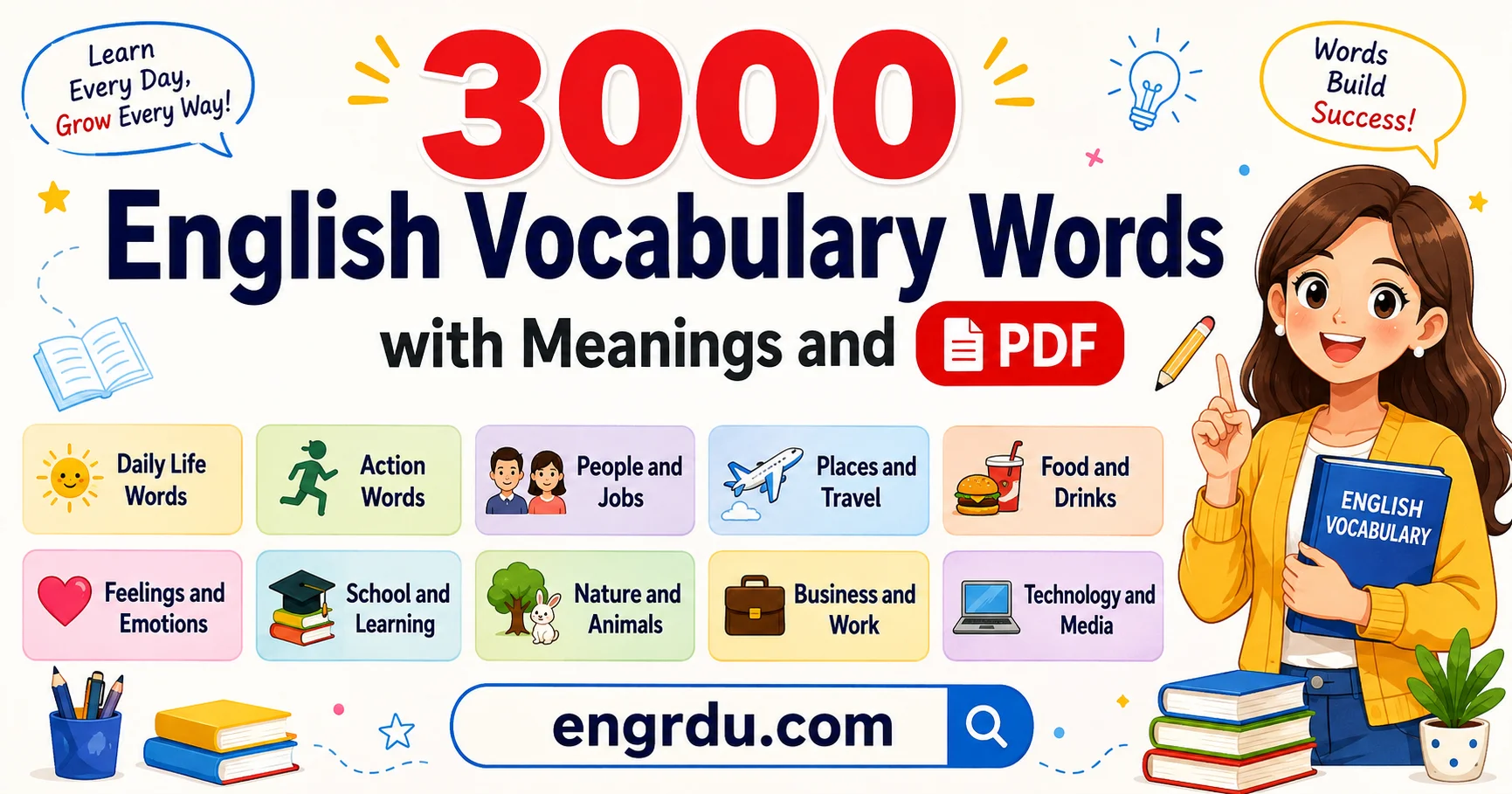
Building a strong English vocabulary can help you communicate more clearly, understand texts faster, and feel more confident in everyday conversations. To support your learning, we have prepared a complete PDF containing 3,000 English vocabulary words with meanings.
The vocabulary PDF is designed for elementary and intermediate learners, ESL students, school learners, and anyone who wants to improve their English word knowledge.
You can download the complete book and study the words at your own pace.
What Is English Vocabulary?
English vocabulary refers to the words people understand and use when reading, writing, listening, and speaking.
A learner may recognize many words while reading but struggle to use them in conversation. This happens because vocabulary knowledge develops in different ways.
There are two main types of vocabulary:
| Vocabulary Type | Explanation |
|---|---|
| Receptive vocabulary | Words you understand while reading or listening |
| Productive vocabulary | Words you can use correctly while speaking or writing |
A good learning routine should improve both types. You should understand new words and practise using them in meaningful sentences.
About the 3000 English Vocabulary Words PDF
The 3000 English Vocabulary Words PDF is a complete learning resource containing commonly useful English words with clear meanings.
Instead of placing thousands of entries on one long webpage, we have organized them in a downloadable book. This makes the list easier to read, save, print, and study offline.
The book gives learners quick access to a large collection of English words without unnecessary explanations. It is suitable for regular vocabulary practice at home, school, or an English-language class.
What Does the Vocabulary PDF Include?
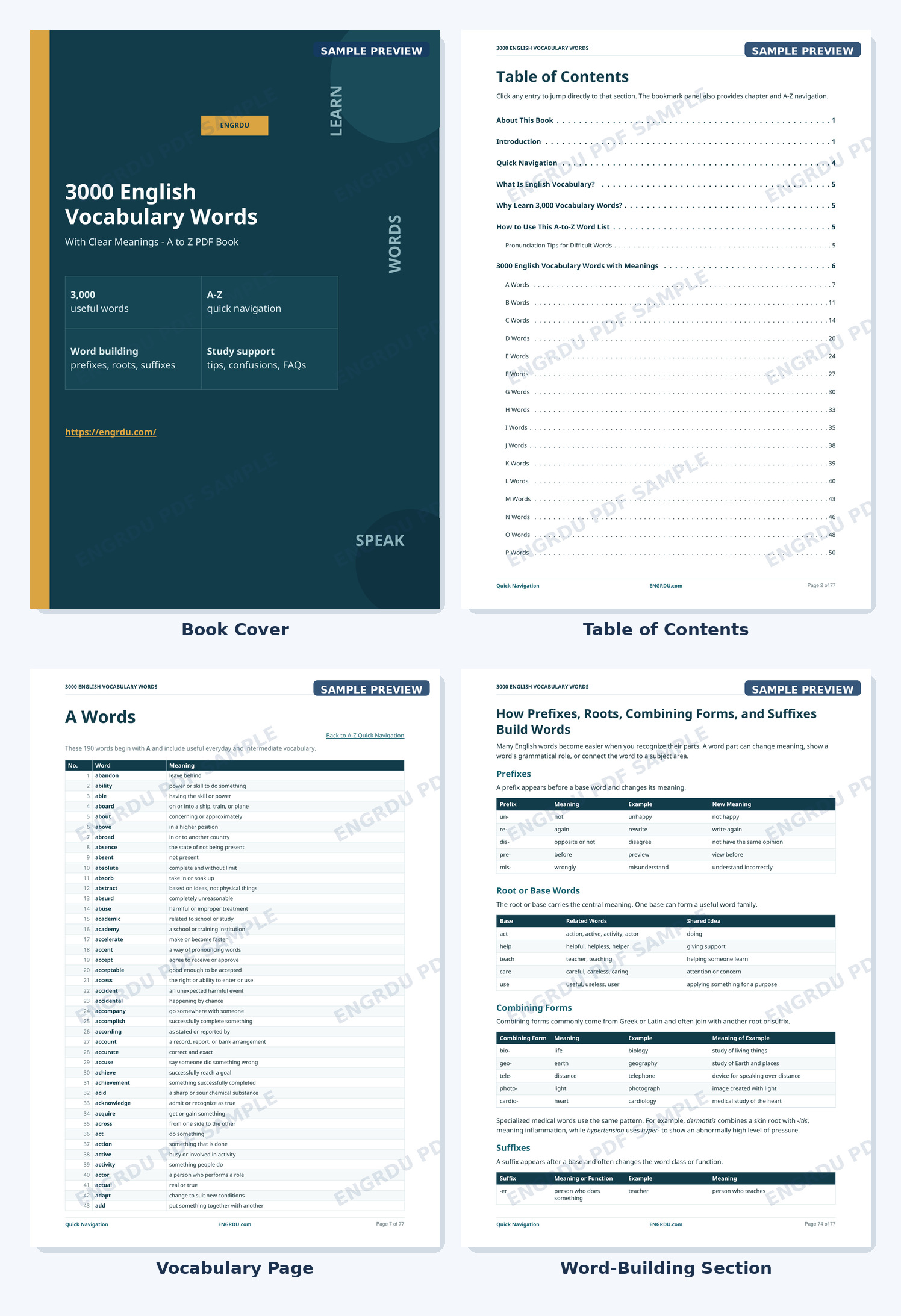
The PDF contains more than a basic word list. It has been designed as a practical vocabulary book with useful navigation and learning sections.
Inside the book, you will find:
- 3,000 English vocabulary words with clear meanings
- Words arranged from A to Z
- Numbered entries for easy tracking
- A clickable table of contents
- A-Z quick navigation
- Searchable and selectable text
- Vocabulary learning categories and topics
- Prefixes, roots, and suffixes
- Commonly confused vocabulary
- A four-week study plan
- Vocabulary learning questions and answers
- Page numbers, headings, and bookmarks
These features allow learners to move quickly between different letters and study sections.
Examples of English Vocabulary Included in the PDF
The 3,000 English Vocabulary Words PDF includes words from different areas of everyday and academic English. Here are a few examples to give you an idea of what you will find in the complete vocabulary book.
Everyday English Vocabulary
| Word | Meaning | Example |
|---|---|---|
| Achieve | To successfully complete or reach something | She worked hard to achieve her goal. |
| Advice | An opinion or suggestion about what someone should do | My teacher gave me useful advice. |
| Attend | To go to a place or event | I attend English classes every week. |
| Benefit | A helpful or useful result | Reading has many benefits. |
| Choice | An act of choosing between possibilities | You have a choice between two options. |
| Decide | To make a choice after thinking | We need to decide before Friday. |
| Effort | The energy used to do something | Learning a language requires effort. |
| Improve | To become better or make something better | Practice can improve your English. |
| Prepare | To make something ready | She prepared for the examination. |
| Support | To help someone or something | Good teachers support their students. |
Education and Learning Vocabulary
| Word | Meaning | Example |
|---|---|---|
| Assignment | A piece of work given to a student | I finished my English assignment. |
| Concentrate | To give full attention to something | Try to concentrate during the lesson. |
| Curriculum | The subjects and content taught in a course | English is part of the school curriculum. |
| Explain | To make something clear or understandable | The teacher explained the new topic. |
| Knowledge | Information and understanding gained through learning | Reading increases your knowledge. |
| Lesson | A period of teaching or learning | Today’s lesson is about vocabulary. |
| Practice | Repeated activity done to improve a skill | Regular practice improves pronunciation. |
| Research | Careful study to discover information | Students conducted research for the project. |
| Skill | An ability gained through learning or practice | Speaking is an important language skill. |
| Understand | To know the meaning of something | I understand the question now. |
Feelings and Personality Vocabulary
| Word | Meaning | Example |
|---|---|---|
| Anxious | Worried or nervous about something | He felt anxious before the interview. |
| Confident | Feeling sure about your abilities | She is confident when speaking English. |
| Curious | Wanting to know or learn something | Children are naturally curious. |
| Generous | Willing to give or share with others | He is generous with his time. |
| Honest | Truthful and sincere | An honest person tells the truth. |
| Patient | Able to wait without becoming annoyed | Good teachers are patient with learners. |
| Polite | Showing good manners and respect | It is polite to say thank you. |
| Proud | Feeling pleased about something you have done | She was proud of her achievement. |
| Responsible | Having a duty and taking care of it | He is responsible for the project. |
| Worried | Feeling concerned about a problem | She was worried about the result. |
Nature and Environment Vocabulary
| Word | Meaning | Example |
|---|---|---|
| Climate | The usual weather conditions of a place | The region has a warm climate. |
| Forest | A large area covered mainly with trees | Many animals live in the forest. |
| Habitat | The natural home of a plant or animal | Pollution can destroy an animal’s habitat. |
| Pollution | Harmful substances added to the environment | Air pollution affects many cities. |
| Protect | To keep someone or something safe from harm | We should protect natural resources. |
| Recycle | To process used materials so they can be used again | Many households recycle plastic and paper. |
| Resource | A useful supply of something | Water is an important natural resource. |
| Species | A group of similar living organisms | This species is found in tropical regions. |
| Sustainable | Able to continue without seriously damaging resources | Sustainable farming protects the environment. |
| Wildlife | Animals living in their natural environment | The park is home to diverse wildlife. |
Work and Communication Vocabulary
| Word | Meaning | Example |
|---|---|---|
| Communicate | To share information, ideas, or feelings | People communicate in different ways. |
| Deadline | The latest time or date for completing something | The project deadline is Monday. |
| Discuss | To talk about something in detail | We discussed the problem in class. |
| Experience | Knowledge or skill gained through doing something | She has five years of work experience. |
| Manage | To organize or control something successfully | He manages a small team. |
| Opportunity | A favorable chance to do something | The course provides a good learning opportunity. |
| Professional | Related to a job or profession | She gave a professional presentation. |
| Respond | To answer or react to something | Please respond to the email. |
| Schedule | A plan showing when activities will happen | Check the meeting schedule. |
| Solution | An answer to a problem | We found a practical solution. |
Useful Action Words
| Word | Meaning | Example |
|---|---|---|
| Analyze | To examine something carefully | Students analyzed the information. |
| Avoid | To stay away from something | Try to avoid unnecessary mistakes. |
| Create | To make something new | They created a study plan. |
| Develop | To grow or improve something over time | She developed strong reading skills. |
| Discover | To find something previously unknown | Scientists discovered a new method. |
| Encourage | To give someone confidence or support | Parents should encourage children to read. |
| Examine | To look at something carefully | The teacher examined the answers. |
| Identify | To recognize or name something | Can you identify the correct word? |
| Reduce | To make something smaller or less | We need to reduce waste. |
| Solve | To find an answer to a problem | He solved the difficult question. |
Vocabulary by Level and Use
The complete collection also gives learners exposure to words that can be used in different situations. Some are common in everyday conversations, while others are more useful in school, writing, reading, and formal communication.
| Vocabulary Area | Examples |
|---|---|
| Everyday English | advice, choice, effort, improve, prepare |
| Education | assignment, curriculum, lesson, research, skill |
| Communication | communicate, discuss, respond, explain, support |
| Work | deadline, experience, manage, professional, schedule |
| Feelings | anxious, confident, curious, patient, worried |
| Environment | climate, habitat, pollution, recycle, wildlife |
| Actions | analyze, create, discover, identify, solve |
| Descriptions | accurate, careful, effective, important, useful |
Who Can Use This Vocabulary PDF?
The vocabulary book is suitable for a wide range of learners.
It can be used by:
- Elementary English learners
- Intermediate English learners
- ESL and EFL students
- School and college learners
- Non-native English speakers
- Teachers preparing vocabulary activities
- Parents helping children learn English
- Students preparing for general English tests
The words are useful for everyday communication, academic learning, reading practice, writing tasks, and classroom activities.
Why Is Learning English Vocabulary Important?
Vocabulary affects almost every English-language skill.
Better Reading
A wider vocabulary helps you understand stories, articles, instructions, emails, and school texts with fewer interruptions.
Clearer Writing
Knowing more words allows you to express ideas accurately and avoid repeating the same basic terms.
More Confident Speaking
Vocabulary gives you more options when describing people, places, actions, feelings, events, and opinions.
Improved Listening
Recognizing common words makes it easier to follow conversations, videos, lessons, and spoken instructions.
Stronger Comprehension
Word knowledge helps you understand the meaning of complete sentences, even when the grammar is unfamiliar.
Grammar helps you arrange words correctly, but vocabulary gives you the words needed to communicate.
How Are the 3000 English Words Organized?
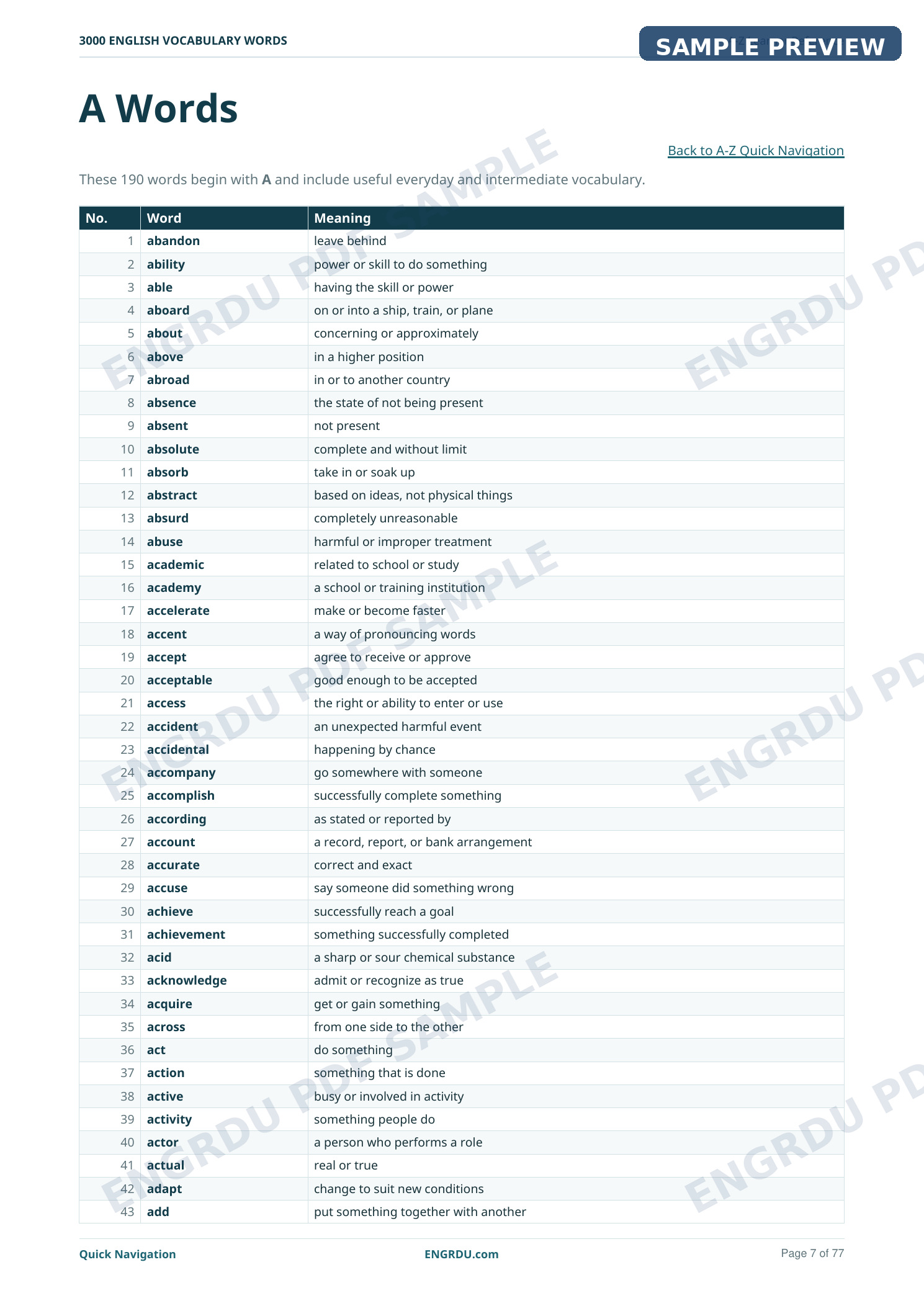
The words in the PDF are arranged alphabetically from A to Z.
This structure allows you to:
- Find a particular word quickly
- Study one letter at a time
- Review words in manageable groups
- Mark completed sections
- Return to difficult words later
The book also includes internal links and bookmarks. You can select a letter from the navigation section and move directly to its vocabulary pages.
Because the PDF text is searchable, you can also use your PDF reader’s search function to locate a word.
What Types of Words Are Included?
The complete list covers vocabulary from several useful areas of English.
These include words related to:
- People and relationships
- Actions and activities
- Feelings and emotions
- Education and learning
- Work and communication
- Home and daily routines
- Travel and transport
- Nature and the environment
- Health and the human body
- Time, numbers, and measurement
- Descriptions and qualities
- Problems, choices, and decisions
The list also includes different parts of speech, such as nouns, verbs, adjectives, and adverbs.
This variety helps learners understand English across different situations rather than memorizing words from only one topic.
How to Use the Vocabulary PDF Effectively
Downloading the PDF is only the first step. Regular practice helps move new words into your long-term memory.
Learn a Manageable Number Each Day
Study around 10 to 15 words daily. Trying to memorize too many words at once often leads to quick forgetting.
Read the Meaning Carefully
Make sure you understand the main idea of each word. Do not memorize spelling without understanding its use.
Write Your Own Sentences
Create one short sentence for every new word. Personal examples are often easier to remember than copied sentences.
Say the Words Aloud
Speaking new vocabulary helps you remember pronunciation and become more comfortable using the words in conversation.
Review Previous Words
Review new words after one day, three days, one week, and two weeks. Repeated review strengthens memory.
Group Related Words
Connect words that belong to the same topic, such as education, travel, work, feelings, or health.
Use the Words Naturally
Try using new vocabulary in conversations, messages, short paragraphs, diary entries, or classroom answers.
A Four-Week Vocabulary Study Plan
You do not need to memorize all 3,000 words immediately. A planned routine is more effective.
| Week | Main Activity |
|---|---|
| Week 1 | Learn new words and read their meanings |
| Week 2 | Write short sentences using selected words |
| Week 3 | Group words by topic and part of speech |
| Week 4 | Review difficult words and test yourself |
Repeat this cycle with new sections of the PDF.
You can also divide the book alphabetically. For example, study words beginning with A and B first, then continue with C and D.
Learning Words Through Prefixes, Roots, and Suffixes
Many English words contain smaller meaningful parts. Understanding these parts can help learners recognize unfamiliar vocabulary.
| Word Part | Position | Function |
|---|---|---|
| Prefix | Beginning of a word | Changes or adds to the meaning |
| Root | Main part of a word | Carries the central meaning |
| Suffix | End of a word | Changes meaning or grammatical form |
For example, the prefix un- often expresses a negative meaning, while the suffix -ful often means “full of.”
Learning common word parts can help you understand groups of related words rather than memorizing every word separately.
Common Vocabulary Learning Mistakes
Avoid these common problems:
- Memorizing long lists without using the words
- Learning spelling but ignoring pronunciation
- Studying once without reviewing later
- Using advanced words without understanding their meaning
- Translating every word instead of learning it in context
A word becomes useful when you can recognize it, understand it, pronounce it, and use it correctly.
Download the Complete 3000 English Vocabulary Words PDF
The downloadable book gives you the complete A-to-Z list in one organized resource.
It can be opened on a mobile phone, tablet, laptop, or desktop computer. You may also print selected pages for classroom or personal practice.
The PDF includes page numbering, clickable navigation, bookmarks, clear vocabulary tables, study guidance, and the complete list of words and meanings.
Download the Complete 3000 English Vocabulary Words with Meanings PDF
Published by ENGRDU
Website: https://engrdu.com/
FAQs About Vocabulary Words
What are English vocabulary words?
English vocabulary words are the words people understand or use when reading, writing, listening, and speaking in English.
How many vocabulary words should I learn daily?
Most learners can study 10 to 15 words daily. The right number depends on available time, review habits, and learning ability.
Is the 3000 English vocabulary PDF suitable for beginners?
Yes. The PDF is designed mainly for elementary and intermediate learners who want to build practical English word knowledge.
Are the words arranged alphabetically?
Yes. All vocabulary words are organized from A to Z, making individual words and letter sections easier to locate.
Can I study the vocabulary PDF offline?
Yes. After downloading the file, you can open and study it without an internet connection on a supported device.
Does the PDF include meanings?
Yes. Every vocabulary entry in the complete PDF includes a clear meaning written for English learners.
Can teachers use this PDF in class?
Yes. Teachers can use it for vocabulary lessons, spelling practice, speaking activities, revision tasks, and student homework.
How can I remember vocabulary for longer?
Learn a few words daily, create sentences, say them aloud, review regularly, and use them in speaking and writing.
Conclusion
A strong English vocabulary can improve reading, writing, listening, and speaking. However, vocabulary growth requires regular practice rather than one-time memorization.
The 3000 English Vocabulary Words with Meanings PDF provides a complete, organized list for elementary and intermediate learners. Download the book, choose a manageable daily target, and review your words regularly.
Download the 3000 English Vocabulary PDF and begin building your word knowledge step by step.