
Pronouns are words that replace nouns in a sentence, such as he, she, it, they, and we. In this Grammar lesson, understanding pronouns helps you avoid repeating the same nouns and makes your sentences smoother. When you master pronouns, your speaking, writing, and reading become easier and more natural. In this blog post, you will discover 100+ examples of pronouns in a sentence to help you practice and use them correctly in everyday English.
What Are Pronouns?
Pronouns are words that replace nouns in a sentence. Instead of saying the same noun again, we use a pronoun to make the sentence shorter and clearer.
Example:
Sarah is my friend. She is very kind.
Here, she replaces Sarah.
100+ Examples of Pronouns in Sentences
Below are over 100 examples of pronouns used in sentences. Read them carefully to understand how they are used in daily English.

Personal Pronouns Examples
- I am reading a new book.
- You look very happy today.
- He plays football every evening.
- She sings beautifully in the choir.
- It is raining outside.
- We are going to the park.
- They live in a small town.
- I know what you mean.
- You can sit beside me.
- He works in a hospital.
- She loves her little cat.
- It looks very cold today.
- We plan to travel soon.
- They enjoy playing chess.
- I saw you at the station.
Possessive Pronouns Examples
- This pencil is mine.
- That coat is yours.
- The red car is his.
- The pretty dress is hers.
- The garden behind the house is ours.
- The toys on the table are theirs.
- Is this seat mine or yours?
- Those shoes are his, not mine.
- This phone is hers, not yours.
- The house on the corner is ours.
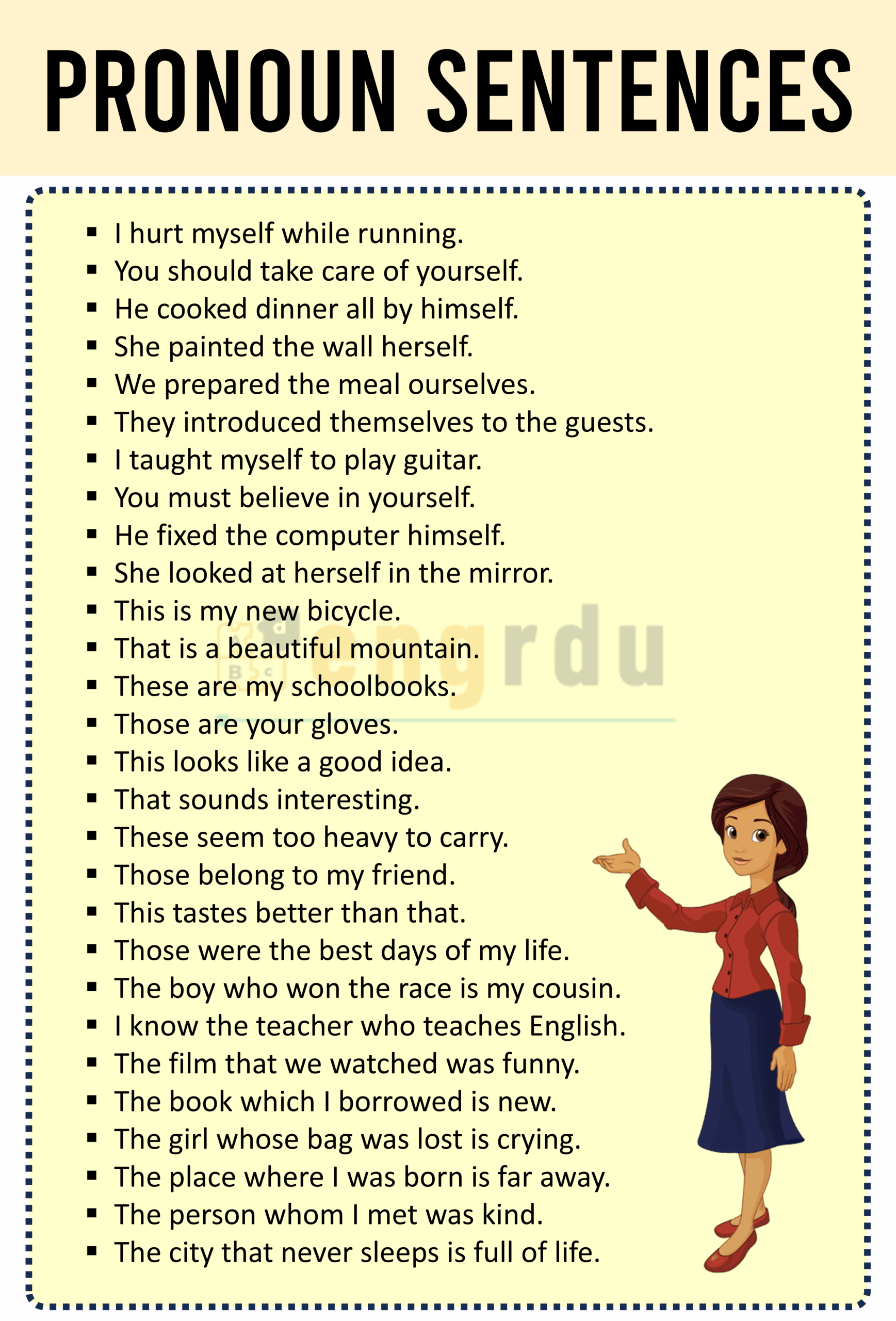
Reflexive Pronouns Examples
- I hurt myself while running.
- You should take care of yourself.
- He cooked dinner all by himself.
- She painted the wall herself.
- We prepared the meal ourselves.
- They introduced themselves to the guests.
- I taught myself to play guitar.
- You must believe in yourself.
- He fixed the computer himself.
- She looked at herself in the mirror.
Demonstrative Pronouns Examples
- This is my new bicycle.
- That is a beautiful mountain.
- These are my schoolbooks.
- Those are your gloves.
- This looks like a good idea.
- That sounds interesting.
- These seem too heavy to carry.
- Those belong to my friend.
- This tastes better than that.
- Those were the best days of my life.
Relative Pronouns Examples
- The boy who won the race is my cousin.
- I know the teacher who teaches English.
- The film that we watched was funny.
- The book which I borrowed is new.
- The girl whose bag was lost is crying.
- The place where I was born is far away.
- The person whom I met was kind.
- The city that never sleeps is full of life.
- The car which broke down is his.
- The woman who helped me was a nurse.

Interrogative Pronouns Examples
- Who is knocking at the door?
- What is your favourite colour?
- Which one do you prefer?
- Whose bag is this?
- Whom did you see at the market?
- What happened to the lights?
- Who told you the news?
- Which road should we take?
- Whose turn is it next?
- Whom are you talking about?
Indefinite Pronouns Examples
- Someone left their umbrella here.
- Nobody knows the secret.
- Everybody enjoyed the concert.
- Anyone can learn English with practice.
- Everything was ready before the event.
- Something smells delicious in the kitchen.
- Each of us tried our best.
- Few understood the real meaning.
- Many came to visit the museum.
- Several students passed the exam.
- Both were tired after the match.
- Either can go with me.
- Neither of them was late.
- All were present in the meeting.
- Some liked the movie, others didn’t.
- One must always be honest.
- Everyone should respect others.
- No one answered the question.
- Someone is waiting at the gate.
- Anybody can join the club.
Emphatic Pronouns Examples
- I myself don’t believe it.
- You yourself said it was true.
- He himself finished the project.
- She herself cleaned the room.
- We ourselves organised the event.
- They themselves made the decorations.
20 Examples of Pronouns in a Sentence
- This is where I live.
- That is who helped us.
- Those are what we wanted.
- It is she who knows the answer.
- He is what they call a genius.
- What we need is teamwork.
- Who we choose will lead us.
- That’s whose car was stolen.
- This is why I left early.
- That is how I learned English.
- These are what make life beautiful.
- Those are who will perform tonight.
- It is they who finished first.
- This is when I realised my mistake.
- Each has their own opinion.
- Everyone was happy with the result.
- Nothing is impossible with effort.
- Somebody has to do the job.
- Everything happens for a reason.
- Anybody can be kind.
- Nobody helped the poor man.
- Something went wrong with the car.
- All is well now.
- Few were late to class.
Pronouns make your sentences shorter, clearer, and more natural. By learning how to use them, you’ll write and speak English more confidently. Read the examples again and try to make your own sentences using pronouns.
FAQs about Pronoun Examples in Sentences
What is a pronoun in English grammar?
A pronoun is a word used instead of a noun to avoid repetition. For example, in “Maria is my friend. She is kind,” the word she replaces Maria.
What are the 7 main types of pronouns?
The main types of pronouns are personal, possessive, reflexive, demonstrative, relative, interrogative, and indefinite pronouns. Each has a different use in a sentence.
What are some examples of pronouns in a sentence?
Examples include: He plays football., This is mine., She hurt herself., Who is calling?, and Someone knocked on the door.
How do pronouns make sentences easier to read?
Pronouns replace repeated nouns, making sentences shorter and smoother. For example, instead of “Anna likes Anna’s bag,” we say “Anna likes her bag.”
What are common mistakes when using pronouns?
Common mistakes include using the wrong pronoun for gender or number, and unclear references. Always match the pronoun with the noun it replaces.
Read More