


Adjectives ending in -ed describe how a person feels. They often come from verbs and show emotions or reactions. For example, “bored,” “excited,” and “tired” tell us about someone’s feelings. In this blog post, you will learn how -ed adjectives are formed, when to use them, and how they are different from -ing adjectives. Understanding these adjectives will help you speak more naturally, write better sentences, and express your feelings in English with confidence.
What are -ed Adjectives?
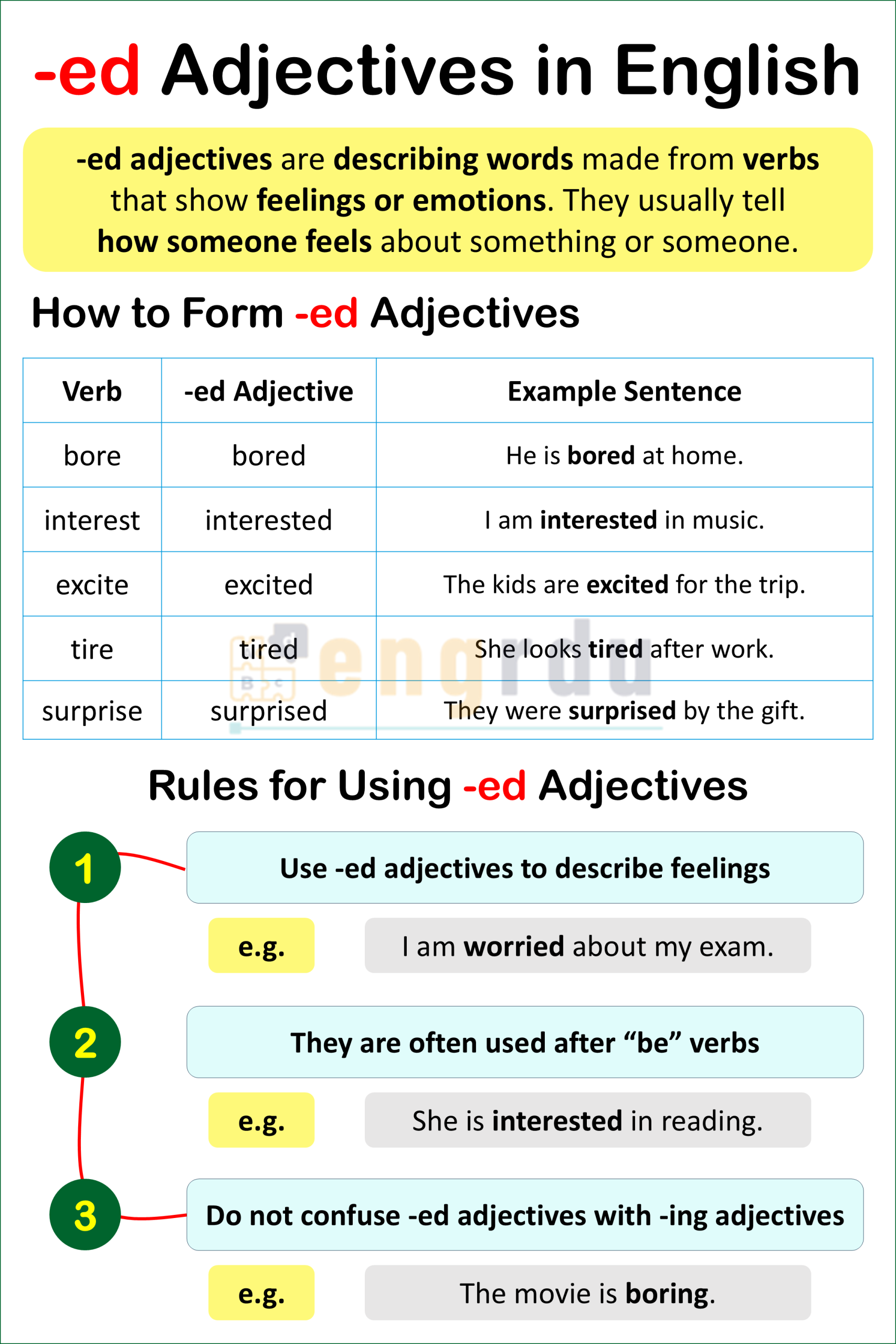
-ed adjectives are describing words made from verbs that show feelings or emotions. They usually tell how someone feels about something or someone.
Example:
- I am bored. → (I feel bored.)
- She is excited. → (She feels excited.)
In short:
-ed adjectives = Feeling words.
How to Form -ed Adjectives
You can make -ed adjectives by adding “-ed” to a verb.
| Verb | -ed Adjective | Example Sentence |
|---|---|---|
| bore | bored | He is bored at home. |
| interest | interested | I am interested in music. |
| excite | excited | The kids are excited for the trip. |
| tire | tired | She looks tired after work. |
| surprise | surprised | They were surprised by the gift. |
ed Adjectives in English
Rules for Using -ed Adjectives
1. Use -ed adjectives to describe feelings.
I am worried about my exam.
He feels relaxed after yoga.
2. They are often used after “be” verbs (am, is, are, was, were).
She is interested in reading.
They were shocked by the news.
3. Do not confuse -ed adjectives with -ing adjectives.
I am bored. (feeling)
The movie is boring. (thing causing the feeling)
Difference Between -ed and -ing Adjectives
| -ed Adjective | -ing Adjective | Meaning |
|---|---|---|
| I am bored. | The lesson is boring. | Person feels bored → Thing causes boredom |
| She is interested. | The story is interesting. | Feeling → Cause of feeling |
| They are tired. | The job is tiring. | Emotion → Source of emotion |
Tip:
Use -ed when talking about how you feel.
Use -ing when talking about what makes you feel that way.
Simple Adjectives and -ed Adjectives
| Simple Adjective | -ed Adjective | Example Sentence |
|---|---|---|
| boring | bored | I am bored in the class. |
| interesting | interested | She is interested in science. |
| tiring | tired | He feels tired after work. |
| exciting | excited | We are excited about the trip. |
| surprising | surprised | They were surprised by the result. |
| confusing | confused | I am confused by the question. |
| worrying | worried | She looks worried about the test. |
| annoying | annoyed | He is annoyed with the noise. |
| satisfying | satisfied | I am satisfied with my marks. |
| relaxing | relaxed | She feels relaxed on the beach. |
| disappointing | disappointed | We were disappointed by the movie. |
| shocking | shocked | He was shocked by the news. |
| embarrassing | embarrassed | I felt embarrassed after falling. |
| pleasing | pleased | They are pleased with the service. |
| frustrating | frustrated | He seems frustrated with his work. |
| confusing | confused | The lesson is confusing, but I am confused. |
| depressing | depressed | She feels depressed in bad weather. |
| amazing | amazed | We were amazed by the magician. |
| disappointing | disappointed | I’m disappointed in my test score. |
| terrifying | terrified | The child was terrified of the dog. |

Examples of –ed Adjectives
When to Use -ed Adjectives
After “be” verbs:
I am tired.
She is excited.
After “feel” or “seem”:
I feel worried.
He seems interested.
After “look” or “sound”:
She looks surprised.
That sounds confused.
Summary
| Function | Example | Meaning |
|---|---|---|
| Show feelings | I am bored. | Describe emotion |
| After “be” verbs | She is excited. | State of feeling |
| Compare with -ing | The movie is boring, but I am bored. | Cause vs. Feeling |
Always remember:
-ed adjectives = describe feelings.
-ing adjectives = describe things that cause feelings.
Learning these adjectives helps you speak more naturally, describe emotions easily, and sound fluent in everyday English.
FAQs
What are -ed adjectives in English grammar?
-ed adjectives are describing words that show how someone feels. They are made by adding “-ed” to a verb, such as bored, interested, or excited.
What is the difference between -ed and -ing adjectives?
-ed adjectives describe feelings (how a person feels), while -ing adjectives describe things or situations that cause those feelings.
Example: I am bored. (feeling) / The movie is boring. (thing)
How do you form -ed adjectives?
Answer: You form -ed adjectives by adding “-ed” to a verb.
bore → bored, interest → interested, excite → excited.
When do we use -ed adjectives?
Answer: Use -ed adjectives when you talk about emotions or feelings.
She is tired.
They were surprised by the news.
What are some common examples of -ed adjectives?
Some common -ed adjectives are: bored, tired, interested, excited, worried, surprised, confused, relaxed, and annoyed.
Read More





Leave a Comment