In this blog post, you will learn the names of important dissection, tools, and vocabulary used in science labs and classrooms. These tools help students and scientists examine plants, animals, and other specimens carefully. English learners often encounter these words in biology lessons, science experiments, and textbooks. When you understand dissection tools names, it becomes easier to talk about lab activities, follow instructions, and read science materials. Learning this vocabulary also improves speaking, reading, writing, and listening skills related to scientific work. As you continue reading, you will learn the common dissection tools and understand how each one is used.
What Are Dissection Tools?
Dissection tools are instruments used to study the inside of plants, animals, or other specimens. Scientists and students use these tools in labs for learning, research, and experiments.
Each tool has a specific purpose. Some tools cut or slice specimens, while others help hold, move, or examine small parts. Learning these words helps English learners understand science vocabulary clearly.
Why Learn Dissection Tools Vocabulary?
Dissection tools vocabulary is important for students and science learners. These words appear in textbooks, lab manuals, and classroom instructions.
When learners know these words, they can follow experiments, describe lab activities, and explain observations in English. This vocabulary also strengthens communication about scientific processes.
Common Dissection Tools Names in English
Below are important dissection tools and their uses.
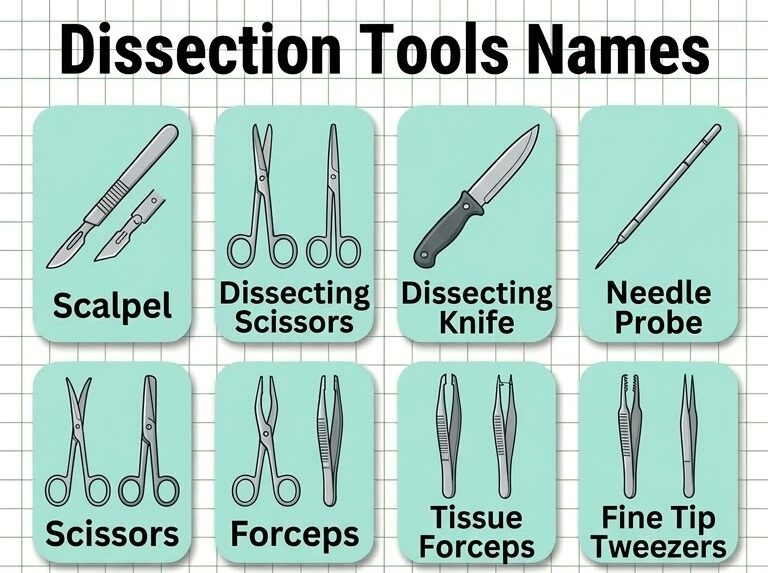
- Scalpel – A small, sharp knife used to cut specimens carefully.
- Dissecting Scissors – Used for precise cutting of tissue or materials.
- Forceps (Tweezers) – Used to hold or pick up small specimens.
- Probe – A pointed tool used to examine or explore parts of a specimen.
- Dissecting Pins – Small pins used to hold specimens in place on a tray.
- Dissecting Tray – A flat tray where specimens are placed during dissection.
- Needle Probe – A thin needle used to point or separate tissues.
- Tissue Forceps – Special forceps for delicate tissue handling.
- Scissors (Curved or Straight) – Used to cut specific shapes or layers of tissue.
- Ruler or Measuring Scale – Used to measure specimen parts.
- Magnifying Glass – Helps see small details clearly.
- Petri Dish – A small dish used to hold specimens or small samples.
- Dissecting Needles – Sharp tools to separate tissues carefully.
- Tweezers with Fine Tips – For picking tiny or fragile parts.
- Gloves – Protect hands during experiments.
- Lab Coat – Protects clothing during dissections.
- Safety Goggles – Protects eyes from chemicals or sharp tools.
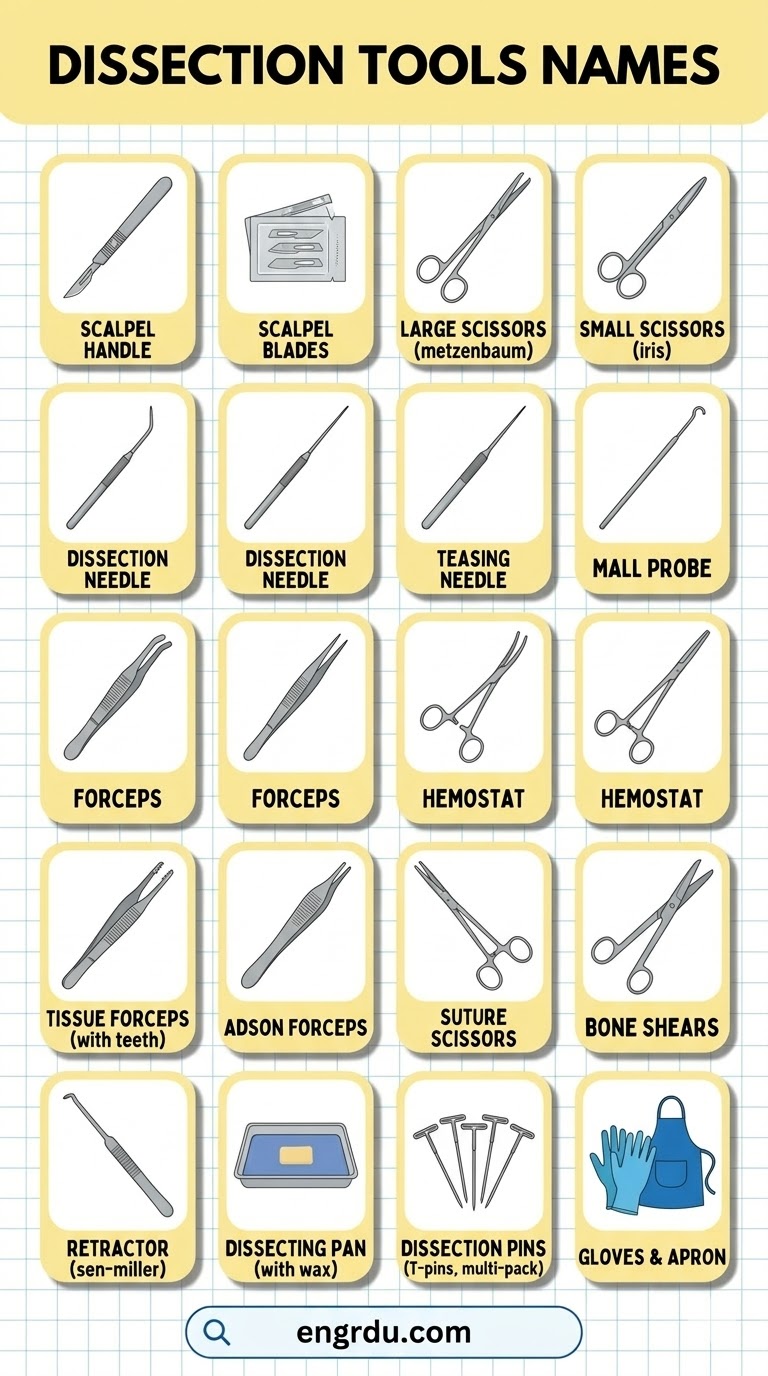
These tools help students and scientists study specimens carefully, safely, and accurately.
Complete List of Dissection Tools and Equipment
Cutting and Slicing Tools
- Scalpel
- Dissecting Scissors (Curved and Straight)
- Dissecting Knife
- Needle Probe
- Scissors (Standard for tissues)
Holding and Examining Tools
- Forceps (Tweezers)
- Tissue Forceps
- Fine Tip Tweezers
- Probe
- Dissecting Needles
- Magnifying Glass
Pinning and Positioning Tools
- Dissecting Pins
- Dissecting Tray
- Petri Dish
- Pin Cushion (for pins)
Measuring and Observation Tools
- Ruler or Measuring Scale
- Caliper (optional for precise measurements)
- Magnifying Glass
- Microscope (for small specimens)
Safety and Protective Equipment
- Gloves
- Lab Coat
- Safety Goggles
- Apron (optional for extra protection)
Supporting Equipment
- Specimen Storage Containers
- Forceps Stand (optional for organization)
- Tongs (for larger specimens)
Basic Dissection Tools List for Beginners
For beginners, essential dissection tools include:
- Scalpel
- Dissecting Scissors
- Forceps
- Probe
- Dissecting Pins
- Dissecting Tray
- Needle Probe
- Tweezers
- Ruler
- Magnifying Glass
With these tools, students can start lab experiments safely and understand scientific observations.
Conclusion
Dissection tools vocabulary is important for science learners and English students. Knowing these words helps learners follow experiments, describe specimens, and communicate lab observations confidently.
Practice using these words in sentences or while doing experiments to strengthen your science and English vocabulary skills.
Related Articles:
FAQs
What are the tools used in dissection?
Dissection tools include a scalpel, dissecting scissors, forceps, probes, dissecting pins, and a dissecting tray. These tools help examine, cut, and hold specimens safely.
What instrument is used for dissection?
The main dissection instruments are the scalpel, forceps, and dissecting scissors. Probes and pins are also used to explore and secure specimens during study.
What is a dissecting instrument?
A dissecting instrument is a tool used to cut, examine, or handle specimens in a lab. Examples include scalpels, scissors, forceps, probes, and pins.
What’s in a dissection kit?
A typical dissection kit contains a scalpel, dissecting scissors, forceps, probes, dissecting pins, and a dissecting tray. Some kits also include a ruler, magnifying glass, and gloves.
Which tools help hold specimens during dissection?
Dissecting pins, forceps, and probes help hold or stabilize specimens on a tray, making it easier to examine or cut without damage.
What safety tools are used during dissection?
Safety tools include gloves, lab coats, and goggles. These protect students from sharp instruments and chemicals during experiments.