
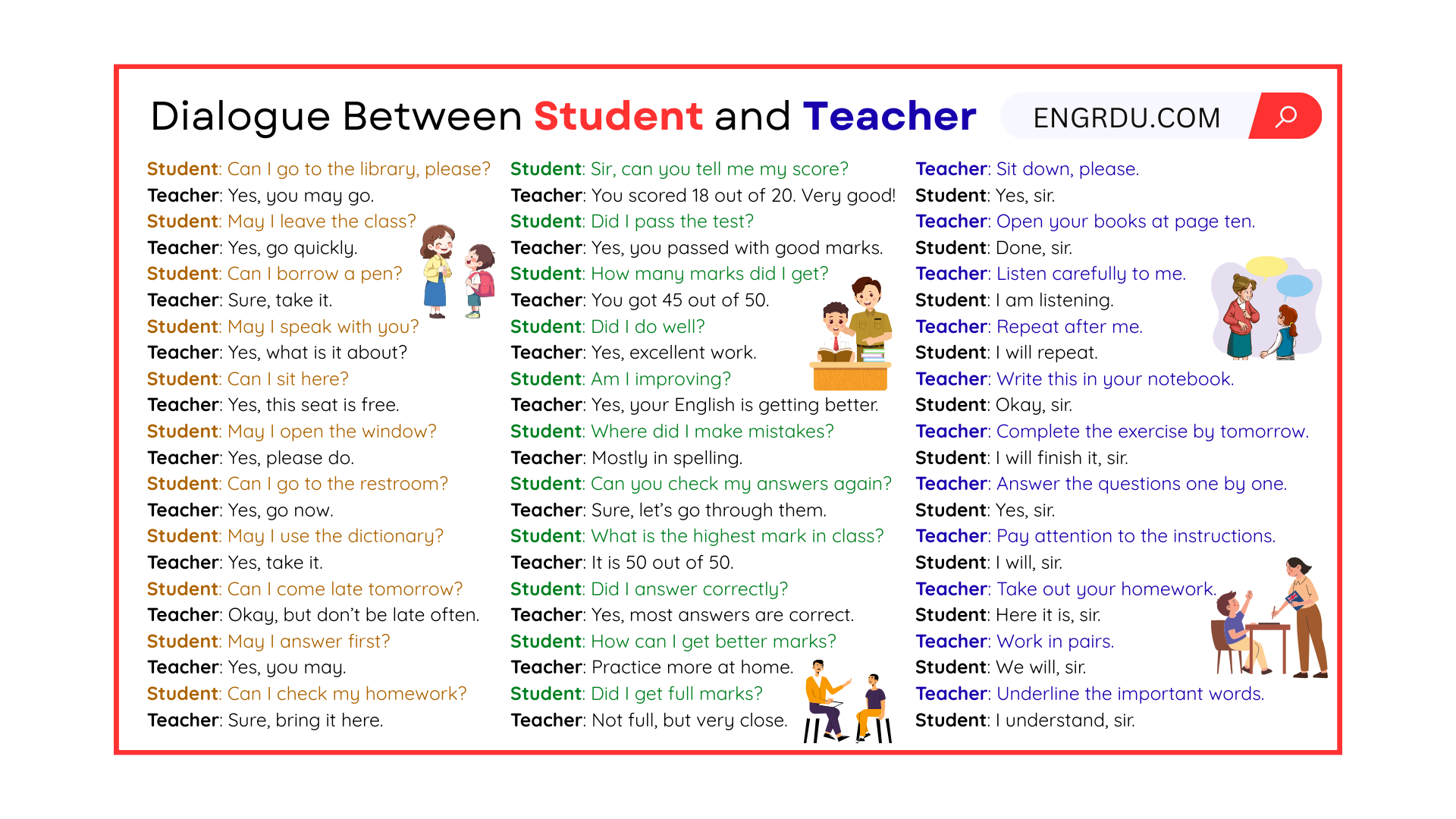
In this blog post, you will learn a dialogue between a student and a teacher in English. Knowing this dialogue helps you understand how to ask questions, answer queries, and communicate clearly in the classroom. It also improves your speaking and listening skills because you can practice real-life classroom conversations confidently. By studying and practicing this dialogue, you can use similar sentences in your own school or learning environment. Learning student-teacher dialogues will make your English more practical and useful for daily school life.
Why Dialogues Are Important
- Improve English speaking
- Build confidence in classroom
- Learn polite communication
- Prepare for real-life situations
Contexts of Student and Teacher Dialogues
Dialogues can happen in different situations in school. Here are the most common ones:
| Context | Purpose | Example |
|---|---|---|
| Asking a question | The student wants help | Student: Excuse me, I don’t understand this question. Teacher: No problem. Let me explain it slowly. |
| Giving instructions | The teacher explains tasks | Teacher: Please complete your homework by tomorrow. Student: Yes, I will do it. |
| Discussing marks | Talking about exams | Student: Sir, can you tell me my score? Teacher: You scored very well in English. |
| Requesting permission | Student needs leave | Student: Can I go to the library, please? Teacher: Yes, you may go. |
Dialogue Between Student and Teacher for Asking Questions
Student: Excuse me, sir. I don’t understand this question.
Teacher: No problem. Let me explain it slowly.
Student: Can you help me with the homework?
Teacher: Sure! Which part is difficult for you?
Student: What does this word mean?
Teacher: It means “happy” or “joyful.”
Student: I am confused about past tense.
Teacher: Okay, let’s practice together.
Student: Could you repeat that, please?
Teacher: Yes, I will say it again.
Student: What is the answer to this question?
Teacher: Try to think first, then I will help.
Student: How do I write this sentence correctly?
Teacher: Look at the example on the board.
Student: Can you show me an example?
Teacher: Yes, here is one.
Student: Why is this rule important?
Teacher: It helps you speak English correctly.
Student: I don’t understand this part. Can you explain?
Teacher: Of course, pay attention now.
Student: How can I solve this problem?
Teacher: Follow the steps in the book.
Student: Can I ask about the exercise?
Teacher: Yes, what is your question?
Student: Is this the right way?
Teacher: Almost right, try again.
Student: Can you check my work?
Teacher: Sure, let’s see it together.
Student: Could you tell me more about this?
Teacher: Yes, I will explain everything.
Student: I have a question about grammar.
Teacher: Go ahead, ask me.
Student: What should I do next?
Teacher: First complete this exercise.
Student: Can you explain it slowly again?
Teacher: Yes, I will speak slowly this time.
Student: I don’t understand this rule.
Teacher: No worries, we will practice it.
Student: How do I use this word in a sentence?
Teacher: Try this example: “I am happy today.”

Dialogue Between Student and Teacher for Giving Instructions
Teacher: Sit down, please.
Student: Yes, sir.
Teacher: Open your books at page ten.
Student: Done, sir.
Teacher: Listen carefully to me.
Student: I am listening.
Teacher: Repeat after me.
Student: I will repeat.
Teacher: Write this in your notebook.
Student: Okay, sir.
Teacher: Complete the exercise by tomorrow.
Student: I will finish it, sir.
Teacher: Answer the questions one by one.
Student: Yes, sir.
Teacher: Pay attention to the instructions.
Student: I will, sir.
Teacher: Take out your homework.
Student: Here it is, sir.
Teacher: Work in pairs.
Student: We will, sir.
Teacher: Underline the important words.
Student: I understand, sir.
Teacher: Circle the correct answer.
Student: Okay, sir.
Teacher: Practice this at home.
Student: I will, sir.
Teacher: Don’t forget to revise the lesson.
Student: I won’t, sir.
Teacher: Follow the rules carefully.
Student: Yes, sir.
Teacher: Write neatly in your notebook.
Student: I will try, sir.
Teacher: Read the paragraph aloud.
Student: I am ready, sir.
Teacher: Start from question one.
Student: Okay, sir.
Teacher: Submit your work on time.
Student: I will, sir.
Teacher: Listen and repeat the sentences.
Student: I will, sir.

Dialogue Between Student and Teacher for Discussing Marks
Student: Sir, can you tell me my score?
Teacher: You scored 18 out of 20. Very good!
Student: Did I pass the test?
Teacher: Yes, you passed with good marks.
Student: How many marks did I get?
Teacher: You got 45 out of 50.
Student: Did I do well?
Teacher: Yes, excellent work.
Student: Am I improving?
Teacher: Yes, your English is getting better.
Student: Where did I make mistakes?
Teacher: Mostly in spelling.
Student: Can you check my answers again?
Teacher: Sure, let’s go through them.
Student: What is the highest mark in class?
Teacher: It is 50 out of 50.
Student: Did I answer correctly?
Teacher: Yes, most answers are correct.
Student: How can I get better marks?
Teacher: Practice more at home.
Student: Did I get full marks?
Teacher: Not full, but very close.
Student: Am I top of the class?
Teacher: You are in the top three.
Student: Can I discuss my result with you?
Teacher: Yes, come after class.
Student: Is my score enough to pass?
Teacher: Yes, it is enough.
Student: What is the average mark?
Teacher: Around 40 out of 50.
Student: Did I answer all questions?
Teacher: Yes, good effort.
Student: Can you explain my mistakes?
Teacher: Of course, let’s see them.
Student: How much is this question worth?
Teacher: This one is five marks.
Student: Will I improve next time?
Teacher: Yes, if you practice well.
Student: Thank you for checking my marks.
Teacher: You are welcome, keep learning.

Dialogue Between Student and Teacher for Requesting Permission
Student: Can I go to the library, please?
Teacher: Yes, you may go.
Student: May I leave the class?
Teacher: Yes, go quickly.
Student: Can I borrow a pen?
Teacher: Sure, take it.
Student: May I speak with you?
Teacher: Yes, what is it about?
Student: Can I sit here?
Teacher: Yes, this seat is free.
Student: May I open the window?
Teacher: Yes, please do.
Student: Can I go to the restroom?
Teacher: Yes, go now.
Student: May I use the dictionary?
Teacher: Yes, take it.
Student: Can I come late tomorrow?
Teacher: Okay, but don’t be late often.
Student: May I answer first?
Teacher: Yes, you may.
Student: Can I check my homework?
Teacher: Sure, bring it here.
Student: May I bring my notebook?
Teacher: Yes, that’s fine.
Student: Can I ask a question?
Teacher: Yes, go ahead.
Student: May I go home early?
Teacher: Only if you finish your work.
Student: Can I use the computer?
Teacher: Yes, after class.
Student: May I share my answer?
Teacher: Yes, tell the class.
Student: Can I take this book?
Teacher: Yes, but return it tomorrow.
Student: May I work in pairs?
Teacher: Yes, find a partner.
Student: Can I leave for a minute?
Teacher: Yes, hurry back.
Student: May I try this exercise?
Teacher: Yes, start now.

Common Phrases Used in Dialogues
Here are easy phrases that students and teachers often use:
For Students:
→ Excuse me, I have a question.
→ Can you explain this, please?
→ I am ready for the test.
→ May I go to the restroom?
For Teachers:
→ Sit down, please.
→ Repeat after me.
→ Good job!
→ Try again.
Tips to Use Dialogues in Real Life
- Listen carefully to what the teacher says.
- Speak politely using words like please and thank you.
- Practice often with friends or classmates.
- Repeat dialogues to improve fluency.
- Use simple words – no need to use difficult words at first.
FAQs
What is a dialogue between student and teacher?
A dialogue between student and teacher is a short conversation that usually happens in a classroom. It can be about asking questions, giving instructions, or discussing study matters.
Why is a dialogue between student and teacher important?
It helps students improve English speaking, understand lessons clearly, and learn polite communication with teachers.
Can you give examples of student and teacher dialogues?
Yes. Example:
→ Student: Sir, can you explain this question?
→ Teacher: Of course, let me explain it step by step.
What are common situations for student and teacher dialogues?
Common situations include asking questions, giving instructions, discussing marks, and requesting permission in the classroom.
How can students practise dialogues with teachers?
Students can practise by reading examples aloud, role-playing with friends, and repeating simple classroom dialogues daily.
Read More


